


Your Guide to the Best Organic Vitamin D Supplement
Choosing the best organic vitamin D supplement isn't just about grabbing any bottle off the shelf. It’s about being intentional with your health, prioritizing clean, powerful ingredients that your body will actually use. The best choice is almost always one sourced from nature—like plant-based lichen—that skips the synthetic junk and works with other key nutrients, like Vitamin K, to do its job right.
Why an Organic Vitamin D Supplement Matters
Let’s be honest, the supplement aisle can feel overwhelming. Every bottle promises the world, but when it comes to a nutrient as critical as vitamin D—the one that shores up your immune system and keeps your bones strong—the quality and source are just as crucial as the dose. This is exactly why so many health-savvy people are now looking specifically for organic options.
Seeing the word "organic" on a label is more than just a buzzword; it's a promise. It tells you the ingredients were grown and handled the right way, without synthetic pesticides, nasty herbicides, or GMOs. For you, that means a cleaner supplement that’s closer to what nature intended, so you’re not accidentally taking in unwanted chemicals or artificial fillers. Think of it as an investment in purity.
A Growing Demand for Purity and Transparency
This move toward cleaner supplements isn’t just some fringe trend. It’s a full-blown movement. People are waking up to the importance of transparency and demanding better, more natural products. And as awareness of widespread vitamin D deficiency grows, the market is exploding.
The global vitamin D market was valued at around USD 5.22 billion in 2025 and is expected to hit USD 7.96 billion by 2030. While old-school, animal-based sources still dominate, the real story is the surge in demand for plant-based and vegan alternatives, which are projected to grow at a massive 15.23% clip between 2025 and 2030.
This isn't just about numbers; it shows a real shift in what we value. We want supplements that fit a clean, sustainable, and natural lifestyle. You can dive deeper into these market dynamics and check out more insights on the industry's direction.
The Peak Performance Standard for Vitamin D
At Peak Performance, we live by a simple rule: what you put in your body should be incredibly clean and seriously effective. We built our formulas to not just meet the standard for a top-tier organic vitamin D supplement, but to set a new one.
We have two targeted options to help you hit your goals:
- For high-potency support, our Advanced Vitamin D 10,000 IU + All 3 Types of Vitamin K{target="_blank"} is designed to make sure calcium goes where it belongs—your bones.
- For daily, all-around wellness, our Vitamins D 5,000 IU + A + K + E{target="_blank"} offers a powerful team of fat-soluble vitamins working together to keep you at your best.
Decoding Vitamin D: D2 vs. D3
When you start digging into vitamin D supplements, you'll immediately run into two names: D2 and D3. They sound similar, but in terms of how your body uses them, they're worlds apart.
Think of it like putting fuel in a high-performance car. One is premium, high-octane fuel that the engine was built for. The other is a lower-grade alternative that just doesn't deliver the same power or efficiency.
So, What's the Difference?
Vitamin D3, also known as cholecalciferol, is the star of the show. It’s the exact form of vitamin D your body makes when sunlight hits your skin. Because it's biologically identical, your body recognizes it instantly and knows exactly how to put it to work. This makes D3 far more effective at raising and sustaining healthy vitamin D levels.
Then you have vitamin D2, or ergocalciferol. This version is usually made from plant sources, like mushrooms exposed to UV light. While it's technically a form of vitamin D, study after study has shown it's less potent and not as biologically active as D3. It just doesn't pack the same punch.
To make it simple, here’s a quick breakdown of how these two forms stack up.
Vitamin D2 vs. Vitamin D3 At a Glance
| Attribute | Vitamin D2 (Ergocalciferol) | Vitamin D3 (Cholecalciferol) |
|---|---|---|
| Source | Plant-based (e.g., mushrooms), fortified foods | Animal-based (e.g., lanolin, fatty fish), lichen, and synthesized by skin in sunlight |
| Effectiveness | Less effective at raising blood levels | Significantly more effective at raising and maintaining blood levels |
| Bioavailability | Lower | Higher and more readily used by the body |
| Common Use | Fortifying foods, some older prescription formulas | Preferred form for high-quality dietary supplements |
| Vegan Options | Always vegan | Traditionally animal-sourced, but now available from vegan lichen |
This table really drives home the point: if you're looking for results, D3 is the clear winner.
Where Your Vitamin D Comes From Matters
The source is a huge piece of the puzzle. For a long time, the best source of D3 was animal products like lanolin from sheep's wool. That obviously wasn't a great option for vegans or anyone wanting a purely plant-based supplement.
But then came a game-changer: lichen. This incredible plant-like organism offers a clean, vegan, and fully organic source of D3. You get all the benefits of the superior form without a single animal byproduct. It's the best of both worlds.
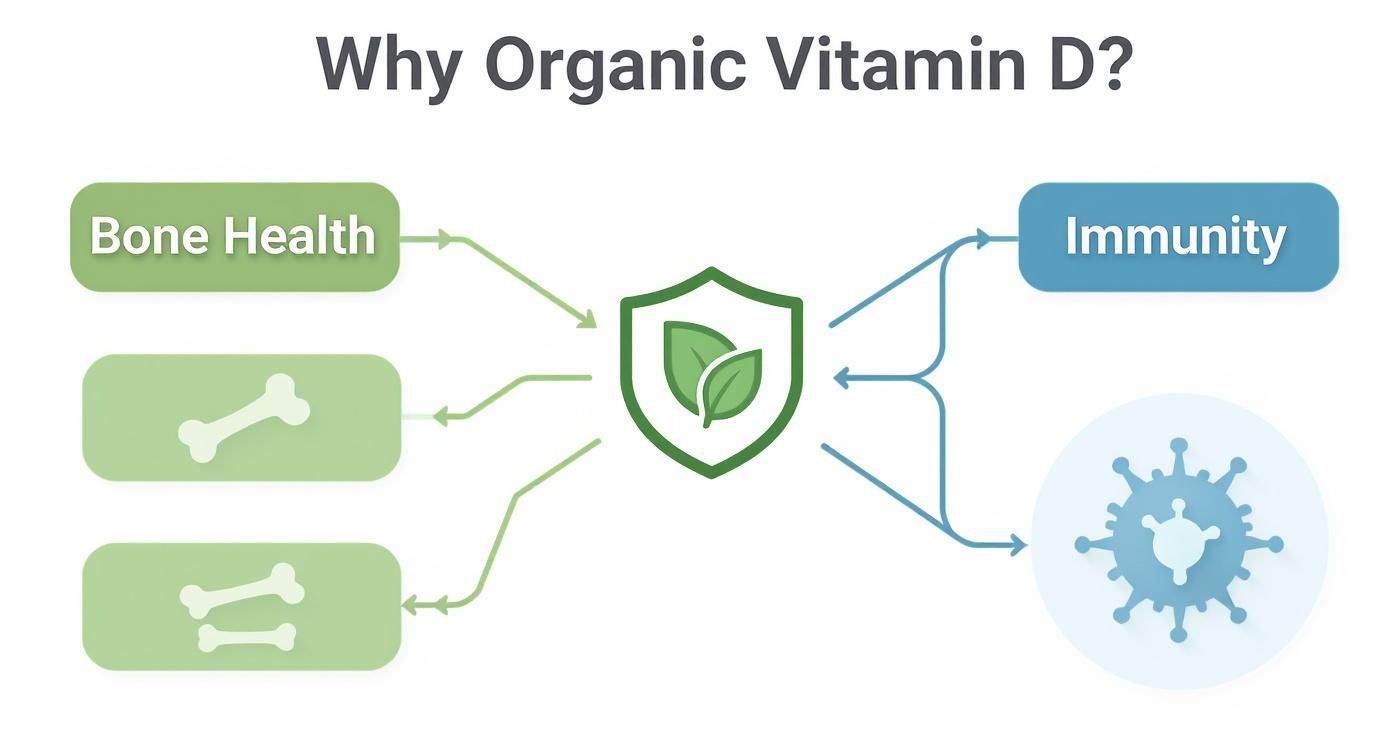
As this shows, choosing a clean, organic source of vitamin D is fundamental for building strong bones and a resilient immune system—two of its most critical jobs.
Why D3 Dominates the Market
The supplement world has caught on. The vitamin industry is massive, and vitamin D supplements make up a huge slice of it—a staggering 32.7% of the market share, to be precise. You can explore more insights into the vitamin market here.
This isn't a fluke. It's driven by a growing understanding of how essential vitamin D is for everything from calcium absorption to immune function. As a result, top-tier brands are focusing on high-quality D3 formulations to give people what actually works.
If you’re looking for a potent, targeted dose, a formula like Peak Performance's Advanced Vitamin D 10,000 IU + All 3 Types of Vitamin K{target="_blank"} is designed to deliver serious support. For daily wellness, the Vitamins D 5,000 IU + A + K + E{target="_blank"} offers a more comprehensive blend.
At the end of the day, knowing the difference between D2 and D3 is one of the most important things you can learn on your health journey. When you choose D3, you're not just buying another bottle of vitamins—you're investing in the most effective form to support your body for the long haul.
The Real Meaning of an Organic Supplement
When you see the word "organic" on a bag of apples, you know exactly what it means: no synthetic pesticides or GMOs. But what about when that same word is on a bottle of vitamins? It’s a fair question.
For supplements, the promise of "organic" goes much deeper, guaranteeing that every single ingredient is clean, right from its source. It means the entire process, from how the raw materials were grown to how they were handled, follows strict federal rules. You're getting a product free from synthetic pesticides, herbicides, and GMOs. It’s a commitment to a purer, more natural way of supporting your health.
Sourced Sustainably from Nature
The story of the best organic vitamin D supplement always starts with its source. For a top-tier, plant-based Vitamin D3, the journey often leads to a unique organism: wild-harvested lichen.
Lichen is pretty amazing. It grows in remote, untouched environments where it soaks up sunlight and nutrients, naturally producing a potent and bioavailable form of D3.
The path from a wild lichen to the capsule in your hand is a meticulous one. It involves sustainable harvesting that respects the ecosystem and gentle extraction methods that keep the vitamin’s integrity intact. Every step is designed to protect its organic purity.
This level of care ensures you're not just getting an effective supplement, but one that aligns with a more environmentally conscious way of living.
Why USDA Organic Certification Is Your Best Guarantee
In a market flooded with claims and flashy labels, it’s easy to get confused. But there’s one seal that cuts through the noise: USDA Organic.
This isn't just clever marketing; it's a legally protected stamp of approval backed by a mountain of verification.
To earn that seal, a product has to jump through some serious hoops:
- Non-GMO Ingredients: Everything inside must be free from genetic engineering.
- Pesticide-Free Farming: The raw ingredients have to be grown on land that has been free of prohibited synthetic substances for at least three years.
- Clean Processing: The manufacturing facilities and the entire process must prevent any contact with non-organic substances, keeping the supplement's organic integrity locked in.
- Thorough Audits: Facilities undergo annual inspections to make sure they're sticking to the rules.
This intense scrutiny gives you total confidence and transparency. You know what's on the label is exactly what's in the bottle. To see just how high the bar is, you can dig into the specific USDA Organic certification requirements in our detailed guide and understand why this seal is a non-negotiable for quality.
The move toward organic isn't just a niche trend; it's a massive shift. In 2023, the organic food market in the U.S. hit record sales of nearly $70 billion. People are voting with their wallets for cleaner, more sustainable products. This demand is spilling over into the supplement world, as more of us look for organic and plant-based options to support our health without compromise. You can discover more insights about these dietary supplement market trends that show just how much this preference is growing.
Ultimately, when you choose an organic supplement like Peak Performance's Vitamins D 5,000 iu + A + K + E{target="_blank"} or the high-potency Advanced Vitamin D 10,000 IU + All 3 Types of Vitamin K{target="_blank"}, you're making a clear choice for purity, safety, and quality in your daily routine.
Your Checklist for Choosing a Quality Supplement
Walking down the supplement aisle can feel overwhelming. With so many bottles making big promises, how do you cut through the marketing noise to find something that genuinely works? The trick is to shop like an expert by zeroing in on five key factors. This checklist will give you the tools to analyze any organic vitamin D supplement and pick a product that actually delivers on purity, potency, and real results.

This isn't just about scanning labels. It's about understanding the entire story behind the supplement—from where it was sourced in nature to the final capsule you hold in your hand. Using these five pillars of quality, you can make a decision you feel confident about.
1. Form and Source: The Foundation of Quality
First things first: what kind of vitamin D is in the bottle, and where did it come from? As we've already covered, Vitamin D3 (cholecalciferol) is the form you want. It's biologically identical to what your body makes from sunlight, making it far superior to the less effective D2.
But the source matters just as much. For the best organic vitamin D supplement, look for plant-based D3 that comes from wild-harvested lichen. This is the gold standard for clean, vegan supplementation. It gives you the most effective form of vitamin D without any animal byproducts.
2. Purity and Certifications: Your Assurance of Cleanliness
A supplement is only as good as what’s not in it. Without outside verification, there's no way to know if a product is truly free of contaminants like pesticides or GMOs. That's where third-party certifications become your best friend.
Keep an eye out for these crucial seals on the label:
- USDA Organic Seal: This is non-negotiable. It’s your guarantee that the ingredients were grown and processed without any synthetic pesticides, herbicides, or GMOs.
- Third-Party Lab Testing: The best brands voluntarily send their products to independent labs to verify both potency and purity. This transparency is your proof that what’s on the label is exactly what's in the bottle.
These certifications aren't just for show; they're objective proof of a brand's commitment to quality control.
3. Potency and Dosage: Tailored to Your Needs
Potency tells you the strength of the supplement, measured in International Units (IU). Vitamin D comes in a huge range of dosages, from a maintenance dose of 1,000 IU to much higher-potency options of 5,000 IU or even 10,000 IU.
The right dose for you depends entirely on your unique situation—things like where you live, how much sun you get, and what your current vitamin D levels are.
For daily wellness, a balanced formula like the Vitamins D 5,000 iu + A + K + E{target="_blank"} is a great starting point. If you need more intensive support, a higher potency option like our Advanced Vitamin D 10,000 IU + All 3 Types of Vitamin K{target="_blank"} might be a better fit. When in doubt, chat with a healthcare professional to figure out the ideal dosage for your goals.
4. Delivery Method: Finding Your Perfect Fit
How you take your supplement can make all the difference in consistency and absorption. Vitamin D is available in a few different forms, and each has its perks.
- Capsules: Simple, pre-measured, and tasteless. They’re an incredibly easy addition to your daily routine.
- Liquid Drops: Great for those who don’t like swallowing pills, and they offer flexible dosing.
- Sprays: A quick, on-the-go option that absorbs rapidly.
Ultimately, the best method is the one you’ll actually stick with every day. Choose the format that fits your lifestyle.
5. Synergistic Ingredients: The Power of Partnership
Vitamin D doesn't work in a vacuum. Its effectiveness can be significantly enhanced when paired with the right nutrients, particularly Vitamin K. This powerful duo works together to ensure calcium is properly utilized in the body.
When you're looking at a supplement, check the label for helpful partners like Vitamin K2. K2 is crucial for directing calcium to your bones and teeth, and keeping it out of your arteries where it doesn't belong.
Formulations that include the full spectrum of fat-soluble vitamins (A, D, E, and K) offer even more comprehensive health support. Beyond just vitamin D, choosing a high-quality supplement contributes to your overall cellular energy. For a deeper dive into how nutrition impacts your vitality, you might find guides on improving mitochondrial health useful.
Why Your Vitamin D Needs a Partner Like Vitamin K
Taking a high-quality vitamin D supplement is a fantastic move for your health, but it's only one half of the equation. To really unlock its full potential, vitamin D needs an essential co-pilot: Vitamin K.
These two nutrients work in perfect harmony. Taking D without K is like having a car with a powerful engine but no steering wheel—you’ve got horsepower, but no control over where it goes.
Think of it like this: Vitamin D acts as the gatekeeper. Its main job is to help your body absorb calcium from your diet, pulling it into your bloodstream. This is a vital first step for building strong bones. But once the calcium is circulating, Vitamin D’s job is pretty much done. It doesn't tell the calcium what to do next.
That’s where Vitamin K2 comes in. If Vitamin D is the gatekeeper, Vitamin K2 is the traffic director. It activates special proteins that grab calcium out of the bloodstream and deposit it exactly where you want it to go: your bones and teeth. This synergy is non-negotiable if you want the full benefits of vitamin D.
The Importance of Directing Calcium Correctly
Without enough Vitamin K2 to manage the flow, all that calcium Vitamin D worked so hard to absorb can end up in the wrong places. Instead of fortifying your skeleton, it can start building up in soft tissues like your arteries and kidneys.
This isn't just inefficient; it can lead to arterial calcification (hardening of the arteries), which is a major health concern.
By making sure calcium is used correctly, the combination of Vitamin D and K2 supports both your skeleton and your cardiovascular system at the same time. It’s a two-for-one benefit that a single-ingredient supplement just can't deliver.
This dynamic relationship is exactly why a thoughtfully designed formula is so important. It manages the entire process—from absorption to final placement—ensuring you get all the upside without any of the potential downsides.
Understanding the Different Forms of Vitamin K
Just like Vitamin D, Vitamin K isn't one single compound. It's a family of fat-soluble vitamins, and two main forms matter for your health: Vitamin K1 and Vitamin K2.
- Vitamin K1 (Phylloquinone): You’ll find this mostly in leafy green vegetables. K1’s primary role is in blood clotting. It’s essential, but it isn’t the best form for directing calcium.
- Vitamin K2 (Menaquinone): This is the one you want for bone and heart health. K2 also has its own subtypes, mainly MK-4 and MK-7, which work in slightly different ways to activate those crucial calcium-directing proteins.
A truly superior formula will include a smart blend of these K vitamins. That's why we formulated our Advanced Vitamin D 10,000 IU + All 3 Types of Vitamin K{target="_blank"} with K1, K2 MK-4, and K2 MK-7. This gives your body every tool it needs to manage calcium effectively. For a broader, more holistic approach, our Vitamins D 5,000 IU + A + K + E{target="_blank"} provides a full spectrum of synergistic, fat-soluble nutrients.
This isn't just theory; it's a well-documented biochemical partnership. The crucial interaction between these vitamins is a key factor in maximizing health benefits.
The Peak Performance Approach to Synergy
Finding the best organic vitamin d supplement means looking past a single ingredient and judging the intelligence of the entire formula. The partnership between D and K is a perfect example of nutritional synergy—where the combined effect is far greater than what each nutrient could do on its own.
By prioritizing this relationship, you’re not just taking Vitamin D. You’re investing in a smarter, safer, and more effective strategy for long-term bone and cardiovascular wellness.
If you want to learn more, check out our in-depth article on the powerful vitamin D and K benefits that breaks down this crucial partnership even further.
How to Read Supplement Labels Like a Pro
Alright, you've got the basics down on D3, K2, and why "organic" matters. Now it's time to put that knowledge to work where it counts—reading the actual label.
A supplement label might seem intimidating at first, but once you know the key things to look for, it's actually your best tool for seeing through the marketing hype. Think of yourself as a detective looking for clues of quality and purity. It’s the final step to confidently choosing the best organic vitamin d supplement for your health.
The Supplement Facts Panel
This is mission control. It's the most important part of the entire label.
First, zero in on the Active Ingredients. You want to see "Vitamin D3 (as Cholecalciferol from Lichen)." This one line tells you everything: you're getting the most effective form (D3) from a clean, plant-based source (lichen).
Next, check the dosage, which is listed in International Units (IU). A transparent brand will be crystal clear about the amount per serving. This lets you match the product to what you actually need, whether it's a daily maintenance dose or something more potent for targeted support.
Scanning for Quality Indicators
Beyond the facts panel, the best brands give you visual proof of their standards right on the bottle. Look for the official logos.
- USDA Organic Seal: This is your at-a-glance confirmation that the supplement is free from synthetic pesticides, GMOs, and other junk.
- Non-GMO Project Verified: This seal adds another layer of trust, verifying the ingredients haven't been genetically messed with.
These seals aren't just for show. They represent a serious commitment and mean the company has gone through rigorous third-party audits to prove they meet the highest standards for clean ingredients. They're a shortcut to spotting a brand you can trust.
The most reputable brands make their labels clean and easy to understand. Transparency is a hallmark of quality. When you see clear sourcing information and trusted certifications, it’s a strong signal that the company has nothing to hide and is confident in the purity of its product.
Finally, always give the "Other Ingredients" section a quick scan. This is where companies often hide unwanted fillers, binders, or artificial colors. A premium product will have a short, simple list with ingredients you can actually recognize, like the vegetable capsule itself or an organic oil to help with absorption.
For a deeper dive, you can learn more about how to read supplement labels in our complete guide.
By using this simple framework, you can move past marketing claims and analyze what’s actually in the bottle. Peak Performance products like our Advanced Vitamin D 10,000 IU + All 3 Types of Vitamin K{target="_blank"} and Vitamins D 5,000 IU + A + K + E{target="_blank"} are designed with this transparency in mind, making it easy to see the quality you deserve.
Common Questions About Vitamin D Supplementation
Getting started with a new supplement always brings up a few questions. Let's tackle some of the most common ones about vitamin D so you can feel completely confident in your routine. Having clear, straightforward answers is the best way to build a wellness plan that actually works for you.
When Is the Best Time of Day to Take Vitamin D?
The single most important factor is consistency. Pick a time and stick with it. But, if you want to give your body a helping hand, timing your dose can make a real difference.
Vitamin D is a fat-soluble vitamin, which means your body absorbs it much better when you take it with a meal containing some healthy fats. Think avocado, nuts, seeds, or a drizzle of olive oil. For most people, taking it with breakfast or dinner is the easiest way to make it a daily habit.
Can I Get All the Vitamin D I Need From the Sun?
It’s a great thought, but for most of us, it’s nearly impossible. Our bodies are absolutely designed to make vitamin D from sunlight, but our modern lives create a massive gap that supplementation can help fill.
Think about all the variables working against us:
- Where You Live: If you're far from the equator, the sun's UVB rays are much weaker, especially in the fall and winter months.
- Sunscreen: It’s essential for protecting your skin, but an SPF of 30 or higher can slash vitamin D production by over 95%.
- Skin Tone: Melanin, the pigment that gives skin its color, is a natural sunblock. People with darker skin tones need significantly more sun exposure to produce the same amount of vitamin D as someone with lighter skin.
- Time of Day & Season: The sun is only strong enough to trigger vitamin D synthesis during specific midday hours, and that window of opportunity shrinks or disappears completely outside of summer.
When you add it all up, relying only on the sun just isn't a reliable strategy for keeping your levels optimal.
How Do I Determine the Right Vitamin D Dosage?
This is where it gets personal. There's no one-size-fits-all answer, because your ideal dose depends on your current blood levels, diet, age, sun exposure, and even your genetics.
The only way to know for sure is to get tested. Ask your doctor for a simple blood test to measure your vitamin D levels. They can give you a personalized recommendation to get you exactly where you need to be, safely and effectively.
While supplements come in standard doses, getting professional guidance takes all the guesswork out of the equation and ensures you’re getting results.
At Peak Performance, we're all about giving you transparently labeled, high-quality options you can trust. Whether you need the high-potency dose in our Advanced Vitamin D 10,000 IU + All 3 Types of Vitamin K{target="_blank"} or the daily comprehensive blend in our Vitamins D 5,000 iu + A + K + E{target="_blank"}, you know you're getting a clean, powerful product designed for your health.
Also in Blog


Superfood Powder for Energy A Lasting, Clean Boost


How to Increase Stamina Naturally and Boost Energy

