


How to Stay Focused at Work and Boost Productivity
If you find yourself struggling to concentrate during the workday, you're not fighting a personal battle of willpower. It's a systemic problem. The secret to staying focused isn't about forcing yourself to concentrate harder; it's about being strategic and intentionally designing your day to protect your attention.
Why Is It So Hard to Focus at Work?
Does it feel like your attention is being yanked in a million different directions at once? You’re definitely not alone. The modern workplace, with its barrage of notifications, constant connectivity, and an "always-on" expectation, is practically an engine designed for distraction. It’s a massive obstacle for anyone trying to sink into meaningful, deep work.
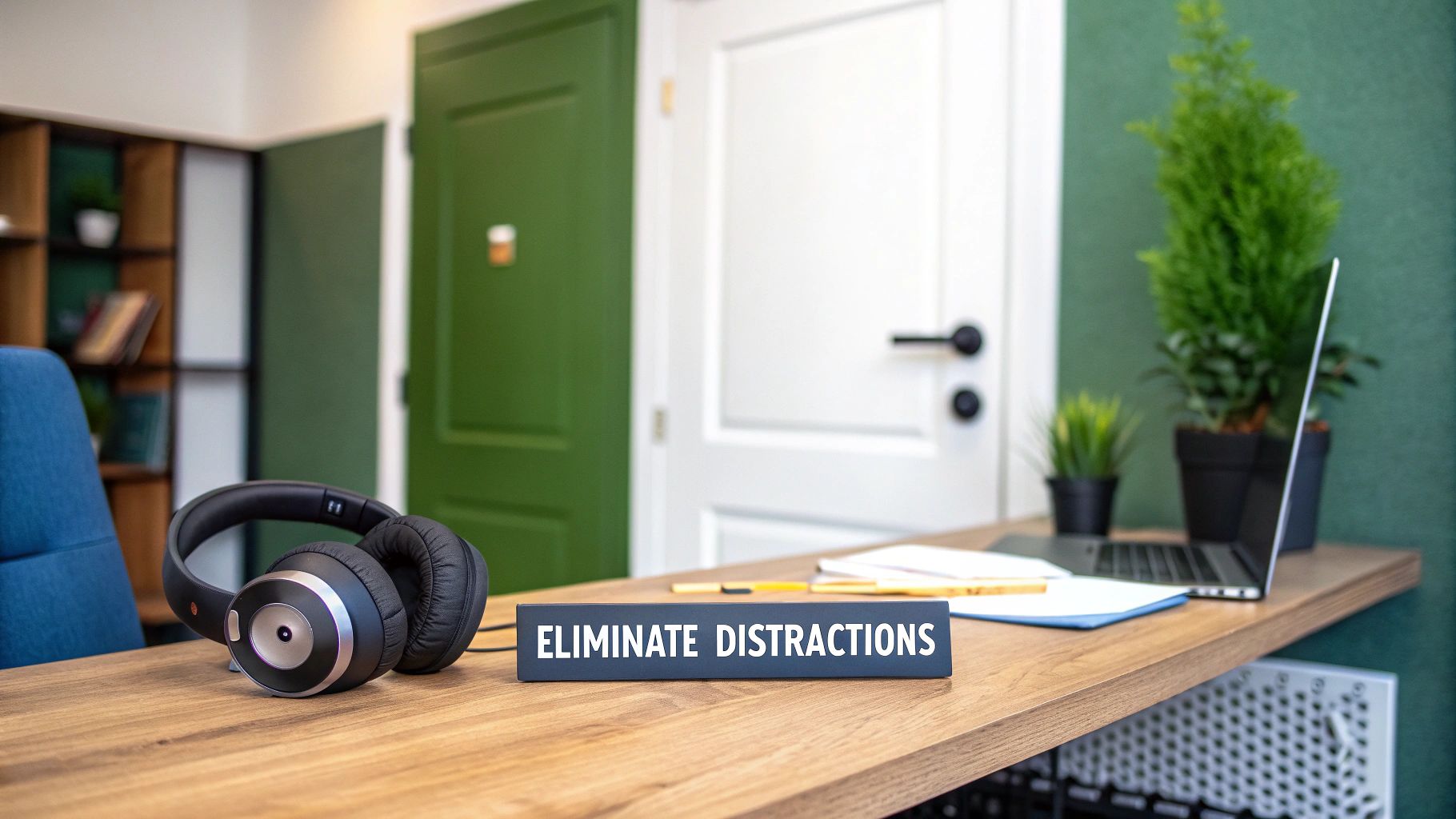
This isn’t just a feeling; it’s a well-documented issue. Research shows that the average office worker is interrupted roughly every three minutes. Think about that. Even worse, it can take a staggering 23 minutes to get fully back on track after each distraction. When you start doing the math, it becomes painfully clear how these "tiny" interruptions compound into a colossal waste of productive time.
The pressure to be hyper-responsive to every message, email, and tap on the shoulder traps us in a state of what experts call continuous partial attention. We end up spreading our cognitive resources thin instead of dedicating them to one important task, and the quality of our work inevitably suffers.
The True Cost of Distractions
Beyond the lost hours, this constant context-switching takes a heavy mental toll. When your brain is forced to jump from task to task, it leads directly to mental fatigue, heightened stress, and a much greater chance of making sloppy mistakes. It’s why you can feel completely exhausted by 5 p.m., even if your to-do list looks depressingly similar to how it did at 9 a.m.
This cognitive overload makes it nearly impossible to do the kind of high-level thinking required for creative problem-solving or strategic planning. Sometimes, the struggle to focus is also an inside job, rooted in things like self-doubt or imposter syndrome. Learning how to increase confidence at work can be a surprisingly powerful first step toward building a more focused and resilient mindset.
A Framework for Sustainable Focus
The answer isn't to just "try harder" or power through. Real, sustainable focus comes from a strategic approach that gets to the root cause of the problem. It’s about building a system—a personal fortress—that defends your attention instead of letting it leak out all day.
To get us started, here’s a quick overview of the core strategies we'll be covering in this guide. Think of it as a roadmap for what's to come.
A Framework for Sustainable Focus
| Pillar | Core Principle | Key Action |
|---|---|---|
| Environment Design | Your surroundings dictate your ability to concentrate. | Curate your physical and digital spaces to minimize noise. |
| Energy Management | Focus is a finite resource that must be managed like energy. | Work in sprints and align tasks with your natural energy cycles. |
| Mindful Technology | Tools should serve you, not the other way around. | Tame notifications and set clear boundaries with your devices. |
| Strategic Planning | Clarity on priorities is the foundation of deep work. | Define your most important tasks and block time for them. |
| Mental Fortitude | Internal distractions can be as disruptive as external ones. | Build resilience through mindfulness and self-awareness practices. |
This table gives you the big picture, but now we're going to dive into the practical, actionable principles you can start applying today. By understanding both the external and internal forces vying for your attention, you can finally begin to build a more intentional, productive, and frankly, more satisfying workday.
Design Your Environment for Deep Work
Your ability to lock in and focus is massively influenced by your surroundings. Let's be real—your workspace is either helping you or hurting you. It's an ally or an enemy to your concentration, whether you're in a loud open-plan office or a quiet corner of your home.
It’s about more than just "tidying up." To get into a state of deep work, you have to be intentional about architecting an environment that actively supports it.

Think about it this way: your physical and digital spaces are constantly sending signals to your brain. A cluttered desk screams chaos. A non-stop stream of notifications signals a state of manufactured urgency. If you truly want to learn how to stay focused at work, you have to seize control of these signals.
Conduct a Distraction Audit
First things first, you need to know exactly what's derailing your focus. For one week, keep a simple log every time you get distracted. Was it a coworker tapping you on the shoulder? A notification? The urge to check the news?
Be brutally honest. After just a few days, you'll start to see clear patterns. These are your personal focus-killers, and now you can build a targeted strategy to shut them down.
Interestingly, where you work plays a huge role. Studies have shown that remote workers tend to get a 22% increase in deep-focus time, racking up about 22.75 hours a week compared to just 18.6 hours for people in the office. It's a clear sign that a controlled environment pays off.
Master Your Physical Space
Once you’ve identified your biggest physical distractors, you can start engineering solutions. Every little thing, from the noise level to the lighting, makes a difference.
- Control the Sound: In a noisy office, a good pair of noise-canceling headphones is a must-have. They're the universal sign for "do not disturb" and create an instant bubble of quiet. Pair them with ambient sound apps that play rain or white noise to drown out distracting chatter.
- Optimize Lighting: Bad lighting is a focus killer. It causes eye strain and fatigue, making it feel like a chore to concentrate. If you can, set up your desk near a window for natural light. If not, a quality desk lamp that mimics daylight can keep your brain feeling alert and engaged.
- Ergonomics for Endurance: An uncomfortable chair or a poorly positioned monitor creates subtle physical pain that slowly drains your mental stamina. Adjust your setup so your feet are flat on the floor and your screen is at eye level. It’s a small tweak that frees up a surprising amount of cognitive energy for your actual work.
The goal isn't to create a sterile, silent chamber. It's about consciously removing the friction and needless distractions so that focusing becomes your default state, not an uphill battle.
Tame Your Digital World
Let's face it, digital distractions are often the most insidious. Those pings, pop-ups, and notifications are literally designed to hijack your attention. The only way to fight back is to embrace digital minimalism—curating your online world to serve your goals, not the goals of app developers.
Start by turning off all non-essential notifications on your phone and computer. Do you really need an alert every single time an email lands in your inbox? Of course not. Instead, schedule a few specific times a day to check your email and batch-process it.
If you find yourself mindlessly scrolling social media or news sites, use a website blocker during your deep work blocks. It’s a simple way to enforce discipline when willpower fails. The more friction you can put between yourself and your biggest time-wasters, the easier it becomes to stay on task.
If you feel like your digital habits are truly getting out of hand, it might be time to take a more structured approach. Our guide on doing a digital detox can help you reclaim control over your technology and your attention.
Master Your Schedule with Proven Focus Techniques
Getting your desk organized is one thing, but if your schedule is a total mess, you're still going to struggle. When your to-do list feels more like a vague wish list and your day is just a series of fires to put out, it's time to get intentional about your workflow.
These aren't just trendy productivity hacks; they're battle-tested systems for wrangling your time and, more importantly, your attention. Knowing how to stay focused at work is all about picking the right tool for the job and giving your brain the structure it needs to do its best work.
Ditch the Multitasking Myth and Embrace Single-Tasking
Before we get into specific strategies, we have to talk about the biggest focus-killer out there: multitasking. The idea that we can effectively juggle a bunch of complex tasks at once has been completely debunked. What feels like multitasking is actually just rapid context-switching—forcing your brain to jump between different jobs over and over.
This constant gear-shifting has a massive cognitive cost. It leads to more mistakes, drains your mental energy, and tanks your overall efficiency. Instead of getting two things done at once, you’re just doing both of them poorly. Real productivity happens when you give one task your full, undivided attention until you're done or hit a planned stopping point.
The Pomodoro Technique for Intense Sprints
The Pomodoro Technique is a deceptively simple way to maintain intense concentration on one thing. It's perfect for anyone who needs to chip away at a big, intimidating project, like a developer hunting down a bug or a writer working on a long article.
Here’s the breakdown:
- Pick one single task to focus on.
- Set a timer for 25 minutes and work on only that task. No emails, no phone, no distractions.
- When the timer rings, take a 5-minute break. Get up, stretch, grab some water—do literally anything but work.
- After four of these "Pomodoros," take a longer break of around 15-30 minutes to properly reset.
This method works because it breaks down intimidating tasks into manageable chunks. Those short, built-in breaks are key for preventing burnout and keeping your mind sharp. You're basically training your brain to work in short, focused bursts, which makes it way easier to ignore distractions when they pop up.
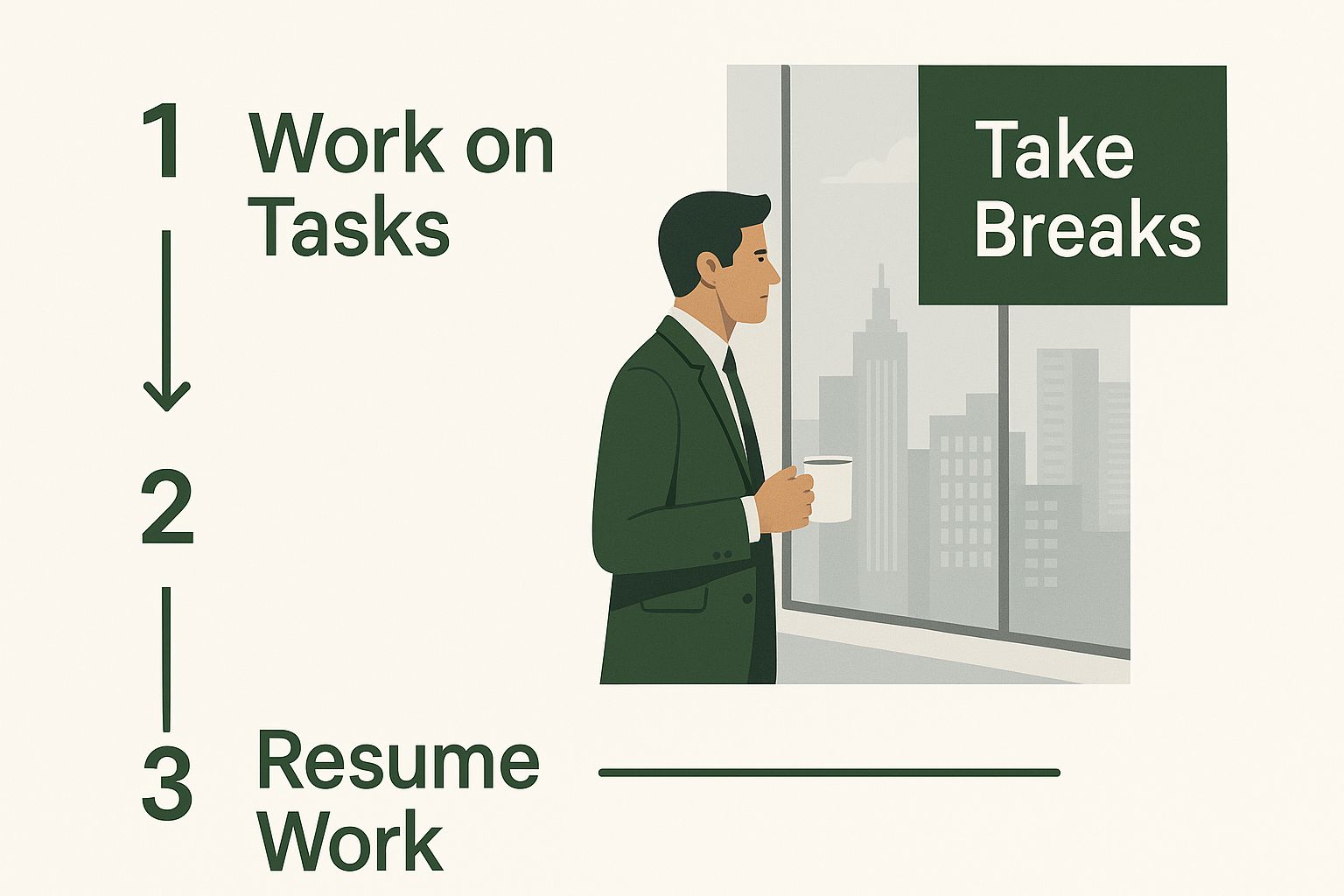
This visual is a great reminder that stepping away from your desk isn't a distraction from your work—it's a crucial part of a productive workflow.
Time Blocking for Proactive Planning
Is your day constantly getting hijacked by "urgent" requests that aren't actually important? Time Blocking is the antidote. Instead of just working off a to-do list, you assign every single task a specific time slot on your calendar. It’s a proactive way to turn your calendar into a concrete game plan for the day.
For instance, a marketing manager could block out 9 AM to 12 PM every morning for "Creative Strategy Work." By scheduling an appointment with themselves, they signal to everyone else that they're unavailable. This fences off precious time for high-priority work, protecting it from meetings and interruptions.
Time Blocking forces you to get real about what you can actually accomplish in a day. It’s not just about managing time; it’s about managing your priorities with intention.
Eat That Frog for Maximum Impact
Brian Tracy's "Eat That Frog" method is as simple as it is effective: figure out the most important and difficult task on your plate (your "frog") and get it done first thing in the morning. This is usually the one thing you're most likely to put off.
By tackling your biggest challenge when your energy and willpower are at their peak, you build incredible momentum for the rest of the day. Knocking out that one critical task delivers a huge sense of accomplishment and makes every other task feel easier by comparison. This is all about prioritizing for impact.
To take this even further, you can pair it with dedicated strategic thinking. Learning how to do high-level thinking time can be a fantastic complement to this approach. By combining these scheduling techniques, you can shift your workday from reactive chaos to a model of intentional productivity.
Work with Your Brain, Not Against It
Ever feel like your focus just comes and goes? One hour you're absolutely dialed in, crushing your to-do list, and the next, you hit a wall. Suddenly, even simple tasks feel like wading through mud.
That's not a personal failure or a lack of willpower. It’s just your brain’s natural rhythm.
Instead of fighting your own biology, the real secret to staying sharp all day is learning to work with it. Our bodies run on what are known as ultradian rhythms—natural, cyclical waves of energy and alertness. These cycles typically last 90-120 minutes, moving from a peak of high-energy brain activity down into a trough where we desperately need to rest and recharge.
Pushing through one of those low points is a guaranteed recipe for burnout. It’s like flooring the gas pedal when your car is on empty. You won’t get far, and you'll just put unnecessary strain on the engine. The smarter move is to recognize these cycles and build your workday around them.
Identify Your Peak Productivity Windows
First things first: you need to become an observer of your own energy. Spend a week just paying attention to when you feel most alert, creative, and ready to tackle the hard stuff. Is it right after your morning coffee? Or maybe you get a second wind in the mid-afternoon?
Jot down a few simple notes each day. It could look something like this:
- Morning (9-11 AM): Felt sharp, clear-headed, and ready for deep work.
- Midday (12-2 PM): Hit a major slump after lunch. Brain fog set in.
- Afternoon (2-4 PM): Energy bounced back. Perfect time for meetings and collaboration.
Once you’ve mapped out your personal energy highs and lows, you can start scheduling your day strategically. Block out your peak focus time for the most demanding work—the report you need to write, the code you need to ship, or the strategy you need to plan.
Then, save your energy troughs for the low-hanging fruit: clearing out your inbox, organizing files, or catching up on routine calls.
This isn't about logging more hours. It's about aligning your most important tasks with the moments your brain is already primed for peak performance. This one shift can radically improve not just your output, but how you feel at the end of the day.
The Science of a Truly Restorative Break
The work sprint is only half the equation. The recovery period is just as crucial. But let's be honest, not all breaks are created equal. Mindlessly scrolling through social media for 15 minutes might feel like a break, but you're just swapping one type of mental load for another. You end up feeling just as drained.
A truly restorative break is one that lets your brain completely disengage and recharge. The goal is to give your prefrontal cortex—the part of your brain handling all that heavy lifting of focus and decision-making—a genuine rest. For a deeper dive, check out our guide on 8 ways to boost brain function for greater focus and productivity.
Effective micro-breaks don't have to take long, but they do have to be intentional. Try one of these:
- Get Some Sunlight: Step outside for a few minutes. Natural light is a powerful mood and alertness booster.
- Move Your Body: Just stand up, do a few stretches, or take a quick walk around the block. Getting your blood flowing is great for your brain.
- Practice Mindfulness: Close your eyes and just focus on your breath for two solid minutes. It's a fantastic way to silence the mental chatter and hit the reset button.
For a real edge, incorporating some powerful mindfulness activities into your routine can make a huge difference. When you embrace your natural rhythms and take purposeful breaks, you stop fighting an exhausting uphill battle and start creating a sustainable workflow that keeps you energized and focused all day long.
Connect Your Work to a Bigger Purpose
Let's be honest. All the focus hacks and productivity timers in the world won't stick if you fundamentally don’t care about what you're doing. The most powerful, long-lasting driver of focus isn't a technique—it's genuine connection to your work.
When you feel that connection, focus stops being a constant battle. It just... happens. This isn't some feel-good platitude; it's a core principle of human motivation. We are wired to seek meaning, and that drive is what fuels our attention. The problem is, the daily grind of emails, meetings, and small tasks can easily bury that bigger picture, leaving us feeling disconnected and just going through the motions.
Finding the "Why" in Your Daily Grind
To really master your focus, you have to get good at connecting the dots between your small, daily to-dos and a larger, meaningful outcome. It's all about a simple perspective shift.
You’re not just "answering customer support tickets"; you're "saving a customer's day and building brand loyalty." You're not just "crunching numbers for a report"; you're "providing the data that will guide our next big strategic move."
This is a bigger deal than it sounds. Widespread disengagement is a massive issue at work. Globally, a staggering 21% of workers report feeling engaged. That disconnect isn't just a morale problem; it costs the global economy an estimated $438 billion every year in lost productivity. You can dig into more of these employee productivity statistics on TeamOut.com.
To start making that connection for yourself, try asking a few questions before you dive into a task:
- Who am I helping? Picture the actual person—a colleague, a customer—who will benefit from this. It makes the work feel real.
- How does this fit into the puzzle? See your task not as an isolated chore, but as one essential piece of a larger company goal.
- What skill am I sharpening? Even a tedious task is a chance to practice something, whether it's attention to detail, patience, or getting faster with a new tool. It’s all part of your own growth.
When you consciously link the daily grind to these bigger outcomes, mundane tasks start to feel like meaningful progress.
Getting Into a Flow State
When you hit that sweet spot of engagement and motivation, you can tap into a state of flow. This is that magical zone where you're so immersed in what you're doing that the outside world fades away and time flies. Your focus is effortless, you're incredibly productive, and the work itself feels rewarding.
Flow isn't something that just happens by accident. It's a state you can actively cultivate. It shows up when you’re working on something that’s challenging enough to keep you hooked, but not so hard that it becomes frustrating.
To set the stage for flow, you need a clear goal and immediate feedback. Think of a developer debugging code. The goal is obvious: find and fix the bug. The feedback is instant: the code either works or it doesn’t. That tight loop is what creates intense, sustainable concentration.
If you’re not a natural morning person, priming your brain for these deep work sessions can be a game-changer. The right fuel provides clean, sustained energy. Adding a scoop of Peak Performance Organic Greens Superfood Powder to your morning routine can provide mental clarity. Its blend of over 25 organic ingredients helps provide the focus needed to find and hold onto that elusive flow state.
How Leaders Can Foster Engagement
While finding your "why" is a personal journey, leaders have a massive role to play. A manager who just doles out tasks without context is missing the entire point. A great leader is constantly connecting the "what" to the "why."
Here's how leaders can build a more focused and motivated team:
- Share the Vision, Over and Over: Regularly explain how the team's daily work plugs into the company's bigger mission. Don't assume they know.
- Acknowledge the Wins: When someone's work moves a project forward, call it out. Show them their impact.
- Give People Ownership: Trust your team. When people have autonomy over their work, they feel a much stronger sense of pride and responsibility.
When people feel like they’re valuable contributors to a mission that matters, their internal motivation takes over. That’s how you solve the root cause of a wandering mind.
Common Questions About Staying Focused at Work
Even with the best game plan, you're going to run into real-world roadblocks. It happens. Let's tackle some of the most common questions people have when they're trying to lock in and focus at work. Here are some no-fluff answers to get you through the daily grind.
How Can I Stay Focused in a Noisy Open-Plan Office
Trying to do deep, meaningful work in a loud, open-plan office can feel completely hopeless. The constant chatter, the people walking by... it's a concentration killer. Your best move is to build a personal "focus bubble" to wall yourself off from the chaos.
First things first: a solid pair of noise-canceling headphones. They're basically non-negotiable. You can also use little visual cues, like a small sign on your desk, to signal to your coworkers that you're in a sprint and can't be disturbed.
If your office has them, get into the habit of using the designated quiet rooms. Even just booking a small meeting room for an hour can work wonders. Sometimes, a simple change of scenery is the most powerful way to tell your brain (and everyone else) that it's go-time.
What Is the Best Way to Handle Interruptions from Coworkers
This one's a delicate dance: protecting your focus without coming off as rude. It's totally possible. When a colleague comes over with something that isn't a true emergency, you can politely set a boundary.
Just try saying something like, "Hey, I'm right in the middle of something, but I can swing by in about an hour. Does that work?" This simple line does two things: it respects their request while protecting your immediate workflow.
You can also get ahead of it by being proactive with your digital status. Set your status to a "Focusing" mode and hit snooze on notifications. For an even better system, block out "office hours" on your calendar when you're free for drop-ins. This starts training your team to bundle their questions and respect your deep work time.
You have to teach people how to treat your time. Setting clear, friendly boundaries isn't selfish—it's absolutely essential for producing high-quality work and keeping burnout at bay.
I Get Distracted by My Own Thoughts How Do I Manage That
Let's be honest, sometimes the biggest enemy to our focus isn't the office chatter, it's the chaos inside our own heads. Taming a wandering mind takes a totally different approach.
One of the most powerful things you can do is a "thought dump." Just keep a notebook or a simple text file open. Anytime a random thought, a new to-do, or a brilliant idea pops into your head, scribble it down immediately to deal with later. The act of getting it out of your head gives your brain permission to release it and get back on task.
Even a quick, 5-minute mindfulness practice each day can be a game-changer. It literally trains you to notice when your mind has drifted and gently pull it back. That skill is priceless for maintaining focus. And don't forget the basics—being hungry or tired is a huge trigger for a wandering mind, so make sure you're taking care of your physical needs.
Do Focus-Enhancing Apps and Tools Actually Work
Yes, they can be incredibly helpful, but they're not magic. Think of them as support systems for good habits, not a replacement for them.
They work best as guardrails for your attention.
- Website and app blockers are fantastic for enforcing a bit of self-discipline, especially if you know you have a bad habit of mindlessly scrolling social media.
- Task managers that build in methods like Time Blocking or the Pomodoro Technique give you the structure to keep you honest throughout the day.
- Ambient sound apps can be great for drowning out unpredictable office noise and creating a more stable audio environment that helps you concentrate.
The key is to pick a tool that solves a specific problem you actually have. Don't just download a dozen apps and hope for the best. Pinpoint your biggest distraction and find a tool designed to fight that. When you pair the right tech with the habits we've been talking about, you build a seriously resilient system for focus.
At Peak Performance, we know that sustained focus starts with the right fuel. Giving your brain the high-quality nutrients it needs is foundational for mental clarity and all-day energy. Our products are designed to support your cognitive function, helping you perform at your best, day in and day out.
Ready to unlock your full potential? Explore our range of USDA Organic superfoods and supplements designed to elevate your focus and vitality. Visit Peak Performance today and discover the difference clean nutrition can make.
Also in Blog


Your Guide to the Best Organic Vitamin D Supplement


Superfood Powder for Energy A Lasting, Clean Boost

