


How to Increase Productivity at Work
If you want to get more done, stop trying to just work harder. The real secret is to start mastering your time with a few proven frameworks. It's all about shifting from being reactive—letting your day happen to you—to proactively structuring your schedule around what actually matters.
Master Your Time Instead of Letting It Master You
We’ve all had those days. You start with a huge to-do list, but by 5 PM, you're left wondering where the hours went, with almost nothing to show for it. It's a frustratingly common feeling.
This cycle kicks in when we let our calendars and inboxes run the show. But real productivity isn't about cramming more into your day. It’s about being strategic with your limited focus and energy, and pointing them at the work that will move the needle.
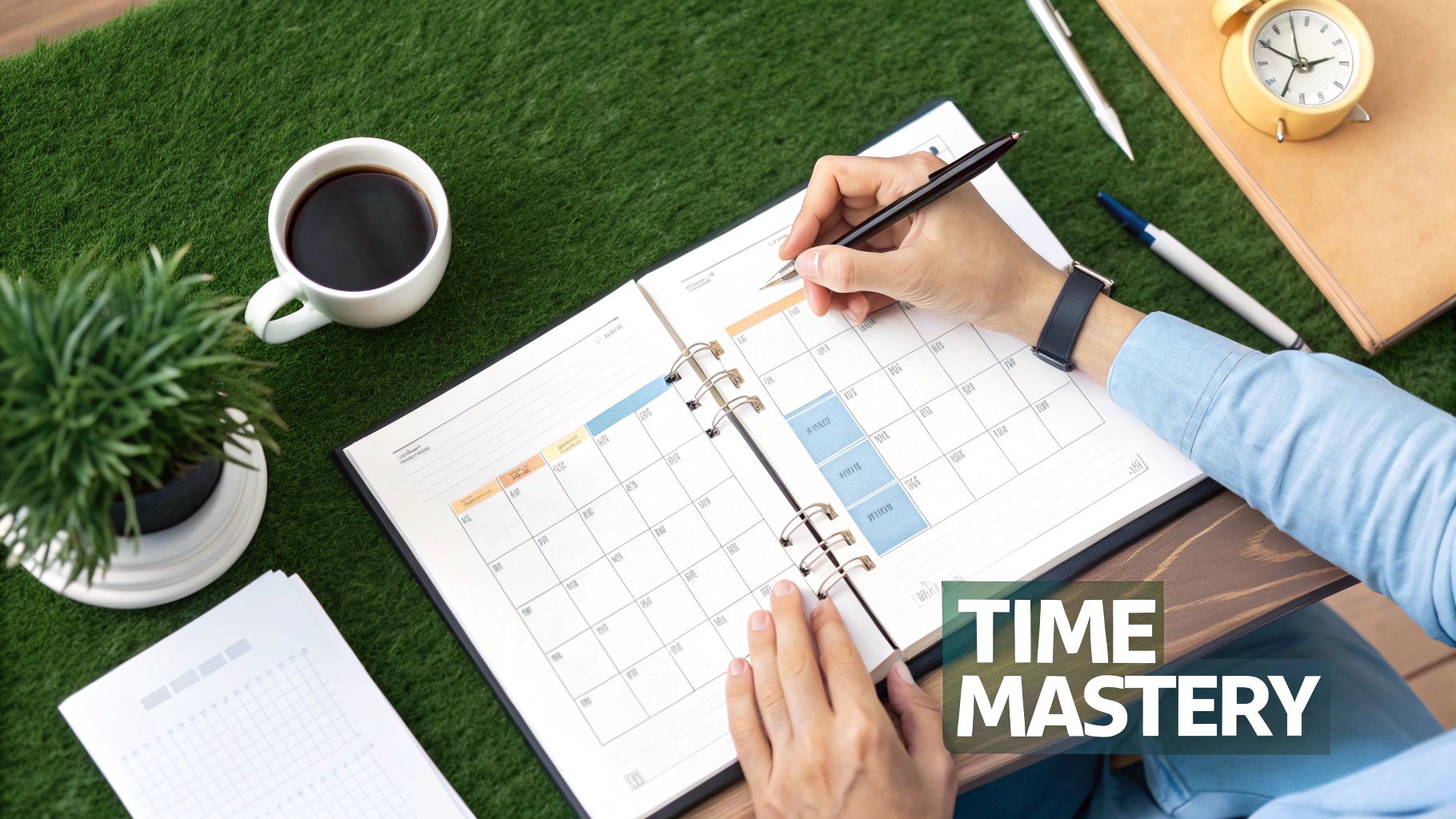
Adopting a solid time management system is your first real step toward taking back your workday and seriously boosting your output. Instead of getting overwhelmed by a simple list of tasks, these frameworks give you the rules and boundaries you need to do deep, focused work.
Prioritize with Proven Frameworks
Two of the most effective methods I've seen for getting priorities straight are the Pomodoro Technique and the Eisenhower Matrix. They each solve a different piece of the productivity puzzle, and they work brilliantly.
-
The Pomodoro Technique: This is your weapon against distraction and burnout. You work in focused 25-minute sprints (a "Pomodoro"), then take a short 5-minute break. After four of these cycles, you take a longer break. It’s simple, but it trains your brain to lock in, making massive projects feel way more manageable.
-
The Eisenhower Matrix: This one is all about deciding what’s worth your time in the first place. You sort tasks into four boxes based on urgency and importance: Do, Decide, Delegate, or Delete. It forces you to see the difference between what feels urgent (like a notification) and what is truly important (like planning your next big move). Learning how to practice high-level thinking time is absolutely essential for spotting those high-impact tasks.
Structure Your Day for Success
Once you know what to focus on, you have to actually make time for it. Time blocking is a game-changer.
You literally schedule everything on your calendar—and I mean everything. Deep work, checking emails, meetings, even your lunch break gets a specific time slot.
This creates an intentional plan for your day, leaving no empty space for distractions to sneak in and derail your progress. If you're juggling a lot, it's also worth looking into some effective strategies for managing multiple projects to keep everything on track.
Tame Digital Overload and Constant Interruptions
Let’s be honest: the endless pings, notifications, and "quick question" messages are wrecking our focus. Every single alert yanks you out of whatever you were doing, and the mental energy it takes to get back on track is huge. The game is to stop being reactive—letting alerts run your day—and start being proactive about where you put your attention.
It’s about building a fortress around your focus. You can start with something simple, like batching your emails. Instead of leaving your inbox open like a constant source of distraction, pick two or three specific times a day to check it. I like 10 AM and 3 PM. That way, you decide when to deal with email, not the other way around.
This infographic really drives home how vital it is to block out these digital distractions if you want to get anything meaningful done.
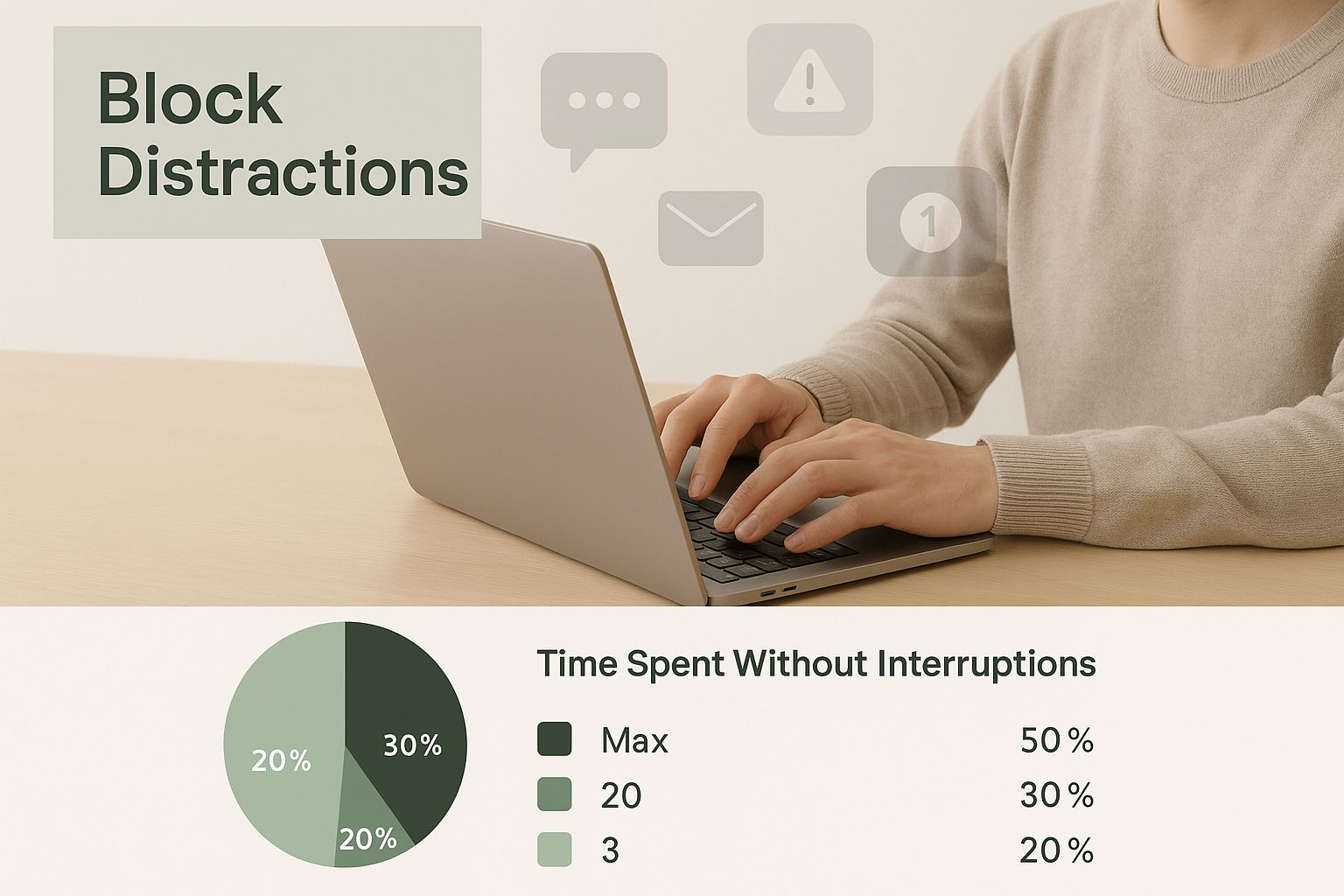
Think of every notification you mute as a small victory. Each one saves a little sliver of focus, and those moments add up big time throughout the day.
Reclaim Your Calendar and Attention
Beyond the constant pings, unplanned meetings are the other big productivity killer. You have to get comfortable setting some clear boundaries to protect your time.
- Decline with purpose: You don't have to accept every meeting invite that lands on your calendar. If one comes through without a clear agenda or objective, it's perfectly fine to politely push back. A simple, "Thanks for the invite! To make sure I can contribute effectively, could you share an agenda or the key goals for this meeting?" works wonders.
- Use 'Do Not Disturb' strategically: Every communication app has a status setting. Use it. When you’re diving into deep work, switch your status to "Focusing" or "Do Not Disturb." It’s a simple signal to your team that you shouldn't be interrupted unless it’s a real emergency.
The scale of this problem is staggering. Some data shows employees get interrupted about every two minutes, with the worst-off workers getting hit with 275 pings a day. On top of that, an estimated 60% of meetings are completely unscheduled, throwing any sense of a plan out the window. You can discover more insights about workplace productivity statistics here.
A powerful move is to get the whole team on board. Try setting up "no-meeting Wednesdays" or establishing core focus hours where interruptions are off-limits for everyone. It’s a cultural shift that protects the team’s most valuable resource—time—and reduces the collective anxiety of always being “on.”
If all this digital noise feels like too much, it might be a sign you need a more serious break. We’ve got a guide on recognizing when it's time for a digital detox that can help.
Design an Environment That Boosts Your Focus
It’s easy to underestimate, but the space around you has a massive impact on your ability to concentrate. Your workspace—both the physical one on your desk and the digital one on your screen—is one of the most powerful levers you can pull to get more done.
You don’t need a complete office overhaul. Small, deliberate tweaks can be game-changers, cutting out the distractions and friction that secretly drain your momentum all day long.
Start With Your Physical and Digital Desk
Think about it: a cluttered desk creates a cluttered mind. When you’re surrounded by piles of paper, sticky notes, and random objects, your brain has to work harder just to ignore it all. That’s cognitive load you can’t afford to waste.
So, the first move is simple. Clear everything off your desk that isn’t absolutely essential for what you’re working on right now. This one act sends a powerful signal to your brain: it's go-time.
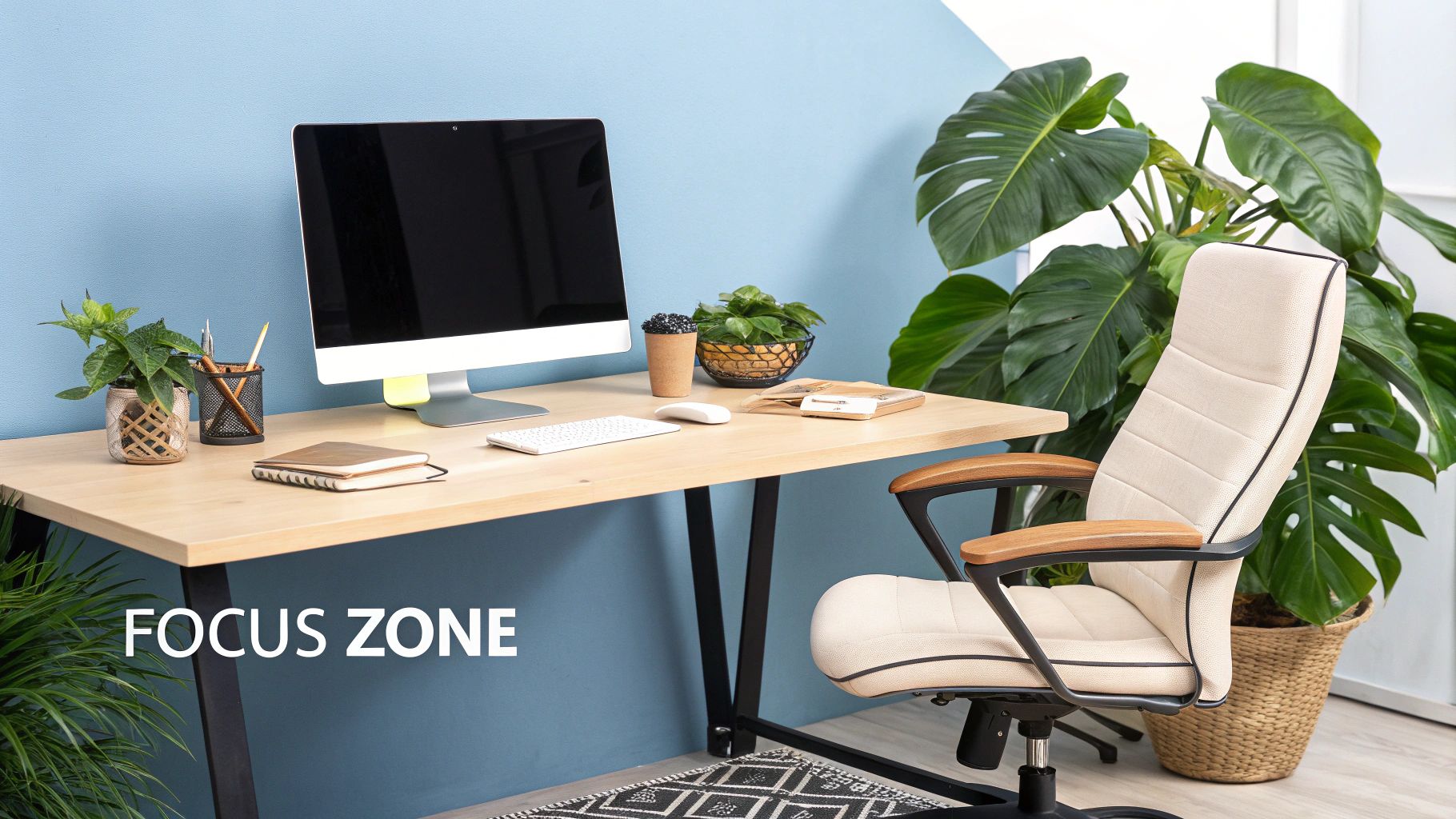
This same logic applies directly to your digital world. A desktop littered with dozens of files or a browser with 20 open tabs is the digital equivalent of a messy room. It’s just as distracting. Take a minute to organize files into clear folders and ruthlessly close any app or tab that isn't helping you with the task at hand.
Set Up Your Space for Success
Beyond a simple tidy-up, you can engineer your environment to support deep, focused work and even reduce physical strain. Ergonomics isn't just a corporate buzzword; it's about setting up your workstation so you can stay comfortable and energized for hours.
- Adjust Your Chair: Make sure your feet are flat on the floor and your knees are at a comfortable 90-degree angle.
- Position Your Monitor: The top of your screen should be at or just below eye level. This tiny adjustment saves your neck from a world of hurt.
- Control Your Senses: Let in natural light whenever you can. If you’re in a noisy office or a busy home, a good pair of noise-canceling headphones can be your best friend.
Even in a perfect setup, interruptions are the true productivity killers. Recent data is pretty shocking: the average office worker gets interrupted every three minutes. What’s worse, it can take over 23 minutes to get fully back into the zone after a distraction.
While remote work helps a bit—giving back about 29 minutes of productive time each day—the threat of pings, notifications, and pop-ins is constant for everyone. You can read the full research on workplace interruptions here.
For anyone working from home, creating a clear physical boundary is non-negotiable. Having a dedicated workspace, even if it’s just a specific corner of your living room, helps your brain switch into "work mode." When you step away from that space, you can truly disconnect and recharge.
Fuel Your Brain and Body for Peak Performance
You can have the best time management system in the world, but it won't mean a thing if you don't have the energy to execute. True, sustainable productivity is really about managing your energy, not just your calendar.
It all starts with what you put in your body. That 3 PM candy bar might feel like a quick fix, but the sugar crash that follows an hour later will completely derail your focus. Instead, think about sustained energy from brain-boosting foods like nuts, berries, and leafy greens. For a clean, powerful boost, try mixing a high-quality Organic Green Superfood Powder into your morning smoothie. And don't forget water. Even a little bit of dehydration can tank your cognitive function and make every decision feel harder.
The Power of Strategic Breaks
This might sound backward, but one of the best ways to get more done is to step away from your desk. Trying to power through mental fog is a losing game. The real pros know how to schedule short, deliberate breaks to recharge.
A quick walk outside, a few simple stretches, or even just two minutes of mindful breathing can reset your brain far more effectively than another shot of espresso. These aren't wasted moments; they're investments in the quality of your next work block.
The goal is to work in focused sprints, not a draining, endless marathon. When you build recovery time into your day, you fend off burnout and keep your work sharp from start to finish.
And of course, none of this works without a solid foundation of quality sleep. A good night's rest is non-negotiable for memory, problem-solving, and simply holding your attention. If you're looking for more ways to sharpen your mental edge, you can learn how to boost brain function for greater focus and productivity.
Ultimately, performing at your best is a long-term game of continuous growth, which includes developing professional skills alongside your physical and mental well-being.
Connect Your Work to a Bigger Purpose
Productivity hacks are great, but motivation is the real engine. You can have the most organized calendar in the world, but if you don't have a compelling why behind the work, you'll eventually run out of steam. Finding real meaning in what you do every day is the ultimate productivity booster because it turns a list of obligations into something you actually own.
It's all about seeing how your daily grind fits into the bigger picture. You're not just cranking out a report; you're handing your team the key data they need to land a massive new client. You’re not just answering support tickets; you're building brand loyalty, one happy customer at a time. When you see that direct line between your actions and the company's success, it sparks a powerful sense of purpose.
Find Your Why
So, how do you find it? You have to get proactive. Start asking for feedback on how your work actually moved the needle on a project. Set personal goals that directly ladder up to what the team is trying to achieve. That way, when you hit your mark, you see it as part of a collective win. This is how you find the "why" that gets you out of bed in the morning.
When you take real ownership of your role, productivity stops feeling like a chore and starts feeling like a fulfilling mission. That feeling of belonging and seeing your efforts count creates a positive feedback loop for you and everyone around you.
This isn't just fluffy stuff—it has a massive impact. A disengaged workforce is a huge drag on output. In fact, one of the biggest killers of productivity is low employee engagement. New research from Gallup is pretty staggering: only 21% of employees feel engaged at work. Globally, that translates to an astonishing $438 billion in lost productivity every single year.
When you connect to a larger mission, you're directly fighting that trend on a personal level. You're bringing your best self to the table.
Common Productivity Questions, Answered
Even with the best-laid plans, you’re bound to hit a few productivity snags. It’s just part of the process. Let's dig into some of the most common questions that pop up when people are trying to get more done and sharpen their focus.
Think of these as the final roadblocks to clear on your path to peak performance.
How Can I Actually Be Productive While Working from Home?
This is the big one. Is it even possible to stay productive when your office is also your living room? Absolutely, but it won’t happen by accident. You have to be deliberate about creating structure.
The whole game is about setting clear boundaries that separate “work time” from “home time,” even if they’re happening in the same chair.
- Carve out a dedicated workspace. It doesn't need to be a fancy home office. A specific corner of a room or even one side of the kitchen table works, as long as your brain learns to associate that spot strictly with work.
- Keep a real schedule. Stick to consistent start and end times. This is your best defense against work creeping into your personal life and, frankly, it’s a non-negotiable for avoiding burnout.
- Over-communicate with your team. You lose all those little in-person cues when you're remote. Get in the habit of sharing your availability and progress so everyone stays aligned. It keeps you accountable, too.
What’s the Best Way to Tackle an Overwhelming To-Do List?
When your to-do list feels like a mountain, the problem isn't the number of tasks—it's the absence of a filter. If you try to do everything at once, you'll end up doing nothing at all.
The most powerful thing you can do is ruthlessly prioritize. A simple tool like the Eisenhower Matrix can be a game-changer, forcing you to sort tasks into four buckets: Do, Schedule, Delegate, or Delete. It clarifies what feels urgent versus what is actually important.
For those massive, intimidating projects, break them down. Slice them into tiny, manageable steps. Just ticking off one small piece of a huge task creates momentum and makes the whole thing feel less impossible.
How Do I Stop Procrastinating on Big, Important Projects?
Let's be real: procrastination is rarely about laziness. It's an emotional response, usually to feeling overwhelmed, bored, or disconnected from the task at hand. The secret is to make starting as painless as possible.
Try the "Two-Minute Rule." If a task takes less than two minutes, just do it. Don't even think about it. For those bigger projects, just commit to working on it for five minutes. That tiny investment is almost always enough to break through the initial resistance and get you into a state of flow. To further support this process, consider supplements like Organic Lion's Mane Mushroom Capsules, known for enhancing focus and cognitive clarity, making it easier to engage with challenging tasks.
At Peak Performance, we know that true productivity is an inside job, starting with how you nourish your mind and body. Our organic superfoods and supplements are formulated to deliver the sustained energy and mental clarity you need to operate at your best, day in and day out. Explore our collection and fuel your focus.
Also in Blog


Iodine Deficiency: The Pink Salt Trap


Maximize Muscle Growth: amino acid powder Before Bed

