


How to recover from burnout: steps to regain energy
That deep-seated dread that creeps in on a Sunday night, paired with an exhaustion that coffee can’t even pretend to fix? That’s not just stress. It's often the first real sign that burnout is settling in.
Getting back on your feet starts with two things: being brutally honest about the symptoms you’re feeling and then immediately taking deliberate steps to create some space. This isn't about the long-term fix just yet. Think of it as emotional and physical first aid to stop the freefall.
Recognizing the Red Flags of Burnout
Burnout is a state of chronic exhaustion, but it’s sneaky. It often shows up disguised as a normal reaction to a demanding job or a packed schedule, making it easy to brush off persistent fatigue or a growing sense of “I don’t care anymore” as just a bad week.
But those feelings are warning signs. They’re your body and mind telling you that your internal battery is dangerously low.
And you're not alone. This has become a massive issue, with workplace burnout now affecting an estimated 82% of employees globally. It's a problem that costs businesses a staggering $322 billion a year in lost productivity and turnover. If you're curious about the numbers, you can learn more about the economic impact of burnout and see why recovery is so critical.

Key Symptoms to Watch For
To really know if you're burnt out, you have to look beyond just feeling tired. It shows up in how you feel, how your body feels, and how you act. A quick, honest self-check can tell you a lot. Ask yourself if you’ve been experiencing any of these lately:
- Emotional Exhaustion: This is the big one. It’s that feeling of being completely drained, like you have nothing left in the tank to give to anyone or anything.
- Cynicism and Detachment: Do you find yourself feeling more negative about your job? Disconnected from your work? Maybe even irritable with colleagues? This is often a subconscious way of creating emotional distance from things that feel overwhelming.
- Reduced Sense of Accomplishment: This is when you start to feel ineffective and like nothing you do matters. You might doubt your own skills and feel like your contributions are meaningless, even if you’re still getting things done.
Those three are the classic pillars, but the physical signs are just as real and often show up first—things like unexplained headaches, stomach issues, or being unable to sleep even when you're completely wiped out.
Burnout isn't a personal failure. It’s a sign that you’ve been pushing way too hard for way too long without enough support or rest. The first step to getting better is just admitting that there’s a problem, without any judgment.
Your First 48 Hours Burnout Triage Plan
Once you've recognized the signs, the goal isn't to fix everything at once. It's about triage—stopping the bleeding and creating a little bit of breathing room. The next 48 hours are about applying your first-aid kit with small, manageable steps designed for immediate relief. This will give you the headspace you need to plan your real recovery.
This initial phase is all about getting stable. You can't start rebuilding a house while it's still on fire, right? Your first job is to put out the flames.
Here’s a quick-start plan to help you do just that.
Your First 48 Hours Burnout Triage Plan
| Action | Objective | Example |
|---|---|---|
| Clear Your Calendar | Reduce immediate cognitive load and decision fatigue. | Cancel all non-essential meetings and social plans for the next two days. |
| Communicate a Boundary | Create protected time and space to decompress. | Send a brief email: "I'm focusing on a priority project and will be slower to respond to emails for the next 48 hours." |
| Disconnect Digitally | Lower nervous system stimulation from constant notifications. | Turn off all non-essential phone notifications. Set a specific "off" time in the evening (e.g., no screens after 8 PM). |
| Do One Restorative Activity | Give your body and mind a break from "doing" and shift into "being." | Take a 20-minute walk without your phone, listen to a calming playlist, or do a guided meditation. |
| Hydrate and Eat Simply | Support your physical system without adding digestive stress. | Drink a large glass of water first thing. Plan for simple, nourishing meals like soup or a smoothie. |
This isn't about being lazy; it's a strategic retreat. By reducing inputs and protecting your energy, you give your nervous system a chance to calm down. These small wins build the foundation for the deeper work of learning how to recover from burnout for good.
Reclaim Your Energy with Intentional Rest
When you’re deep in the clutches of burnout, everyone’s first piece of advice is to "just get more sleep." And while quality sleep is a huge piece of the puzzle, it's rarely the complete solution.
True recovery demands a much more deliberate approach. It starts with recognizing that you have different kinds of energy tanks—mental, physical, emotional—and they don’t all get refilled by an extra hour in bed.
This is where intentional rest comes in. It’s about matching the type of rest to the type of exhaustion you're feeling. If you're mentally fried from back-to-back decisions, forcing yourself to go on a long run might just feel like another chore. On the flip side, if you're physically drained, trying to learn a new skill is probably the last thing your brain can handle.

Beyond Just Sleep: The Seven Types of Rest
To really get a handle on burnout recovery, it helps to break rest down into seven distinct categories. Once you pinpoint which areas are most depleted, you can apply the right kind of "first aid" instead of a one-size-fits-all approach that doesn't work.
-
Physical Rest: This is the one we all know. It can be passive, like sleeping and napping, or it can be active, like gentle yoga or stretching. Good sleep hygiene is the absolute bedrock of all other recovery. If your sleep is suffering, we've got some powerful strategies in our guide on how to get better sleep to perform at your best.
-
Mental Rest: Do you feel like you have a dozen browser tabs open in your brain at all times? Mental rest is all about quieting that internal chatter. This could look like taking short breaks every hour at work, practicing mindfulness, or doing a "brain dump" in a notebook at the end of the day to clear your head.
-
Sensory Rest: Our lives are a constant flood of notifications, bright screens, and background noise. Sensory rest means intentionally dialing down that stimulation. Dim the lights, turn off the TV, or just enjoy a few moments of total silence.
Creating Space for Deeper Recovery
Beyond those foundational types of rest, there are other, more nuanced forms that are critical for pulling yourself out of the deep fatigue of burnout. These are all about reconnecting with yourself and what truly matters.
True rest isn't just about stopping; it's about giving yourself what you've been missing. Sometimes that's silence, sometimes it's inspiration, and sometimes it's just a complete change of scenery.
-
Creative Rest: This is about letting yourself appreciate beauty without any pressure to produce something. Visit an art gallery, take a walk in a beautiful park, or put on music that really moves you. It's about filling your well, not performing.
-
Emotional Rest: Are you the person everyone unloads on? Emotional rest means carving out space where you don't have to be strong for everyone else. It’s about being honest about your own feelings with a trusted friend, partner, or therapist.
-
Social Rest: This means being picky about who you give your energy to. Spend time with people who lift you up and energize you, and consciously limit your contact with those who leave you feeling drained. It’s all about quality over quantity.
-
Spiritual Rest: This is about connecting to something bigger than yourself. For some, this is prayer or meditation. For others, it’s volunteering for a cause they believe in or spending time in nature. It’s about finding a sense of belonging and purpose.
Making Rest a Non-Negotiable Practice
Treating rest as a luxury is exactly what gets us into burnout in the first place. The real shift happens when you start scheduling and protecting your rest time with the same fierce commitment you give a work deadline.
To really reclaim your energy, it's so important to seek out environments that are built for rejuvenation, like finding opportunities for sun, silence, and self-care.
Vacations and structured time away are especially powerful. Taking that time to fully disconnect allows the mental, physical, and emotional resources depleted by work to actually replenish. Don’t just take my word for it—start small by scheduling a 15-minute "sensory rest" break into your calendar today, and build from there.
How to Set Boundaries That Actually Stick
Burnout doesn't happen in a vacuum. It thrives where boundaries are weak or just don't exist. If you’re always available, saying "yes" to everything, and letting work bleed into every corner of your life, you're rolling out the welcome mat for exhaustion. Recovering from burnout isn't about escaping work; it's about fundamentally reshaping your relationship with it.
That process begins with building—and defending—your boundaries. This isn't about being difficult. It's about drawing clear, respectful lines to protect your time, energy, and mental health. In the long run, it makes you far more effective and sustainable.

Find Your Personal Boundary Weak Spots
Before you can build a better fence, you have to know where the holes are. For most of us, these weak spots fall into a few common traps. Getting brutally honest with yourself is the only way to start.
Ask yourself a few direct questions:
- Do you check work emails right before bed or the second you wake up?
- Do you constantly take on "just one more thing" when you're already drowning?
- Do you feel a wave of guilt when you need to say "no" to a colleague or your boss?
- Is working through lunch or skipping breaks your default mode?
Your answers will pinpoint exactly where your energy is draining away. These are the areas that need immediate reinforcement.
Communication Scripts You Can Use Tomorrow
Actually setting a boundary can feel intimidating, but it doesn't have to be a major confrontation. The secret is clear, calm communication. Having a few go-to phrases ready removes the in-the-moment anxiety of trying to find the right words.
Here are a few real-world examples you can adapt right away:
Scenario 1: You're asked to take on another project when you're already at max capacity.
- Instead of: "Yeah, sure, I'll figure it out."
- Try this: "Thank you for trusting me with this. Right now, my focus is on X and Y. To give this new project the attention it deserves, which of my current tasks should we de-prioritize?"
This isn't a "no." It reframes the conversation around resource allocation. It shows you're engaged but also communicates the reality of your workload, putting the decision back on the person asking.
Scenario 2: A colleague messages you with a non-urgent question at 8 PM.
- Instead of: Replying immediately (which trains them that you're always on).
- Try this: Wait until the next morning and reply, "Good morning! Saw your message last night. To answer your question..."
That simple delay gently reinforces your personal time. If you want to be more direct, set an "away" status on your messaging apps that clearly states your working hours.
Key Takeaway: A boundary isn’t a wall to keep people out. It's a clear line that teaches others how to respectfully engage with you, protecting both your focus and your energy.
Proactively Protect Your Time and Energy
The best boundaries are the ones you set for yourself before anyone even has a chance to cross them. It’s all about creating systems and routines that automatically fence off your time.
- Schedule Your Shutdown: Create a non-negotiable end-of-day ritual. Close the laptop, mute the notifications, and do something completely unrelated to work for 15 minutes. This is a powerful signal to your brain that the workday is officially done.
- Block Your Calendar: Don't just block time for meetings. Block out chunks for deep, focused work, for your lunch break, and even for 10-minute breaks to get up and stretch. When your calendar looks full, people are less likely to try and fill it for you.
- Master the Art of Delegation: Burnout often stems from the belief that you have to do it all yourself. Identify tasks that could be handled by someone else on your team or even automated. Delegating isn't a sign of weakness; it's a mark of smart leadership.
One of the biggest modern boundary violations is the constant digital leash. If the endless pings and notifications are a major source of stress, it might be time for a more structured break. For a deeper dive, check out our guide on whether it is time for a digital detox.
Ultimately, setting boundaries is a practice, not a one-and-done task. It takes consistency and a little self-compassion. You’ll slip up now and then, but every time you successfully hold a boundary, you strengthen your resilience and take one more crucial step out of burnout.
Fueling Your Body for Mental Resilience
Constant stress does more than just drain your mind—it physically robs your body of vital resources. When you’re running on fumes, your system burns through key nutrients at a startling rate, leaving you wide open to crushing fatigue and brain fog.
This is where strategic nutrition becomes a powerful, active tool in your recovery. Think of it less like just "eating healthy" and more like a high-performance pit stop for your body. You're giving it the specific fuel it needs to repair the damage and get back in the race.
Stabilize Your Energy to Avoid the Crash
One of the first things to go in burnout is stable energy. Chronic stress jacks up your cortisol, a hormone that plays games with your blood sugar. This is what creates that awful energy rollercoaster: a quick high followed by a brutal crash that has you reaching for another coffee or a sugary snack just to stay upright.
Your first job is to get off that ride. The trick is to build every meal around a balance of three key players:
- Lean Protein: Think chicken, fish, beans, or tofu. Protein slows down how quickly sugar hits your bloodstream, which is crucial for preventing those sharp energy spikes and dips.
- Healthy Fats: Avocado, nuts, seeds, and olive oil are non-negotiable. They're critical for brain health and keep you feeling full and satisfied much longer.
- Complex Carbohydrates: It's time to swap the white bread and sugary junk for whole grains, sweet potatoes, and veggies. These give your brain a steady supply of its favorite fuel, glucose, without the subsequent crash.
By getting your blood sugar under control, you’re doing more than just managing physical energy. You’re building a more stable foundation for your mood and your ability to think clearly—an absolute must for anyone figuring out how to recover from burnout.
Combat Stress-Induced Inflammation
Long-term stress creates a quiet, constant state of low-grade inflammation inside your body. It's this internal fire that contributes to that bone-deep fatigue, brain fog, and even those mysterious aches and pains.
Your best defense is an anti-inflammatory diet. Focus on packing your plate with brightly colored fruits and vegetables, which are loaded with antioxidants. These compounds are like your body’s own personal cleanup crew, neutralizing the cellular damage caused by stress.
A few easy wins to add to your rotation:
- Leafy Greens: Spinach, kale, and Swiss chard are true nutritional powerhouses.
- Berries: Blueberries are especially famous for their brain-protective benefits.
- Turmeric: This golden spice contains curcumin, a seriously potent anti-inflammatory compound.
- Omega-3s: You'll find these in fatty fish like salmon, plus chia seeds and walnuts.
Just as important is cutting back on the things that fuel the fire, like processed snacks, excess sugar, and refined carbs. It’s a simple trade-off that can make a huge difference in how you feel, day in and day out.
Supercharge Recovery with Targeted Support
While a solid diet is your foundation, sometimes your body needs an extra leg up to truly rebuild its resilience. This is where targeted nutrients and adaptogens are a game-changer. Adaptogens are a unique class of herbs that actually help your body adapt to stress and resist its damaging effects.
These natural compounds work by supporting your adrenal glands, which take a serious beating during burnout. Adding them to your routine can help regulate your entire stress response system and bring back a sense of balance. For a deeper dive into boosting your cognitive function during this process, check out our guide on how to improve mental clarity.
To provide this kind of targeted, concentrated support, our Organic Greens Superfood Powder is expertly formulated to give your body the exact tools it needs to fight back. It brings together potent adaptogens with a full spectrum of vital nutrients, giving you a simple, effective way to fortify your system against stress and speed up your recovery from the inside out.
Building Your Sustainable Recovery Plan
Real recovery isn't just about putting out the immediate fire of exhaustion. It's about fireproofing your life so burnout can't take hold again. This is where we move past the quick fixes and start designing a new normal—one where rest, boundaries, and even joy are built into your daily architecture, not just slapped on like emergency patches.
The journey often starts by finding your way back to yourself. Burnout has a nasty habit of stripping away our connection to what we actually care about, leaving us feeling like we're just going through the motions. Take a real moment to think about what lights you up outside of your job title. Is it creating something? Connecting with people? Learning a new skill? That's your compass, and it's time to start using it again.
Identify Your Unique Burnout Triggers
Before you can build a solid defense, you have to know what you’re fighting. Burnout triggers are sneaky and incredibly personal, often hiding in the daily grind. They're the specific situations, mindsets, or pressures that consistently drain your battery.
Think back to the last time you felt completely fried. What was going on?
- Was it a specific task? Maybe it was the endless back-to-back video calls or the black hole of your email inbox.
- Was it a person or a dynamic? A micromanaging boss, a teammate who doesn't pull their weight, or just a general lack of support can be huge drains.
- Was it a mindset? Things like perfectionism, imposter syndrome, or feeling like you have to be "on" 24/7 are classic internal triggers.
Jot these down without judging yourself. Naming your triggers is the first step to taming them. It turns that vague, overwhelming feeling of dread into a series of smaller, solvable problems. For a deeper dive into the mechanics of this, check out this excellent science-backed neuroscience guide to burnout recovery.
Setting Meaningful and Measurable Milestones
Trying to overhaul your entire life at once is a surefire way to get even more stressed out. The key is to set small, meaningful, and measurable milestones. These are your guideposts, proving to yourself that you’re making real progress.
A good milestone is specific. For instance:
- Instead of a vague goal like "I'll rest more," make it concrete: "I will take a full 30-minute lunch break away from my desk three times this week."
- Instead of "I need better work-life balance," get specific: "I will log off completely by 6 PM every day and not check emails afterward."
These small victories create momentum. They build confidence and prove that you can change your circumstances, one tiny step at a time. This is especially critical for younger workers, who are hitting the wall earlier than ever. Gen Z and Millennials are now reaching peak burnout at just 25 years old—a staggering 17 years earlier than previous generations. With 84% of Millennials reporting burnout in their current jobs, it's clear that building these skills early is non-negotiable.
Recovery is a marathon, not a sprint. Celebrate every small victory, whether it's saying "no" to an extra task or taking a 10-minute walk in the middle of the day. Each one is a step toward rebuilding your resilience.
This simple three-stage visual shows how you can align your nutrition with your recovery, moving from immediate stabilization to long-term rebuilding.
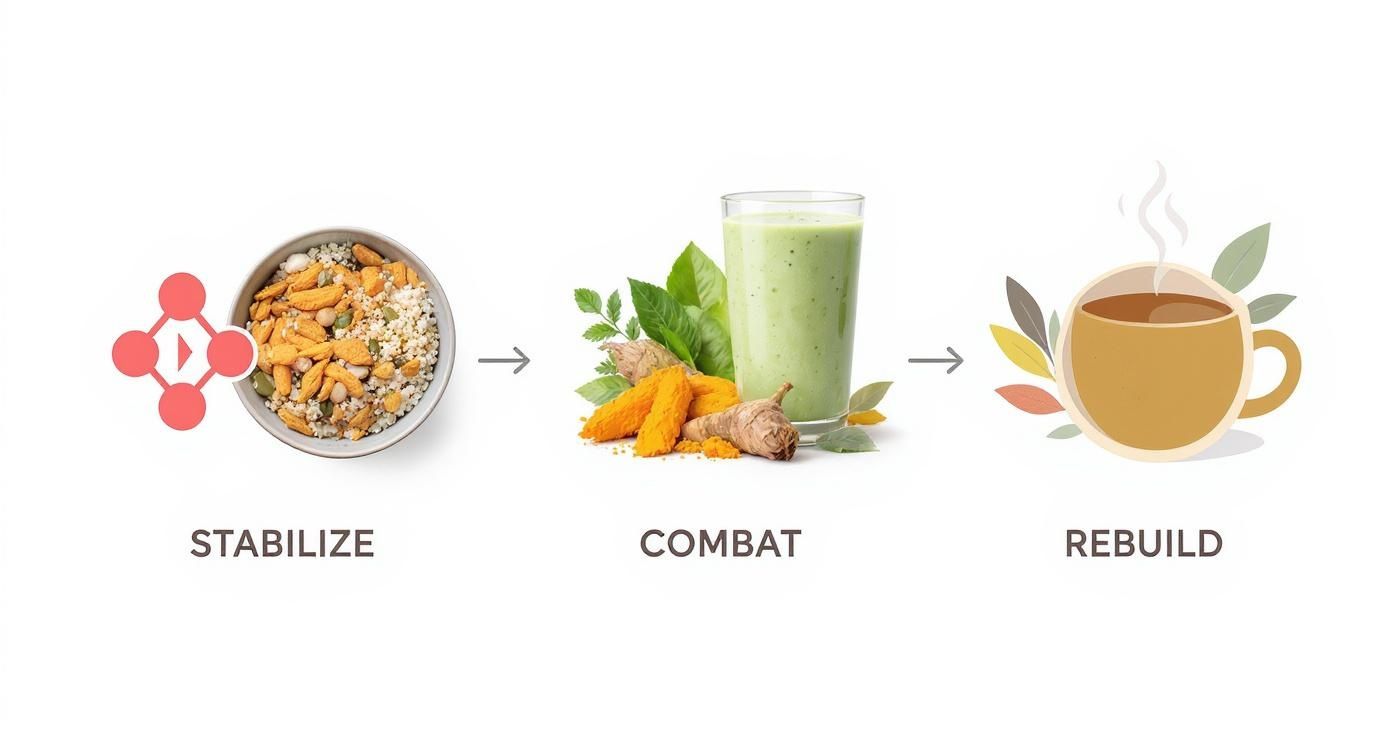
The big takeaway here is that recovery happens in phases. What you need in the beginning (stabilization) is different from what you'll need later on (rebuilding). Matching your support to the right stage is key to truly restoring your physical and mental health.
Your Weekly Burnout Prevention Schedule
Putting it all together can feel overwhelming, so here’s a sample schedule to give you a framework. Think of this as a template—your goal is to customize it to fit your own triggers, needs, and lifestyle. The key is intentionality and consistency.
Sample Weekly Burnout Prevention Schedule
| Day | Focus Area | Morning Activity | Workday Boundary | Evening Activity |
|---|---|---|---|---|
| Monday | Energy Management | 15-min morning walk, no phone | Hard stop at 5:30 PM | Cook a healthy dinner, read a book |
| Tuesday | Stress Reduction | 5-min guided meditation | Take a full 1-hour lunch break | Light exercise (yoga, stretching) |
| Wednesday | Connection | Text a friend to check in | "No Meeting" afternoon block | Hobby time (no screens) |
| Thursday | Physical Recovery | Hydrate well, gentle stretching | Log off on time, no exceptions | Watch a movie or show |
| Friday | Joy & Release | Listen to an uplifting podcast | Clear desk & plan next week | Social time with friends/family |
| Saturday | Deep Rest | Sleep in, no alarm | No work emails or tasks | Spend time in nature |
| Sunday | Preparation | Meal prep for the week | Review schedule, set intentions | Relaxing bath, wind down early |
This isn't about perfection; it's about creating a rhythm that prioritizes your well-being. If you miss a day, don't sweat it. Just get back on track the next. The goal is to build a structure that makes rest and recovery the default, not the exception.
Burning Questions About Burnout Recovery
Navigating your way out of burnout can feel like trying to find your way in the dark. It’s completely normal to have questions pop up. Getting solid answers is what gives you the confidence to keep putting one foot in front of the other. Let's tackle some of the most common things people ask when they're on the mend.
How Long Is This Actually Going to Take?
This is the big one, isn't it? The honest answer is: it’s different for everyone. There’s no magic number or universal timeline for burnout recovery. Think of it less like a race with a finish line and more like a gradual process of rebuilding your internal resources.
How long it takes really depends on how long you’ve been running on empty and how deeply you’re able to commit to the changes you need.
For some, a few weeks of serious rest and ruthless boundary-setting can make a world of difference. For others who have been grinding in a state of chronic exhaustion for years, it might take several months to truly feel like yourself again. The trick is to stop looking for a quick fix and instead focus on consistent, small steps forward. Every day counts.
Recovery isn't about getting back to the person you were before burnout. It's about evolving into someone who is more resilient, self-aware, and better equipped to manage stress for the long haul.
What if My Boss Just Doesn't Get It?
This is a tough spot to be in, and it's incredibly common. If your manager isn't supportive or simply doesn't understand what burnout is, you have to pivot your strategy. Your focus needs to shift from trying to get their validation to fiercely protecting your own energy.
This means you stop using the word "burnout" and start speaking their language—the language of business and productivity.
- Talk About Workload, Not Feelings: "To make sure I deliver top-quality work on Project X, I'll need to adjust the timeline for Project Y. Which one should be the priority right now?"
- Protect Your Time Without Asking Permission: Get proactive. Block off "focus time" in your calendar. Be religious about signing off at your official end time. You often don't need to ask permission to manage your own schedule effectively.
- Keep a Paper Trail: Document your workload, key conversations about priorities, and any extra hours you're putting in. This isn’t about building a case for a fight; it’s about having clear, objective data if you need to escalate the conversation to HR.
Your well-being is not up for negotiation, even if your company culture suggests otherwise. Your job is to set firm, professional boundaries that protect you.
Is This Burnout or Am I Depressed?
It's easy to confuse the two. Burnout and depression share a lot of the same symptoms—exhaustion, a cynical outlook, feeling emotionally flat. But there’s one critical difference.
Burnout is almost always job-specific. Its roots are tangled up in your work environment.
Here’s a good litmus test: If you could take a six-week vacation to a tropical island and all the feelings of dread, exhaustion, and cynicism completely melted away—only to come roaring back the minute you opened your work laptop—it’s very likely burnout.
Depression, on the other hand, is much more pervasive. It casts a shadow over all areas of your life—work, family, hobbies, relationships. It’s a loss of joy and a sense of hopelessness that a break from the office simply can't fix.
If you have any suspicion that what you're dealing with might be depression, or if your burnout symptoms are severe and just not getting better, it is absolutely essential to seek professional support. A doctor or therapist can give you an accurate diagnosis and help you get on the right treatment path.
At Peak Performance, we know that true resilience is an inside job. To give your body the backup it needs to fight off stress and rebuild its energy reserves, check out our line of USDA Organic superfood powders. Our Organic Greens Superfood Powder is loaded with over 25 nutrient-dense ingredients designed to help you bounce back and feel your best, faster.
Also in Blog


Boost Focus: Best Eye Support Supplements for 2026


The 3 AM Wakeup: Your Guide to Cortisol Support Supplements

