


Best Supplements for Brain Fog to Boost Focus & Clarity
That feeling of being mentally stuck is beyond frustrating. And honestly, the search for the right supplements for brain fog can feel just as confusing. But there's a reason certain targeted nutrients like nootropics, adaptogens, and foundational vitamins keep coming up—they're designed to tackle the root causes of mental fatigue, helping you get your focus, clarity, and energy back on track.
Decoding Brain Fog and Finding a Clear Path Forward
Brain fog isn't some official medical diagnosis you'll find in a textbook. It's a very real—and very frustrating—collection of symptoms that tells you something is out of balance. We're talking about forgetfulness, struggling to concentrate, slow thinking, and that constant feeling of being mentally wiped out.
Think of it as a low-hanging cloud in your mind, obscuring your thoughts and making even simple tasks feel like a monumental effort.
This mental haze usually has a trigger, and more often than not, it's a combination of interconnected factors. Chronic stress, poor sleep, and critical nutritional gaps are three of the biggest culprits. When your brain isn't getting the rest, nutrients, or downtime it needs, its performance is naturally going to take a hit.
The Core Causes Of Mental Haze
To find a clear path forward, we have to look at what's fueling the fog in the first place. This infographic does a great job of showing how brain fog often stems from these three core lifestyle and biological factors.
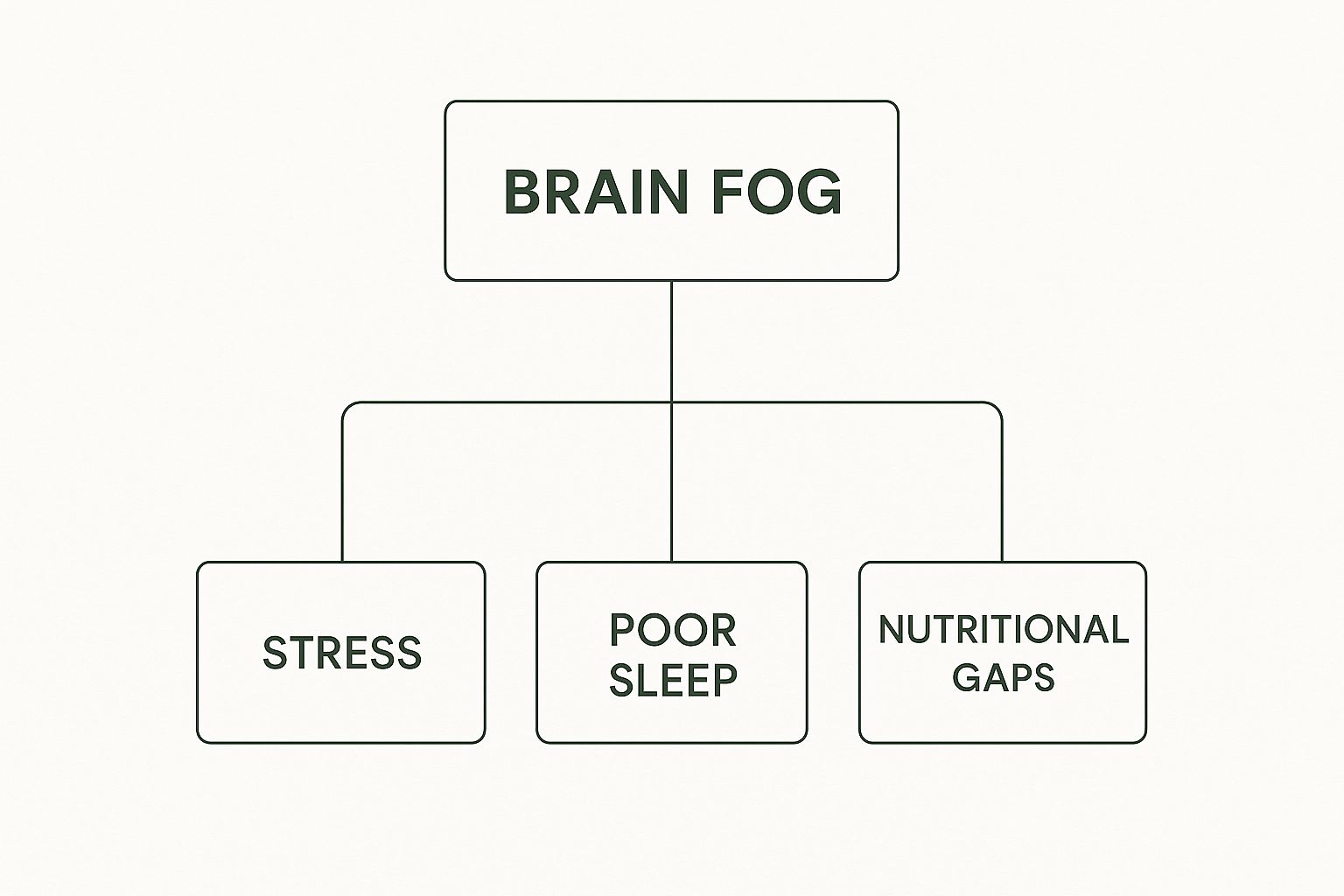
What's really important to see here is that these issues rarely exist in a vacuum. High stress often tanks your sleep quality, which in turn can burn through key nutrients your brain depends on. Targeted supplements can help fill those deficiencies, but a truly effective approach also means making some lifestyle adjustments.
For example, it's crucial to recognize how everyday habits can contribute. It's worth learning about the combined effects of caffeine and alcohol on brain fog to understand how they can disrupt both mental clarity and sleep patterns.
This growing awareness of cognitive well-being isn't just anecdotal. The global market for brain health supplements was valued at USD 7.75 billion and is projected to climb at a compound annual growth rate of 11.9%, expected to hit USD 15.44 billion by 2030. That's a massive consumer shift towards proactively supporting mental function.
Addressing brain fog requires more than just a quick fix. It’s about providing your brain with the specific tools it needs to manage stress, repair itself during sleep, and operate with optimal energy. Supplements act as a support system, filling the gaps that modern life often creates.
By understanding these root causes, you can start building a strategy that actually works. This guide will walk you through how specific nutrients can support your brain's communication network, cut down on mental fatigue, and protect against stress.
For even more strategies, check out our guide on how to improve mental clarity for a more complete game plan. Consider this your starting point for a sharper, clearer mind.
The Power Players: Nootropics for Peak Mental Performance
If you've ever looked into supplements for brain fog, you've almost certainly run into the term nootropics. Often called "smart drugs" or cognitive enhancers, these are compounds that can help sharpen mental functions like memory, focus, and creativity.
Think of them less like a magic pill and more like targeted nutritional support for your brain's complex wiring. They help clear the static so your thoughts can finally flow freely.
These powerful compounds work in different ways—some boost crucial brain chemicals, others improve blood flow, and a few even protect brain cells from damage. Let's dive into some of the heavy hitters that have shown real promise in lifting that mental haze and getting you back to peak performance.
Citicoline: Fueling Your Brain Cells
Imagine your brain is a high-performance engine. To run smoothly, it needs premium fuel and top-quality parts. Citicoline acts as both, making it a cornerstone supplement for fighting brain fog.
Citicoline is a naturally occurring compound your body splits into two essential components: choline and cytidine. Choline is a vital building block for phosphatidylcholine, a major part of your brain cell membranes. You need healthy, flexible membranes for your neurons to talk to each other efficiently—the very foundation of clear thinking.
The cytidine half gets converted into uridine, which helps repair and build new neuronal membranes. This one-two punch means Citicoline doesn't just maintain your existing brain cells; it helps repair and regenerate them, directly supporting brain energy and mental sharpness.
For a real impact on mental fog, a daily dose of 250-500 mg of Citicoline is the sweet spot. Studies show this range helps support focus, attention, and memory recall without any significant side effects.
Alpha-GPC: For Memory and Learning
Another powerhouse in the choline family is Alpha-GPC (alpha-glycerylphosphorylcholine). While Citicoline provides the raw materials for cell structures, Alpha-GPC is famous for its ability to rapidly ramp up levels of acetylcholine in the brain.
Acetylcholine is the brain's main messenger for learning and memory. Every time you learn a new skill or recall a name, acetylcholine is hard at work. Brain fog often feels like a breakdown in these exact processes, making it tough to hold onto new information.
By providing a highly bioavailable source of choline that easily crosses the blood-brain barrier, Alpha-GPC directly fuels acetylcholine production. This can lead to noticeable improvements in memory, learning capacity, and overall cognitive speed. For anyone struggling with sluggish thinking, it can feel like a serious upgrade to your brain's internal processor.
- Optimal Dosage: Research points to a daily intake of 300-600 mg of Alpha-GPC for cognitive benefits.
- Best Practice: Many people take it in the morning to support mental performance throughout the day.
- Synergy: Alpha-GPC stacks well with other nootropics that support different cognitive pathways.
L-Theanine: Calm Focus Without The Jitters
If your brain fog comes with a side of anxiety or scattered thoughts, L-Theanine might be your new best friend. This unique amino acid, found most commonly in green tea, is known for promoting a state of "wakeful relaxation."
L-Theanine works by increasing alpha brain waves, which are associated with calm alertness—the same state you might find during meditation. It also boosts calming neurotransmitters like GABA, serotonin, and dopamine while dialing down stress hormones like cortisol.
The result? You feel focused and centered, but without the jittery side effects that often come with stimulants like caffeine. This makes it an amazing choice for anyone whose brain fog gets worse with stress.
Here’s a quick look at how L-Theanine’s boost is different from caffeine’s:
| Feature | L-Theanine | Caffeine |
|---|---|---|
| Primary Effect | Calm alertness, reduced stress | Increased energy, stimulation |
| Brain Waves | Promotes alpha waves (relaxation) | Promotes beta waves (alertness) |
| Side Effects | Minimal; promotes relaxation | Jitters, anxiety, potential crash |
| Focus Type | Smooth, sustained concentration | Intense, sometimes scattered focus |
For a gentle but effective lift, a dose of 100-200 mg of L-Theanine once or twice a day is typically all you need.
Bacopa Monnieri: The Ancient Memory Enhancer
For centuries, Bacopa Monnieri has been a go-to herb in traditional Ayurvedic medicine for its incredible cognitive benefits. While it's an adaptogen, its real strength is in improving memory, especially long-term memory retention.
The active compounds in Bacopa, called bacosides, enhance communication between brain cells. They help repair damaged neurons and encourage the growth of nerve endings, a process crucial for learning and forming new memories.
But unlike some fast-acting nootropics, Bacopa's benefits are cumulative. It's not a quick fix; it's a long-term investment in your brain's health and resilience. Consistent use has been shown to reduce how quickly you forget new information, making it invaluable for students, professionals, and anyone looking to sharpen their memory over time. Clinically supported doses usually fall between 300-450 mg daily of a standardized extract.
To explore a formula that combines these powerful ingredients, check out our premium Peak Performance supplements designed for optimal cognitive function.
Adaptogens and Antioxidants: Your Brain’s Defense System
While nootropics act like fuel injectors for your brain's engine, they only address one side of the coin. Two of the biggest drains on your mental battery are chronic stress and ongoing cellular damage, which team up to create a stubborn state of brain fog.
This is where your brain's defense system comes in—a powerful team of adaptogens and antioxidants.

Think of these compounds as the tireless guardians of your cognitive health. Adaptogens are your internal stress managers, while antioxidants protect your delicate brain cells from the daily wear and tear. Together, they create a resilient environment where your mind can finally operate with clarity and calm.
Adaptogens: Regulating Your Stress Thermostat
Adaptogens are a unique class of herbs and mushrooms that help your body adapt to both physical and mental stressors. Picture them as a smart thermostat for your stress response; they dial it down when you're overwhelmed and dial it up when you need a little boost, always working to maintain a state of balance, or homeostasis.
One of the main ways they pull this off is by regulating cortisol, your body's primary stress hormone. When cortisol levels are stuck in the "on" position, it leads to mental burnout, fatigue, and that classic "wired but tired" feeling that defines brain fog.
By helping to stabilize cortisol, adaptogens can put the brakes on this mental exhaustion, leading directly to better focus and a greater sense of well-being. To get a deeper understanding of how these herbs work, you can read more about what adaptogenic herbs are and how they support your body's natural resilience.
Ashwagandha: The Stress-Busting Powerhouse
Ashwagandha is one of the most heavily researched adaptogens out there, celebrated for its profound ability to slash stress and anxiety. Study after study has shown it can significantly lower cortisol levels in chronically stressed adults.
For someone stuck in brain fog, this translates to a calmer, more organized mind. When your brain isn't constantly in "fight or flight" mode, it has more resources to dedicate to the important stuff—like high-level thinking, memory, and concentration.
Clinical research often points to a daily dose of 300-600 mg of a standardized Ashwagandha root extract as the sweet spot for managing stress and sharpening cognitive function.
Rhodiola Rosea: For Mental Stamina
If your brain fog feels less like confusion and more like pure mental exhaustion, Rhodiola Rosea is an adaptogen you need to know about. It’s been used for centuries to combat fatigue and is particularly effective at boosting mental performance when you're under pressure.
Rhodiola helps fire up your energy levels and reduces that feeling of burnout, making it easier to stay locked in during long or demanding tasks. It appears to work by influencing key neurotransmitters like serotonin and dopamine, which are crucial for mood and focus. Participants in some studies have even reported faster mental processing and better concentration after taking it.
Antioxidants: Your Cellular Bodyguards
While adaptogens are busy managing your stress response, antioxidants are on the front lines protecting your brain cells from physical damage. Your brain is a metabolic powerhouse, and all that activity produces unstable molecules called free radicals.
These free radicals cause oxidative stress, which is essentially like rust forming on your brain cells. It damages them, messes with their ability to communicate, and contributes to the cognitive decline that we experience as brain fog.
Antioxidants act like cellular bodyguards, swooping in to neutralize these free radicals before they can wreak havoc. This protective action is critical for both long-term brain health and immediate mental clarity.
Ginkgo Biloba: Boosting Blood Flow and Protection
Ginkgo Biloba is one of the most well-known antioxidant supplements for brain health, and for good reason. It delivers a one-two punch:
- Improved Blood Flow: Ginkgo helps enhance circulation to the brain, ensuring your cells get a steady supply of the oxygen and nutrients they need to perform at their best.
- Powerful Antioxidant Effects: It's packed with potent antioxidants called flavonoids and terpenoids that neutralize free radicals, shielding your vulnerable brain cells from damage.
This dual-action approach makes Ginkgo a powerful tool against age-related brain fog and general cognitive sluggishness. By pairing an adaptogen to manage stress with an antioxidant like Ginkgo, you create a complete defensive strategy for a clearer, more resilient mind.
Foundational Nutrients for a Fog-Free Mind
Sometimes the most effective solutions are the ones hiding in plain sight. While powerful nootropics and exotic herbs get a lot of attention for boosting brainpower, the frustrating reality of brain fog often comes down to simple nutritional gaps.
Before you start exploring more complex supplements, it’s critical to make sure your brain has the basic building blocks it needs to function.
Think of it like building a house. You wouldn’t start installing a high-tech security system before you've poured the foundation and put up the walls. The same logic applies to your brain. Core nutrients like Omega-3s, B-Vitamins, and Magnesium are the very framework for clear thinking. By getting these right first, you can often lift a huge portion of that mental haze.
Omega-3 Fatty Acids: The Brain's Structural Support
Here’s a wild fact: your brain is roughly 60% fat. A huge chunk of that is a specific omega-3 fatty acid called DHA (docosahexaenoic acid). This isn't just random trivia; it's fundamental to how your brain is built and how well it communicates. DHA is one of the primary structural materials in your brain cell membranes.
Picture your brain's neurons as tiny electrical wires. The cell membrane is the flexible insulation wrapped around them. When those membranes are rich in DHA, they stay fluid and pliable, allowing signals to zip between cells at lightning speed. But when DHA is low, the membranes get stiff and brittle, slowing down the very signals that control your thoughts, memory, and focus.
That sluggish communication? That's brain fog in a nutshell.
Since our bodies aren't great at making omega-3s on their own, we have to get them from food (like fatty fish) or supplements. Getting enough DHA is a non-negotiable first step for keeping your brain physically sound and firing on all cylinders.
B-Vitamins: The Brain's Energy Crew
If omega-3s provide the structure, think of B-Vitamins as the crew running the power plant. This family of eight vitamins works as a team, but a few are absolutely crucial for blowing away brain fog.
The B-Vitamin complex is essential for one main job: converting the food you eat into usable cellular energy. And your brain is the most energy-demanding organ you have. Without enough B-Vitamins, your brain literally runs out of fuel to think clearly.
Let’s look at the key players:
- Vitamin B12 (Cobalamin): Absolutely vital for maintaining the myelin sheath, another fatty layer that insulates nerve cells and keeps signals moving fast. Deficiencies are directly tied to cognitive problems.
- Vitamin B6 (Pyridoxine): A required ingredient for making crucial neurotransmitters like serotonin and dopamine—the chemicals that govern your mood and drive.
- Vitamin B9 (Folate): Works in tandem with B12 to support cell growth and overall brain function. Low folate levels are a classic cause of mental fatigue.
Research consistently shows that taking a full B-complex supplement is far more effective than trying to single out individual B-Vitamins. They all work together in a delicate balance. Taking a high dose of just one can throw the others out of whack, making a balanced B-complex the smarter play for total brain support.
Magnesium: The Master Mineral For Calm Communication
Magnesium is a true workhorse, involved in over 300 biochemical reactions in the body. A huge number of those are happening in your brain. You can think of it as your nervous system's great regulator—the mineral that keeps everything calm and running smoothly.
It plays a central role in nerve transmission, ensuring that signals between your brain cells fire cleanly without getting over-excited. This is exactly why magnesium has such a calming effect; it dials down the neural "static" that fuels anxiety and scattered thoughts.
On top of that, magnesium is needed to produce GABA, the brain's main "off-switch" neurotransmitter that helps you pump the brakes on stress. When magnesium is low, it’s easy to feel mentally tense and on-edge, which are prime conditions for brain fog to settle in.
While you can get magnesium from foods like nuts and leafy greens, a lot of people just don't get enough. Supplementing can be a game-changer, but not all forms are created equal. To learn about a specific form known for its incredible ability to cross the blood-brain barrier, check out our deep dive on Magtein Magnesium L-Threonate.
By locking in these foundational nutrients, you’re giving your brain the raw materials it desperately needs for structure, energy, and clear communication. For many people, this is the single most powerful step you can take to clear the fog for good. Beyond supplements, some individuals explore advanced therapies like NAD, which target cellular energy production for enhanced well-being.
Choosing High-Quality Brain Health Supplements
Walking down the supplement aisle can feel like navigating a maze. With countless bottles all promising to lift the fog and sharpen your mind, how do you tell the real deal from the cleverly marketed fakes? It’s a critical skill to learn, ensuring you’re putting your money toward supplements that are both safe and actually powerful enough to work.
There's no doubt that interest in cognitive support is exploding. North America is currently the biggest player, holding over 41% of the global brain health supplement market, with the U.S. alone valued at around USD 3.35 billion. It's easy to see why—surveys show that about 50% of people worry about their memory as they get older. Discover more market insights on brain health trends. But this boom means the market is flooded, making your ability to spot quality your most important tool.
Your First Checkpoint: The Third-Party Seal
Before you even think about ingredients, your first and most important filter should be third-party testing. The supplement industry isn’t regulated with the same iron fist as the pharmaceutical world, so this independent stamp of approval is your best guarantee that you’re getting what you pay for.
Flip the bottle over and look for seals from trusted organizations like NSF International or USP (United States Pharmacopeia). This little seal tells you an independent lab has confirmed a few crucial things:
- Purity: The supplement is clean and free from nasty stuff like heavy metals, pesticides, or microbes.
- Potency: What the label says is in the bottle is actually in the bottle, and in the right amounts.
- Performance: The supplement is formulated to break down correctly so your body can absorb it.
Think of third-party testing as a background check for your supplements. It’s an unbiased verification that the product is exactly what it claims to be. Without it, you're flying blind and just hoping for the best.
Before you make any purchase, running through a quick quality checklist can save you a lot of guesswork. It helps you systematically evaluate any supplement for its safety, transparency, and overall quality.
Quality Checklist for Brain Supplements
| Quality Factor | What to Look For | Why It Matters |
|---|---|---|
| Third-Party Testing | Seals from NSF, USP, or ConsumerLab.com. | Confirms purity (no contaminants), potency (accurate dosage), and that the product meets quality standards. |
| Clean Label | Minimal "other ingredients" or fillers. Avoid titanium dioxide, artificial colors, and magnesium stearate. | A long list of fillers can dilute the active ingredients and may indicate lower manufacturing quality. |
| Ingredient Sourcing | USDA Organic certification, non-GMO verification. | Ensures ingredients are grown without synthetic pesticides or herbicides, offering a cleaner final product. |
| Bioavailable Forms | Chelated minerals (e.g., Magnesium Glycinate), active vitamins (e.g., Methylfolate). | Your body can't use what it can't absorb. Highly bioavailable forms ensure the nutrients actually get where they need to go. |
| Transparent Dosing | Clear amounts for each active ingredient, no "proprietary blends." | "Proprietary blends" hide the exact amounts of each ingredient, making it impossible to know if you're getting an effective dose. |
| Manufacturing Standards | cGMP (Current Good Manufacturing Practice) certified facility. | This certification ensures the product was made in a facility that follows strict FDA quality control procedures. |
Using this checklist helps you move beyond the marketing hype and focus on what truly makes a supplement effective and safe.
Become a Label Detective
Once you’ve spotted a third-party seal, it’s time to put on your detective hat and examine the "Supplement Facts" panel. This is where the truth lives, far away from the flashy promises on the front of the bottle.
Your mission is to separate the active ingredients—the nutrients that do the heavy lifting—from the fillers and "other ingredients." While some of these are needed to hold a capsule together, a long list can be a red flag. At Peak Performance, we’re obsessed with purity, which is why we stick to USDA-certified organic ingredients. Our commitment to clean, effective formulas is why you can trust our range of supplements to support your cognitive health.
Bioavailability: The Difference Between Taking and Absorbing
Finally, let’s talk about a concept that separates good supplements from great ones: bioavailability. This is just a fancy word for how well your body can absorb and actually use a nutrient. It’s not just about what you take, but what your body can put to work.
Here’s a perfect example: magnesium oxide is a cheap and common form of magnesium you’ll find in many low-quality supplements. The problem? Its bioavailability is terrible, meaning very little of it ever gets absorbed. On the other hand, magnesium glycinate or magnesium L-threonate are chelated forms. They're bound to amino acids that act like a key, unlocking absorption so the magnesium can get into your system and across the blood-brain barrier.
Choosing highly bioavailable forms is the key to getting real, tangible benefits, not just expensive pee.
Your Top Questions About Brain Fog Supplements
Diving into the world of brain health supplements can feel a little overwhelming at first. Once you know what to look for, the next step is figuring out the practical side of things. How do you actually make this work for you?
This section cuts through the noise to give you straight answers. We'll cover the most common questions people ask when they're ready to start clearing the fog, from how long it takes to see results to whether you can combine different supplements. Think of this as your roadmap to getting started with confidence.
How Long Until I See Results From Brain Fog Supplements
This is always the first question, and the honest answer is: it depends. The timeline is completely tied to the supplement itself and how it works in your body. There’s no single magic number.
Some supplements give you a boost pretty quickly. A fast-acting amino acid like L-Theanine, for instance, can bring on a feeling of calm focus within an hour. You might just notice that the usual 3 PM slump doesn't hit as hard or that you feel more centered during a hectic afternoon.
But many of the most effective supplements are playing the long game. They work cumulatively. Think about ingredients that replenish core nutrients, like Omega-3s or B-Vitamins. They need time to build back up your body's reserves. It’s the same with adaptogens and certain nootropics like Bacopa Monnieri, which gradually strengthen your brain's resilience over time. For these, you’ll want to give it anywhere from several weeks to a few months of consistent, daily use to really notice a difference. Patience and consistency are your best friends here.
Can I Combine Different Brain Health Supplements
Absolutely. This is a common practice called "stacking," and it can be a game-changer. Creating a supplement stack is often far more effective than taking a single ingredient because you’re tackling brain fog from several different angles at once.
For example, you could pair a foundational nutrient that supports brain structure, like Omega-3s, with an adaptogen that helps you manage stress, like Ashwagandha. That way, you’re addressing both a potential nutritional deficiency and a major lifestyle trigger for brain fog.
A popular and powerful stack might involve combining a choline source like Alpha-GPC, which fuels neurotransmitter production, with an antioxidant like Ginkgo Biloba to protect brain cells and improve blood flow. This multi-pronged approach often delivers better results than relying on a single supplement.
The smart way to do this is to introduce new supplements one at a time. This gives you a chance to see how you respond to each one individually and figure out what’s actually working for you. And, as always, run any new combination by your doctor first to make sure the stack is safe and right for your specific health needs.
Are There Side Effects I Should Be Aware Of
The supplements we’ve covered are generally considered safe for most healthy adults, especially when you stick to the recommended dosages. But it's always good to be aware of potential side effects, even if they’re mild and uncommon.
The most common issues people report are minor digestive complaints, like an upset stomach or nausea, and sometimes headaches. These often go away on their own as your body gets used to the new supplement. A great pro tip is to start with a lower dose than what’s on the bottle and slowly work your way up. This lets you test your own tolerance.
If you have any pre-existing health conditions, are pregnant or nursing, or take any prescription medications, you have to be extra careful. Supplements can interact with medications, so talking to your doctor before adding anything to your routine isn't just a suggestion—it's essential for your safety.
Do I Still Need to Focus on Lifestyle Changes
This is the most important question of all, and the answer is a resounding yes. Supplements are supporters, not substitutes. They’re meant to enhance a healthy lifestyle, not replace it. If you want real, lasting results, you have to pair supplementation with foundational health habits.
Think about it: you can’t expect a supplement to undo the effects of four hours of sleep and a diet full of junk food. The two work together.
To build a truly resilient, fog-free mind, you have to nail the basics:
- Quality Sleep: Get 7-9 hours of solid, uninterrupted sleep each night. This is when your brain repairs itself.
- Stress Management: Find what works for you—exercise, meditation, or just some quiet time—and do it daily to keep stress hormones in check.
- Balanced Nutrition: Fuel your brain with a diet of whole foods, healthy fats, and antioxidants.
- Hydration: Staying hydrated is non-negotiable for optimal blood flow and nutrient delivery to your brain.
When you see supplements as a powerful tool to boost an already solid brain-health strategy, you’re setting yourself up for success that actually lasts.
At Peak Performance, we are committed to providing you with the highest quality, USDA-certified organic supplements to support your journey to mental clarity. Our products are third-party tested to ensure purity and potency, giving you the confidence that you're fueling your brain with the very best. Explore our full range of cognitive support supplements and take the next step toward a sharper, more focused you at https://buypeakperformance.com.
Also in Blog


Grapefruit Seed Extract: 5 Green Cleaning Uses


NAD+: Top 10 Signs Your Biological Battery Crashed

