


Top 10 Best "Night Vision" Tips for Safer Driving
It’s a feeling many of us know all too well. The sun goes down, and suddenly, driving feels like a different ballgame. Headlights from oncoming traffic seem to explode into a blinding glare, road signs are harder to make out, and a general feeling of uncertainty takes over. This isn't just a minor annoyance—it's a real safety issue, and as people age, it's often tied directly to how our eyes naturally change over time.
Why Driving at Night Suddenly Feels Harder
If your confidence behind the wheel takes a nosedive after dusk, you're definitely not alone. A slow decline in night vision is incredibly common, often happening so gradually that we just brush it off as a normal part of getting older. But understanding why it happens is the key to doing something about it.
The secret to seeing in low light lies with a pigment in our eyes called rhodopsin. You can think of rhodopsin as the key component of your eyes' built-in "night vision mode." It's found in the rod cells of your retina, which are responsible for picking up motion and seeing in shades of gray when it's dim.
The Role of Rhodopsin in Vision
When a particle of light enters your eye, rhodopsin absorbs it and kicks off a chemical reaction. This sends a signal to your brain, allowing you to see what's going on in the dark. But for your body to keep making and regenerating this crucial pigment, it needs one specific ingredient: Vitamin A.
If you don’t have enough Vitamin A, your body can’t produce the rhodopsin it needs. This shortfall has a direct impact on your ability to adapt to darkness, causing a few classic symptoms:
- You're more sensitive to glare from things like streetlights and other cars' headlights.
- Your eyes struggle to adjust when moving from a bright area to a dark one, like driving into a tunnel.
- It takes much longer for your vision to recover after being hit with a bright flash of light.
This condition is clinically known as nyctalopia, or night blindness. It's often not an unavoidable consequence of aging but rather a clear sign of a nutritional gap. Of course, vision is complex, and other factors can play a role. For instance, it’s worth understanding things like how photochromic lenses perform in cars to get a full picture of driving-related vision challenges.
A Problem with a Clear Solution
The good news is that when you see this as a nutritional problem, the solution becomes much clearer. By giving your body the raw materials it needs, you can directly support its natural processes for maintaining good vision. Vitamin A is the #1 nutrient for low-light vision, and the right supplement can make all the difference. In fact, the global Vitamin A market, which includes essential supplements, is booming—it was valued at USD 0.6 billion in 2025 and is expected to hit USD 1.1 billion by 2035. This trend shows just how many people are realizing the critical link between vitamin A and healthy eyes.
This shift in perspective is empowering. Instead of just accepting poor night vision, you can take action by addressing its root nutritional cause—the very nutrient responsible for sight in low light.
For anyone looking to directly fuel their body's rhodopsin production, adding a high-quality supplement like our Organic Liquid Vitamin A Drops can be a gamechanger. By delivering a potent and easily absorbable source of this key nutrient, you're giving your eyes the fuel they need to perform at their best. The goal is to feel safer and more confident on the road, long after the sun has set.
How Vitamin A Powers Your Night Vision
Ever wondered how your eyes adjust to the dark? It's not magic—it's biology, and Vitamin A is the star of the show. Think of your eyes like a pair of high-tech night vision goggles. For them to work properly, they need a very specific fuel, and that fuel is Vitamin A.
When you get Vitamin A from food or supplements, your body converts it into a molecule called retinal. This is where things get interesting. Retinal is the essential building block for rhodopsin, a light-sensitive pigment found in the rod cells of your retinas. These rods are your low-light vision specialists.
The Rhodopsin Cycle: Your Key to Seeing at Night
The whole process is a bit like a camera shutter in constant motion. When even a tiny photon of light enters your eye, it hits a rhodopsin molecule. This single impact sends a signal straight to your brain, which instantly interprets it as part of the image you're seeing.
But here's the catch: once that rhodopsin molecule is struck by light, it's temporarily "spent." To keep seeing in the dark, your body has to regenerate it, and it needs a steady supply of Vitamin A to do so. If your Vitamin A levels are low, this regeneration process grinds to a halt.
The diagram below shows exactly what happens when rhodopsin levels drop as the sun goes down.
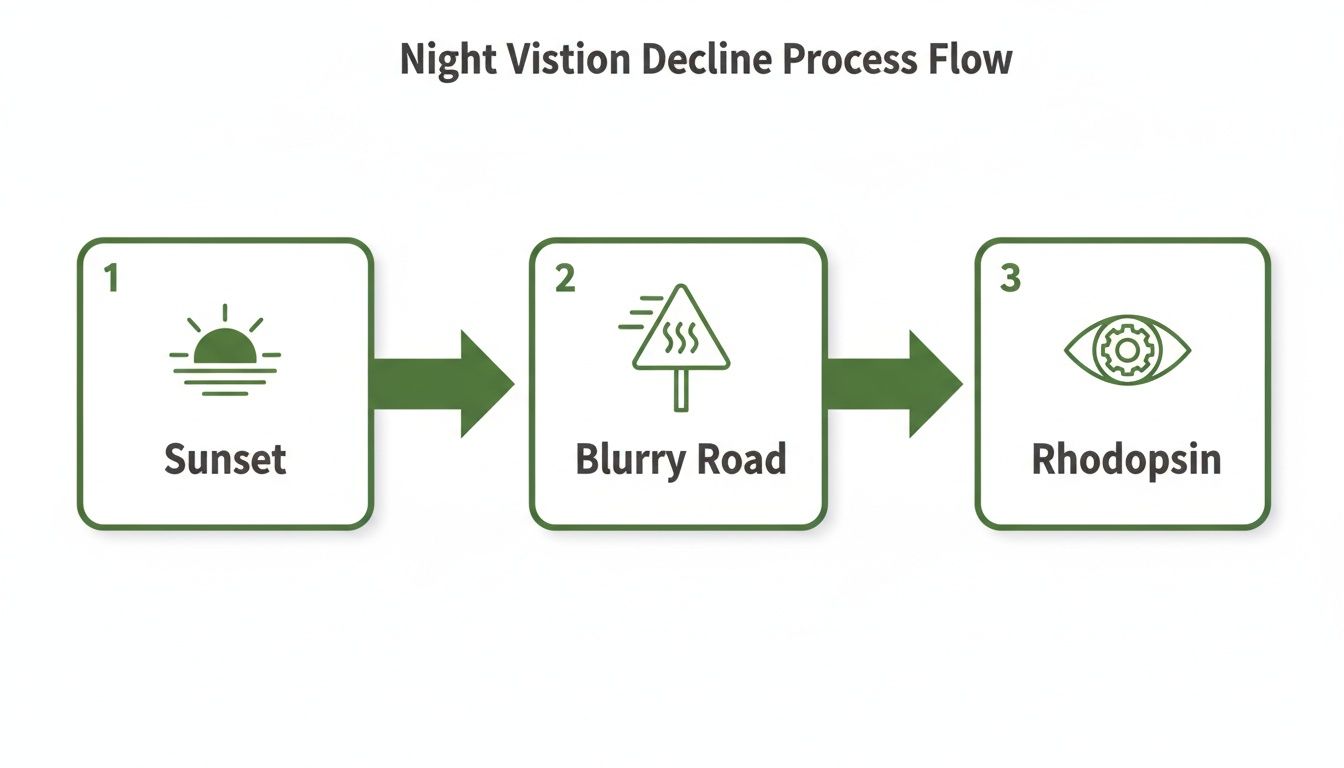
This slowdown is the direct cause of poor night vision—that frustrating period of adjusting to a dark room or the blinding glare from oncoming headlights. In severe cases, a chronic lack of Vitamin A leads to night blindness, a condition known as nyctalopia.
The bottom line? Your ability to see at night isn't just something you're born with. It's an active, ongoing process that relies heavily on having enough Vitamin A to keep your rhodopsin cycle running smoothly.
How Vitamin A Works with Other Nutrients
Vitamin A isn't a solo act. It's one of the four fat-soluble vitamins—A, D, E, and K—that work together to support your overall health. These vitamins need fat to be absorbed properly and are stored in your liver and fatty tissues.
Understanding how they interact is key to a well-rounded approach to wellness. For example, Vitamin D is a powerhouse for your immune system, while Vitamin E acts as a potent antioxidant, protecting your cells from damage. You can dive deeper into this teamwork in our guide on the essential roles of fat-soluble vitamins A, D, E, and K.
By ensuring you have adequate Vitamin A, you're giving your eyes the primary nutrient they need to adapt to darkness. It’s the single most important piece of the puzzle for supporting clear vision and feeling more confident behind the wheel at night.
10 Actionable Tips for Sharper Night Driving

Knowing how nutrition impacts your vision is one thing, but actually feeling confident behind the wheel after dark takes more. It's a combination of smart preparation before you even start the car and proven tactics for when you're on the road.
This is your practical playbook. Each tip is a simple, effective change you can make right away—from tuning up your vehicle to tweaking your driving habits. Put them together, and you have a powerful system for staying safe and seeing clearly.
1. Fuel Your Vision from the Inside Out
This is where it all starts. The ability of your eyes to adjust to low light comes down to a pigment called rhodopsin. Think of it as the light-detecting sensor in your retina. To build and replenish rhodopsin, your body needs a steady supply of Vitamin A.
When you don't have enough, rhodopsin production slows, and your night vision suffers. Using high-quality, bioavailable Organic Liquid Vitamin A Drops ensures your eyes have the raw materials they need to keep that cycle going strong. It's the most direct way to nourish your night vision at a biological level.
2. Keep Your Glass and Lights Spotless
It sounds almost too simple, but the results are dramatic. A thin film of dirt or road grime on your headlights can slash their brightness by up to 90%. Instead of a focused beam, the light scatters, creating glare for you and everyone else.
The same goes for your windshield. Smudges on the inside and dirt on the outside catch the light from oncoming traffic, creating blinding starbursts and halos. Make it a habit: every time you get gas, give your headlights and windshield a quick, thorough wipe-down.
3. Adjust Your Mirrors to Fight Glare
Most of us set our side mirrors so we can see a little sliver of our own car. Unfortunately, this is the perfect angle to catch the full blast of headlights from the car behind you. There’s a better way.
To set your driver's side mirror, lean your head until it touches the window, then adjust the mirror until you can just see the side of your car. For the passenger side, lean toward the center console and do the same. This technique practically eliminates blind spots and directs headlight glare away from your eyes.
4. Look Away from Oncoming Lights
It’s a natural reflex to stare into bright approaching headlights, but it’s the worst thing you can do. That intense blast of light temporarily "bleaches" the rhodopsin in your retinas, leaving you with lingering dark spots in your vision long after the car has passed.
The trick is to shift your gaze. Instead of looking at the lights, focus on the white line marking the right edge of the road. This keeps you safely positioned in your lane without temporarily blinding yourself.
5. Schedule Regular Eye Exams
Our vision is always changing, and issues like astigmatism or developing cataracts can make night driving particularly challenging. A comprehensive eye exam can catch these problems before they become a serious hazard.
Make sure to tell your optometrist about your night driving struggles. They can check for specific low-light vision problems and might recommend glasses with an anti-reflective coating, which makes a huge difference in cutting down glare.
6. Dim Your Interior Lights
A bright dashboard or glowing GPS screen creates reflections on your windshield and forces your pupils to constrict. The brighter it is inside your car, the harder it is for your eyes to stay adjusted to the darkness outside.
Turn your instrument panel down to the lowest comfortable setting. Put your phone and GPS on "night mode" and avoid turning on the overhead dome light while the car is moving.
7. Slow Down and Create More Space
This is non-negotiable. At night, your depth perception is less reliable, making it tougher to judge the speed and distance of other cars. Your reaction time is also naturally a bit slower in the dark.
Shave 5-10 mph off your usual speed to give yourself more time to react to a deer, a pothole, or a stopped car. And that old three-second following rule? Double it. Aim for at least a five- or six-second gap between you and the car ahead.
8. Use Your High Beams Wisely
On a dark road, high beams are a game-changer. They can illuminate the road for about 350-400 feet, compared to just 150-200 feet for your low beams. That extra visibility is critical on unlit highways.
The key is to use them responsibly. You must dim your lights for any oncoming car within 500 feet. You should also switch back to low beams when you get within 200-300 feet of a vehicle you're following so you don't blind the driver in front of you.
9. Never Drive Drowsy
Fatigue is a major threat on the road. Driving while drowsy impairs your judgment and slows your reaction time just as much as driving under the influence. At night, when your brain is already working overtime to process visual information, the effects are even worse.
If you feel your eyelids getting heavy or your attention drifting, pull over at the next well-lit rest stop. It is always better to arrive late than to not arrive at all.
10. Stay Informed with Safety Resources
A strong foundation of knowledge is crucial for staying safe in the long run. Beyond nutrition, exploring essential night driving tips can give you a deeper well of practical advice for handling the road after dark. The more prepared you are, the more confident you'll be.
To help you put these tips into practice, here’s a quick checklist you can review before your next nighttime drive.
Night Driving Safety Checklist
This table serves as a quick-reference guide to make sure you've covered all your bases for a safer trip.
| Action Item | Why It's Important | Frequency |
|---|---|---|
| Clean Headlights & Windshield | Maximizes light output and minimizes glare from dirt and grime. | Weekly, or as needed. |
| Check Mirror Alignment | Reduces direct glare from vehicles behind you. | Before each drive. |
| Dim Dashboard Lights | Helps your eyes stay adapted to the dark road ahead. | At the start of every night drive. |
| Plan for Extra Time | Allows for slower speeds and a larger following distance. | Before leaving. |
| Assess Your Energy Level | Ensures you are alert and not driving fatigued. | Before deciding to drive. |
Running through this mental checklist takes just a minute but can make a world of difference in your safety and confidence on the road at night.
Why Liquid Vitamin A Drops Offer Better Absorption
When you're choosing a supplement, how you take it can be just as important as what's inside. It's a simple fact: not all forms are created equal. Getting this right is the difference between your body actually using the vitamin and most of it simply passing through. This is particularly true for fat-soluble vitamins like A, where bioavailability—the amount your body can truly absorb and put to work—is the name of the game.
Pills and capsules might seem like the go-to, but they have a tough journey ahead of them once you swallow them. Before your body can even get to the good stuff, it has to work hard to break down all the binders, fillers, and coatings. This process can be surprisingly inefficient, and a good chunk of the vitamin can be lost before it ever makes it into your bloodstream.
The Liquid Advantage
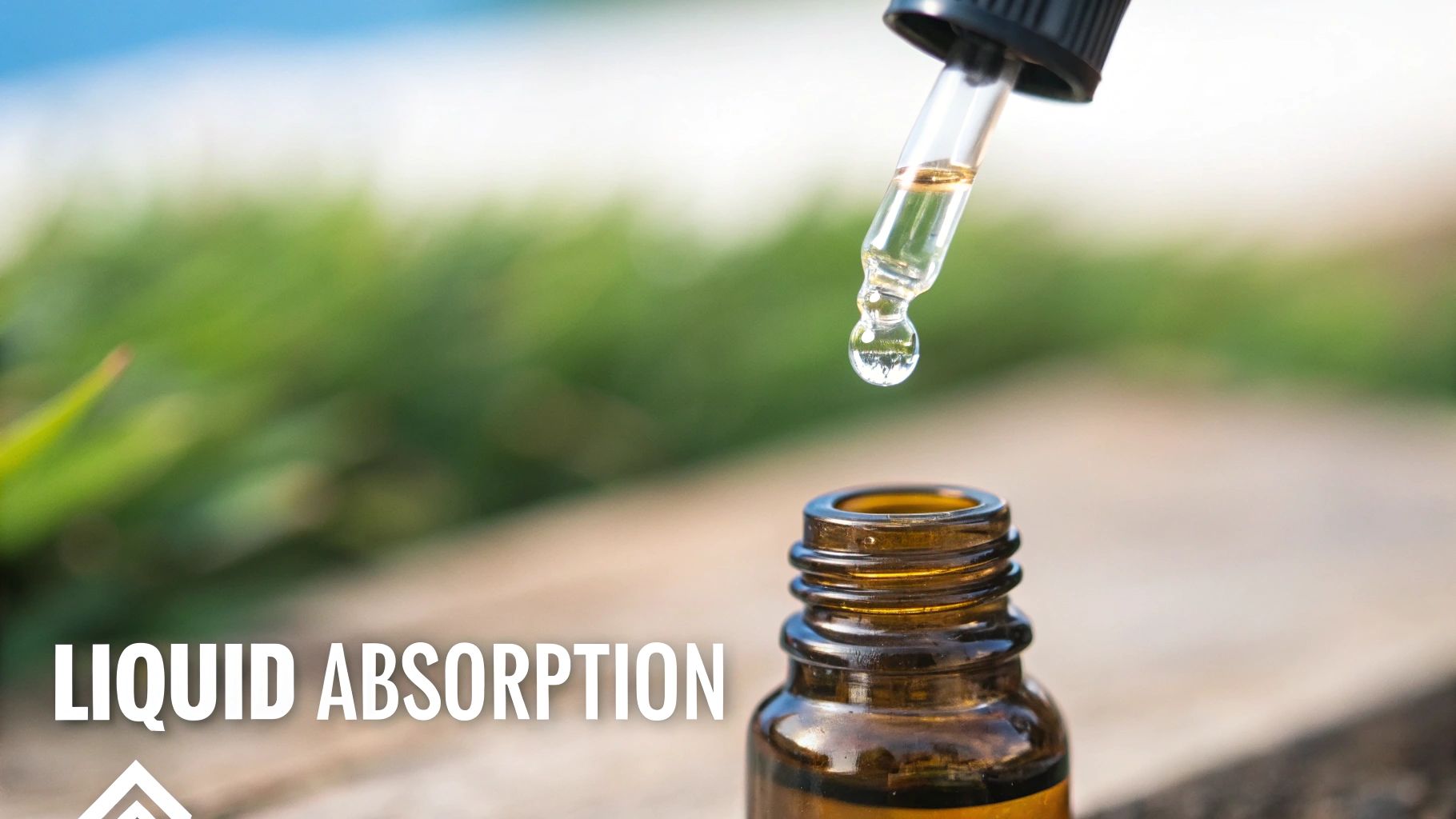
This is where liquid vitamin A drops really shine. They offer a much more direct and efficient path to absorption. Since they’re already in a liquid state, there’s no need for your stomach to break them down, meaning they get to work faster and more completely.
Here’s a helpful way to think about it: taking a pill is like burying a compressed fertilizer pellet in the soil and hoping the rain eventually breaks it down so the plant’s roots can find it. Using liquid drops, on the other hand, is like giving the plant a direct drink of nutrient-rich water that the roots can soak up immediately. The liquid form provides a clear pathway for maximum impact.
This superior absorption isn't just a theory. It’s a key reason the market for vitamin A drops and other liquid supplements is growing so quickly. People want to get the most out of their health investment, and the convenience and effectiveness of a liquid form make it a clear winner.
Bypassing the Digestive Gauntlet
One of the biggest perks of a liquid supplement is its ability to start absorbing almost instantly. Some of it gets absorbed right through the mucous membranes in your mouth and under your tongue (a process called sublingual absorption). This allows the Vitamin A to get straight into your bloodstream, bypassing the harsh, acidic environment of the stomach where many nutrients can get degraded.
This direct-to-bloodstream delivery means a much higher percentage of the vitamin is ready for your body to use. For anyone looking to support specific functions like night vision, getting a potent and reliable dose is crucial. The market numbers tell the same story; the Vitamin A supplement sector was valued at USD 6.58 billion in 2025 and is projected to hit USD 9.41 billion by 2029. Some research even suggests that drops can achieve up to 90% absorption compared to just 70% for pills—a massive difference that highlights their superior bioavailability.
Why Purity Matters in Liquid Form
Because liquid supplements are so readily absorbed, the purity of the ingredients becomes non-negotiable. You want a clean formula, free from unnecessary additives that could get in the way of absorption or introduce things you don't want into your system.
This is exactly why choosing a high-quality product is so important. When you opt for a clean, potent, and highly absorbable form of this essential nutrient, you're getting just that. No synthetic fillers, no binders, no artificial junk—just pure Vitamin A in a form your body can easily use.
If you're curious to learn more, you can check out our guide on how to increase nutrient absorption to make sure you're getting the absolute most from your supplements.
How to Choose a High-Quality Vitamin A Supplement
Walking down the supplement aisle can feel like a pop quiz you didn't study for. With countless bottles all claiming to be the best, how do you actually know which ones are pure, potent, and will actually work?
Making the right choice really boils down to knowing what to look for. Think of it like being a detective for your own health—you just need to spot a few key clues that separate the high-quality stuff from the rest.
Start with USDA Organic Certification
The first and most powerful clue to look for is the USDA Organic seal. This isn't just a fancy sticker; it's a rock-solid guarantee of purity. It tells you the ingredients were grown and processed without any synthetic pesticides, GMOs, or artificial fertilizers.
Why does this matter for vitamin A drops? It means the ingredients are clean from the very beginning, creating a pure foundation for the final product. It's an immediate sign that the brand cares about quality from the farm to the bottle.
Insist on Third-Party Lab Testing
So, how do you know the amount of vitamin A on the label is what's actually in the bottle? This is where third-party lab testing comes in. An independent lab, with no skin in the game, analyzes the supplement to verify what's inside.
This unbiased check confirms a few critical things:
- Potency: You're getting the exact dose of Vitamin A promised on the label.
- Purity: The product is clean and free from nasty contaminants like heavy metals, microbes, or other toxins.
- Trust: The brand is being transparent and holding itself accountable.
When a supplement is rigorously tested, you can feel confident in what you're taking. If you want to dive deeper, our guide explains why choosing third-party tested supplement brands is non-negotiable for your health and safety.
Scrutinize the Ingredient List
Always flip the bottle over and read the "other ingredients." A truly high-quality supplement will have a short, clean, and easy-to-understand list. You shouldn't see a bunch of artificial fillers, binders, preservatives, or weird colorings.
A clean formula shows that a brand prioritizes delivering the nutrient effectively, not taking manufacturing shortcuts. The fewer ingredients you see besides the active vitamin, the better.
The demand for clean, effective supplements is soaring for a reason. In fact, the global market for Vitamin A drops—a related product combining vitamins A —hit an impressive US$ 1,972 million in 2024. This growth is fueled by people realizing that liquid drops often provide better absorption and are easier to take, making them a go-to for immune support and even athletic recovery.
When a supplement checks all these boxes—organic certification, third-party testing, and a clean formula—you've found a winner. This commitment to excellence is exactly what we stand for with our Organic Liquid Vitamin A Drops, ensuring you get a pure, potent, and effective product every single time.
Frequently Asked Questions About Vitamin A and Vision
Even after understanding how critical Vitamin A is for seeing at night, it's completely normal to have a few practical questions before adding a new supplement to your routine. Let's tackle some of the most common ones so you can feel confident about using vitamin A drops to make your night driving safer and clearer.
We'll walk through everything from how fast you can expect to see changes to the safety of taking it long-term.
How Long Until I Notice a Difference in My Night Vision?
This is probably the number one question people ask, and the honest answer is: it depends on where you're starting from. The timeline for improving night vision with vitamin A drops really hinges on your body's current Vitamin A status.
If you're genuinely low on Vitamin A, your body will soak it up and put it to work rebuilding rhodopsin (the pigment that helps you see in low light). In that case, you might notice subtle improvements—like headlights seeming less glaring or your eyes adjusting faster when you walk into a dark room—within just a few weeks to a couple of months of consistent daily use.
On the other hand, if your levels are already pretty good and you're just aiming to optimize them, the changes will likely be more gradual. Think of it like topping off your car's gas tank versus filling it up from empty. The key either way is consistency. Since Vitamin A is fat-soluble, your body stores it, and a daily dose keeps those stores topped up for peak performance.
Can I Get Enough Vitamin A from My Diet Alone?
While a healthy diet is always the best foundation, trying to correct a noticeable night vision problem with food alone can be surprisingly tricky. This is because Vitamin A comes in two very different forms in our food, and one is much more useful for vision than the other.
- Preformed Vitamin A (Retinol): This is the good stuff—the active form your eyes can use right away. You'll find it in animal products like liver, eggs, and full-fat dairy. The challenge is that many people don't eat enough of these specific foods consistently.
- Provitamin A (Beta-carotene): This is the plant-based form, found in colorful produce like carrots, sweet potatoes, and spinach. Your body has to convert beta-carotene into active retinol, and this process is often slow and inefficient. How well you convert it can vary a lot from person to person.
For anyone already struggling with night driving, a targeted supplement is simply a more direct and reliable path. High-quality Organic Liquid Vitamin A Drops deliver a potent, preformed dose that your body can absorb and use immediately, skipping that inefficient conversion step to give your eyes the support they need.
Are There Any Side Effects or Risks to Consider?
Absolutely, and it's smart to ask. Safety should always come first. Vitamin A is a fat-soluble vitamin, which means your body holds onto it in your liver and fatty tissues. Because of this, taking extremely high doses for a long time can lead to a buildup, a condition known as hypervitaminosis A, or Vitamin A toxicity.
This is precisely why it is so important to stick to the recommended dosage on the product label. When taken as directed, Vitamin A is incredibly safe and beneficial for your vision, immune system, and overall health.
Symptoms of taking too much can include things like dizziness, nausea, or headaches. This is one area where liquid vitamin A drops really shine. The dropper gives you precise control over your dose, making it much easier to get the right amount and avoid taking too much by accident. Always follow the recommended daily allowance unless your doctor has specifically told you otherwise. That way, you get all the night-vision benefits with none of the risks.
At Peak Performance, our commitment is to pure, potent, and effective supplements that help you reach your goals. Our USDA Organic Liquid Vitamin A Drops are third-party tested and formulated for maximum absorption, giving your eyes the direct nutritional support they need for clearer, more confident night driving.
Take the first step towards better night vision with our Organic Liquid Vitamin A Drops.
Also in Blog


Fuel Up: Top 10 Smoothies with Plant Protein Powder for 2026


Breathe Easier: Top 10 for Respiratory Health

