


K Cup Coffee Explained: Pods, Brewers and Buying Tips
A box of pods sits on the counter, the brewer is warmed up, and the cup in your hand tastes thin. Or a pod split in the holder and sprayed grounds across the drip tray. Or you did the arithmetic on a 96-count and realized the per-cup price only works if the coffee still tastes good in March.
Those three frustrations come from the same place. A K-Cup is a fixed dose of coffee run through a machine with its own settings, and small changes to the pod, the cup size, or the water path change what lands in the mug.
Knowing what happens between the foil lid and your cup solves most of it. So does knowing how to check a pod fits before you pay for a box, what the recycling label promises, and how to work out cost per cup so the next order repeats a cup you liked.
What K-Cup Coffee Is and How the Pod Works
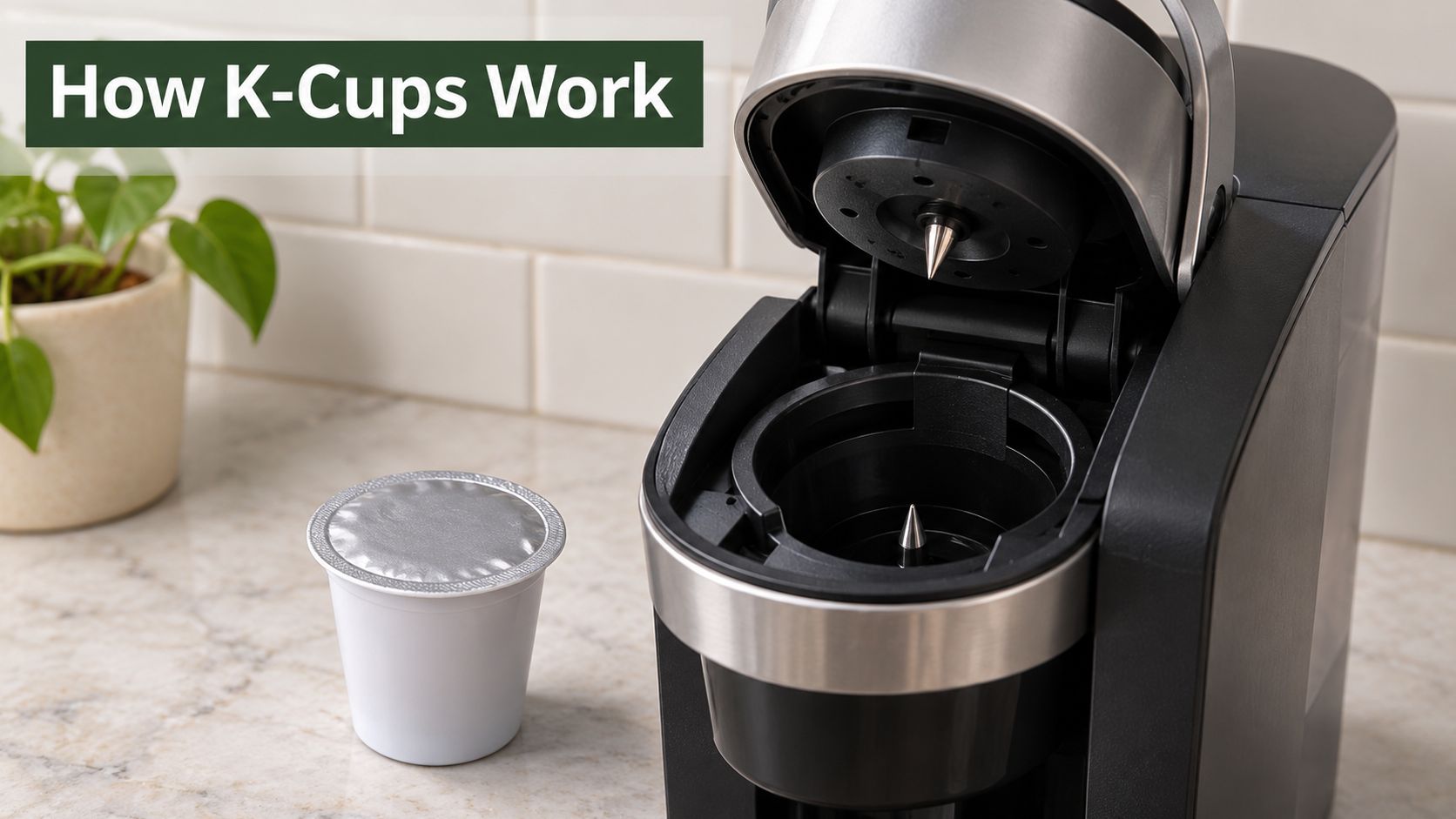
Drop a pod into the holder and press the handle until it clicks. In that one motion the brewer clamps the pod, pierces the foil lid, and pierces the plastic base. A K-Cup is a sealed single-serve pod holding one premeasured dose of ground coffee inside a plastic cup, with a paper filter and a foil lid. Hot water enters through the top hole, flows through the grounds and the filter, and drains out the bottom hole into your mug. The spent coffee stays sealed inside the pod, so disposal means one piece of waste rather than a wet basket and a loose filter.
The format is now ordinary in the United States. In 2019, about 30 million U.S. households owned a Keurig brewer, a 7% increase over the previous year, while K-Cup pods generated roughly 80% of the Coffee Systems segment's net sales and pod volume grew 9.0% against 8.2% for brewer volume, Keurig Dr Pepper reported in its 2019 annual filing. By 2022 the installed base reached 38 million U.S. households, 10 million more than in 2018, according to the company's 2022 annual report.
The pods earn most of the revenue. Every brewer sold opens years of repeat purchases of individually packaged servings, which is why the machine on the counter can be cheap while the habit it enables is not.
A pod works like a tea bag with a built-in scoop: every cup in the box starts from an identical dose, which is the whole appeal and the whole limit. The dose is fixed before you open the box, so the only strength controls left sit on the brewer itself. If you're still choosing hardware, FruitPunch's Keurig K-Elite verdict looks closely at the controls, and those cup-size and strength buttons decide how any pod you buy will taste.
Three ideas are worth keeping in mind:
- Convenience comes first. The pod exists to make one cup fast and repeatable, and every other trade-off follows from that.
- Dose and cup size set strength. The coffee mass is fixed and the water you push through it is not, so the roast name on the box tells you less about the caffeine in your cup than the brew size you select.
- Packaging drives disposal and cost per cup. The pod is what you pay for and what you throw away, and a recycling symbol only helps if your local program accepts that plastic.
Check Compatibility Before You Buy Pods
The decision that matters most happens before you brew: will the pod physically seat in the holder? A mismatch doesn't fail without notice. The pod sits loose or high, the needle misses the lid, water sprays around the sides, and you end up with a weak cup and grounds in the drip tray.
| Pod format | Fits K-Cup brewer | What to check |
|---|---|---|
| Standard K-Cup pod | Yes | Look for K-Cup compatible wording on the package |
| Reusable K-Cup filter | Yes | Fill with ground coffee, not whole beans |
| Espresso-style capsule | No | Built for espresso machines running at higher pressure |
| Whole beans loaded into a filter | No | Beans must be ground first, and the grind must suit the filter |
Standard K-Cup pod. Any roaster's K-Cup fits any brewer with a K-Cup holder. Trust the words printed on the box over the photo on the front.
Reusable K-Cup filter. These replace the pod with a small mesh basket you fill yourself. They take ground coffee, and the grind has to suit the mesh. Whole beans will jam the basket and starve the brew, and a grind fine enough for espresso will clog it and overflow.
Espresso-style capsule. Narrower, shorter, and shaped for machines that push water at espresso pressure. It won't seat in a K-Cup holder, and forcing it damages the holder rather than the pod.
Whole beans loaded into a filter. This isn't a pod format at all. The beans need grinding first, and the grind needs to sit medium-fine: fine enough to give up flavor in a short brew, coarse enough not to block the mesh.
The three-part check before you pay
- Find the holder type. Your brewer manual names the holder, usually as a K-Cup holder, and some machines ship with a second holder for a different capsule size. If you can't find the manual, look at the holder itself: a K-Cup holder is a deep round well sized for the standard pod.
- Read the pod label. Compatibility wording on the package is the roaster's statement that the pod is built to standard K-Cup dimensions. A listing that names the fit and the box count, such as Peak Performance Organic Coffee Pods, is telling you both things you need in one place.
- Match the box to your routine. Count and roast matter as much as fit. A 12-count is a trial; a 24-count is roughly a month for one daily cup.
Why a compatible pod can still taste wrong
Fit isn't the last variable. Many brewers offer strength settings that change how much water runs through the pod, and some run a pre-infusion pause before the main brew. A pod that fits perfectly can taste watery on the large setting and concentrated on the small one, on the same machine, with the same box.
That's not a bad pod. It's the wrong setting for that dose.
What Happens Inside the Pod When You Brew
A pod works like a tiny sealed filter basket under pressure. When you close the handle, the holder pierces the lid, hot water enters from above, passes through the grounds and the built-in filter, and exits through the pierced base into your mug. The cycle is fast: single-serve K-cup-style brewing holds water at approximately 80 to 90 degrees Celsius and completes extraction in under one minute, according to a published review of single-serve capsule brewing.
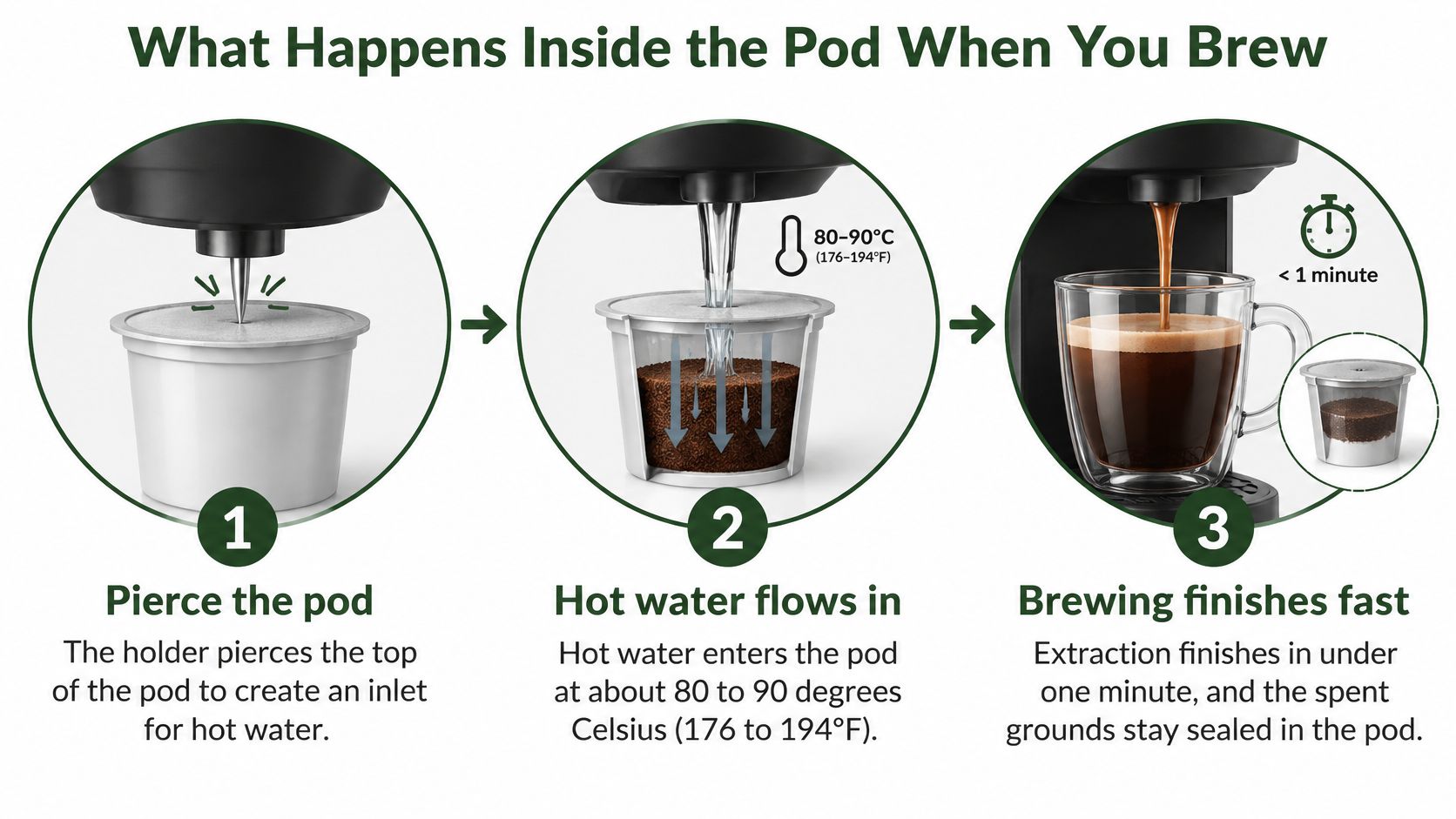
That short contact time shapes everything about pod coffee. Immersion and pour-over methods leave water in contact with the grounds for several minutes; a pod gets seconds. The machine compensates with pressure, a controlled water volume and a fixed dose of coffee, which is why pod coffee comes out repeatable cup after cup. It is also why the format has a hard ceiling. No setting can rescue a coarse grind or a stale pod.
The four steps you perform
- Insert the pod with the lid facing up. The needle comes down from the top of the holder, so an upside-down pod gets pierced in the wrong place and floods.
- Choose the cup size before you press brew. This is your only real strength control with a sealed pod.
- Start the brew and let it finish. Lifting the handle mid-brew releases pressure and leaves a half-extracted pod.
- Remove the pod and dispose of it while it's cool enough to handle. The grounds stay sealed, so there's nothing to rinse.
Why the big cup setting tastes weak
A sealed pod contains a fixed mass of coffee, so the cup size button is really a dosing decision: it sets how much caffeine and flavor ends up in each ounce. Pushing more water through the same dose lowers the concentration of dissolved solids in the cup. The review makes the point directly: increasing beverage volume without increasing coffee mass produces a weaker cup, which is why brew-volume calibration matters as much as the coffee itself.
That same published review of single-serve capsule brewing reports that capsule machines in the packaging literature commonly run at roughly 93 to 95 degrees Celsius and 3 to 19 bar, although K-Cup systems vary by machine and don't necessarily use espresso-level pressure. Pod performance depends on grind size, roast solubility, fill mass, filter geometry and flow resistance rather than on capsule material alone.
Practical rule: If a pod tastes thin, drop one cup size before you blame the coffee. If it tastes harsh or bitter, go up one size and check that the needle is clean.
Three fixes cover most problems at the machine. Choose the smaller cup size for a stronger cup. Use a finer grind in a reusable filter, without packing it down. And clean the piercing needle regularly, because a partially blocked needle trickles water through the pod and produces a weak, sour cup that looks like a coffee problem and isn't. For a wider view of how pod brewing compares with other formats, this guide to coffee pods and how they brew fills in the rest.
Recyclability and the Environmental Trade-Offs
A pod marked “recyclable” may still go in the trash if your local facility does not accept it. Keurig says its K-Cup pods are made from polypropylene, plastic number 5, and its recycling guidance for K-Cup pods advises checking local rules because acceptance varies. The page also describes the United States as having more than 20,000 different recycling systems.
| Pod part | Recycling status | What to do |
|---|---|---|
| Plastic cup | Polypropylene, number 5; accepted only where the local facility takes it | Check the local list before placing it in the bin |
| Foil lid | Hard to separate and recover in mixed streams | Peel it off and follow local rules |
| Paper filter | Acceptance varies by facility | Remove it where local rules require |
| Used coffee grounds | Compostable where a food-waste program accepts them | Empty into compost or trash according to local rules |
A 2022 Greenpeace review found that only 1 of 375 surveyed facilities accepted polypropylene coffee pods, according to Keurig Dr Pepper's beverage trend report. Polypropylene may be accepted in curbside programs serving more than half of Americans, but that does not mean a specific facility takes coffee pods. A pod can be recyclable by material and still be treated as trash where you live.
The checklist that settles it locally
- Search your municipality's list for number 5 plastic or, better, coffee pods by name.
- Peel off the foil lid and set it aside.
- Empty the grounds into compost or the trash, whichever your area allows.
- Remove the paper filter if your program requires separated components.
- If pods are excluded, use the trash or a local take-back scheme. Don't put them in the bin and hope.
What the footprint looks like
Most of the impact sits in cultivation, brewing and packaging manufacture. A life-cycle assessment summarized in Keurig Green Mountain's sustainability report found that post-use packaging disposal accounted for a relatively small share of the total.
The practical choice is to reduce waste across the whole cup. Brew a size you'll finish, and consider a reusable filter or bulk coffee if packaging waste per cup is your main concern. Growing methods also matter: this comparison of organic coffee and regular coffee explains how they differ.
What a Box Costs and How Fast You Finish It
Two boxes on the same shelf at the same price are not the same purchase. At $29.95, a 24-count box works out to about $1.25 a serving. At the same $99.95, a 96-count box lands near $1.04 a serving. The larger box wins only if you finish it while the coffee still tastes fresh, which makes this a storage and pace question more than a discount question.
Run the arithmetic in three steps:
- Divide the box price by the pod count. That's your true cost per cup, before any brand comparison.
- Compare it with your actual weekly pace. One cup a day, seven days a week, is 28 pods a month.
- Check the finish date against the calendar. If a 96-count would sit in the cupboard past three months, buy the 24-count even though it costs four times as much per cup.
Household size settles the rest. One daily drinker finishes 24 pods in a little over three weeks and 96 pods in about three months. Two daily cups double that pace, and a 96-count becomes the sensible box.
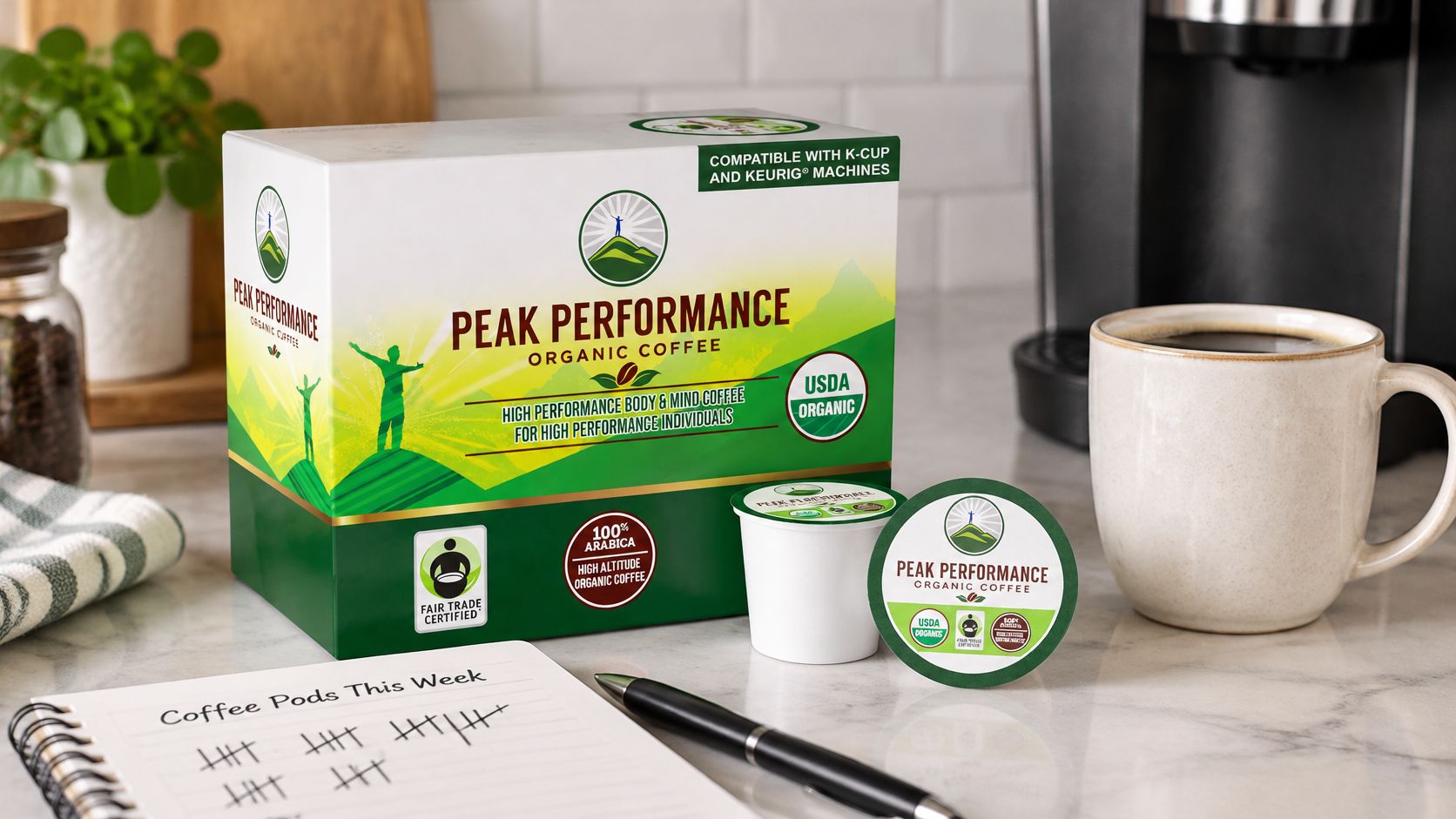
Peak Performance sells USDA organic medium roast K-Cup pods in 24-count and 96-count boxes, which is exactly where those two per-cup figures come from. Sealed pods hold a fixed dose, but an opened box still ages, so the count you buy should match the weeks you'll take to drink it.
Write the price per cup next to the cup size you liked, on the box or in your phone. The next order then repeats a known cup instead of restarting the guesswork, and you'll notice if a larger setting has been making every pod taste thin.
Choose a Pod by Caffeine Dose and Compatibility
Questions about pod safety usually skip caffeine dose. The confirmed factors are brew temperature, contact time, cup materials, serving size and your own caffeine sensitivity. Whether packaging chemicals cross into the coffee remains an open research area rather than a settled finding, and treating it as settled pushes people toward worse decisions, like brewing two pods to get one strong cup.
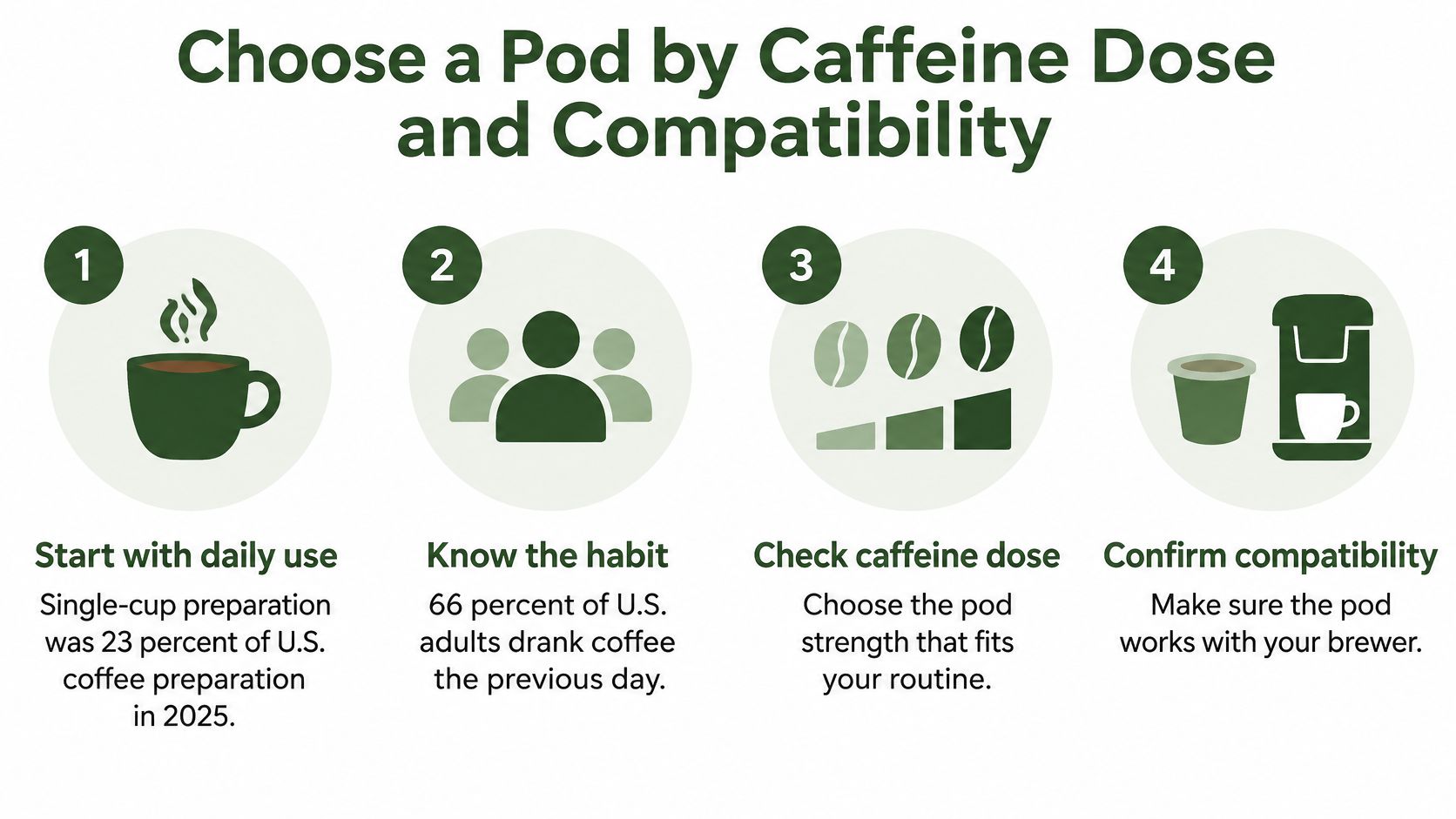
The scale of the habit is the reason this matters. 2025 market data summarized in a packaging and sustainability review puts single-cup preparation at 23% of U.S. coffee preparation, with 66% of U.S. adults reporting coffee the previous day. Pod coffee is a daily habit for a large share of adults, and the dose question repeats every morning.
How to work out caffeine per cup
Roast name is a flavor label. The same review points out the gap: there is no standardized, brand-independent reporting of caffeine per pod, and pod sizes plus strength settings produce materially different servings.
A sealed pod works like a fixed measuring spoon, and your brew size and strength setting decide how that spoonful lands in the cup. Use this method:
- Read the pod label or the roaster's published caffeine figure for one brewed serving. If neither exists, assume a typical cup and adjust from how you feel.
- Count each pod as one serving, then multiply by the pods you brew in a day. A second pod on a strong setting is still a full serving, even if the cup tastes similar to the first.
- Add tea, soda and energy drinks before you judge your total intake, because coffee is rarely the only source.
A strong setting slows the pour so the same grounds yield a bolder cup, and a larger size spreads one pod across more water. Concentration and volume shift between settings; the pod count does not, which makes the count the unit worth tracking. For the longer explanation of how dose accumulates across a day, this piece on caffeine in coffee goes deeper.
Caffeine per cup follows the pod and the setting, not the word "medium" on the box.
A buying sequence that avoids repeats
Work through this once and the next ten orders get easier.
- Confirm the holder type in the brewer manual.
- Read the pod for K-Cup compatibility wording before you look at anything else.
- Prefer verifiable marks. USDA Organic, fair trade certification and a named single origin can be checked against a certificate or a stated farm region. Unverified high-altitude or "healthy" wording on a box cannot.
- Buy decaf for later cups. Removing caffeine from an evening cup removes the dose question with it, and USDA organic decaf pods keep the same compatibility and format as the regular box.
- Check local number 5 acceptance before you trust any recyclable claim on the package. Recyclable is a question your municipality answers, not a label that settles it.
A box that fits this checklist: Peak Performance sells K-Cup pods that are USDA certified organic, fair trade, low acid, single origin, high altitude and medium roast, grown in the Guatemalan Highlands. The company labels the pods 100% recyclable and compatible with K-Cup and Keurig machines, which leaves step 5 as a local question rather than a claim to take on faith.
Run one box before you commit to a larger count. Note the cup size and strength setting that tasted right, then repeat that combination on the next order.
Also in Blog


Synbiotic Explained: Definition, Benefits and Safe Choices


Dandelion Root Extract for Liver: What the Evidence Shows

