


Morning Hydration: Top 10 Grapefruit Seed Extract Benefits
You wake up thirsty, a little sluggish, and unsure whether your usual glass of water is doing much for your digestion. Perhaps you add lemon, sip it while checking your phone, and hope the familiar ritual will help you feel more comfortable and alert.
Grapefruit seed extract, often shortened to GSE, is sometimes added to that first drink as a concentrated botanical supplement. It may fit a carefully planned morning routine, but it isn't a magic digestive reset. Product quality, dilution, medication safety, and realistic expectations matter more than adding drops to water.
The Morning Hydration Upgrade Your Digestion Actually Needs
A better morning habit starts with the basics. Drink water consistently, eat a breakfast that suits your digestion, and add gentle movement before expecting any supplement to transform how you feel. If those foundations are already in place, grapefruit seed extract liquid drops can become a measured addition rather than the centre of the routine.
Consider a typical morning. You wake with a dry mouth, drink water quickly, and feel no immediate change in bloating or sluggishness. Instead of taking a concentrated supplement straight from the bottle, you could dilute the product according to its label and sip it slowly alongside your normal hydration. That approach makes the habit easier to control and gives you a clear way to notice how your body responds.
GSE is often discussed as an antimicrobial botanical, not as a conventional hydration ingredient. That distinction matters. Water supports fluid intake, while GSE may affect microorganisms in laboratory settings depending on the formulation. The two roles shouldn't be confused.
Practical rule: Improve the hydration habit first. Treat GSE as an optional, carefully evaluated addition, not a replacement for water, food, or medical care.
Your wider digestive routine also deserves attention. A fibre-rich breakfast, including foods that provide prebiotic support, may be more useful than continually increasing the amount of any supplement. You can explore the role of organic inulin powder in a fibre-focused routine, but introduce any concentrated fibre gradually and pay attention to bloating or discomfort.
The ten ideas below compare practical ways to use GSE in the morning while keeping its limitations visible. Some involve liquid drops, some involve timing, and others are really about avoiding unnecessary use. The most valuable upgrade may be learning when not to take it.
What Grapefruit Seed Extract Is and How It May Work
Grapefruit seed extract is a concentrated preparation associated with grapefruit material rather than ordinary grapefruit juice. It has a long commercial history, with market availability documented from the 1970s and development tracing to research that began in the late 1940s. A major controversy emerged after a 1991 analysis reportedly identified synthetic preservatives, including methyl p-hydroxybenzoate and triclosan, in a commercial product. HerbalGram's quality-control review describes how those findings changed the debate around what was producing antimicrobial activity in marketed GSE.
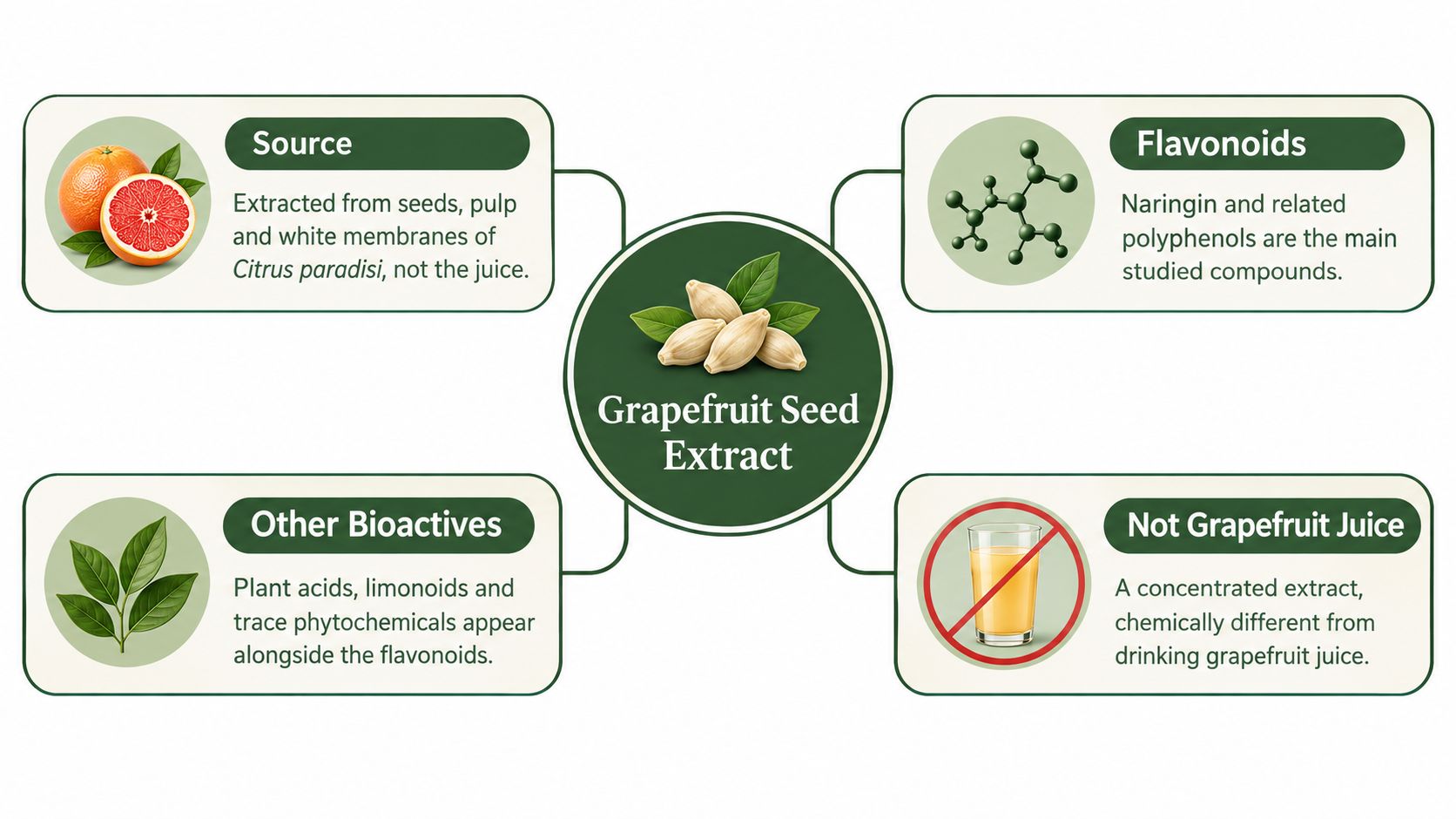
The botanical idea is straightforward. Plant-derived compounds may interact with microbial cells and interfere with growth. In practice, however, a product's observed activity can reflect its entire formulation, including preservatives or disinfectants that aren't part of the grapefruit plant itself. That makes a strong laboratory result difficult to interpret unless researchers verify the product's ingredients and purity.
Why the evidence looks inconsistent
A study of six commercial GSE products found broad growth inhibition against bacteria and yeast in five samples. All five active samples contained benzethonium chloride, while three also contained triclosan and methyl paraben. The only sample without those additives showed no detectable antimicrobial activity. The analysis published in PMC illustrates why “strong antimicrobial activity” doesn't automatically mean “strong activity from pure grapefruit seed extract.”
A later evaluation of three commercial products reported activity against six bacterial strains and one fungal strain, including multidrug-resistant organisms, using several laboratory tests. Other work found no activity in aqueous or ethanolic seed extracts. That later evaluation supports a cautious conclusion: GSE isn't a standardized ingredient, and performance depends on the exact source, concentration, and contamination status.
That variability is the central lesson. GSE may have a plausible antimicrobial role in some applications, but research on one commercial liquid can't be transferred automatically to every capsule or dropper bottle.
Top 10 Ways to Use Grapefruit Seed Extract in Your Morning Routine
These applications aren't interchangeable. Each has a different purpose, and none turns GSE into a guaranteed digestive treatment.
- Dilute liquid drops in water. This is the simplest starting point for someone who already drinks water after waking. Public directions for one commercial product recommend 5–10 drops in 100 ml of water or juice, taken at least 30 minutes before or 2 hours after meals. Follow your own product label rather than copying a dose from another formulation. Review these published dilution directions.
- Use lemon water as the base, not the justification. If lemon water helps you drink more, add GSE only after checking that the combined taste and acidity suit you. Lemon doesn't prove that GSE will improve digestion, and a more complicated drink isn't automatically more effective.
- Try an unsweetened herbal tea. A cooled herbal infusion can be an alternative to plain water or juice. Keep the mixture diluted, avoid hot temperatures if the label gives storage or preparation warnings, and stop if the taste causes nausea or irritation.
- Separate GSE from a probiotic. An antimicrobial supplement and a live-culture product serve different purposes. Rather than taking them together, ask a healthcare professional or follow the product guidance for suitable timing. The practical aim is to avoid treating every digestive concern as a reason to combine multiple products.
- Consider a diluted oral-rinse application only when the label supports it. Never swallow a rinse unless the product is specifically intended for oral use. Avoid using concentrated drops directly in the mouth, and stop if you experience burning, swelling, or sensitivity.
- Keep topical use conservative. A diluted product may be marketed for external applications, but skin tolerance varies. Clean the area first, follow the label, and patch-test cautiously. GSE shouldn't be applied to damaged skin or used as a substitute for treatment of a persistent rash or infection.
- Pair the drink with a gentle breakfast. Oats, fruit, or another fibre-containing meal may support a more sustainable digestive routine than relying on an antimicrobial supplement alone. Start with foods you already tolerate instead of introducing several new ingredients at once.
- Compare it with an apple cider vinegar habit. Both routines involve adding a concentrated ingredient to a drink, but similar preparation doesn't mean similar chemistry or safety. Choose one approach at a time so you can identify what causes discomfort.
- Take it before light movement. A short walk, mobility sequence, or easy stretching session can make the morning feel more structured. GSE won't replace movement, sleep, or adequate food, and there isn't a reason to increase the amount just because you're exercising.
- Use a short, observable trial. Decide what you're evaluating, such as taste, tolerance, or whether the routine is easy to maintain. Don't use vague “detox” language as proof that a product is working, and don't continue if symptoms worsen.
| Application | Typical approach | Best for |
|---|---|---|
| Diluted water | Follow the product label and dilute drops | People who want the simplest routine |
| Lemon water | Add only after establishing tolerance | Those who already enjoy lemon water |
| Herbal tea | Use a cooled, diluted drink | People who dislike plain water |
| Fibre-rich breakfast | Combine hydration with familiar foods | A broader digestion routine |
| Probiotic timing | Keep products separated according to guidance | People already using live cultures |
| Topical or oral use | Only when the label specifically supports it | Product-specific applications, not improvisation |
A more detailed look at grapefruit drops and morning routine ideas can help you compare liquid use with other preparation options. The safest choice is usually the one you can measure, dilute, and stop easily.
Safety, Quality, and Why Product Testing Really Matters
Grapefruit seed extract is a useful example of why “natural” doesn't tell you enough. A product can contain botanical material, added preservatives, or both. If antimicrobial activity comes from an undisclosed synthetic ingredient, a consumer may mistake contamination for evidence that the grapefruit extract itself works.
The quality issue has direct safety implications. A PubMed-indexed analysis of three commercial GSE products found benzethonium chloride in all three and reported no authentic grapefruit seed extract in any sample. The authors concluded that the preservative was likely responsible for an INR increase observed in a warfarin patient after 3 days of use. Read the PubMed-indexed analysis.
What responsible evaluation looks like
Before choosing a product, look for clear information about manufacturing, ingredients, intended use, and testing. A certificate or testing summary should identify what was tested and whether the result relates to identity, contaminants, or potency. “Third-party tested” is useful only when the company explains what that testing covers.
Learn how third-party testing is typically evaluated rather than treating the phrase as a guarantee. You want enough transparency to distinguish a verified formulation from a vague antimicrobial promise.
GSE also deserves medication caution. Grapefruit-derived compounds have recognized interaction potential, and supplement evidence isn't equivalent to evidence from randomized placebo-controlled human trials. If you take prescription medication, especially medication affected by grapefruit interactions, ask a pharmacist or clinician before using GSE.
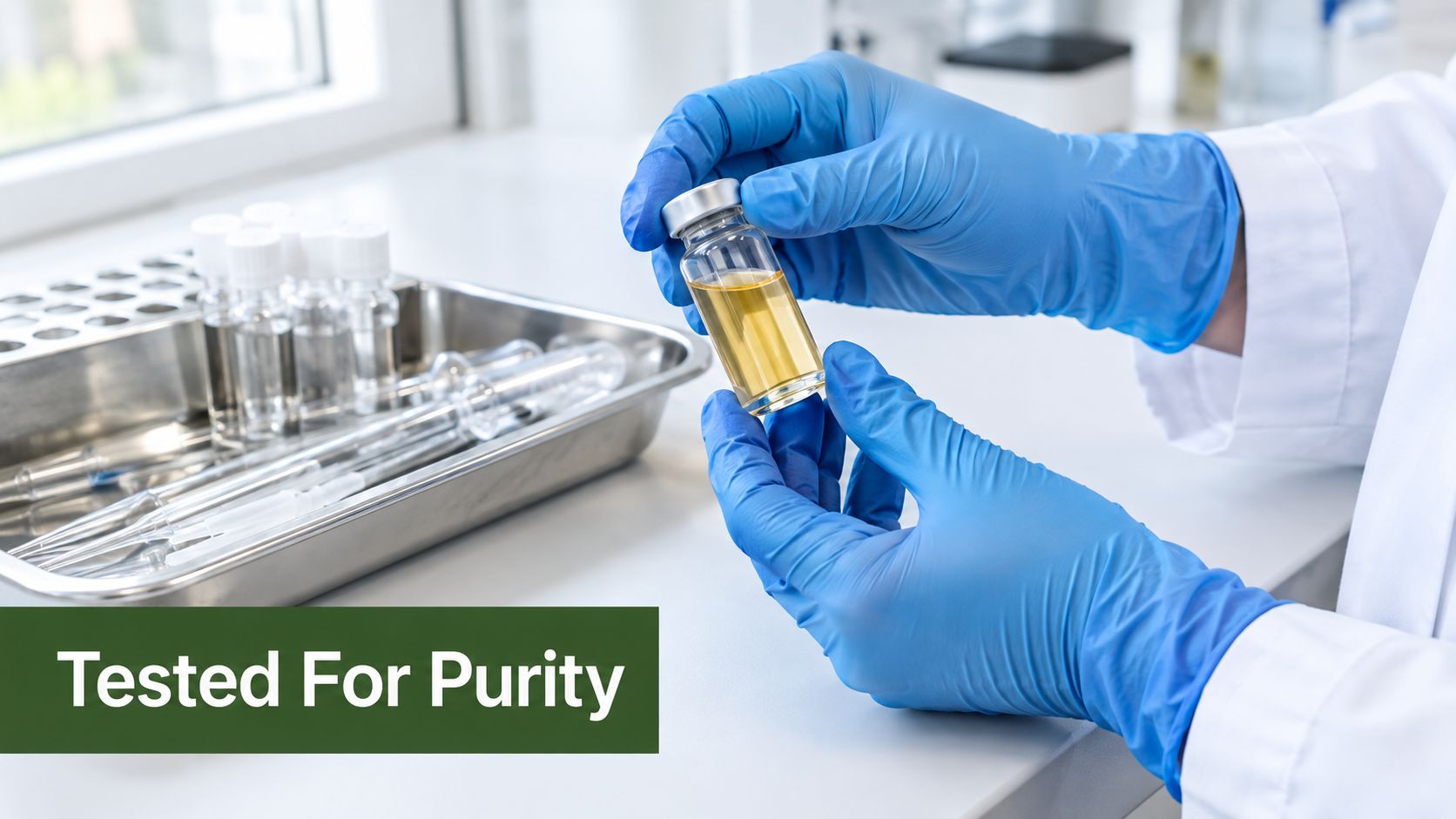
Pure GSE studied for food applications shouldn't be treated as proof that every over-the-counter supplement is suitable for daily ingestion. Industrial preservation research and consumer supplement claims are separate questions. The practical filter is simple: verify the formulation, respect the intended use, and involve a healthcare professional when medication or ongoing symptoms are part of the picture.
How to Choose Safe Grapefruit Seed Extract Products
Start with the label, not the marketing headline. A suitable product should state whether it's intended for oral use, explain dilution, list other ingredients, and provide manufacturing information. If the label makes broad claims while avoiding details about the actual formula, treat that as a reason to keep looking.
A practical buying checklist
- Confirm the format: Liquid drops allow measured dilution, while capsules may be less flexible if you need to adjust or stop quickly.
- Read the directions: Don't assume that a concentrated liquid is safe at full strength. Follow the product's stated preparation method.
- Look for testing detail: Prefer information that identifies the type of purity or contaminant testing performed.
- Check medication risks: Grapefruit-related interaction potential means your pharmacist should review the product if you use medication.
- Avoid unsupported promises: A supplement shouldn't be presented as a cure, a substitute for antibiotics, or a guaranteed solution for bloating.
For a concrete example of a liquid format, review Grapefruit Seed Extract Liquid Drops. The listing describes a drop-based supplement intended for oral use and suitable for mixing into drinks, and it states that the formula is third-party tested for purity and manufactured under GMP regulations. Verify the current label and directions before use, since product information can change.

The right choice isn't the strongest-tasting or most aggressive product. It's the one with understandable instructions, transparent ingredients, and a clear reason for being in your routine.
Putting It All Together for a Smarter Morning Habit
A sensible morning framework has four parts. Drink water first, dilute any GSE according to its label, eat a familiar breakfast, and observe your response without changing several variables at once. If your goal is digestive comfort, track practical signals such as tolerance, regularity, and whether the routine is easy to maintain.
GSE should be optional. Persistent bloating, pain, unexplained bowel changes, or worsening symptoms deserve professional assessment rather than repeated supplement experiments. A morning drink can support a routine, but it can't identify the cause of a medical problem.
Medication review is especially important because grapefruit chemistry can vary between products and grapefruit juice. The FDA GRAS notice for grapefruit extract notes known drug-interaction potential and states that for every one furanocoumarin analyte in GSE, there are at least 1,000 in grapefruit juice or juice fractions. That comparison shows why you shouldn't assume that juice and extract have identical chemistry, or that a supplement is automatically free from interaction concerns.
A useful decision rule: If you can't explain what the product contains, how you'll dilute it, and why you need it, don't add it yet.
Start with one approach, such as diluted drops in your usual morning water, and give yourself a clear reason for trying it. Don't combine it immediately with vinegar, multiple herbs, probiotics, and new fibre products. A disciplined routine produces more useful information than a crowded glass.
If grapefruit seed extract fits your circumstances, use it as a small, measured part of a larger hydration and nutrition pattern. If you're taking medication, pregnant, managing a chronic condition, or dealing with ongoing digestive symptoms, get individual guidance first.
Peak Performance offers Grapefruit Seed Liquid Drops alongside daily supplements and nutrition products designed for practical wellness routines. Visit Peak Performance to review the product details, testing information, and preparation guidance before deciding whether GSE belongs in your morning hydration habit.


