


Quercetin
Quercetin is a plant-derived flavonoid with measurable, dose-responsive absorption in humans. In a controlled study, daily doses of 50, 100, and 150 milligrams raised plasma quercetin concentrations by 178%, 359%, and 570%, respectively, compared with baseline over 2 weeks.
That finding is counterintuitive because higher blood levels don't automatically mean better health outcomes. The study demonstrated absorption, not confirmed disease treatment. Still, it offers a useful starting point for a year-round routine: consistent exposure is more rational than waiting until illness appears and then taking an occasional large dose.
Immune resilience works more like well-maintained infrastructure than an emergency repair. You don't build flood defenses after the water has entered the house. You maintain the system before the storm, using sleep, nourishing food, movement, stress management, and carefully chosen supplements where they fit.
Why Quercetin Belongs in Your Daily Immune Routine
Quercetin works best when you treat it like daily maintenance, not a seasonal rescue. Many people only think about immune support when travel picks up, a sore throat starts, or everyone around them is coughing. That habit makes supplements feel urgent, but immune resilience usually reflects what you do repeatedly, not what you add at the last minute.
A better frame is to place quercetin inside a system. Sleep, regular meals, training you can recover from, stress management, and a plant-rich diet create the conditions immune cells depend on every day. Quercetin can fit into that background much more logically than into a panic response after symptoms appear. The role is modest, but useful. It supports the routine rather than replacing it.
The human trial cited earlier helps explain why consistency matters. In the controlled human study, researchers enrolled healthy volunteers who were not already following unusually high-flavonoid diets, which matters because baseline intake shapes how meaningful a supplement is. The quercetin used was provided in a glycoside form, a detail that helps explain why blood levels rose with daily use. In practical terms, form and repetition both matter. A compound has to be absorbed before it can meaningfully participate in the body's wider signaling environment.
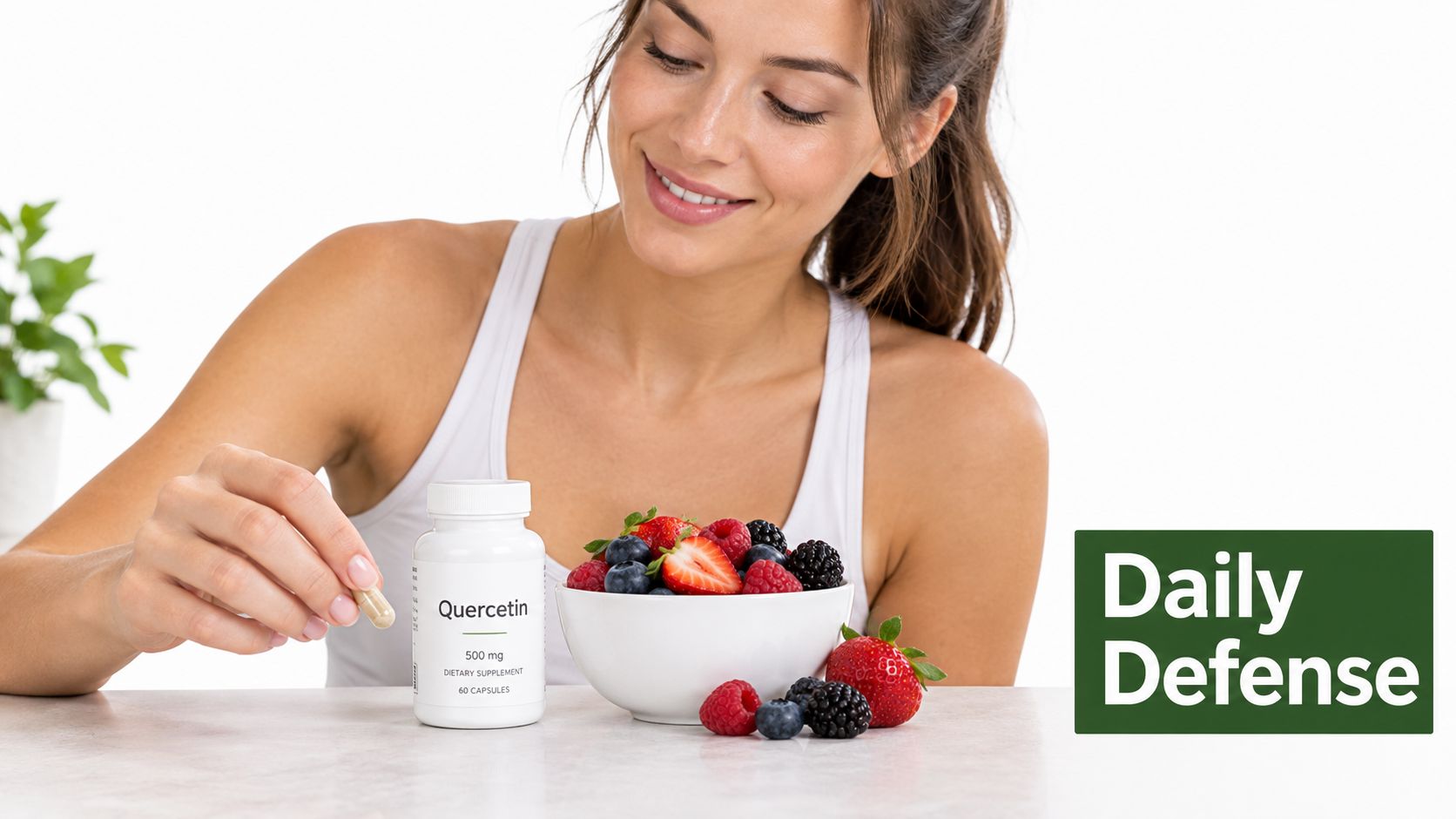
Daily infrastructure beats seasonal panic
This is also where confusion often starts. Absorption is not the same as clinical benefit. A rise in circulating quercetin shows that the body is exposed to it. It does not prove that a supplement will prevent illness, shorten every cold, or cancel out poor sleep, under-fueling, or unmanaged health issues.
That narrower view is more helpful. Quercetin belongs in the same category as other supportive habits that build capacity over time. Infrastructure works like insulation in a house. You notice its value most when conditions get harder, but it only helps if it was already in place.
Research reviews of quercetin in respiratory viral models describe plausible immune-related actions, including effects on inflammatory signaling, antioxidant defenses, viral entry, replication, and clearance, as noted in the academic review discussed later in this article. Plausibility matters, but it is still not a guarantee for healthy people in daily life.
Practical rule: Use quercetin as one steady part of an immune-support routine, then judge it by how well it fits your food, sleep, training, and recovery habits.
For a broader foundation, pair quercetin with the habits outlined in this guide to boosting your immune system naturally.
Understanding Quercetin's Biochemical Foundation
Quercetin matters because it is not just a seasonal add-on. It is a flavonoid family of polyphenols compound that shows up in everyday plant foods, including onions, tea, herbs, fruit skins, and vegetables. Plants use compounds like this as part of their own protection system. In people, that same chemistry helps explain why quercetin fits better into a daily resilience routine than a last-minute response.
Calling quercetin an antioxidant is correct, but it only captures part of the picture. Quercetin works more like a traffic controller, shifting signals that affect oxidative stress, inflammatory tone, and immune-cell behavior. In plain terms, it does more than collide with reactive molecules. It helps influence how cells respond to stress in the first place.
A regulator, not a cure-all
That distinction matters. A compound can look very active in a petri dish and still behave differently in a human body. Quercetin has been studied across respiratory and inflammatory models because it appears to interact with several pathways at once, yet those models often use conditions that do not neatly match what happens after someone swallows a capsule with breakfast.
This is why absorption and metabolism deserve attention at the biochemical level. Quercetin does not circulate as one simple, unchanged molecule for long. Its form, the food it is taken with, and the delivery system all shape how much reaches the bloodstream and in what form. That is one reason labels can be misleading. Total milligrams tell you something, but not the whole story.
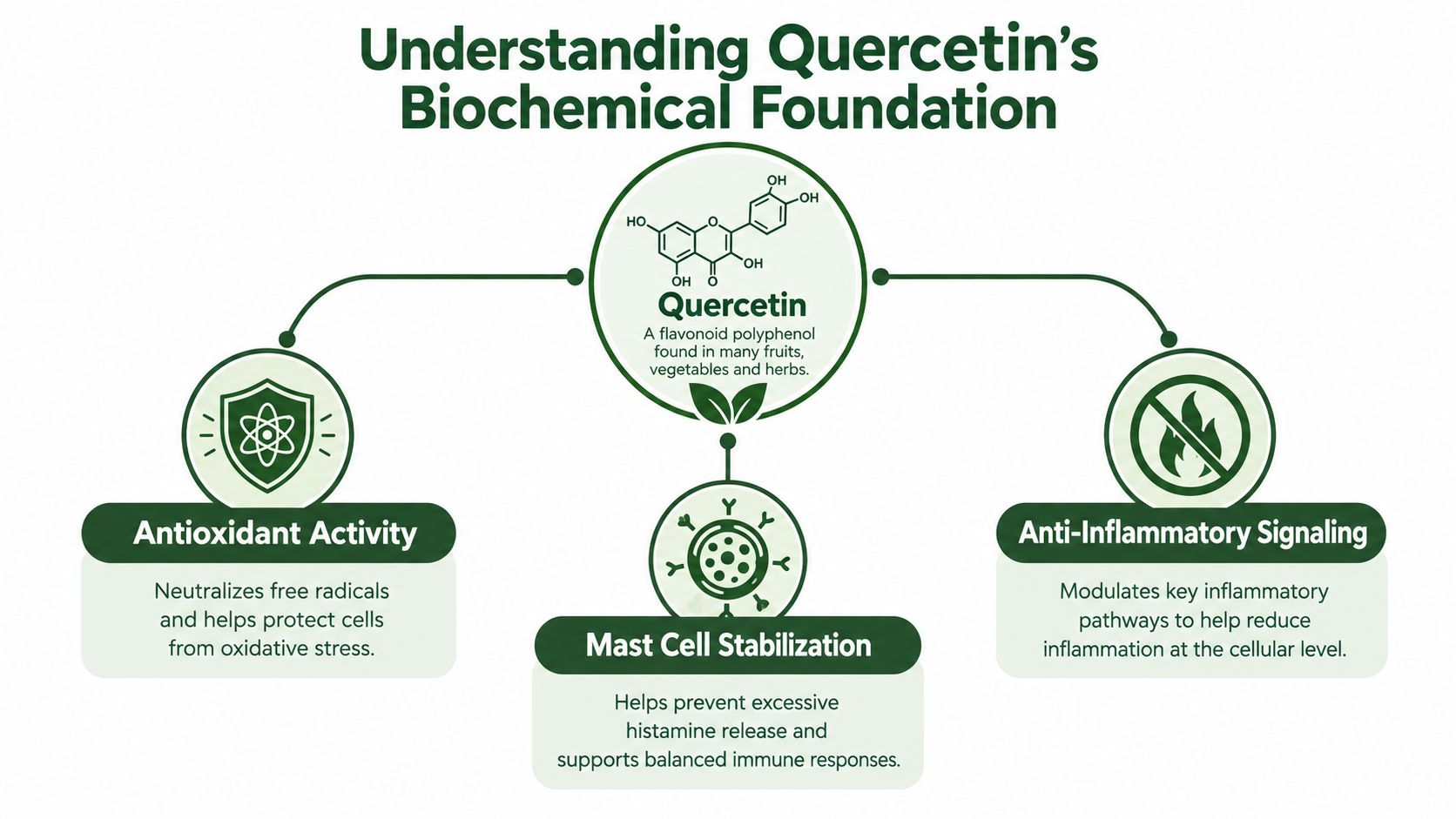
A useful way to read the science is with one foot in biochemistry and one in real life. Mechanistic activity helps explain why researchers keep studying quercetin for immune resilience, respiratory health, inflammation, and recovery. It does not automatically mean broad clinical effects for every person, in every context.
That more grounded view makes quercetin easier to place. It is a biologically interesting plant compound with system-level effects, not a shortcut around sleep, nutrition, or medical care. Readers who want context on similar compounds can compare quercetin with other options in this overview of polyphenol supplements. The practical question is whether the form, routine, and expected outcome fit the person using it.
Evidence-Backed Benefits for Year-Round Immune Resilience
The strongest human evidence for quercetin concerns absorption and exposure, not guaranteed protection from illness. Once that foundation is clear, the potential benefits become easier to categorize without overselling them.
One category involves immune and inflammatory signaling. Quercetin's mechanisms may help explain why researchers study it in respiratory models and allergy-related contexts, but mechanistic evidence remains different from a clinical outcome such as fewer infections, shorter illness, or improved symptoms. A sensible daily routine can include quercetin as one supportive element, while still relying on vaccination where appropriate, hygiene, sleep, nutrition, and medical care.
A second category involves exercise recovery. Numbers can clarify expectations here. A systematic review and meta-analysis of 11 trials involving 254 participants found a statistically significant pooled benefit for endurance capacity and VO₂max, with an effect size of 0.15 and an estimated improvement of approximately 2% versus placebo. The authors classified that result as between trivial and small (exercise meta-analysis on quercetin).
What the evidence supports
That result doesn't justify calling quercetin a reliable performance enhancer. It may be more reasonable to describe it as a possible adjunct for recovery or cellular stress responses, especially for people who already have the fundamentals in place.
- Well established: Human research demonstrates measurable, dose-responsive absorption.
- Moderately plausible: Quercetin's influence on inflammatory and antioxidant signaling supports interest in immune and recovery routines.
- Preliminary: Antiviral effects in respiratory models don't establish infection prevention in healthy people.
- Limited for performance: Exercise findings are inconsistent, and any observed benefit appears modest.
Active adults may find it useful to browse science-backed immune boosters when comparing ingredients and evidence quality. The value of that kind of resource is its context, not a promise that one compound will replace a complete health strategy.
Match the outcome to the evidence
Ask what you're trying to improve. If the goal is measurable blood exposure, formulation research is relevant. If the goal is fewer respiratory infections, the available evidence is less direct. If the goal is better training performance, the human results don't support confident promises.
Quercetin can sit inside a routine that also includes adequate protein, hydration, sleep, and a varied diet. Vitamin C supplementation may be relevant to some people, but combining nutrients shouldn't become an excuse to ignore total dietary quality or professional advice.
Practical Dosing, Timing, and Food Sources
Quercetin works best as a repeatable intake pattern, not a rescue-only habit. The practical question is less “How much can I take?” and more “How do I build steady exposure from food, and when does a supplement add something useful?” That systems view matters because food and supplements do different jobs. Food gives quercetin inside a broader nutrient package. Supplements give a more concentrated and more predictable amount.
A clinical summary of human use reports that many quercetin studies have used about 500 to 1,000 milligrams per day, often split into multiple doses, while also noting that evidence is still limited for precise dosing advice (clinical quercetin dosing and safety summary). That range is better treated as a common research pattern than as a default daily target for every healthy person.
Build exposure through food
Food is the foundation because it turns quercetin into a daily background input rather than an occasional intervention. The amount varies a lot by plant, variety, and preparation, which can make the numbers look confusing at first. The simplest way to read food data is this: some foods are modest contributors you can eat often, while a few are concentrated toppings that can raise intake quickly.
A 2014 review reported about 4.42 milligrams per gram in apples with skin, 3.50 milligrams per gram in raw celery, 4.77 milligrams per gram in raw chives, 19.36 milligrams per gram in cooked onion, and 20.13 milligrams per gram in unsweetened cocoa (review of dietary quercetin sources).
The same review listed about 50.63 milligrams per gram in yellow chili peppers, 55.15 milligrams per gram in dill, and 180.77 milligrams per gram in canned capers. These are concentration figures, not a promise about how much your body absorbs from a normal serving.
Useful habits are straightforward:
- Keep the peel when appropriate: Apples with skin contribute quercetin along with fiber.
- Use onions regularly: Cooked onions are an easy fit for soups, sauces, eggs, grain bowls, and mixed dishes.
- Add herbs and capers: Chives, dill, and capers can noticeably raise the quercetin content of ordinary meals.
- Build variety over time: Green tea, onions, asparagus, green peppers, tomatoes, and other plant foods can all contribute across the week.
Timing and the food matrix
Timing matters because quercetin does not move through the body in isolation. The meal around it can shape exposure, much like the rest of a travel route affects how quickly you reach a destination. Taking quercetin with food is often a sensible default, especially if you are trying to make it part of a consistent routine rather than a sporadic high-dose experiment.
Food and capsules also should not be treated as interchangeable. Whole foods deliver quercetin with other compounds, while supplements use concentrated forms that may behave differently. People who are pregnant, breastfeeding, taking prescription medicines, or managing a medical condition should get professional guidance before using amounts above normal dietary intake.
Formulation Matters, Choosing Quality Quercetin Supplements
A quercetin label can look precise and still tell only part of the story. Two products may list the same milligrams, yet lead to very different blood levels because chemical form and delivery system change how much gets into circulation.
That matters if you want quercetin to function as a steady part of a daily immune routine rather than a supplement you reach for only when symptoms start.
Research comparing forms in humans shows a wide spread in bioavailability. In a review of 31 human studies, quercetin-3-O-oligoglucosides showed approximately 2-fold higher bioavailability than quercetin-3-O-glucoside, about 10-fold higher than quercetin-3-O-rutinoside, and roughly 20-fold higher than quercetin aglycone. The practical lesson is simple. The form on the label can matter as much as the dose itself.
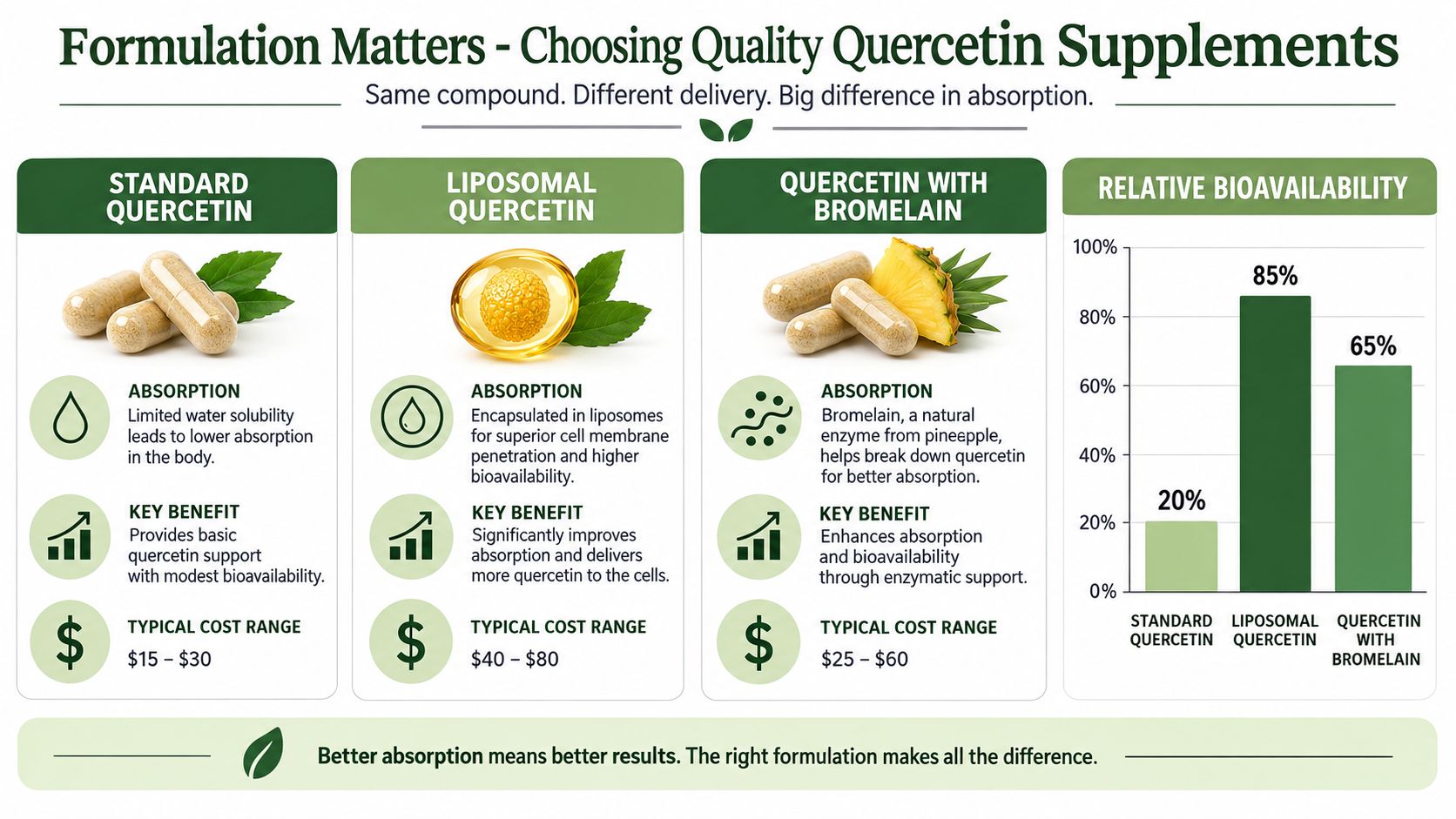
Compare the delivery system, not just the label
Phytosome technology has some of the clearest human pharmacokinetic data. In one study, a 500 milligram dose of Quercetin Phytosome produced a maximum plasma concentration of approximately 223 nanograms per milliliter, about 20 times higher than unformulated quercetin at the same dose. Total exposure, measured by area under the curve, was approximately 18 times greater (human Quercetin Phytosome pharmacokinetic study).
These findings support formulation-focused shopping. They do not mean that higher exposure automatically creates proportionally larger health effects. Absorption is one step in the chain, not the whole outcome.
When you evaluate a supplement, look for:
- Transparent form: The label should state aglycone, glycoside, phytosome, liposomal, or another delivery format.
- Clear quantity: Check quercetin per serving, not just a proprietary blend total.
- Testing information: Prefer products that explain quality control and third-party testing.
- Appropriate directions: Use the product instructions instead of copying a dose from an unrelated study.
- Medical context: Review potential interactions if you take prescription medicines.
Label lesson: Milligrams tell you how much ingredient is present. They do not tell you how much your body will absorb.
A sensible choice balances formulation, transparency, tolerance, cost, and your reason for using it. Advanced delivery can help, but it is not automatically necessary when food intake and daily health habits already give quercetin a solid place in the system.
Integrating Quercetin into Your Peak Performance Routine
Quercetin is usually treated like a seasonal add-on, but it makes more sense as a daily systems habit. The practical goal is not to chase a dramatic effect on the day you feel run down. The goal is to give your routine one more steady input that supports immune resilience alongside food, recovery, and sleep.
Consistency matters here. A regular breakfast can anchor a labeled supplement with a meal that includes some fat and fiber, much like putting a recurring payment on autopay instead of trying to remember it during stressful moments. Sporadic use is easy to start and easy to forget. Daily use fits the way long-term habits typically work.
For active people, the better frame is recovery support. Training stress, hydration, protein intake, and sleep all shape how well you bounce back. Quercetin may fit into that system, but it does not do the whole job by itself.
Choose a role that fits your routine
A simple framework can keep the decision practical:
- Start with food. Include onions, herbs, tea, and fruits with skin regularly, so quercetin is part of your baseline diet.
- Pick the job. Use it for general nutritional support, a formulation-focused absorption strategy, or as one part of an exercise recovery routine.
- Read the label carefully. Check the quercetin form, serving amount, and directions, not just the front-of-package message.
- Review safety in context. As noted earlier, potential interactions include caffeine, cyclosporine, diclofenac, and fexofenadine. Seek guidance during pregnancy or lactation.
- Reassess with realistic expectations. Judge it by whether it fits your daily pattern, not by whether it prevents every cold or changes one workout.
Peak Performance offers Quercetin Phytosome Capsules, which can suit readers who want a phytosome-based option as part of a consistent routine.
For readers comparing broader supplement strategies, browse functional medicine supplements to see how targeted nutrients may fit within individualized care. Peak Performance offers Quercetin Phytosome Capsules alongside other daily nutrition products. Visit Peak Performance to review the product details and choose an approach that supports your broader habits rather than replacing them.


