


Spearmint Capsules: Benefits for Hormonal Balance
Maya keeps noticing the same unsettling pattern. A new line of chin hair. A jawline breakout right before her period. A part in her hair that seems wider than it used to be. None of those changes feel dramatic on their own, but together they can point to a real androgen shift, not just a bad skin week.
That's why spearmint capsules keep coming up in hormone conversations. They're not a cure, and they're not a shortcut around evaluation, but they do sit in a small body of research on androgen-related symptoms, sleep, attention, and short-term tolerability. For readers who want a gentle botanical option while they sort out what's going on, spearmint has become interesting for reasons that go beyond social media buzz.
If you're trying to make sense of your own symptoms, a symptom checklist like Spa Black's overview of hormonal imbalance can help you notice patterns before they get dismissed. For broader lifestyle context, Peak Performance's guide to balancing hormones naturally fits well with the same practical mindset.
When Hormones Tip Out of Balance
Maya's mirror check is the kind of moment that sends a lot of women down a rabbit hole. One week it's a stubborn breakout along the jaw, the next it's tweezing a few more chin hairs than usual, then it's wondering whether the widening part in her hair is just lighting or something deeper. Those are the kinds of changes people often call cosmetic, but they can be the visible edge of androgen excess.
Why the pattern matters
High-androgen symptoms in women often overlap. Acne, hirsutism, scalp thinning, and cycle changes can show up together, and that's why it helps to think in patterns rather than isolated annoyances. Clinical guidance from the Endocrine Society says women with an abnormal hirsutism score should be tested for increased androgen levels, and it advises against antiandrogen monotherapy as initial treatment unless adequate contraception is used because of teratogenic risk. Endocrine Society hirsutism guidance
That matters because visible hair-growth changes aren't just a wellness complaint, they can be a real trigger for hormone testing. AAFP's review adds a hard escalation point, stating that a total testosterone greater than 200 ng/dL (6.94 nmol/L) is indicative of an androgen-secreting tumor, and that rapid onset, virilization, or a palpable abdominal or pelvic mass should prompt a thorough workup. AAFP hirsutism review
Practical rule: if the symptoms are new, progressive, or clustered, they deserve a clinical look, not just another skincare product.
That's where spearmint capsules enter the conversation. They're gaining attention as a gentle botanical lever, especially for people who want to support the conversation around hormones without jumping straight to a stronger intervention. The evidence is still limited, but the pattern is consistent enough to make them worth understanding.
What Spearmint Capsules Actually Are
Spearmint capsules aren't the same thing as spearmint tea bags, and they're definitely not the same as essential oil. A capsule usually contains dried leaf, a standardized extract, or a blend designed to deliver a more consistent dose than steeping leaves in hot water can reliably provide. That difference matters because the clinical research has used specific doses and forms, not vague “mint” products.
The compounds inside the capsule
The herb Mentha spicata contains rosmarinic acid, which is the dominant polyphenol researchers focus on because of its anti-inflammatory and possible anti-androgen activity. It also contains terpenes such as carvone and limonene, plus flavonoids like luteolin and hesperidin. Those compounds are part of why the herb is discussed as more than a flavoring agent.
The proposed mechanisms are still being mapped, but the current thinking is practical enough for readers: spearmint may partly reduce testosterone conversion, it may soften androgen signaling, and it may calm inflammatory pathways that can make skin and cycle symptoms feel louder. That doesn't turn it into a hormone drug. It does help explain why the herb keeps showing up in small clinical trials and not just in kitchen folklore.
Standardization is the key idea. Two products can both say “spearmint,” but the dose of active compounds can still be very different.
That's why label details matter. Whole-herb powders, concentrated extracts, and tea infusions don't behave identically, and the evidence is stronger for the specific protocols used in research than for generic “herbal support” claims.
Five Subtle Signs Your Androgens May Be High
Androgen excess doesn't always announce itself. More often, it leaves a trail of smaller changes that women explain away as stress, age, or bad luck. If you're trying to spot a pattern, these five signs are the ones worth taking seriously.
The signs that tend to get brushed off
Persistent jawline or chin acne often resists the usual topical routine because the driver isn't only surface oil, it can also be hormone signaling.
Gradual facial hair growth on the chin, upper lip, or sideburn area fits the clinical idea of hirsutism, which is often graded on the modified Ferriman-Gallwey scale.
Scalp hair thinning or a widening part can show up when androgens are affecting follicle behavior more than they're affecting skin.
Irregular cycles are another clue, especially if your periods are consistently shorter than 21 days or longer than 35 days.
Unexpected bloating or mood shifts around the cycle can happen alongside hormone fluctuation, even when labs aren't dramatic.
| Sign | What It Looks Like | Typical Threshold |
|---|---|---|
| Jawline acne | Recurrent breakouts along the chin and lower face | Not a lab threshold, but persistence despite basic care is a clue |
| Facial hair growth | Dark hairs on chin, lip, or jawline | Hirsutism is assessed clinically |
| Scalp thinning | Wider part or reduced density at the crown | Not a single cutoff, pattern matters |
| Irregular cycles | Periods shorter than 21 days or longer than 35 days | Cycle spacing outside that range is often evaluated |
| Mood or bloating shifts | Mid-cycle discomfort or emotional swings | Pattern recognition matters more than one-off episodes |
If facial hair removal is becoming part of your routine, a practical explainer like NYC Laser Hair Removal's PCOS facial hair guide can help you understand why the symptom deserves attention.
Clinical note: lab ranges vary by lab, so the pattern of symptoms matters as much as any single number.
Spearmint capsules can be one modest dietary lever while you're doing the essential work of getting evaluated, but they're not a substitute for hormone testing, cycle tracking, or medical care.
What the Research Actually Shows
The human research on spearmint is small, but it isn't empty. The clearest signal comes from androgen-related outcomes, with additional interest in sleep, sustained attention, and working memory from later capsule trials. The main caution is that the studies are short, the samples are small, and the products aren't all the same.
Hormones, hair, and short timelines
A clinical review summarizing spearmint tea trials reports that women drinking spearmint tea twice daily experienced about a 24% reduction in free testosterone and a 29% reduction in total testosterone after one month in one study, while another small trial found about a 30% drop in free testosterone after 30 days. Those numbers matter because they show a real anti-androgen signal, but the protocols were tea-based, not broad capsule use. Spearmint trial review
A 2024 systematic review table notes that one spearmint intervention used standardized dried tea in 2 capsules per day for 30 days and found a reduction in free testosterone from 5.12 ± 2.14 to 3.64 ± 2.67 pg/mL in the treatment group, while total testosterone did not show a significant change overall in the review. That distinction matters, because free testosterone and total testosterone don't always move together. 2024 spearmint review table
Cognition and sleep
A double-blind trial in older adults with age-associated memory impairment enrolled 90 participants, 67% female, with a mean age of 59.4 years. Participants received spearmint extract at 900 mg/day, 600 mg/day, or placebo for 90 days, and the 900 mg/day group improved quality of working memory by 15% and spatial working memory accuracy by 9% versus placebo. That same dose also improved sleep onset, with the outcome reaching statistical significance at p = 0.0046. Age-associated memory impairment trial
A later randomized, double-blind, placebo-controlled parallel trial in healthy adults assigned 142 participants aged 18 to 50 to receive 900 mg/day of proprietary spearmint extract for 90 days. The study reported an 11% increase in sustained attention performance at day 90 compared with baseline, while placebo improved by only 0.6%. Healthy adult attention trial summary
| Study | Dose & Duration | Population | Primary Outcome | Key Result |
|---|---|---|---|---|
| Age-associated memory impairment trial | 900 mg/day, 600 mg/day, or placebo for 90 days | 90 older adults | Working memory and sleep | 900 mg/day improved working memory and sleep onset |
| Healthy adult attention trial | 900 mg/day for 90 days | 142 adults aged 18 to 50 | Sustained attention | 11% increase at day 90 versus 0.6% with placebo |
| Spearmint tea hirsutism studies | Tea twice daily for short protocols | Women with androgen-related symptoms | Testosterone and hair-related outcomes | Free and total testosterone declined in tea-based trials |
The limitation is simple. These studies help explain why spearmint capsules are getting attention, but they don't prove long-term everyday use, and they don't settle digestive or anti-inflammatory claims for capsules the way they do for the short protocols already tested.
How to Take Spearmint Capsules for Best Results
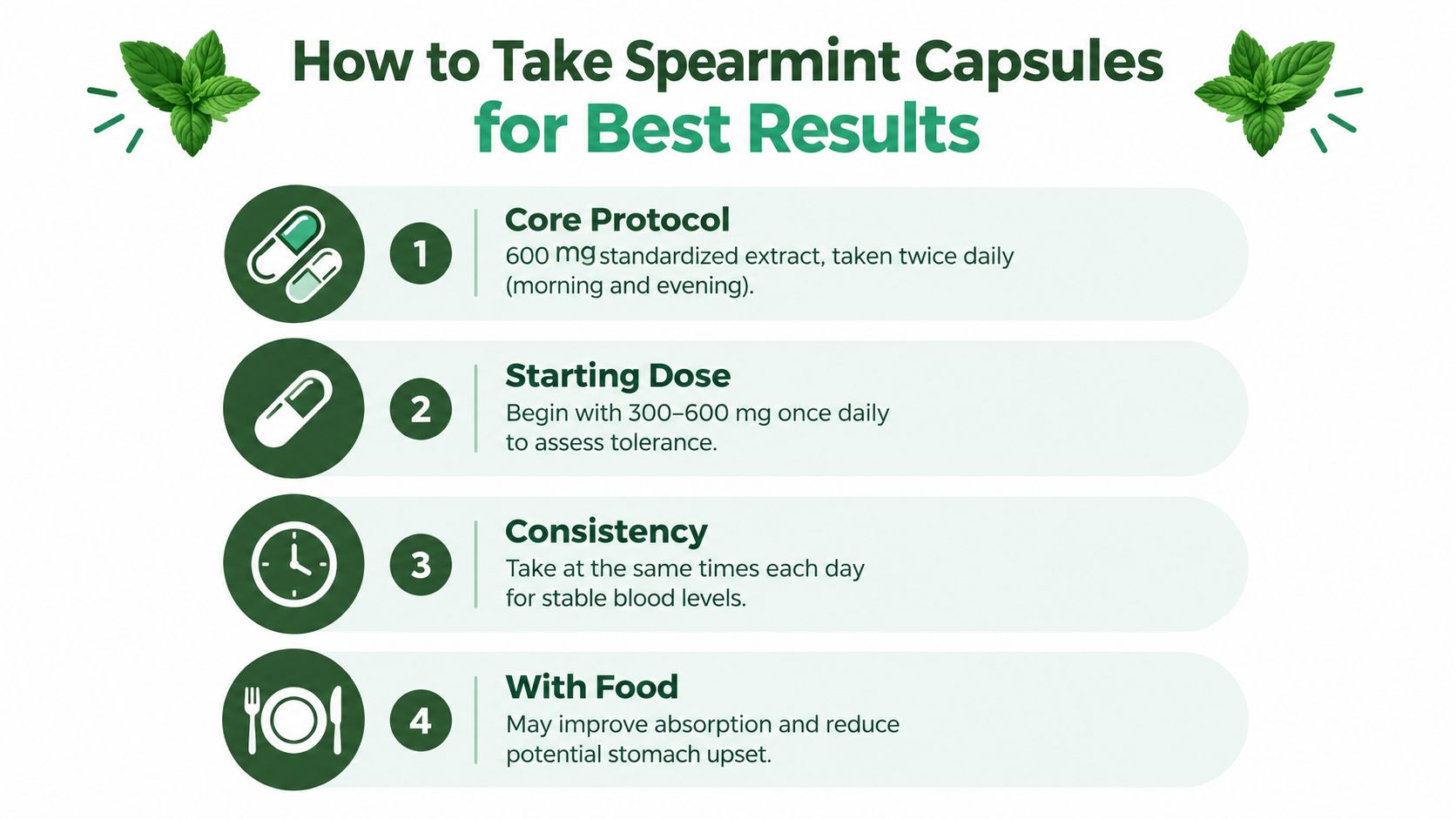
The cleanest way to use spearmint capsules is to match the research as closely as you can. If your goal is hormonal support, 600 mg standardized spearmint extract twice daily is the closest practical match to the published human protocols, while a lower 300 to 600 mg once-daily approach makes sense for people who want to assess tolerance first. The capsule in USDA Organic Spearmint Capsules is an example of the kind of product shoppers look at when they want a concentrated format, but the label still needs to tell you what's inside.
Timing and consistency
Take capsules with food if your stomach is sensitive. That can help reduce nausea and may make the routine easier to stick with, especially if you're already taking other supplements at breakfast or dinner. For people using spearmint for attention or alertness goals, morning timing may feel more intuitive, while evening timing can fit better with a relaxation routine.
Consistency matters more than intensity. A spearmint protocol should be given 8 to 16 weeks before judging whether it's helping, because hormone-related changes rarely show up overnight. If you want a broader timing framework for supplements, Peak Performance's guide to the best time to take vitamins is a useful companion read.
Think in routines, not rescue doses. A herb taken inconsistently rarely tells you much about your response.
Spearmint also pairs sensibly with inositol, zinc, or an adaptogen stack if those are already part of your plan, but that combination should be chosen thoughtfully rather than piled on by default. If you're taking several products, keep the routine simple enough that you can track what changes.
Side Effects, Interactions, and Who Should Skip Them
Herbal doesn't mean consequence-free. Spearmint is generally tolerated in short trials, but that doesn't erase the possibility of side effects or medication interactions, especially when a capsule is more concentrated than a cup of tea.
The caution list
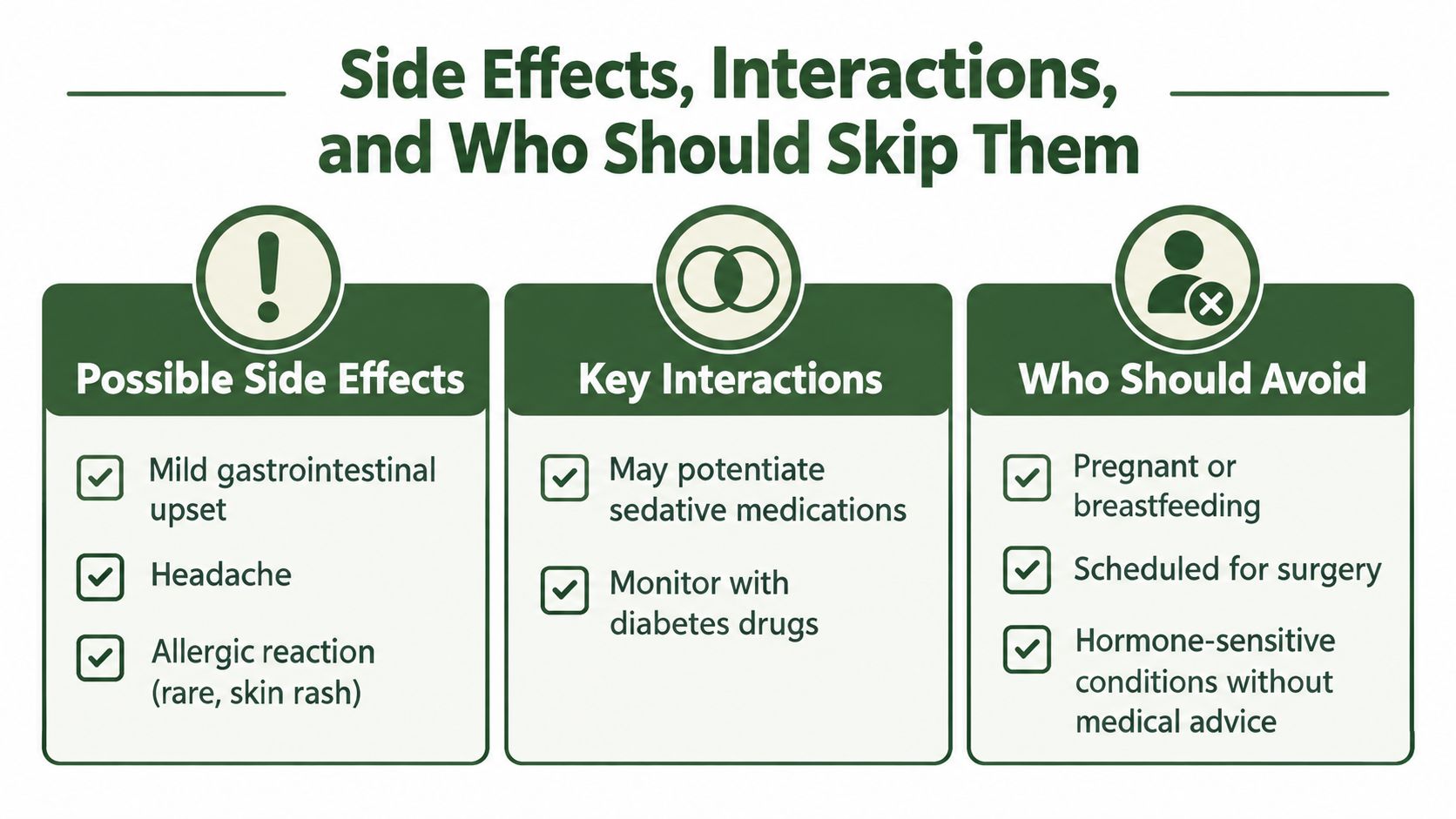
The most common issues are mild gastrointestinal upset, headache, and occasional allergy-type reactions in people sensitive to mint. Patient-oriented safety summaries also note that higher-dose or long-term effects aren't clear, which is one reason concentrated supplements deserve more caution than casual tea drinking. Medical News Today spearmint safety summary
Interactions are mostly theoretical, but they matter. Be careful if you use hormone-sensitive medications, anti-androgen drugs, sedatives, or prescription therapies that depend on liver metabolism. If you're already taking medication for blood sugar, thyroid function, or any chronic condition, a clinician should help you sort out whether spearmint fits.
Who should skip spearmint capsules unless a clinician says otherwise?
- Pregnant or breastfeeding women, because safety data are limited.
- People trying to change androgen levels while using oral contraceptives or hormone replacement, because the combined effect can be hard to predict.
- People with kidney or liver conditions, since concentrated supplements deserve extra caution.
- Anyone preparing for surgery, because supplement use should be reviewed in advance.
- People with known mint allergy or strong sensitivity, because reactions can happen.
If you're thinking of pairing spearmint with prescription anti-androgens, that conversation needs to happen before you start, not after symptoms shift.
How to Choose a Quality Spearmint Capsule
A good spearmint capsule should answer basic questions before you even open the bottle. What plant part is inside, how was it tested, how concentrated is it, and who stands behind it if something feels off? Those details matter more than front-label promises.
A simple shopping checklist
| Quality Criterion | What to Look For | Why It Matters |
|---|---|---|
| Organic certification | USDA Organic or equivalent | Helps reduce concern about synthetic pesticide residues during extraction |
| Third-party testing | Independent lab verification and a current Certificate of Analysis | Confirms identity, potency, and contamination status |
| Form clarity | Standardized extract or clearly labeled whole-herb powder | Predicts how consistent each dose will be |
| Capsule material | Vegetable cellulose or pullulan | Useful for people avoiding gelatin |
| Extraction details | Country of cultivation and extraction method | Gives context for compound profile and quality |
| Brand transparency | Clear ownership, sustainability notes, and responsive support | Helps you judge accountability |
Standardized extracts are easier to dose because they guarantee a specific amount of active compounds, while whole-herb powders preserve the broader plant profile but can vary more from batch to batch. If a brand publishes a QR code that links to a current Certificate of Analysis, that's a stronger sign than a vague quality claim.
Shopping rule: if the label is vague, the product probably is too.
Look for brands that explain harvest season and extraction method, since those details can affect the final compound profile. That's the kind of transparency Peak Performance's third-party testing guide encourages shoppers to look for across supplements, not just spearmint. The point is to buy a product you can evaluate, not one you have to trust on faith.
Making Spearmint Capsules Work for You
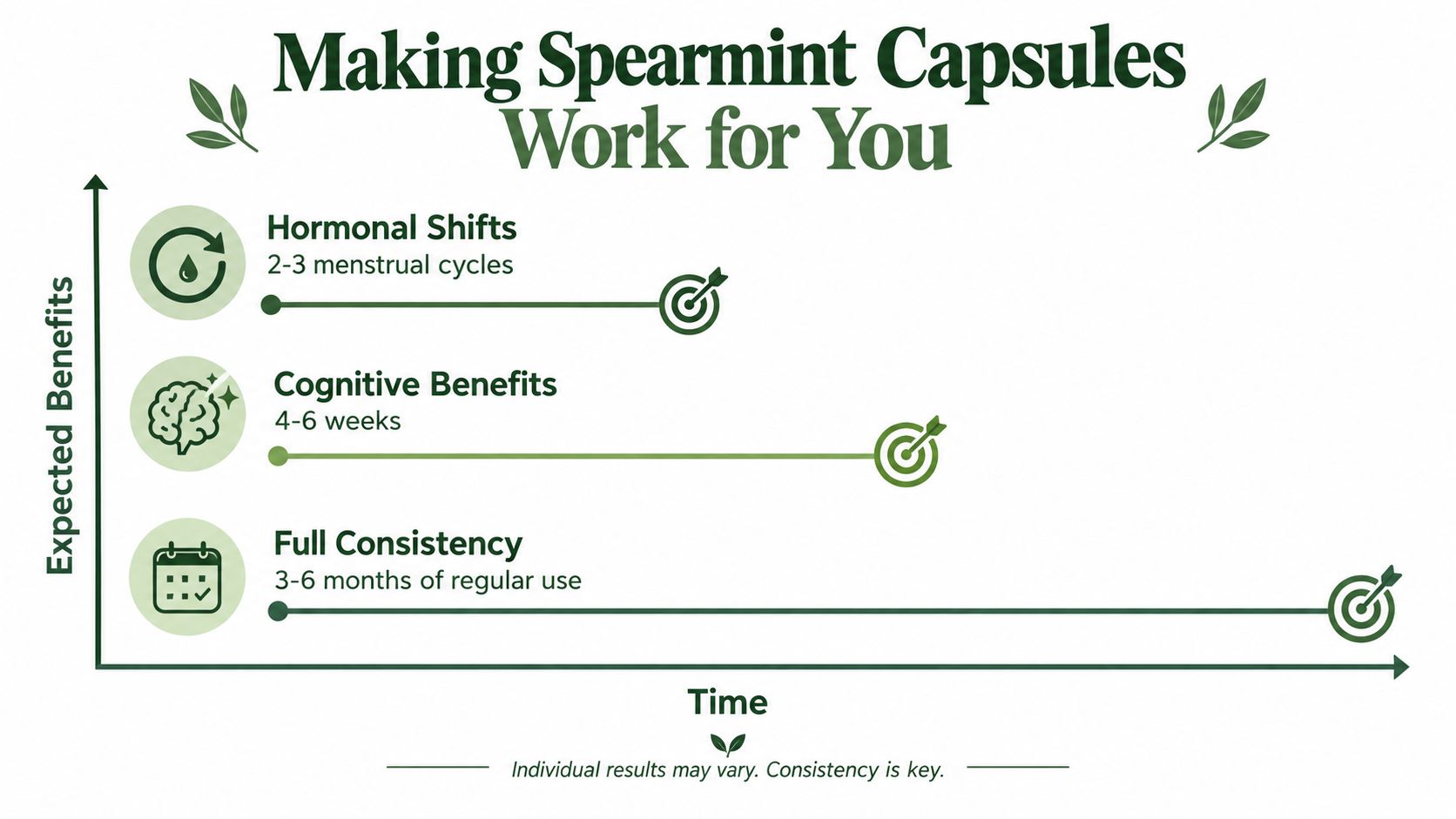
The most realistic way to use spearmint capsules is as a measured experiment. If your symptoms are mild to moderate, you want a lower-intervention option, and you can commit to daily use, the herb may be worth trying for a full 90 days. If your symptoms are severe, rapidly changing, or paired with cycle disruption, get the hormone workup first.
What to watch and when to stop
Track five things in a simple journal: skin clarity, facial hair changes, scalp shedding, cycle regularity, and focus or sleep quality. Hormonal shifts usually take 2 to 3 menstrual cycles, while cognitive benefits may show up within 4 to 6 weeks, and that aligns with the short-term research on sleep and attention. A quick note after each week makes patterns easier to see than memory does.
Stop and seek evaluation if you notice irregular bleeding, persistent stomach upset, allergic skin reactions, or mood changes that feel new or intense. If you take prescription anti-androgens, thyroid medication, blood thinners, or chemotherapy agents, get medical guidance before combining anything, because supplement interactions can change how medications behave.
A sensible default is simple: use spearmint capsules alongside sleep hygiene, resistance training, stress management, and a nutrient-dense diet, then reassess at the three-month mark. If the symptoms ease, you've learned something useful. If they don't, that's a sign to move from self-experimentation to a more complete medical conversation.
Peak Performance offers USDA Organic Spearmint Capsules as part of its supplement line, and that can be a practical starting point if you're comparing capsule formats for hormone-related routines. If you want to check the product details, then explore how it fits into your own symptom pattern, visit Peak Performance and read the label with the same care you'd bring to any supplement decision.


