


Top 10 Functional Mushrooms Explained: Turkey Tail
Turkey Tail is the only functional mushroom in this group approved as a prescription drug adjuvant in Japan for cancer therapy, and that makes it the most clinically validated option for immune support. Its purified extract PSK has been used in oncology for decades, while many other functional mushrooms are still discussed mainly through wellness claims.
When people compare Lion's Mane, Reishi, Cordyceps, and Turkey Tail, they're usually comparing four very different jobs. The mistake is treating them like interchangeable “immune boosters” when the evidence points to a far narrower, more practical answer.
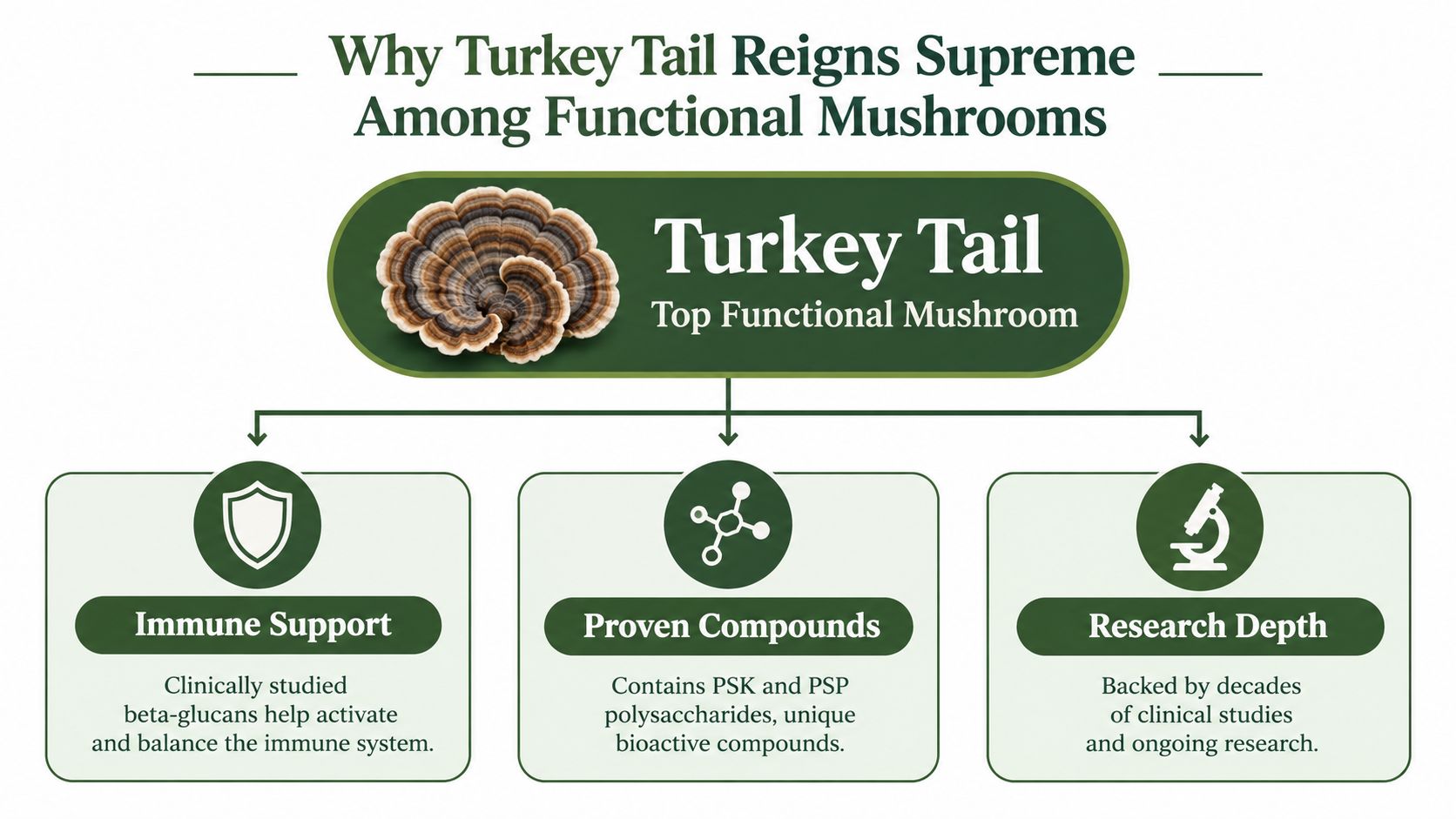
Why Turkey Tail Reigns Supreme Among Functional Mushrooms
Turkey Tail has a different clinical profile from the rest of the functional mushroom aisle. Lion's Mane gets attention for cognitive support, Reishi for relaxation, Cordyceps for performance, and Turkey Tail for immune modulation. Those categories matter, because the right mushroom depends on the outcome you want, not on which one sounds the most impressive.
What sets Turkey Tail apart is its long bridge between traditional use and formal medical study. It has been consumed in China for thousands of years under the name Yunzhi, and modern clinical documentation of purified extracts began around 1970, when PSK research intensified in Japan. PSK was approved in Japan in 1977 as an adjuvant cancer therapy, and a major evidence base has since grown around it, including more than 400 published studies on PSK-related anticancer research. ^1
Turkey Tail also stands out because the strongest human evidence centers on a standardized extract, not a loose wellness trend. That matters to readers trying to separate biology from branding. If you're comparing mushrooms for immune support, you want the one with the clearest clinical story, not the one with the loudest marketing.
Practical rule: when a mushroom's evidence comes from standardized extracts, the product form matters as much as the species name.
For a broader seasonal lens on resilient habits, winter wellness from Healtsy is a useful read alongside a Turkey Tail routine. The same principle applies in both places, the tool only works well when the use case matches the evidence.
Identifying Turkey Tail Mushroom and Understanding Its Biology
Turkey Tail gets its name from the fan-shaped caps that resemble the layered feathers of a wild turkey. In the forest, it grows as a bracket fungus on hardwood logs and fallen trees, usually with concentric bands of blue, green, orange, and brown. It looks decorative, but its real value lies in the chemistry inside the fruiting body.
Why the mushroom form matters
A useful analogy is an apple. Grinding up the whole apple gives you fiber, sugar, and skin, but it does not selectively concentrate the compounds you'd want if you were after a very specific effect. Extraction works more like pressing and refining the parts that are most relevant, and with Turkey Tail that means pulling out polysaccharides such as PSK and PSP.
That distinction is why whole-mushroom powders and extracted supplements are not interchangeable. The mushroom contains high-molecular-weight immunomodulatory polysaccharides, and the activity is generally attributed to beta-glucans that work on innate immune pathways rather than functioning like ordinary dietary fiber. In practice, that means the label has to tell you what kind of product you're buying, or you're guessing.
Simple takeaway: the species name tells you what the mushroom is, but the extract process tells you what you're likely getting.
If you're curious about the grower's side of the equation, practical mushroom growing advice can help you see why substrate, moisture, and identification all matter before a mushroom ever becomes a supplement. Turkey Tail's biology is one reason the species attracts so much attention, because the compounds in research-grade preparations aren't random plant-like fibers, they're structured polysaccharides tied to immune signaling.
The point for consumers is simple. Turkey Tail isn't special because it looks like a fan. It's special because that fan-shaped fungus contains the kind of compounds that have been studied far more extensively than the average “functional mushroom” product.
Comparing Top Functional Mushrooms by Primary Benefit
The smartest way to compare mushrooms is by primary job, not by popularity. A person looking for focus, sleep support, workout stamina, or immune support shouldn't be pushed into the same bottle for every concern. The evidence-based choice starts with the outcome.
Ranked by primary clinical evidence
| Mushroom | Primary Benefit | Evidence Strength | Best For |
|---|---|---|---|
| Turkey Tail | Immune modulation, oncology adjunct context | Strongest clinical recognition in this group | People prioritizing immune support and standardized extracts |
| Lion's Mane | Cognitive support | Promising, but different use case | Focus, mental clarity, nerve-support conversations |
| Reishi | Stress and relaxation support | Commonly used, more wellness oriented | Evening routines and calming rituals |
| Cordyceps | Energy and exercise performance | Popular in athletic settings | Physical output and endurance-focused users |
| Chaga | Antioxidant-oriented wellness | Often discussed broadly | General wellness, not a targeted immune strategy |
Turkey Tail ranks first here because its evidence is tied to immune regulation in human oncology settings, not only to generalized “wellness.” That makes it easier to match to a clear use case. Lion's Mane, Reishi, Cordyceps, and Chaga may each have a place, but they're solving different problems.
The confusion usually starts when people assume “functional mushroom” means one category with one purpose. It doesn't. A mushroom that supports calm before bed is not automatically the right mushroom for immune modulation, and a performance mushroom doesn't substitute for a standardized oncology adjunct history.
Decision rule: choose the mushroom that matches the job, not the trend.
Once you view the market this way, the ranking gets easier to understand. Turkey Tail doesn't need to claim every benefit to deserve the top spot for immune support. It just needs to be the mushroom with the clearest, most medically relevant evidence in that lane.
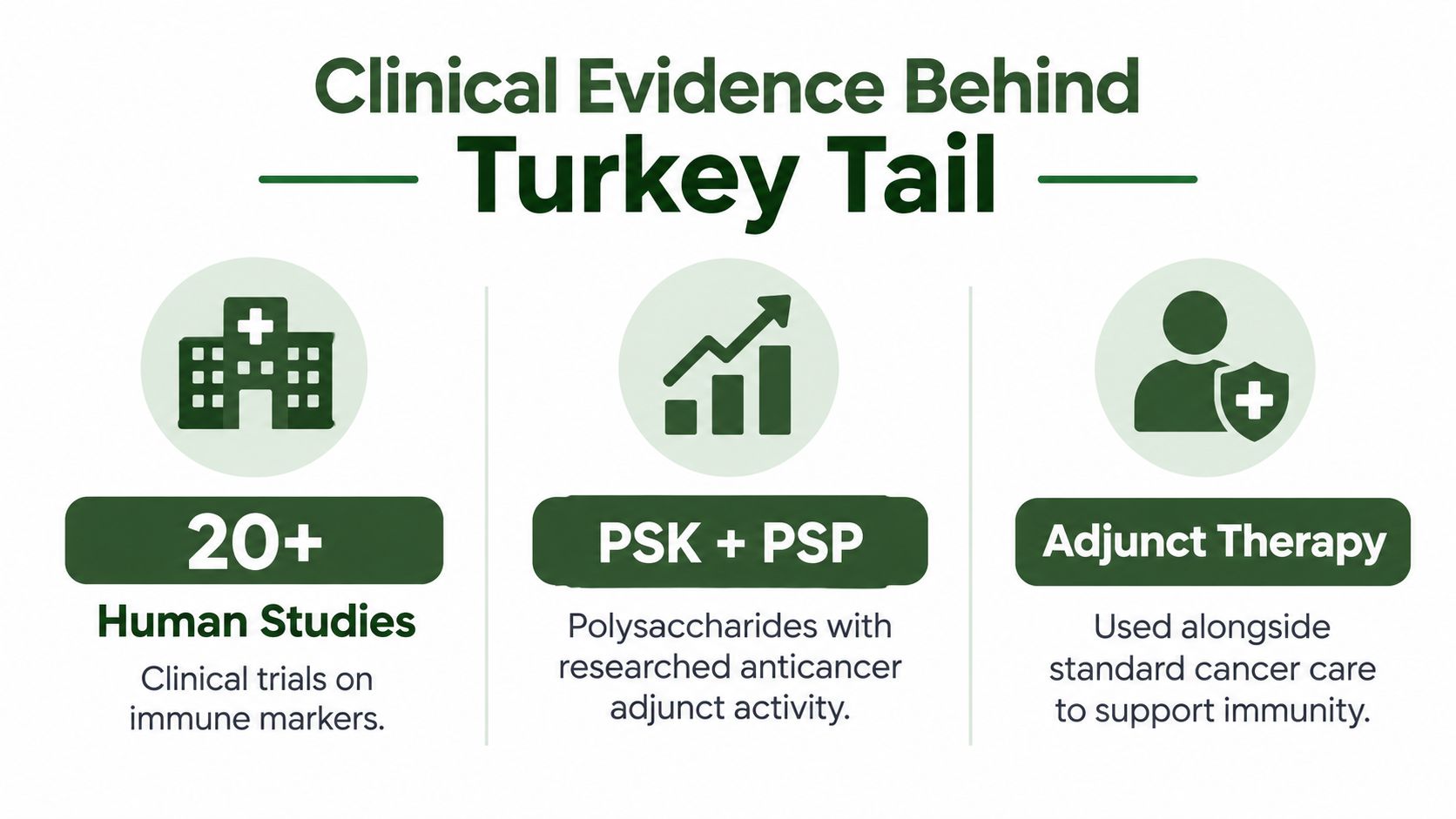
Clinical Evidence Behind Turkey Tail for Immune Support and Cancer Adjunct Therapy
Turkey Tail's strongest human evidence comes from purified extracts, especially PSK, used alongside standard care. In a meta-analysis of gastric cancer studies, adding PSK to chemotherapy was linked with a lower risk of death. Another meta-analysis in colorectal cancer reported improved overall survival and better disease-free survival. ^2
The key word is adjunct. These findings do not support raw Turkey Tail powder as a stand-alone cancer treatment. They point to a narrower setting, a standardized extract used with conventional care, where the research signal is stronger than the usual supplement claim.
What the human data actually suggests
NIH literature summarized a study in stage II/III colorectal cancer that reported a higher 5-year survival rate in the PSK group than in controls, with PSK given at 3 g/day for 2 years. A phase I breast-cancer trial found Turkey Tail extract was well tolerated at 6 g or 9 g daily and was associated with increases in CD8+ T cells and CD19+ B cells. ^4
That pattern matters. The evidence is strongest when the extract is standardized and studied in a medical context, the way a calibrated instrument gives a clearer reading than a rough estimate. Broad claims about “boosting immunity” for everyone go beyond what these studies show.
The National Cancer Institute notes that the FDA has not approved Turkey Tail or PSK for cancer or any other condition, which keeps the evidence in proper perspective. ^2
For readers trying to support immune health beyond supplements, our guide on how to improve the immune system adds practical context around sleep, diet, and daily habits.
How to Choose Quality Turkey Tail Supplements and Avoid Common Mistakes
Not every Turkey Tail product is built the same. The biggest mistake is buying something because the front label says “mushroom” while the back panel hides the details that matter most. If the goal is to align with the research, the product has to resemble the extracts used in that research.
What to check on the label
- Dual extraction: water and alcohol extraction help capture a broader range of compounds than one method alone.
- Standardized beta-glucans: the label should make clear what active compounds are being measured, not just list a mushroom name.
- Third-party testing: purity screening matters because consumers need confidence in identity and contaminant control.
- Avoid unnecessary fillers: extra additives can dilute the actual mushroom content.
That's why standardized products are more predictable than vague blends. A capsule that lists only “Turkey Tail powder” may be fine for a general wellness routine, but it isn't the same as a research-aligned extract. The difference is similar to comparing loose tea leaves with a lab-standardized infusion, both are tea, but only one has a controlled concentration.
If you're reading labels for supplements in general, the mushroom supplement benefits page from Hemp Well Ireland is a helpful way to think about category differences without assuming every mushroom product does the same thing. For more shopping discipline, best functional mushroom supplements can be used as a framework for evaluating what belongs in the bottle and what doesn't.
Peak Performance's Organic Turkey Tail Capsules are one example of a product page that puts the species front and center, and that's the kind of clarity consumers should expect from any brand. The point isn't to chase the prettiest label, it's to check whether the formulation fits the evidence.
Buyer check: if the label won't tell you how the extract was made, it's harder to trust the result.
Safe Usage Guidelines and Practical Ways to Incorporate Turkey Tail
Turkey Tail is generally well tolerated, but “generally” is not the same as “for everyone.” People with autoimmune conditions, those on chemotherapy or immunotherapy, anyone taking blood-thinning medication, and pregnant or breastfeeding women should talk with a clinician before using it. Immune-active compounds can be useful, but they also deserve respect when someone's medical situation is already complex.
A practical starting point is consistency. In research settings, Turkey Tail extract has often been used in the one to three grams daily range, though consumer products vary, so the label matters more than the species name alone. If someone is trying a new supplement, a slow, steady routine is easier to evaluate than sporadic use.
Easy ways people use it
- Capsules with breakfast: simple for people who want a no-mess routine.
- Powder in coffee or smoothies: useful when taste isn't a barrier.
- Added to broth or soup: a comfortable option for people who prefer a food-based habit.
For people who like a blended ritual, mushroom coffee can be an easy way to build repetition into the day, especially if the goal is habit adherence rather than novelty. The same logic applies to any functional mushroom routine, keep the form convenient enough that you can maintain it.
Turkey Tail is not a magic shield, and it doesn't need to be. It's better understood as a well-studied immune-focused mushroom with a specific clinical lane, a clear product-quality requirement, and a strong case for standardized use when people are looking beyond general wellness language.
If you want a Turkey Tail product that fits a more evidence-aware routine, visit Peak Performance and review their Organic Turkey Tail Capsules alongside their other mushroom-based options. Choose the format that matches your goals, then keep the routine simple enough to stick with it.


