


What Is Dihydroberberine and Why It Works
If you’ve heard of berberine, you probably know it’s an ancient compound with deep roots in traditional medicine. But let's be honest, it has a major drawback. Think of standard berberine as an old, finicky key—it sort of fits the lock, but you have to jiggle it just right, and even then, it doesn't always work.
Dihydroberberine is the modern, high-tech version of that key. It’s creating a ton of buzz for one simple reason: superior bioavailability. In plain English, your body can actually absorb and use it.
Unlocking a More Powerful Form of Berberine
For centuries, berberine has been pulled from plants like goldenseal and barberry, valued for its support of metabolic health. But it has always had an Achilles' heel: your body just doesn't absorb it very well. Most of it never makes it into your bloodstream, which severely limits its potential.
Dihydroberberine is the elegant, scientific solution to this very problem. It's what's known as a metabolite of berberine—it’s the form your gut naturally converts berberine into after you take it. By starting with dihydroberberine, you're essentially giving your body a shortcut, bypassing that inefficient conversion process and allowing for dramatically better absorption.
Why Enhanced Absorption Matters
This isn’t just some minor tweak; it's a total game-changer for how well the compound works. Because dihydroberberine gets into your system so much more effectively, it delivers more consistent and powerful benefits.
This translates into some pretty significant advantages that have caught the eye of both health enthusiasts and researchers:
- Greater Potency: You can get better results while taking a much smaller dose. No more megadosing.
- Fewer Side Effects: Let's face it, the high doses of standard berberine often lead to digestive issues. With dihydroberberine's lower, more efficient dose, that problem is far less common.
- More Reliable Results: Stable levels of the compound in your bloodstream mean more predictable support for your metabolic health goals.
This isn't just anecdotal buzz. The market is reflecting a clear shift. The global demand for berberine-related compounds, especially the more effective dihydroberberine, was valued at $1.67 billion in 2023. It’s projected to explode to $4.22 billion by 2033. This kind of growth shows that people are actively seeking out natural supplements that are backed by real, measurable science. You can dig into these market trends to see how consumer demand is driving innovation.
To put it all in perspective, here’s a quick side-by-side look at why this upgraded form is gaining so much ground.
Quick Look: Dihydroberberine vs. Standard Berberine
This table breaks down the essential differences at a glance. It really highlights why so many people are making the switch.
| Attribute | Standard Berberine | Dihydroberberine |
|---|---|---|
| Bioavailability | Low and often unpredictable | Up to 5x higher and more stable |
| Typical Dosage | High (often 1500mg/day) | Low (e.g., 200-400mg/day) |
| GI Side Effects | Common (bloating, cramping) | Minimal to rare |
As you can see, dihydroberberine offers a more efficient, comfortable, and reliable way to get the benefits of berberine without the common downsides.
The Science of Superior Absorption
So, why is dihydroberberine getting all the attention when its predecessor, berberine, has been around for ages? The answer is a simple, yet brilliant, scientific tweak that solves one major problem.
Imagine trying to get a large, awkwardly shaped package through a small mail slot. That's standard berberine. The package holds valuable stuff, but most of it just won’t fit, so it never gets delivered. Your gut has a similar problem with berberine.
Dihydroberberine, on the other hand, is like taking that same package and breaking it down into small, perfectly sized components that slide right through the slot with zero effort. It’s built for express delivery straight into your system.
The fundamental issue with standard berberine has always been its terrible bioavailability. Before your body can even think about using it, your gut bacteria have to work hard to convert it into dihydroberberine first. This conversion is often slow, inefficient, and depends entirely on the health and composition of your unique gut microbiome. For many people, it just doesn't work well.
Dihydroberberine completely sidesteps this biological bottleneck. It’s already in that pre-converted, absorbable form, allowing it to pass directly through the intestinal wall and into your bloodstream with incredible efficiency.
Bypassing the Biological Roadblocks
Once it's safely inside the intestinal tissue, something pretty cool happens. Your body quickly and easily converts the dihydroberberine back into its active berberine form. Think of it like a "Trojan Horse"—it sneaks past the gates in a disguise and then reveals its true, powerful form once inside. This trick ensures a much higher, more stable concentration of berberine actually reaches your cells where it can do its job.
And we’re not talking about a minor tweak here. This is a massive leap forward. Research comparing the two forms found that dihydroberberine achieved plasma concentrations approximately five times higher than the same dose of standard berberine. What that means for you is getting far better results with a much smaller, more comfortable dose.
This superior absorption is precisely why dihydroberberine is making waves in modern health. While berberine has a long, respected history in traditional medicine, this refined version is gaining serious attention for its enhanced power in supporting metabolic health, especially for regulating blood glucose and lipids. Its improved bioavailability has also sparked significant global interest in developing more effective health products.
This advanced delivery system really boils down to a few key advantages:
- Greater Potency: More of the active compound gets to where it needs to go.
- Increased Reliability: The effects are far more predictable and don't depend on the whims of your gut flora.
- Improved Comfort: Smaller doses mean you can finally avoid the digestive upset that often comes with high-dose standard berberine.
Ultimately, the science behind dihydroberberine takes a historically powerful but clunky compound and transforms it into a modern, reliable, and highly effective tool for anyone serious about their metabolic health.
Key Health Benefits of Dihydroberberine

The superior absorption of dihydroberberine isn't just a neat scientific fact—it's what unlocks its most powerful health benefits. Since your body can put it to use so much more effectively, this upgraded compound becomes a dependable partner for your metabolic wellness, especially in how your body manages and uses energy.
Its biggest strength is in supporting healthy blood sugar levels. You can think of dihydroberberine as an intelligent traffic controller for glucose. It directs sugar out of your bloodstream and into your cells where it belongs, turning it into fuel and preventing the biological equivalent of a traffic jam.
How does it do this? By flipping a switch on a critical enzyme called AMP-activated protein kinase (AMPK). When AMPK is active, it tells your body to dial up its insulin sensitivity and dial down the amount of glucose your liver produces.
Mastering Metabolic Control
The effect of this metabolic fine-tuning is pretty profound. For anyone working to keep their blood sugar in a healthy range, dihydroberberine offers steady, reliable support. By making your cells more responsive to insulin, it helps your body manage glucose more efficiently all on its own.
This improved efficiency is a game-changer. Better insulin sensitivity means your body doesn’t have to work nearly as hard to keep blood sugar stable, which is a cornerstone of long-term metabolic health.
But it’s not just about sugar. This effect also ripples out to how your body handles fats. Dihydroberberine’s influence over AMPK helps regulate fat storage and breakdown, a crucial piece of the puzzle for healthy weight management.
On top of that, its metabolic support extends to a powerful peptide hormone known as glucagon-like peptide-1 (GLP-1). Research has shown that dihydroberberine can naturally increase GLP-1 levels, a key messenger that helps regulate both appetite and blood sugar.
Supporting a Healthy Heart and Lipid Profile
The benefits don't stop at blood sugar. Dihydroberberine also directly supports your cardiovascular wellness. A healthy heart relies on keeping your lipids—cholesterol and triglycerides—in check, and this is another area where dihydroberberine really delivers.
Studies show it can make a real difference for key lipid markers:
- Lowering LDL Cholesterol: Often called "bad" cholesterol, high LDL is known to contribute to plaque buildup in the arteries. Dihydroberberine helps keep LDL levels in a healthy range.
- Reducing Triglycerides: These are fats circulating in your blood. When elevated, they become a risk factor for heart problems. Research shows its use can lead to a significant drop in triglyceride levels.
- Improving Total Cholesterol: By tackling both LDL and triglycerides, it helps you maintain a healthier overall cholesterol profile, which is vital for clear arteries and good circulation.
By addressing both glucose and lipid management, dihydroberberine offers well-rounded support for your entire metabolic system. To see just how potent this ingredient can be, you might be interested in the ingredient that increased plasma berberine levels by over 450% compared to its standard form, which is what leads to these incredible effects. Its ability to work on so many fronts makes it a standout choice for anyone taking a proactive approach to their long-term wellness.
Dihydroberberine vs. Berberine: A Detailed Comparison
So, you’re looking at berberine and its newer, souped-up cousin, dihydroberberine. It can be a little confusing. They both come from the same place and target the same health goals, but how they work inside your body is a night-and-day difference.
The real distinction isn't what they do, but how well they do it.
Think of it like this: regular berberine is like a trusty old pickup truck. It’ll get the job done, but it guzzles gas, the ride is rough, and a lot of power is lost along the way. Dihydroberberine is the brand-new, high-performance EV. It’s sleek, hyper-efficient, and delivers a smooth, powerful experience using far less energy (a smaller dose) to get a much bigger result.
This image really drives home just how much of a performance upgrade you get with dihydroberberine across key metabolic functions.
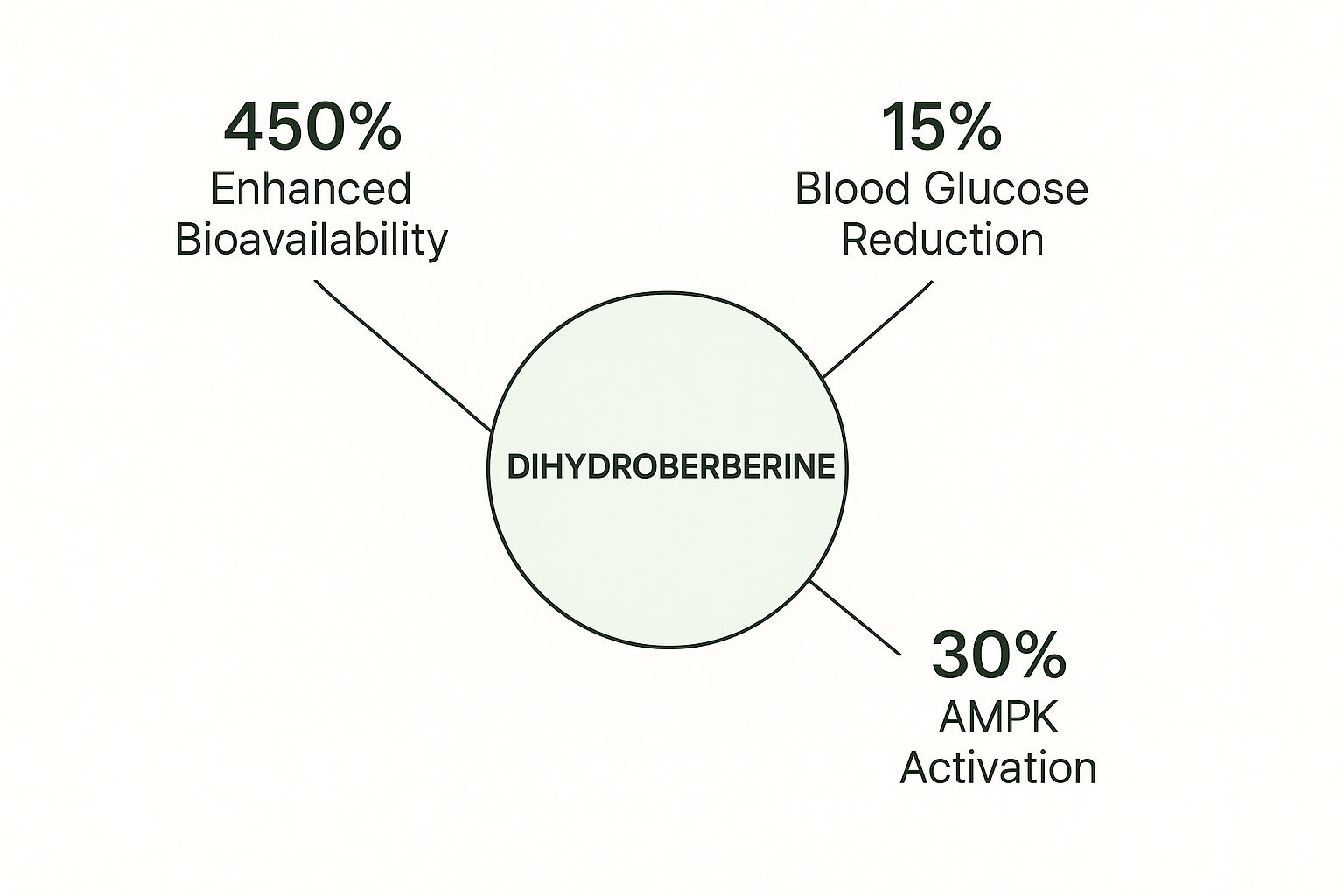
You can see how its superior absorption directly translates into more muscle for things like blood glucose control, AMPK activation, and overall metabolic health.
Key Points of Comparison
Let’s get into the weeds on what makes dihydroberberine the smarter choice for so many people, especially if you’ve had a bad run-in with standard berberine before. The whole story boils down to four things: bioavailability, dosage, side effects, and value.
- Bioavailability: This is the big one. Standard berberine is notoriously difficult for your body to absorb, meaning most of it goes to waste. Dihydroberberine, on the other hand, is basically "pre-converted" into a form your body can absorb up to 5 times more effectively.
- Dosage: Because you absorb so much more, you don't need to take nearly as much. We’re talking a typical dose of just 200-400mg, a huge drop from the 1,500mg or more you often need with the standard stuff.
- Gastrointestinal Side Effects: Those high doses of standard berberine are famous for causing digestive chaos—cramping, bloating, you name it. The smaller, more efficient dose of dihydroberberine makes these issues a rarity, offering a much gentler path to the same benefits.
For anyone who has tried berberine in the past but gave up because of stomach issues, dihydroberberine can be a complete game-changer. You get all the metabolic support you were looking for without the uncomfortable side effects.
This shift toward more stable and effective compounds isn't just happening on supplement shelves. It's a major trend in the pharmaceutical ingredient world, too. The demand for high-purity berberine derivatives is on the rise, with premium grades hitting over 99% purity for maximum safety and performance. The market is also moving beyond just tablets, with powders and capsules offering more choice. You can see these industry quality trends for yourself.
In-Depth Feature Comparison Berberine vs. Dihydroberberine
To lay it all out, this table gives you a head-to-head comparison of the two. It makes the choice crystal clear.
| Feature | Standard Berberine | Dihydroberberine |
|---|---|---|
| Bioavailability | Low and highly variable | Up to 5x higher and more consistent absorption |
| Typical Daily Dose | 1,000 - 1,500 mg, split into multiple doses | 200 - 400 mg, often taken once or twice daily |
| GI Side Effects | Common (bloating, cramping, stomach upset) | Minimal and rare |
| Mechanism | Requires gut bacteria to convert it for absorption | Bypasses conversion; directly absorbed and then converts |
| Value Proposition | Lower cost per gram, but much higher dose needed | Higher cost per gram, but far greater efficiency |
When you get down to it, standard berberine paved the way, but dihydroberberine is a massive leap forward in terms of efficiency, comfort, and getting reliable results.
Safe Dihydroberberine Dosage and Guidelines
When you're trying a new supplement, figuring out the right amount is everything. With dihydroberberine, the golden rule is pretty simple: less is more. Because it’s so much more bioavailable than regular berberine, you don't need nearly as much to get powerful results.
You might see standard berberine protocols calling for 1,500 mg or even more per day. Dihydroberberine is a different ballgame. Most studies and product guidelines land on a daily intake somewhere between 200 mg and 400 mg. This dramatically lower dose is a huge reason why it’s so much easier on the stomach.
But before you start anything, the most important step is to talk with your healthcare professional. They can look at your specific health picture, your goals, and any other medications you’re taking to help you find the best starting point.
Starting Low and Listening to Your Body
Even with a fantastic safety profile, it’s always smart to start with a lower dose and see how your body reacts. Think of it as a "start low, go slow" approach—a best practice for any new addition to your health routine.
Kick things off with the lowest recommended dose, maybe 100 mg to 200 mg a day. Just pay attention to how you feel. If everything is going smoothly, you can gradually increase the amount if needed, ideally with your doctor's okay. Taking it with a meal can also help your body make the most of its effects on glucose disposal.
The goal is to find your "minimum effective dose"—the smallest amount that gives you the benefits you're looking for. This ensures you get the support you need while keeping any potential for side effects to an absolute minimum.
Potential Side Effects and Interactions
One of the biggest wins for dihydroberberine is its massively reduced risk of GI side effects. While high doses of standard berberine are notorious for causing an upset stomach, bloating, and cramps, those problems are incredibly rare with its more efficient cousin.
Still, you need to be aware of how it might interact with other things, especially if you're managing existing health conditions.
- Diabetes Medications: Since dihydroberberine is so good at lowering blood sugar, combining it with other diabetes drugs (like metformin or insulin) could potentially lead to hypoglycemia (blood sugar that's too low).
- Blood Pressure Medications: It can also help support healthier blood pressure. If you're already on medication for hypertension, it’s important to monitor your levels closely. For more on this, check out these natural ways to lower your blood pressure.
- Other Supplements: Make sure your doctor knows about every supplement you’re taking to sidestep any unwanted interactions.
Using it responsibly is the name of the game. By working with a healthcare provider and starting with a conservative dose, you can safely make dihydroberberine a part of your wellness plan.
Is Dihydroberberine the Right Choice for You?
Deciding whether to add a new supplement to your routine can feel like a big step. When it comes to dihydroberberine, the choice usually boils down to a few key factors. Let’s cut through the noise and talk about who really stands to gain the most from this upgraded compound.
If you're already on a journey to improve your metabolic health, think of dihydroberberine as a powerful new tool in your arsenal.
Making an Informed Decision
This advanced form of berberine is a game-changer for a few specific groups. For instance, have you tried standard berberine before, only to be put off by the digestive issues? If so, dihydroberberine offers a much gentler experience. Because it’s so much more efficient, you can take a smaller dose, which dramatically cuts down the risk of stomach upset.
If you’re looking for more noticeable and reliable metabolic support, dihydroberberine consistently outshines its predecessor. It’s the clear choice for anyone who wants maximum benefit from every dose without the usual drawbacks.
So, who is it for?
- Individuals who experienced GI upset with regular berberine.
- Those seeking potent metabolic support to help manage blood sugar and lipid levels.
- Anyone wanting a more efficient, lower-dose alternative to a traditional supplement.
Ultimately, dihydroberberine represents a smarter, more targeted approach to your health. It packs the well-known power of berberine into a far more comfortable and effective package.
Before you start any new supplement, though, it’s always best to make a fully informed choice. A great first step is chatting about dihydroberberine with your healthcare provider. You can also explore how to use nutritional testing to get a clearer snapshot of your body's specific needs and ensure any new addition is a perfect fit for your goals.
Your Dihydroberberine Questions, Answered
Jumping into a new supplement always brings up questions. It's only natural. We've put together some of the most common things people ask about dihydroberberine to give you clear, straight-up answers and make sure you feel confident.
How Quickly Will I Actually Feel Something?
This is the big one, and the honest answer is: it depends on the person. Because dihydroberberine gets into your system so efficiently, some people report feeling subtle changes, like how they feel after a meal, within just the first couple of weeks.
But for the big-picture stuff—the numbers on your lab reports like fasting blood sugar or cholesterol—you need to give it more time. We generally recommend sticking with it for at least 4-8 weeks to let the compound really do its work. Think of it as a long-term partner for your health. Dihydroberberine works best when you do, so pairing it with a solid diet and some regular movement is what will get you the most impressive and lasting results. Patience is your friend here.
While everyone's body is different, many people notice the initial benefits within a few weeks. For measurable shifts in your bloodwork, you’ll want to commit to a few months to see the full impact of what dihydroberberine can do.
Can I Take It With My Other Supplements?
Yes, in many cases, you absolutely can. Dihydroberberine often plays well with others, especially supplements that are also aimed at metabolic health, like omega-3s or magnesium. It can be a powerful addition to a well-rounded supplement stack.
However, you need to be smart about it. Always, and I mean always, tell your doctor or healthcare provider about every single supplement you're taking. This is non-negotiable, especially if you're taking other things known to impact blood sugar or blood pressure. Combining them could make their effects too strong.
What’s It Like to Switch Over From Regular Berberine?
If you're upgrading from standard berberine to dihydroberberine, you're likely in for a much smoother ride. The transition is usually seamless, and most people notice a few key improvements right away.
- A Smaller Dose: You'll be taking a much smaller pill. We're talking just a fraction of the dose you were probably taking with regular berberine.
- Easier on the Gut: Let's be real—a common complaint with berberine is digestive upset. This is one of the main reasons people make the switch. Dihydroberberine is known for being significantly gentler on your stomach.
- More Consistency: Thanks to its superior absorption, you can count on more stable, reliable support for your metabolic goals, day in and day out.
Just start with the recommended low dose of dihydroberberine and pay attention to how your body responds.
Ready to feel the difference for yourself? The team at Peak Performance has brought this next-generation metabolic support to the forefront to help you hit your wellness goals with less hassle and more efficiency. Explore our Super Berberine & our AMAZING 4-in-1 Berberine products and discover what you've been missing.
Also in Blog


A Guide to Third Party Tested Supplement Brands


Dietary Supplement B12: The Scientific Link to Fighting Anemia and Boosting Energy

