


Paraxanthine vs Caffeine: Which Stimulate Fits You Best?
When you get right down to it, the difference between paraxanthine and caffeine is surprisingly simple. Paraxanthine gives you a smoother, cleaner energy boost without the jitters, anxiety, and eventual crash that so many people associate with caffeine.
It’s like getting all the good parts of your morning coffee—the focus, the alertness—while leaving the baggage behind.
The Core Differences Between Paraxanthine and Caffeine
Here's something most coffee drinkers don't realize: when you have a cup of coffee, your body doesn't actually use the caffeine directly. Your liver has to break it down first, metabolizing it into three separate compounds.
The main one, paraxanthine, makes up about 84% of that breakdown. This means paraxanthine is the primary molecule doing the heavy lifting to deliver that focused, awake feeling you’re after. The other two metabolites, theophylline and theobromine, are largely responsible for the less-desirable side effects, like a racing heart or that jittery feeling.
By taking pure paraxanthine, you essentially skip the metabolic middleman and get straight to the good stuff. For a clean, predictable boost, many are now turning to pure paraxanthine supplements like our Paraxanthine Capsules to get the job done right.
The bottom line is, you’re already well-acquainted with what paraxanthine does. It's the main reason your coffee works. Supplementing with it directly just provides a cleaner, more predictable experience.
Paraxanthine vs Caffeine At a Glance
To really understand the practical differences, it helps to see how these two stimulants stack up side-by-side. This table gives you a quick rundown of what to expect from each.
| Feature | Paraxanthine | Caffeine |
|---|---|---|
| Primary Effect | Clean, focused energy with enhanced cognitive function | Broad stimulation that can easily lead to overstimulation |
| Common Side Effects | Minimal; far less anxiety and fewer jitters | Jitters, anxiety, energy crashes, and sleep disruption are common |
| Metabolic Consistency | Highly predictable; it bypasses genetic variations | Effects are inconsistent and vary widely based on your genetics |
| Withdrawal | Lower potential for withdrawal symptoms like headaches | Commonly leads to withdrawal symptoms and a cycle of dependence |
As you can see, paraxanthine is engineered for a more targeted outcome, whereas caffeine’s effects can be a bit of a mixed bag.
This infographic breaks down some of the key pharmacokinetic differences, showing how each compound behaves in the body over time.
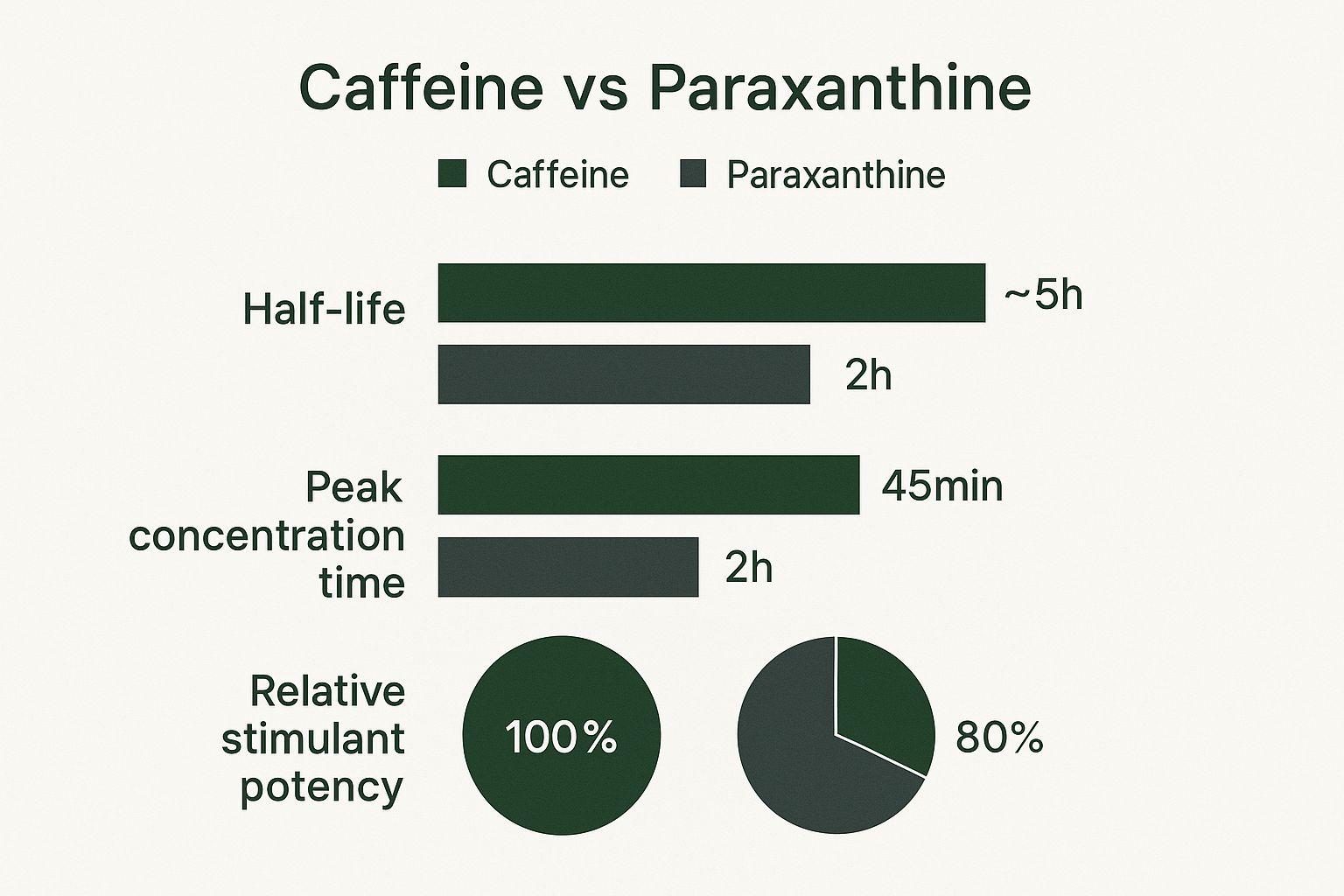
While caffeine might hit its peak a bit faster, the data shows paraxanthine offers a much more controlled and targeted stimulant profile overall.
Why This Difference Really Matters
The biggest problem with caffeine is its inconsistency. How your body handles it comes down to your unique genetic makeup—specifically, how well your CYP1A2 enzyme works. This is the reason one person can have an espresso after dinner and sleep like a baby, while another gets wired and anxious from a single cup in the morning.
It’s a genetic lottery.
Paraxanthine takes that genetic guesswork out of the equation. Because you’re consuming the primary active metabolite directly, you get a reliable, consistent effect every single time. This makes it a far better choice for anyone sensitive to caffeine or for those who want to optimize their performance without gambling on the outcome.
For a clean, predictable boost, many are now turning to pure paraxanthine supplements like Peak Performance Paraxanthine Capsules to get the job done right.
How Your Body Processes Each Stimulant
To really get what makes paraxanthine different from caffeine, you have to look at how your body handles each one. The difference isn't just about what you're putting in your mouth—it’s about the entire metabolic journey that follows. This journey is exactly why you and your friend can drink the same coffee and have totally different experiences.
When you drink caffeine, it doesn't just hang around in its original form. Your liver gets to work, using an enzyme called CYP1A2 to break it down into three separate metabolites. Paraxanthine is the main player here, making up the vast majority of that conversion.
The Caffeine Metabolic Rollercoaster
Caffeine's metabolic path is, to put it mildly, unpredictable. After you drink coffee, caffeine levels in your blood peak within an hour or two. But here's the kicker: paraxanthine, its primary metabolite, doesn't become the dominant compound in your system until 8 to 10 hours later. This delayed takeover is a big reason caffeine's stimulating effects can linger for so long and mess with your sleep.
This whole process is wildly inconsistent from person to person. Genetics, lifestyle choices like smoking, and your overall health all play a role. You can dig into the full metabolic timeline of caffeine to see just how complex it is.
The real problem for many people is this variability. Your genes determine how well your CYP1A2 enzyme functions, which can cause caffeine's half-life to swing wildly between 2.5 to 12 hours. What feels like a morning boost for one person can be an all-day anxiety attack for another.
This metabolic uncertainty is why caffeine can feel like a gamble. You're never quite sure if you'll get clean focus or a case of the jitters, all because of a complex and highly individualized breakdown process.
Paraxanthine for Predictable Performance
This is where taking pure paraxanthine changes the entire equation.
When you consume paraxanthine directly, you get to skip the messy, unpredictable conversion process that caffeine requires. No more genetic lottery. No more waiting on your liver to do its job.
You're essentially giving your body the finished product instead of the raw ingredient. This leads to a far more consistent and predictable experience for a few key reasons:
- No Metabolic Guesswork: You get the effects of the primary active metabolite without your individual CYP1A2 enzyme activity muddying the waters. The result is the same, every single time.
- Cleaner Profile: You avoid the other two metabolites, theophylline and theobromine. These are the two often blamed for side effects like a racing heart or that nervous, on-edge feeling.
- Controlled Experience: The energy and focus are direct and reliable. This makes it a perfect choice for anyone who needs to perform at their best without rolling the dice on side effects.
By choosing Peak Performance Paraxanthine Capsules, you're taking a more direct route to clean energy and sidestepping the metabolic variables that make caffeine so hit-or-miss.
Comparing Cognitive and Performance Enhancements
When you reach for a stimulant, the goal is pretty straightforward: you want to perform better, mentally and physically. Both paraxanthine and caffeine get this job done by acting as adenosine receptor antagonists. That’s just a scientific way of saying they stop the brain signals that tell you you’re tired. It’s this shared mechanism that makes them both effective for boosting alertness.
But this is where the two start to diverge. The quality of that mental boost is where the real difference between paraxanthine and caffeine shows up. Caffeine gives you that familiar, broad-spectrum jolt of energy, but paraxanthine delivers a much cleaner, more targeted cognitive lift. From what we're seeing, it’s simply more efficient, leading to a pure sense of focus without the scattered, anxious energy that can sometimes come with a strong cup of coffee.
Think about the times you need intense mental clarity—cramming for a final, grinding through a complex coding problem, or prepping for a big presentation. The type of focus is just as important as how awake you feel. Paraxanthine seems to have an edge here, supporting these high-demand brain functions with more precision.
The Nootropic Advantage of Paraxanthine
New research is starting to back up what many people have been feeling. It turns out paraxanthine isn't just some leftover byproduct of caffeine metabolism; it might actually be the main compound responsible for the nootropic benefits we chase.
So, how does it work? Paraxanthine is better at kicking off the release of key neurotransmitters like dopamine and acetylcholine. These are the brain’s chemical messengers in charge of:
- Focus and Attention: Helping you lock onto a single task for longer stretches.
- Memory Recall: Making it easier to pull up stored information when you need it.
- Learning Capacity: Improving your brain's knack for forging new connections.
By stimulating these neurotransmitters more effectively than caffeine, paraxanthine provides a seriously potent mental upgrade. This makes it a compelling choice for anyone trying to sharpen their mental edge. If you're looking to maximize your cognitive output, you can explore more strategies in our guide on 8 ways to boost brain function for greater focus and productivity.
A Clearer Head Under Pressure
The real test for any cognitive enhancer is how it holds up when the pressure is on. This is where preclinical research gives us some powerful clues. In a head-to-head study, paraxanthine didn't just keep up with caffeine—it pulled ahead. The research showed that a high dose of paraxanthine boosted cognitive function by 14% more than an equal dose of caffeine in young subjects, a clear sign of its superior ability to sharpen focus and memory. You can read more about the study's findings on paraxanthine's cognitive benefits.
This key finding positions paraxanthine as a potentially superior choice for anyone who needs to maintain peak mental clarity, especially for demanding tasks. It delivers the focus without the side-order of distraction.
At the end of the day, the goal isn't just to be awake. It's to be sharp, efficient, and clear-headed. By offering a cleaner, more direct route to neurotransmitter release, paraxanthine helps you get there more effectively. For a measured and reliable dose designed for peak cognitive performance, many are now turning to pure supplements like our Paraxanthine Capsules.
Analyzing Jitters, Anxiety, and Energy Crashes
For all its benefits, caffeine comes with a well-known dark side. If you rely on it for an energy boost, you're probably all too familiar with the unpleasant trio of side effects: jitters, anxiety, and the dreaded afternoon crash. This isn't just an occasional inconvenience; it's a major downside for a huge number of people.
The problem lies in how your body processes caffeine. While it’s great at blocking adenosine to keep you awake, its metabolic breakdown is messy. Your body turns it into three different compounds. Paraxanthine does the heavy lifting for focus, but the other two—theophylline and theobromine—are often the culprits behind the negative feelings. They’re notorious for causing overstimulation and a racing heart, which most of us experience as anxiety or jitters.
This is made worse by caffeine's unpredictable metabolism, which varies wildly from person to person. It's like a stimulant lottery—one day you get clean focus, the next you're a bundle of nervous energy.
Why Paraxanthine Is a Game Changer
This is where the difference between paraxanthine and caffeine becomes crystal clear. Paraxanthine offers a targeted solution by giving you only the primary, "clean" metabolite that's responsible for all the good stuff. When you supplement with pure paraxanthine, you completely sidestep the metabolic process that creates those problematic byproducts.
What this means for you is sustained energy and sharper focus, without the baggage. Specifically, paraxanthine helps you avoid:
- Jitters and Anxiety: By cutting out theophylline and theobromine, paraxanthine delivers a much smoother experience. No overstimulation, no racing heart, no nervous tension.
- The Energy Crash: That classic "crash" is often a withdrawal symptom as caffeine’s effects wear off. Paraxanthine has a much lower potential for creating dependency, which significantly reduces the chances of that harsh drop-off.
- Vasoconstriction: Theophylline can constrict blood vessels, a side effect linked to headaches and higher blood pressure. Paraxanthine has far less of this effect, making it a much more comfortable stimulant.
A Superior Safety and Comfort Profile
The discomfort from caffeine isn't just about the immediate jitters; for a lot of people, it's a daily reality. Research shows that roughly 20–30% of caffeine consumers report dealing with adverse effects like anxiety. For these individuals, paraxanthine’s cleaner stimulation is a powerful alternative, giving them the cognitive boost they want without the overstimulation they hate. You can discover more about how paraxanthine offers a gentler stimulant mechanism.
By isolating the single most effective component of caffeine metabolism, paraxanthine provides a more reliable and comfortable experience. It's a precision tool for energy and focus, not a blunt instrument.
This superior safety profile also extends to your sleep. Because it doesn't cause the same lingering stimulation, paraxanthine is far less likely to mess with your sleep patterns—a huge complaint with caffeine. If you struggle with sleep, check out our guide on how to get better sleep to perform at your best.
When to Choose Paraxanthine Instead of Caffeine
Deciding between paraxanthine and caffeine isn’t just about picking a stimulant. It’s about matching the right tool to your specific biology and what you want to achieve. The choice gets a lot clearer when you look at who really benefits from making the switch. For some people, paraxanthine delivers where the unpredictable nature of traditional caffeine just can't.
This decision often boils down to how your body handles caffeine in the first place. For so many, caffeine is a roll of the dice. One person gets clean focus, while another gets an afternoon wrecked by anxiety—a difference dictated almost entirely by your genes. Paraxanthine is a way to sidestep that metabolic lottery, giving you a consistent and targeted effect every single time.
The Caffeine-Sensitive Professional
Are you someone who loves the idea of coffee but dreads the reality? You might be a caffeine-sensitive professional. You need to be sharp for meetings and deep work, but even one cup of coffee leaves you feeling jittery, anxious, and scattered—the exact opposite of what you were hoping for.
For this type of person, paraxanthine is a game-changer. It provides the wakefulness and cognitive lift you’re after by acting directly on adenosine receptors, but without the baggage from caffeine's other metabolites. That means you get pure focus without the nervous energy, letting you perform at your best without those distracting side effects.
The Competitive Athlete
Athletes are always looking for an edge, but the cardiovascular strain from high doses of caffeine can be a huge downside. A racing heart or a spike in blood pressure is the last thing you need, whether you're on the field or in the gym. Peak performance demands calm, controlled energy, not a frantic, jittery mess.
Paraxanthine offers a powerful alternative here, providing a clean ergogenic boost without the significant cardiovascular stress. It supports energy and endurance, helping athletes push their limits while keeping their body in a more balanced state. This makes it a much smarter choice for training and competition when everything is on the line.
The Dedicated Biohacker
The biohacker is all about optimization and predictability. They track inputs and outputs meticulously, aiming to fine-tune their biology for peak mental and physical function. For them, caffeine's inconsistent effects are a major liability. Its half-life can swing wildly from 2 to 12 hours depending on your unique genetics, which makes reliable dosing impossible.
This metabolic variability often leads people to consume more caffeine than intended. Consumption at the 90th percentile has reached up to 520 mg daily, exceeding the FDA's recommended 400 mg limit, largely because fast metabolizers seek a consistent effect. Read more on how paraxanthine offers a more predictable stimulant experience.
Paraxanthine’s predictable metabolism and shorter half-life give biohackers the consistency they demand. It delivers a reliable outcome every time, taking the genetic guesswork out of the equation and allowing for precise control over your state.
If you see yourself in any of these profiles and are ready for a cleaner, more reliable form of energy, trying a precisely measured dose is the logical next step. You can do just that with Peak Performance's Paraxanthine Capsules, designed for a consistent and effective experience.
Common Questions About Paraxanthine
As paraxanthine starts making waves, a handful of great questions keep coming up. Getting clear on the practical side of things—like safety, daily use, and how it really stacks up against the usual suspects—is key to figuring out if it’s the right move for you. Let's tackle some of the most common ones.
Is Paraxanthine Safe for Daily Use?
Yes. Based on what we know, paraxanthine is not only safe for daily use but actually has a much better safety profile when you put it head-to-head with caffeine. Your body is already an expert at handling it, since it naturally produces paraxanthine every time you have coffee. The big difference is that by taking it directly, you're sidestepping the other caffeine byproducts that tend to cause the unwanted side effects.
The research also points to paraxanthine having a lower risk of causing withdrawal or building up a quick tolerance, which makes it a much more stable option for a daily stimulant. For a clean, measured dose, our Paraxanthine Capsules are designed to give you consistent results you can count on.
Should I Combine Paraxanthine with Coffee?
My advice is to replace your coffee with paraxanthine, not mix them. Stacking them together will just jack up your total stimulant load and likely reintroduce the very jitters or anxiety you're trying to get away from.
The whole point of using paraxanthine is to get that clean focus and energy without the baggage that comes with a full dose of caffeine. To really see how your body responds, try swapping out your usual cup of coffee and see how you feel. It's the only way to accurately gauge the difference.
Think of it this way: paraxanthine is the refined, high-performance fuel. Adding regular caffeine would be like mixing premium gasoline with a lower-grade fuel—you'd dilute the benefits you're paying for.
How Does Paraxanthine Differ from L-Theanine and Caffeine?
L-theanine is an amino acid that’s often paired with caffeine to smooth out its rough edges. It promotes a sense of calm to counteract the harshness of caffeine, essentially acting as a band-aid for its built-in flaws like jitters and anxiety.
Paraxanthine, on the other hand, is the main event. It delivers the cognitive and energy benefits directly, without needing a second ingredient to clean up its mess. It’s like upgrading from an engine that needs special additives to run smoothly (caffeine + L-theanine) to a high-performance engine that just runs clean on its own (paraxanthine). It’s a far more direct and efficient way to get clean energy.
Ready to experience the next evolution in clean, focused energy? Peak Performance offers premium Paraxanthine Capsules designed for a jitter-free boost without the crash.
Also in Blog


How to Increase Stamina Naturally and Boost Energy


How to Increase Energy Naturally

