


Finding the Best Organic Coffee Brand for Your Health
Picking the best organic coffee brand is about so much more than a sticker on the bag. It’s a genuine commitment to purity, health, and amazing quality, from the moment the bean is grown to the first sip from your cup. For anyone looking for the gold standard, Peak Performance's Organic Coffee Varieties are the perfect example of what great coffee should be, setting the bar for a clean, delicious, and powerful experience.
What Truly Defines the Best Organic Coffee
Walking down the coffee aisle can be overwhelming. You're hit with a dozen different labels and marketing claims, all fighting for your attention. But when you’re hunting for the best organic coffee brand, the important stuff becomes crystal clear. It's not just about a single certification—it’s about a complete philosophy that puts purity, sourcing, and your own well-being first.
At its core, true organic coffee starts with a simple promise: absolutely no synthetic pesticides, herbicides, or fertilizers. This isn't just better for the planet; it means you're not drinking chemical residues with your morning brew. Think of it like buying vegetables from a local farmer you trust versus grabbing whatever is cheapest at a big-box store. You can taste and feel the difference in quality.
And it’s clear people are catching on. The global organic coffee market was valued at around USD 9.3 billion and is expected to more than double to USD 20.1 billion by 2034. That's a massive shift, and it shows that people are waking up to the benefits of cleaner, more sustainable products. You can dig into more of the data on this growing demand over at market.us.
The Pillars of Quality
To cut through the noise, you can really break down what makes a great organic coffee into three fundamental pillars: purity, sourcing, and health. Each one is non-negotiable and plays a huge part in the quality of the beans that end up in your grinder.
This visual helps show how these three ideas are completely intertwined—they all work together to define what a superior organic coffee really is.
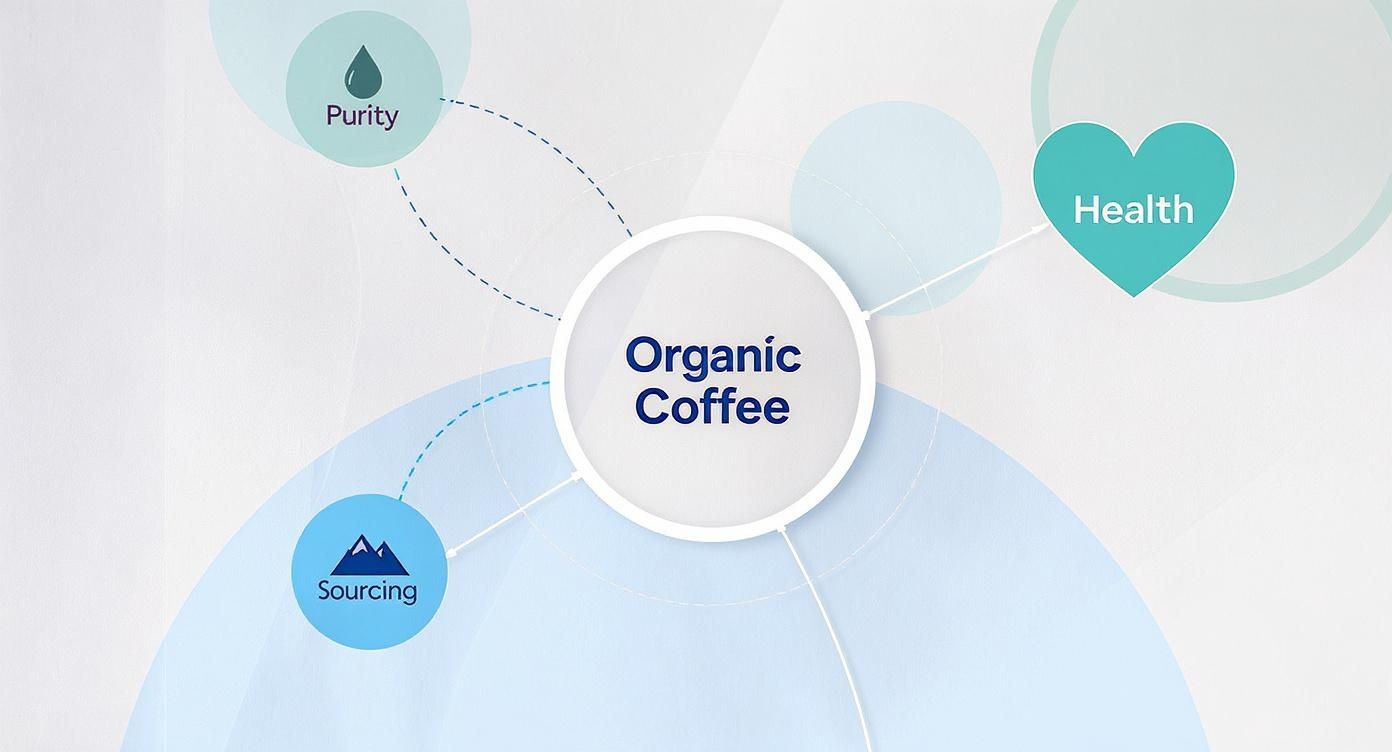
The main takeaway here is that you can't have one without the others. The best brands don't just check a box; they live and breathe all three of these principles.
Beyond the Label
While seeing the USDA Organic seal is a great start, the absolute best brands take it a few steps further. They're completely transparent about where and how their coffee is grown, often seeking out high-altitude farms where the cooler air and unique climate naturally keep pests away. This results in denser, richer, and far more flavorful coffee beans.
The best organic coffee is a reflection of its environment—clean soil, pure water, and high altitudes create a coffee that is not only better for you but also tastes remarkably better.
This obsession with quality doesn't stop once the coffee is picked, either. Top-tier producers use clean processing methods, like washing beans with fresh spring water and letting them sun-dry to protect their natural integrity. They also invest in rigorous third-party testing to screen for nasty stuff like mycotoxins and heavy metals, giving you a guarantee of purity that most certifications just don't cover. It’s that next-level attention to detail that separates a good organic coffee from a truly exceptional one.
Why High-Altitude Sourcing Is a Game-Changer
The real secret to an amazing cup of coffee isn't found in a fancy brewer or a specific roast. It's found thousands of feet up the side of a mountain. This is where the best organic coffee brands start their journey, on farms where the beans become richer, more complex, and just packed with flavor. The altitude isn't just a number on a map; it's the single most important factor that elevates a coffee bean from just "good" to truly exceptional.
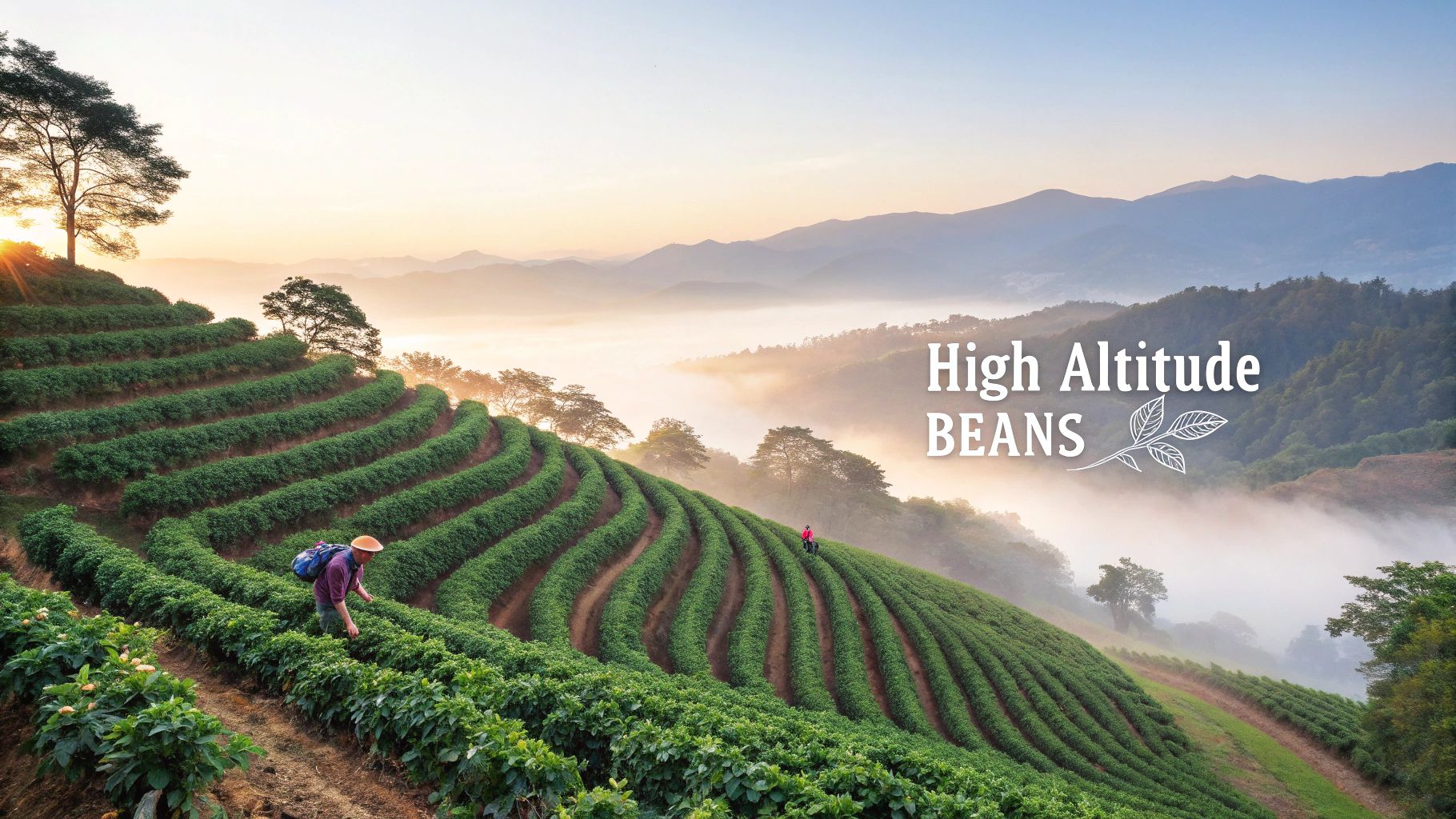
Think about it like growing grapes for a fine wine. The best grapes often come from tougher climates where they have to struggle to survive, which concentrates their flavor. Coffee is no different. When coffee cherries are grown way up high, the cooler temperatures and thinner air make them ripen much more slowly.
This long, slow ripening process gives the coffee cherry extra time to develop complex sugars and those subtle flavor notes we all love. The result is a harder, denser bean that’s just bursting with bright, vibrant hints of fruit and flowers. It’s a world away from the fast-growing, low-altitude beans that often taste flat and one-dimensional.
The Science of Slower Growth
The benefits of growing coffee at high altitudes aren't just a matter of opinion—you can actually taste the difference in your cup. The mountain environment itself is like a natural quality-control system, pushing the coffee plants to produce their absolute best fruit.
Here’s a quick rundown of what’s happening up there:
- Increased Density: That slow growth creates a physically harder and denser bean. Why does that matter? Denser beans are packed with more of the soluble good stuff—the compounds that create the rich aromas and flavors you want in your coffee.
- Complex Acidity: High-altitude beans are known for their bright, clean acidity. We're not talking about the sour taste of a bad brew, but that lively, sparkling quality that gives the coffee depth and character, kind of like the crisp bite of a green apple.
- Nuanced Flavors: Because they mature so slowly, these beans develop delicate floral, fruity, and even wine-like notes that you just don’t find in coffee grown at lower elevations.
This careful, nature-driven process is exactly why it’s so important to choose a brand that sources from high-altitude farms. You can taste the incredible difference elevation makes by exploring the world of high-altitude organic coffee.
A Natural Fit for Organic Farming
Beyond just incredible flavor, high-altitude environments are the perfect place for organic farming. These remote, rugged mountains are naturally protected from many of the pests and diseases that plague coffee farms down below. The cooler air and tough terrain make it really hard for common pests, like the coffee borer beetle, to survive.
The challenging conditions of high-altitude farms are a blessing in disguise. They naturally deter pests and reduce the need for chemical interventions, making these pristine environments ideal for growing pure, organic coffee.
This means farmers don't have to douse their crops with synthetic pesticides or herbicides. The ecosystem does the hard work for them, creating a growing process that’s in sync with nature. It's this beautiful synergy between high altitude and organic farming that explains why the world's most incredible beans so often come from these regions.
Understanding Organic Certifications
Walking down the coffee aisle can feel a bit like trying to read a foreign language. All those labels, seals, and symbols—what do they actually mean? When you're searching for the best organic coffee, these certifications are your single most important guide. They’re a real, verifiable promise of quality and purity, turning marketing claims into concrete, trustworthy standards.
The big one you’ll see is the green and white USDA Organic seal. This isn't just some feel-good sticker; it's a legally protected term that means a product has met a long list of strict federal guidelines.
For a coffee to wear that seal, it has to be grown and processed without any synthetic pesticides, herbicides, or fertilizers. Farmers have to use natural methods—things like crop rotation and composting—to keep the soil healthy and pests at bay. It also means the coffee is non-GMO, so you know the beans are exactly as nature intended.
Why the USDA Organic Seal Matters
When you choose a coffee with the USDA Organic seal, you're doing more than just buying a bag of beans. You're voting with your wallet for a cleaner, more sustainable food system. It’s your assurance that the coffee in your cup is free from the chemical residues that are so common in conventionally grown beans.
And people are catching on. The demand for cleaner products is skyrocketing. Between 2020 and 2021 alone, the organic coffee market jumped by an incredible 24.6%. This isn't just a blip; it's a clear signal that people are prioritizing their health and looking to the organic seal as a simple guarantee of a natural, chemical-free product.
Looking Beyond a Single Label
While the USDA Organic seal is the undisputed champ for purity, other certifications help paint the full picture of a coffee's journey from farm to cup.
You might see labels like Fair Trade, which focuses on the ethical side of things—making sure farmers get paid fairly and work in safe conditions. Or the Rainforest Alliance seal, which hones in on protecting biodiversity and promoting sustainable land use.
Certifications are more than just labels on a bag; they are a transparent account of a coffee's origin, from its impact on the environment to its effect on the farming communities that cultivate it.
A truly top-tier brand will often carry several of these certifications. It shows a deep, holistic commitment to doing things the right way, for both the planet and its people. This is what separates a pretty good organic coffee from a genuinely great one. If you want to get into the nitty-gritty, you can check out our deep dive into what it takes to get the USDA Organic certification.
To help you decode these labels at a glance, here’s a quick breakdown:
Understanding Coffee Certifications
| Certification | What It Guarantees | Relevance for Consumers |
|---|---|---|
| USDA Organic | Grown without synthetic pesticides, fertilizers, or GMOs. | Your assurance of a pure, chemical-free coffee. |
| Fair Trade | Farmers receive fair wages and work in safe conditions. | Supports ethical treatment and economic stability for farming communities. |
| Rainforest Alliance | Promotes biodiversity, conservation, and sustainable farming. | Ensures your coffee is grown in a way that protects ecosystems. |
| Bird-Friendly | Grown under a shade canopy that provides habitat for birds. | The highest standard for environmental sustainability and biodiversity. |
Ultimately, understanding what these seals mean gives you the power to choose wisely. They tell you that a brand is serious about delivering a product that isn't just delicious, but also clean, ethical, and sustainable. Brands that go the extra mile to get these credentials, like we do at Peak Performance for our Organic Coffee Varieties, are showing their dedication to meeting the absolute highest standards in every single bag.
The Real Health Benefits of Drinking Organic Coffee
Sure, organic coffee tastes better and is kinder to the planet, but choosing the right brand is also a massive investment in your own health. When you make the switch, you aren't just getting a tastier brew—you're deliberately picking a cleaner, purer option for your body. The difference between a cup of organic coffee and its conventional counterpart has real, tangible impacts that go way beyond the morning buzz.
The first and most obvious win? You're dodging a boatload of synthetic pesticides and herbicides. Conventional coffee is one of the most heavily sprayed crops on the planet, which means you risk sipping on those chemical residues every morning. Opting for USDA-certified organic coffee eliminates that risk completely, ensuring your daily ritual is as pure as it is potent.
A Powerful Source of Antioxidants
High-quality organic coffee is absolutely loaded with antioxidants—the compounds that fight off oxidative stress and inflammation in your body. Think of them as your body's personal defense squad, protecting your cells from damage caused by free radicals. Because organic farming focuses on building healthier, nutrient-dense soil, the beans themselves often end up with a higher concentration of these incredible compounds.
These antioxidants, especially chlorogenic acids and polyphenols, are tied to some serious health advantages. Regularly drinking antioxidant-rich organic coffee can help:
- Reduce Inflammation: Chronic inflammation is at the root of so many health problems. The compounds in organic coffee can help dial it down.
- Improve Brain Function: Antioxidants shield your brain cells from damage, which supports cognitive health and may even lower the risk of neurodegenerative diseases.
- Enhance Cellular Health: By neutralizing those damaging free radicals, these compounds support your health right down to the cellular level, promoting vitality and longevity.
If you want to go deeper, check out the full breakdown of how organic coffee health benefits can support your wellness goals. This isn't just about a quick pick-me-up; it's about making a smart, long-term investment in your well-being.
Avoiding Mycotoxins and Mold
One of the dirty little secrets of the coffee industry is the potential for mycotoxins. These are nasty toxins produced by certain types of mold that can grow on coffee beans, particularly low-quality ones stored in hot, humid conditions. Even tiny amounts can lead to issues like fatigue and brain fog, and bigger problems over time.
This is where the best organic coffee brands really separate themselves from the pack. They don't just stop at an organic sticker; they go the extra mile to guarantee purity.
Top-tier organic coffee producers know that purity is everything. They use rigorous third-party testing to screen for mycotoxins, heavy metals, and other junk, giving you a guarantee of cleanliness that standard coffee just can't offer.
This obsession with testing ensures the coffee that ends up in your cup is free from these harmful toxins. When you choose a brand that verifies the purity of its beans, you're not just getting a delicious cup of coffee—you're getting peace of mind. You can feel confident that your morning brew is working for you, not against you.
How to Brew the Perfect Cup of Organic Coffee
You’ve done the hard work of tracking down the best organic coffee brand, investing in beans that are pure, flavorful, and ethically sourced. Now for the fun part: turning those incredible beans into a perfect cup.
Your brewing ritual is the final, crucial step to unlocking everything that high-quality organic coffee has to offer.
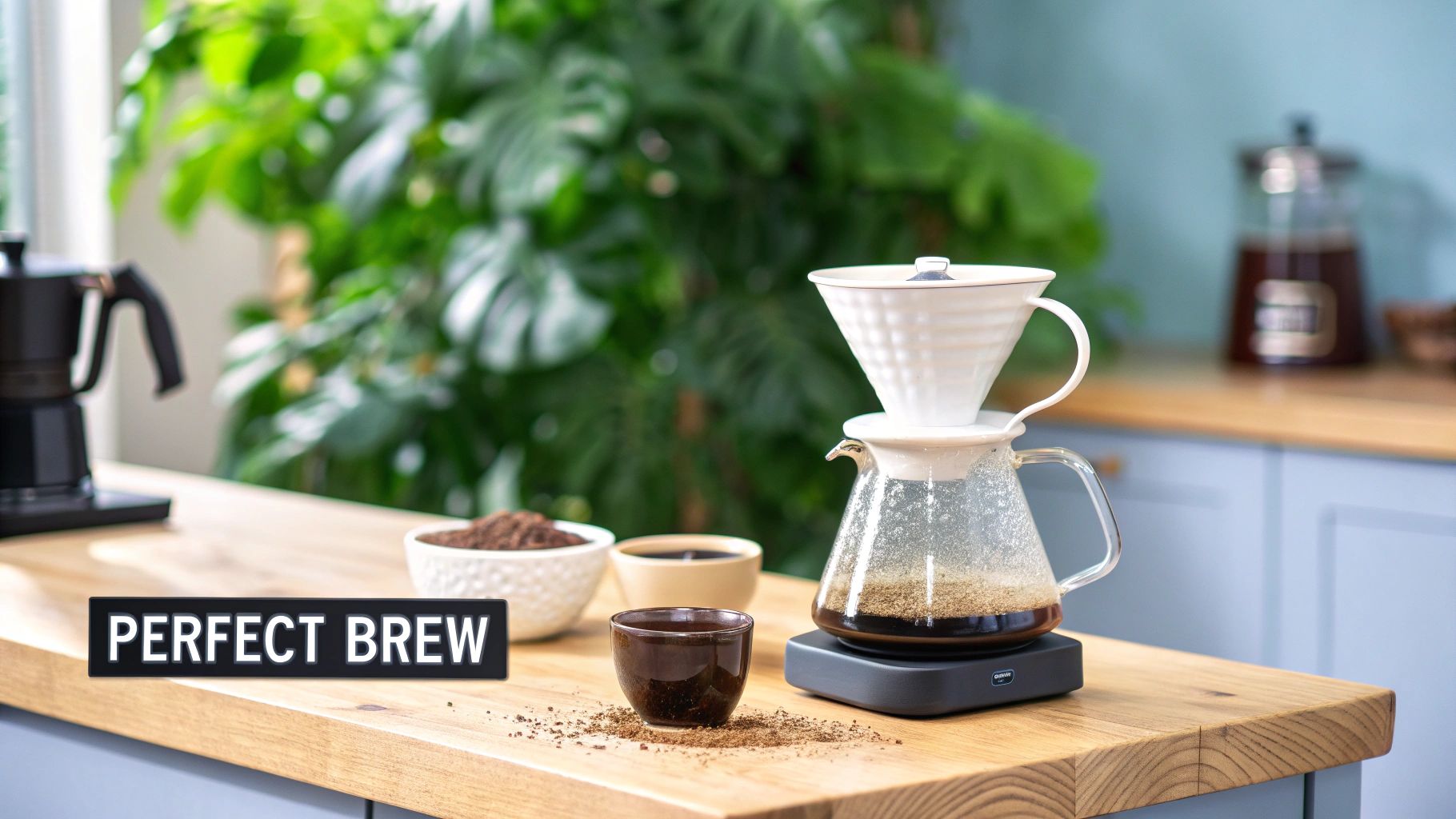
It all boils down to a few key fundamentals. Think of these as the non-negotiables for a great brew, no matter which coffee maker you use. Getting them right will make a night-and-day difference in how your coffee tastes.
Mastering the Brewing Fundamentals
Before you even touch your brewer, let's nail down the three core elements. They’re the foundation for a delicious, perfectly extracted cup, every single time.
- The Right Grind Size: This is all about controlling how quickly water flows through your coffee grounds. A finer grind means more surface area and faster extraction, while a coarser grind slows things down. If you don't match the grind to your brew method, you’ll end up with a cup that's either sour (under-extracted) or bitter (over-extracted). It’s a delicate balance.
- Perfect Water Temperature: Water that’s boiling hot will literally scorch your grounds, leaving a burnt, unpleasant taste. On the flip side, water that’s too cool just won’t pull out enough flavor, resulting in a weak, flat, and lifeless brew. The sweet spot is between 195°F and 205°F.
- Filtered Water Is a Must: Believe it or not, your coffee is 98% water, so the quality of your H2O is a massive deal. Always start with filtered water. This simple step ensures you're not introducing unwanted flavors from chlorine or other impurities hiding in your tap water.
And if you want to take your healthy coffee routine a step further, consider the best non-toxic coffee maker to keep your brew as pure as the beans themselves.
Choosing Your Ideal Brewing Method
Think of different brewing methods as different lenses—each one brings a unique characteristic of the same coffee bean into focus. High-altitude organic beans, like those in Peak Performance's Organic Coffee Varieties, are packed with complex, nuanced flavors. Your brewer is the tool that helps you decide which of those flavors you want to highlight.
For example, a pour-over brewer uses a paper filter, which catches most of the coffee's natural oils. The result? An incredibly clean, bright, and almost tea-like cup that lets delicate floral and fruit notes take center stage. It’s the perfect way to appreciate the subtle complexities of a single-origin bean.
A French press, on the other hand, is all about immersion. The grounds steep directly in the water, and with no paper filter, all those rich oils end up in your mug. This creates a bold, full-bodied cup with a heavy mouthfeel that really brings out the deeper chocolate and nutty notes.
Your brewing method is your final creative touch. It's how you decide which of the bean's inherent flavors you want to amplify, from bright and zesty to deep and robust.
To help you figure out where to start, here’s a quick look at how a few popular methods can shape your final cup.
Brewing Method Comparison for Organic Coffee
The way you brew can dramatically change the flavor and body of your coffee. This table breaks down how different methods highlight the unique notes in high-altitude organic beans.
| Brewing Method | Best For | Flavor Profile | Grind Size |
|---|---|---|---|
| Pour-Over | Highlighting bright, delicate notes and clarity. | Clean, crisp, bright, with nuanced acidity. | Medium-Fine |
| French Press | Creating a rich, full-bodied, and robust cup. | Bold, oily, rich, with a heavy mouthfeel. | Coarse |
| AeroPress | A versatile, quick brew with a smooth finish. | Smooth, low-acidity, and can be customized. | Fine to Medium |
| Drip Coffee Maker | Convenience and brewing larger batches. | Balanced, classic, and consistent. | Medium |
Ultimately, the best way to discover what you love is to experiment. By taking control of the grind, the water, and the technique, you can craft a cup of organic coffee that’s perfectly tailored to your own taste.
So, Why Peak Performance?
After digging into what really separates a decent organic coffee from a world-class one, the picture becomes a lot clearer. This isn't just about spotting a USDA seal on the bag. It’s about finding a brand that lives and breathes excellence at every single stage—from the elevation where the bean is grown to the final lab tests that prove its purity.
When you look at the entire journey, Peak Performance isn't just another option; it's the only one that checks every single box.
Our entire philosophy is built on standards that we simply won't compromise on. We don't just buy "organic" beans. We source them from the pristine, high-altitude slopes of the Guatemalan Highlands. Up there, the cooler air and rich volcanic soil force the coffee cherries to mature slowly, creating a harder, denser bean packed with complex, vibrant flavors you just can't get from coffee grown down the mountain. This is where greatness begins.
More Than Just a Certification
Our obsession with quality goes way beyond the farm. Every bean we source meets the strictest USDA Organic standards, which means no synthetic pesticides, nasty herbicides, or GMOs. Period. But for us, that certification isn't the finish line—it’s the bare minimum.
We know that true purity goes deeper. That's why we take the extra step of sending our beans for rigorous third-party lab testing. We screen for things other brands often ignore, like mold toxins (mycotoxins) and heavy metals. It’s a crucial step that ensures the coffee in your cup is not only incredibly delicious but exceptionally clean.
High-altitude sourcing, strict organic farming, and independent purity testing aren't just bullet points on a label. They’re the pillars of our promise to you: a coffee that supports your health, delights your taste buds, and truly elevates your daily ritual.
The Peak Performance Difference Is Real
If you're someone who refuses to compromise on health or taste, your search for the best organic coffee ends right here. We've obsessed over every detail we've talked about—from ethical sourcing to science-backed purity—to create a coffee that is genuinely in a league of its own.
Stop settling for "good enough" and start experiencing what a truly exceptional cup of coffee can do for your morning, your focus, and your overall well-being.
Elevate your daily grind and explore our lineup of Organic Coffee Varieties. You'll taste the difference that an unwavering commitment to quality makes from the very first sip.
Your Questions About Organic Coffee, Answered
Let's be honest, the world of "organic" can be confusing. When you're trying to find the best organic coffee, a lot of questions pop up. It’s important to get clear, real answers so you can feel good about what you’re putting in your body every morning.
We’re here to cut through the noise and give you the straight-up facts.
Is Organic Coffee Really Better for You?
Yes. It's not just marketing hype. The biggest win is what’s not in your coffee: synthetic pesticides, herbicides, and fertilizers. Conventional coffee is one of the most chemically-sprayed crops on the planet, and those residues don’t always wash away. Choosing USDA Organic certified coffee is your first line of defense.
But the best brands don't stop there. They also test for things like mycotoxins—nasty toxins that can grow on coffee beans—to guarantee a truly clean cup. Plus, the healthier, nutrient-dense soil used in organic farming often produces beans with more antioxidants, which are fantastic for fighting inflammation and supporting your overall health.
Does Organic Coffee Actually Taste Different?
Most of the time, it tastes worlds better. This isn't just because it's organic, but because of how it's grown. The best organic coffee is almost always grown at high altitudes.
Think of it like a fine wine. The beans mature slowly in the cool mountain air, making them harder and denser. This process packs them full of complex sugars and bright, nuanced flavors—something you just don't get from mass-produced, low-altitude coffee.
When you sip a high-quality organic coffee, you're tasting the true character of its origin. The clean soil allows the bean's natural notes—whether that’s a hint of chocolate, a touch of fruit, or a floral aroma—to come through loud and clear, without any chemical aftertaste.
What Should I Look For in an Organic Coffee Brand?
When you’re on the hunt, there are three things that separate the good from the great. If a brand nails these, you know you've found a winner.
- The USDA Organic Seal: This is non-negotiable. It’s your guarantee that the coffee was grown and processed without synthetic chemicals or GMOs, following strict federal rules.
- High-Altitude, Single-Origin Beans: Look for specifics on the bag. A brand that proudly states its beans are from a single-origin, high-altitude region (like the Guatemalan Highlands) is telling you they care deeply about flavor and quality.
- Third-Party Purity Testing: The truly elite brands are transparent. They go the extra mile to have their beans tested by independent labs for things like mycotoxins and heavy metals. This is the ultimate sign of a brand that puts your health first.
A coffee that checks all three boxes isn't just a beverage—it's a commitment to purity, flavor, and your well-being.
Ready to try a coffee that hits every single one of these quality marks? Peak Performance is USDA Organic, high-altitude, and third-party tested for purity. We make sure every sip is clean, delicious, and powerful.
Check out our Organic Coffee Varieties and taste the difference for yourself.
Also in Blog


Unlock Kids' Concentration: Calm Focus Boosts Learning


Probiotics for Bloating: 10 Ways to Evict Gas Bacteria

