


USDA Organic Certification Requirements Explained
When you see that familiar green and white USDA Organic seal on a bag of coffee or a carton of eggs, you're looking at more than just a piece of packaging. It’s a promise—a guarantee that what you're buying meets some seriously strict federal standards.
This isn't just about avoiding a few chemicals. It’s a whole system dedicated to ecological balance and biodiversity, from the moment a seed is planted to the final product on the shelf.
What The USDA Organic Seal Really Means
Think of the USDA Organic seal as a professional license for farmers and producers. Earning it takes a massive commitment to a specific, holistic approach to agriculture. It's a verified mark of quality, backed by a rulebook that leaves no room for shortcuts.
The whole show is run by the National Organic Program (NOP), a branch of the USDA. The NOP sets the gold standard, ensuring that the word "organic" means the same thing whether you're in California or Maine.
A Foundation of Trust
At its heart, the certification is all about trust built on verifiable practices. Before a farm can even think about getting certified, its land has to be free of all prohibited substances for at least three years. This isn't a suggestion; it's a hard-and-fast rule.
This three-year transition period is crucial. It’s a detox for the soil, flushing out old residues and preparing the ground for true organic farming. On top of that, farmers have to keep meticulous records of everything they do and welcome inspectors for an annual on-site audit.
Here’s the seal you should be looking for:
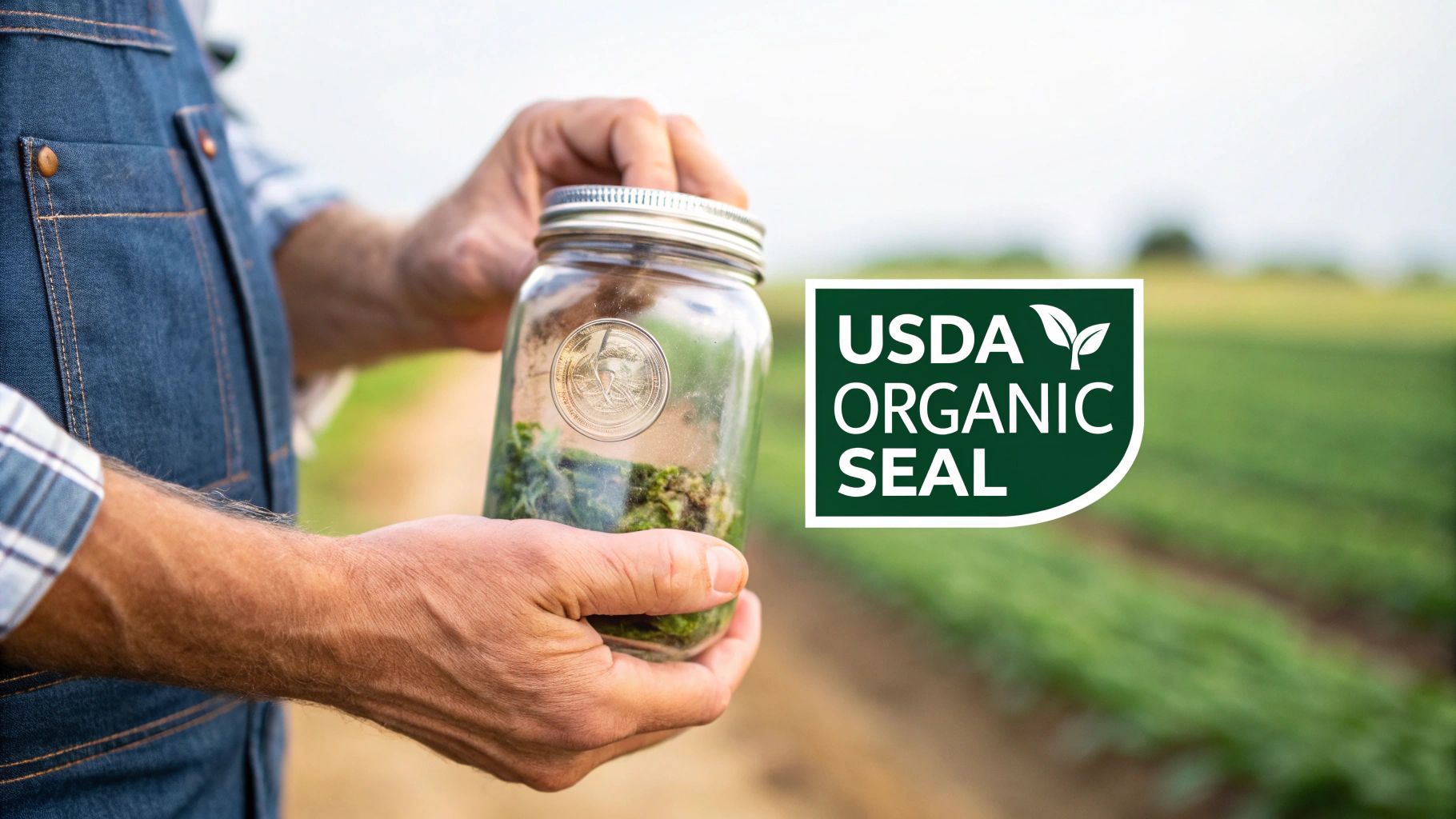
When you see this, you know the product contains at least 95% organic ingredients and has jumped through every hoop required by the NOP.
To give you a clearer picture, these are the fundamental pillars that all organic producers must build their operations on.
Core Principles of USDA Organic Standards
| Pillar | What It Means for Producers |
|---|---|
| Soil and Water Conservation | They must use farming methods that build soil fertility, prevent erosion, and protect water quality. |
| No Synthetic Inputs | Prohibited substances include most synthetic fertilizers, pesticides, and genetically modified organisms (GMOs). |
| Animal Welfare | Livestock must have access to the outdoors, be fed 100% organic feed, and not be given antibiotics or growth hormones. |
| Ecological Balance | Farmers are encouraged to promote biodiversity by maintaining natural habitats and using practices that support wildlife. |
| Supply Chain Integrity | Organic products must be protected from contamination with non-organic products from farm to store. |
These principles are non-negotiable and form the bedrock of the entire organic system.
Beyond the Farm Gate
The rules don't stop at the edge of the field. For a multi-ingredient product to wear the seal, every single step of its journey has to be compliant.
Take coffee, for example. From the high-altitude farm where the beans are grown to the roaster and the final packaging facility, every link in the chain must be certified organic. This ensures the integrity of the product is never compromised. If you're a coffee lover, you can see how this plays out in our guide to finding the best organic coffee brands for a pure brew.
It's a global standard, and its reach is massive.
"The organic community includes over 25,000 organic businesses in more than 120 different countries around the world, and the combined organic markets of the countries with which we have equivalency arrangements are valued at more than $50 billion."
This really puts into perspective just how significant that little green seal is. To get even deeper into reading food labels and understanding exactly what certified organic truly means, check out that guide. It’ll make you a much more confident and informed shopper.
Finding Your Place in The Four Scopes of Certification
When you think "organic," what comes to mind? For most people, it's a sprawling vegetable farm or an orchard bursting with apple trees. That’s a huge part of the picture, but the USDA organic certification actually covers the entire journey from the soil all the way to the store shelf.
To manage this complex process, the National Organic Program (NOP) breaks it down into four distinct categories, or scopes of certification.
Think of these scopes like different departments in a company. Each has its own set of rules and responsibilities, but they're all working toward the same mission. Figuring out your correct scope is the first, most important step, because it determines the exact checklist you'll need to follow to get certified.
The Four Main Scopes Explained
Let's break down where your business might fit in. Getting this right from the start makes the whole process so much simpler.
-
Crops: This is the one everyone knows. It applies to any operation that grows plants—from a small blueberry farm in Maine to a massive wheat field in Kansas. The rules here are all about building healthy soil, using proper seed sources, and managing pests without synthetic chemicals.
-
Livestock: This scope is for anyone raising animals for meat, milk, eggs, or other products. It covers everything from a dairy farm producing organic milk to a poultry operation with free-range chickens. The requirements are incredibly strict, demanding things like 100% organic feed, guaranteed access to the outdoors, and a complete ban on antibiotics and growth hormones. If you want to dive deeper into the differences between labels like "organic" and "grass-fed" in the dairy world, check out an agricultural expert's perspective on GMOs, glyphosate, and other labels.
-
Handling/Processing: This is a wide-ranging category for any business that takes an organic product and processes, packages, or labels it. If you're a coffee roaster using organic beans, a company that mixes organic salad greens, or even just a facility that bags up certified organic granola, this is you. The main goal here is to prevent any contact with non-organic products and ensure the integrity of the organic ingredients is protected at every step.
-
Wild Crops: This is the most unique scope, designed for operations that harvest plants from their natural, uncultivated habitats. Imagine a business that forages for certified organic mushrooms in a forest or harvests wild berries from a mountainside. The key is proving the land hasn't been treated with prohibited substances and that the harvesting is done in a sustainable way that doesn’t harm the environment.
By creating these four distinct paths, the USDA makes sure that every single type of operation is held to the same high standard. Your scope isn't just a box to check—it's the specific roadmap you'll follow to earn that coveted organic seal.
Your Step-By-Step Roadmap to Getting Certified
Getting USDA organic certification can feel like a massive undertaking. It’s a serious commitment that demands careful planning and a clear roadmap. To make it less daunting, we’ve broken the whole journey down into three distinct phases that will take you from your first day of transition to your final approval and beyond.
The process is intentionally strict—it has to be to protect the integrity of that little green and white seal we all look for. Once you understand the lay of the land, you can tackle the requirements with a lot more confidence.
Phase 1: The Transition and Application
The first step actually starts long before you ever fill out a single form. It begins with the land itself. Your farm or operation has to follow all organic practices and avoid every single prohibited substance for three full years before you can harvest your first certified organic crop. This is a non-negotiable transition period that gives the soil and the entire ecosystem time to cleanse and prepare.
After you've put in the time and met the land transition rules, your next big project is crafting your Organic System Plan (OSP). Think of the OSP as the master blueprint for your entire organic operation. It’s an incredibly detailed document that lays out exactly how you plan to follow every USDA organic regulation that applies to your business.
This plan needs to cover it all, from where you get your seeds and how you manage pests to the nitty-gritty of your record-keeping and how you'll prevent any cross-contamination.
Phase 2: The Inspection and Review
Once your application and OSP are submitted to a USDA-accredited certifying agent, it's time for the on-site inspection. A trained inspector will come out to your farm or facility to make sure what you’ve written in your OSP is what's actually happening on the ground. This isn't just a casual walkthrough; it's a comprehensive audit.
The inspector will comb through your records, watch your team in action, and assess whether you're truly sticking to the standards. This hands-on verification is a crucial checkpoint in the process.
The inspector isn't there to judge you; they are an objective, third-party verifier. They act as the certifier's eyes and ears, making sure every detail—from how you store materials to how you produce your goods—lines up with the strict USDA organic certification requirements.
After the visit, the inspector writes up a detailed report and sends it back to the certifying agent. The agent then does a final review of your application, your OSP, and the inspection findings to make the final call on certification.
Phase 3: Certification and Maintenance
Earning that organic certificate is a huge win, but it's really the starting line, not the finish. To keep your certification active, you'll need to update your OSP every year and prepare for an annual inspection to prove you’re still in compliance.
This is where meticulous record-keeping becomes your best friend. For farmers, the standards ban synthetic fertilizers and pesticides, GMOs, sewage sludge, and irradiation, pushing you to embrace natural methods and protect biodiversity. If you're raising livestock, your animals must have organic feed, access to the outdoors, and can't be given antibiotics or hormones. You have to document everything—from the seed you planted to the final harvest—and prove you’re keeping organic products separate to prevent contamination. You can dive deeper into these organic farming practices and standards on the USDA's official site.
This infographic gives a great overview of the different paths for certification, whether you’re in crops, livestock, or processing.
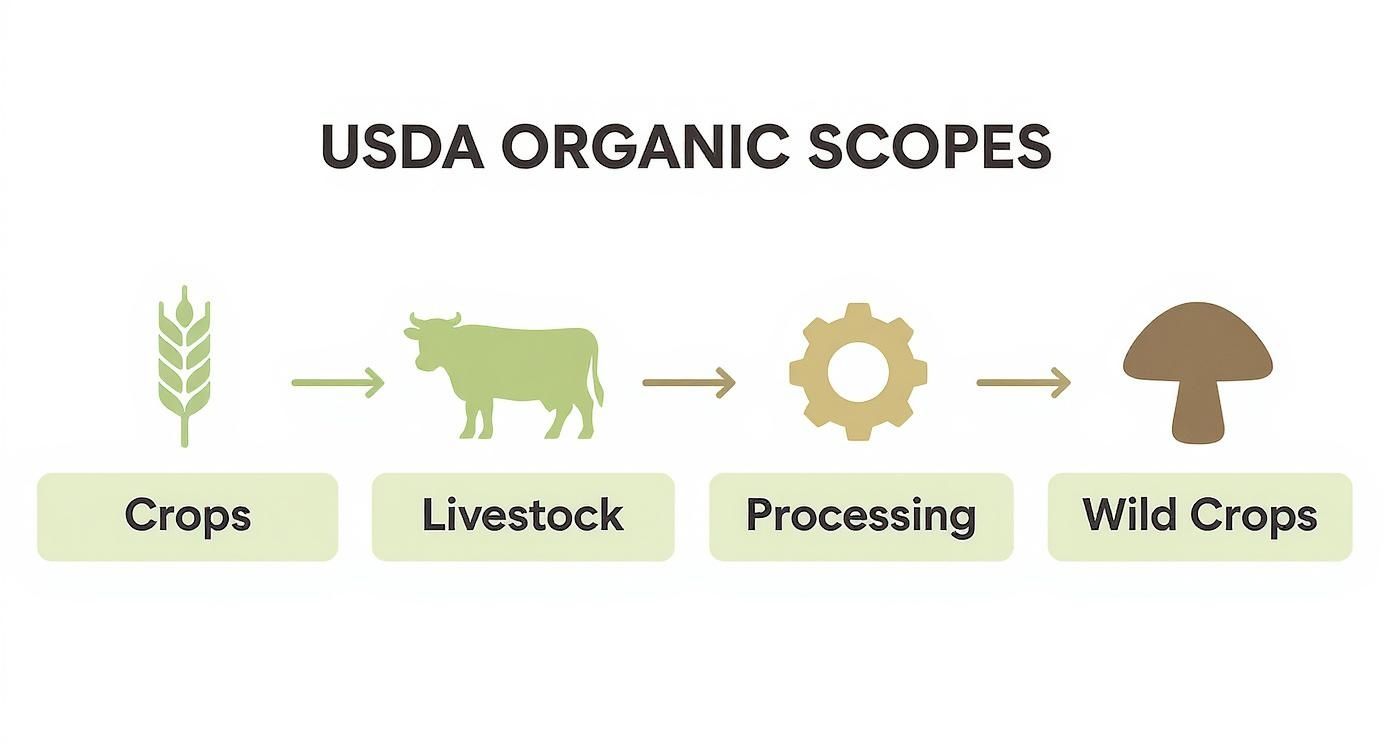
Each category has its own specific rulebook, but they're all held to the same incredibly high standard.
Mastering The Art of Compliance and Record-Keeping
Getting your USDA organic certification is a huge win, but keeping it is where the real discipline comes in. Long-term success is all about consistent compliance and, frankly, obsessive record-keeping. Think of your records as the official story of your product—a clear, auditable trail that proves your commitment to organic integrity, year after year.
I like to call this process "accounting for nature." Every single thing that comes in and goes out has to be tracked. This creates a transparent history that inspectors can easily follow all the way from the seed to the final sale. It’s this paper trail that turns an organic claim into a verifiable fact.

Building Your Audit-Proof Paper Trail
Your records are the absolute backbone of your annual inspection. If you don't have a complete, organized system, you’re setting yourself up for non-compliance. Your certifying agent is going to want to see a clear, unbroken chain of custody for everything organic you handle.
Here’s the kind of stuff you’ll need to have on hand:
- Input Records: This is everything you bring onto your farm or into your facility. We're talking seed purchase receipts, logs for soil amendments, and documentation for any approved pest control materials you use.
- Activity Records: These logs are your day-to-day diary. They should detail things like planting dates, when you turned your compost, and the history of what’s been grown in each field.
- Harvest and Sales Records: You’ll need to be meticulous here. Log your harvest dates, exact quantities, and storage details, along with every single sales transaction to track your certified products.
This level of detail is exactly what gives the USDA seal its weight and authority. It’s the same principle behind why some brands go the extra mile to validate their products' purity and potency, a concept we dive into in our article explaining what is third party testing.
Preventing Contamination and Commingling
One of the biggest compliance hurdles is preventing any contact between your organic products and non-organic stuff. This is called commingling, and it's a huge red flag for inspectors, especially if you handle both organic and conventional goods.
The inspector is going to look for hard evidence that you have systems in place to protect organic integrity at all times. This means dedicated storage areas, rock-solid equipment clean-out procedures, and unmistakable labeling to prevent any mix-ups.
A perfect example is a grain mill that processes both organic and conventional wheat. That mill must have a detailed clean-out log showing exactly when and how the equipment was purged of all conventional grain residue before the organic batch was run. No log, no proof.
On top of the organic rules, many processors also bring in frameworks like HACCP certification principles to build an even more robust system for overall food safety.
Surviving The Annual Inspection Cycle
Your annual inspection isn't a pop quiz. It’s an open-book test, and your records are the textbook. The key to a stress-free review is simply being prepared. The inspector is there to verify that what you do every day matches what you wrote in your Organic System Plan (OSP).
Here’s how to get ready:
- Get Organized: Have all your records from the past year sorted, labeled, and easy to find. Don't make the inspector hunt for anything.
- Review Your OSP: Take an hour to read through your plan. Do your current practices still line up perfectly with what's written down? If not, make a note of it.
- Walk Your Own Operation: A week before the real thing, do a self-audit. Walk through your fields or facility with the eyes of an inspector to spot and fix any potential problems ahead of time.
When you really get the hang of record-keeping, you're not just ensuring compliance. You're building a stronger, more resilient, and more trustworthy organic business from the ground up.
Understanding The Costs and Finding Financial Support
Let's talk money. Getting USDA organic certification is a serious investment in your business, but you need to go in with your eyes wide open about the costs. It's not just a one-time application fee—it's a commitment to a whole new way of doing things.
The initial hit to your wallet will include things like application and inspection fees. You might also have to cover the inspector's travel, which all together can run anywhere from a few hundred to several thousand dollars. It really just depends on how big and complex your operation is.
Breaking Down The Certification Expenses
But the costs don't stop with the fees you pay your certifier. You have to factor in other expenses, too. Organic inputs, like special fertilizers or certified organic feed for your animals, almost always cost more. You also need to account for the time and brainpower that goes into keeping meticulous records and training your team to stay on top of the rules.
Think of these costs as the price of admission for integrity. This is what funds the whole system—the inspections, the paperwork, the oversight—that makes the USDA Organic seal one of the most trusted labels on the shelf.
The total cost of certification is a key part of the USDA organic certification requirements. It ensures the entire system, from certifiers to inspectors, has the resources to uphold the strict standards that give the organic label its value.
The good news? You don't have to shoulder this burden alone. The USDA and other groups have programs specifically designed to help producers like you make the leap without breaking the bank.
Accessing Financial Support and Cost-Share Programs
The biggest one you need to know about is the USDA's Organic Certification Cost Share Program (OCCSP). This program is a total game-changer, especially for small and mid-sized farms. It’s set up to pay you back for a big chunk of your certification costs.
Here’s the breakdown:
- Reimbursement: You can get reimbursed for up to 50-75% of your certification costs. There's a maximum amount for each type of certification you have (like crops or livestock).
- Eligibility: You just need to have a valid USDA organic certificate to apply.
- Application: You’ll typically go through your state's Department of Agriculture or a local Farm Service Agency (FSA) office to get the ball rolling.
The USDA is also putting its money where its mouth is when it comes to helping farmers transition to organic. Through programs like the Environmental Quality Incentives Program Organic Transition Initiative, the agency pumped $12.1 million into covering over 15,700 acres in fiscal year 2023 alone.
They also subsidized more than 10,600 organic crop insurance policies in 2022 to help farmers manage financial risk. You can dig deeper into the USDA's support for the organic sector and its outlook. All of this shows a clear commitment to helping farmers and producers win in the growing organic market.
Common Questions About USDA Organic Certification
Getting into the world of organic certification can feel like learning a new language. You're bound to have questions.
Getting clear, straightforward answers can be the difference between a smooth ride and a bumpy one. Let's tackle some of the most common questions farmers and producers have when they start down this path.
How Long Does It Take to Get USDA Organic Certified?
This is where most people get surprised. The biggest time commitment isn't the paperwork—it's the land itself. Your fields must be completely free of all prohibited substances for 36 consecutive months before you can harvest your first certified organic crop.
Once you’ve cleared that critical three-year hurdle and sent in your application, the certification process itself usually takes another three to six months. The exact time depends on how complex your operation is and how booked up your certifying agent is.
Can I Use the Term Organic Without Being Certified?
There's one very specific exception to this rule. If your farm or business brings in less than $5,000 in gross annual income from organic sales, you're considered an "exempt" operation.
You can label your products as "organic," but you absolutely cannot use the official USDA Organic seal. You also can't market your products as "certified organic." Any operation grossing over $5,000 a year has to go through the full certification process to make any organic claims.
This $5,000 exemption is really designed to help the smallest local producers get a foot in the door without the financial hurdle of full certification. But it comes with very clear lines you can't cross in your marketing.
What Is an Organic System Plan?
The Organic System Plan, or OSP, is the absolute heart of your application. Think of it as the detailed rulebook for your entire operation, explaining exactly how you'll follow USDA organic regulations from seed to sale.
This document has to cover every single part of your process, including:
- Land History and Management: You'll detail what your land was used for in the past and how you plan to build healthy soil now.
- Inputs and Pest Control: This is where you list every seed, soil amendment, and pest control method you intend to use.
- Record-Keeping Systems: A clear outline of how you'll track everything—activities, inputs, sales, and harvests.
- Contamination Prevention: You have to describe the specific steps you'll take to keep your organic products from ever touching non-organic materials.
What Happens if an Inspector Finds a Problem?
The whole point of an inspection is to help you stay in compliance, not to punish you. If an inspector spots a minor issue, you'll typically get a letter detailing the problem and giving you a deadline to fix it. All you have to do is show proof that you've corrected it.
For more serious violations, your certifier might issue a Notice of Proposed Suspension or Revocation. But even then, they almost always work with producers to find a solution. It's the willful violations—knowingly breaking the rules—that will get your certification pulled and could lead to financial penalties.
At Peak Performance, we live and breathe the commitment required for USDA organic certification every single day. Our entire line of superfoods, from our Organic Greens powder to our high-altitude coffee, is built on a foundation of purity, transparency, and tough third-party testing. We do the hard work of sourcing and verification so you can fuel your body with clean, potent nutrition you can actually trust.
Explore our collection of USDA Certified Organic products and feel the Peak Performance difference.
Also in Blog


How to Increase Stamina Naturally and Boost Energy


How to Increase Energy Naturally

