


How to Increase Endurance Fast: A Proven Training Guide
If you want to boost your endurance fast, the formula is refreshingly simple. You need to combine smart, targeted training—the kind that builds both your aerobic base and your top-end speed—with a solid nutrition and recovery plan. It’s all built on the bedrock of consistency and progressive overload.
This isn’t about just grinding out more miles. It’s about training smarter to see real, noticeable gains in stamina in just a few weeks.
Your Blueprint for Rapid Endurance Gains

Forget the vague advice to "just run more." Building real-world endurance quickly demands a structured, intentional plan. True stamina isn’t just one thing; it’s the sum of your body's systems working together in beautiful harmony. This guide is your roadmap to getting that synergy right, focusing on the core pieces that drive fast, sustainable results.
At the heart of any solid endurance plan are two pillars. Both are non-negotiable.
- Aerobic Endurance: This is your engine. It’s your body's ability to keep going during long, low-to-moderate intensity efforts. You build it by teaching your heart, lungs, and muscles to efficiently use oxygen to burn fat for fuel. Think long, steady runs or bike rides.
- Muscular Endurance: This is what keeps you from hitting a wall. It’s a specific muscle's ability to fire over and over again without fatiguing. It’s what prevents your legs from feeling like lead on that last hill or your arms from giving out during a long swim.
Training both is essential. If you only do long, slow miles, you’ll build a base but have no gears to shift into when the pace picks up. On the flip side, doing only high-intensity work without a solid aerobic foundation is a fast track to injury and burnout.
The Core Principles of Fast Gains
To see rapid improvements, your entire approach needs to be governed by two principles: consistency and progressive overload.
Consistency is just about showing up. One killer workout followed by a week on the couch won’t move the needle. Real, lasting adaptation comes from the cumulative effect of regular training.
Progressive overload is the secret sauce. It means systematically and gradually increasing the demands on your body, forcing it to adapt and get stronger. This isn’t just about adding more miles. It can mean increasing intensity, cutting down rest periods, or adding more resistance. This guide will show you how to apply these principles to everything you do.
And while we're talking about training, don't sleep on the mental game. Your body can do more than your brain thinks it can, so learning how to improve mental stamina is just as critical for pushing through those barriers.
Here’s a quick look at how you might structure a week to put these principles into practice.
Sample Weekly Endurance Training Framework
This schedule is designed to blend different training intensities to accelerate your endurance development. It's a template you can adapt to your own sport and schedule.
| Day | Workout Focus | Example Activity | Goal |
|---|---|---|---|
| Monday | Active Recovery | 30-45 min easy spin or jog | Promote blood flow, reduce soreness |
| Tuesday | High-Intensity Intervals (HIIT) | 8 x 400m sprints with 90s rest | Boost VO2 max and top-end speed |
| Wednesday | Muscular Endurance | Full-body strength training | Build strength to resist fatigue |
| Thursday | Tempo/Threshold | 20-30 min run at a "comfortably hard" pace | Increase lactate threshold |
| Friday | Rest or Active Recovery | Full rest day or light stretching | Allow the body to adapt and rebuild |
| Saturday | Long, Slow Distance (LSD) | 60-90 min run/ride at a conversational pace | Build aerobic base and fat-burning efficiency |
| Sunday | Rest or Cross-Training | Full rest day or light swimming/yoga | Maintain fitness without impact |
Mixing these different types of workouts ensures you're developing every aspect of your endurance, from your aerobic engine to your anaerobic power, leading to faster and more well-rounded improvements.
The secret to getting ahead is getting started. The secret of getting started is breaking your complex overwhelming tasks into small manageable tasks, and then starting on the first one. - Mark Twain
Think of this guide as your actionable framework. We're about to dive into the specific workouts, evidence-backed fueling strategies, and essential recovery techniques that will make it all happen. If you’re ever curious about taking things to the absolute extreme, our guide on ultra-endurance shows you how to tap into your inner superpowers.
Let’s get started.
Building Your Aerobic Engine with Foundational Training

If you're wondering how to increase endurance fast, the answer might feel a little backward. It’s not about grinding out every single workout until you can barely walk. The real secret to making rapid, sustainable gains is actually about spending a lot of time going slow.
The foundation of truly elite stamina is a massive aerobic engine. I like to think of it like building a house—the wider and stronger the base, the taller you can build. High-intensity workouts are the flashy upper floors, but without a solid foundation, the whole structure is unstable.
The Power of Zone 2 Training
This foundational work happens in what we call Zone 2, which is a low-intensity effort where you can still comfortably hold a conversation. For most people, that's somewhere around 60-70% of their max heart rate. It feels easy, almost too easy, and that’s precisely why so many people skip it.
But this is where the real magic happens.
Training in Zone 2 is the most effective way I know to stimulate mitochondrial growth. These are the tiny power plants inside your cells. The more you have—and the more efficient they are—the better your body gets at using oxygen to produce energy.
This type of training also fundamentally rewires your metabolism. It teaches your body to become a fat-burning machine, which spares your limited glycogen (stored carbs) for when you really need it—like that final kick in a race or a tough high-intensity interval. For a deeper dive into this, check out this piece on the link between metabolic flexibility and VO2 max.
The great paradox of endurance training is that you have to go slow to ultimately get fast. Building a huge aerobic base is the non-negotiable first step to unlocking your potential and being able to handle the intense work that leads to breakthroughs.
This isn't a new idea. The legendary coach Arthur Lydiard completely changed endurance training back in the mid-20th century by putting a huge emphasis on building this aerobic base. His athletes would dedicate 70-90% of their training to high-volume, low-intensity work, proving this approach was the key to world-class results.
How to Structure Your Base Building
So, how do you actually put this into practice? The goal is simple: spend most of your weekly training time in Zone 2. A great starting point is to dedicate two or three sessions a week just to this kind of steady-state cardio.
- Determine Your Zone 2: The easiest method is the "talk test." You should be able to speak in full sentences without gasping. If you have a heart rate monitor, aim for that 60-70% range of your max heart rate.
- Choose Your Activity: Running, cycling, swimming, rowing—even a brisk walk on a steep incline—all work perfectly. The goal is just to maintain that consistent, low-intensity effort.
- Focus on Duration: Start with sessions around 45 to 60 minutes. As you get fitter, you can start extending one of these sessions into a longer workout of 90 minutes or more.
The biggest mistake I see people make is ramping up their volume too quickly. This is the fastest way to get burned out or injured, which completely defeats the purpose.
A safe and time-tested guideline is the 10% Rule. Simply put, don't increase your total weekly training volume (whether you measure by time or distance) by more than 10% from one week to the next. For instance, if you trained for 120 minutes this week, you'd aim for no more than 132 minutes next week.
This gradual progression gives your body's connective tissues—your tendons and ligaments, which adapt much slower than your cardiovascular system—the time they need to strengthen. It’s a patient approach, but it’s the fastest way to build a durable, powerful aerobic engine that will launch all your future performance goals.
Sharpening Your Edge with High-Intensity Interval Training
After a few weeks of building your aerobic engine, it's time to bring in the secret weapon for getting faster, quick: intensity. That foundational training makes you durable, but high-intensity interval training (HIIT) is what makes you fast. This is where you really sharpen the blade.
Think of your aerobic base as the size of your engine. HIIT is the turbocharger. It forces your body to adapt to working at its absolute limits, triggering powerful changes that steady-state cardio just can't match. By pushing yourself into the red for short, controlled bursts, you seriously upgrade your body's ability to use oxygen and clear out all that metabolic gunk that slows you down.
This isn't just about "feeling the burn"—it's a systematic upgrade to your performance potential.
Why Short Bursts Deliver Big Results
High-intensity work directly targets two of the most critical markers for endurance: your VO2 max and your lactate threshold. Your VO2 max is basically the ceiling for how much oxygen your body can use when you're going all out. HIIT is arguably the most potent way to raise that ceiling, which lets you sustain harder efforts for much longer.
At the same time, these workouts train your lactate threshold. That's the point where lactic acid floods your muscles faster than you can clear it, causing that familiar burn and forcing you to hit the brakes. By training right at or even above this threshold, you teach your body to get way more efficient at clearing lactate. You're effectively pushing your personal red line further and further out.
Implementing HIIT Without Burning Out
Here's the key to making HIIT work for you: the efforts have to be hard, but the sessions need to be brief and infrequent. HIIT puts a massive amount of stress on your system, which is why you only need one or two of these workouts a week to see huge benefits. Any more than that is a fast track to overtraining, or worse, getting injured.
The structure is simple: a short, all-out effort, followed by a period of recovery. The real magic is in the work-to-rest ratio, which you can tweak based on what you're trying to achieve.
One of the most legendary examples of this comes from running history. Roger Bannister's historic sub-4-minute mile back in 1954 was powered by a low-volume, high-intensity training plan. His key workouts often involved just 6-8 repetitions of 400 meters at a blistering pace. It was a strategy that proved the incredible power of intensity, and you can dive deeper into the history of this type of training to see how these ideas have evolved.
The goal of high-intensity training isn't to rack up miles; it's to create a powerful stimulus for your body to adapt. The quality of effort you put into each interval is far more important than the total time on your watch.
Proven HIIT Workouts You Can Steal
Here are a few classic HIIT protocols you can adapt to running, cycling, rowing, or pretty much any other cardio you do. Just make sure you always start with a solid 10-15 minute warm-up and finish with a proper cool-down.
-
Classic 400-Meter Repeats: This is the workout that helped make Bannister a legend. After your warm-up, run 400 meters (one lap on a standard track) at a very hard pace. Recover with 400 meters of slow jogging or walking. Aim for 4-8 repeats.
-
Tabata Protocol: Brutally effective and incredibly fast. The structure is 20 seconds of maximum-intensity work followed by 10 seconds of complete rest. Repeat for 8 rounds, which is just four minutes of actual work. You can do this with sprints, on a stationary bike, or even with bodyweight moves like burpees.
-
Hill Sprints: Find a moderately steep hill that takes you between 30-60 seconds to sprint up. Go hard on the way up, then use the slow walk or jog back down as your recovery. Shoot for 6-10 repeats. This one is a killer for building both explosive power and muscular endurance.
For any of these to work, your "on" intervals need to feel like an 8 or 9 on a 1-10 scale of effort. And don't skimp on the recovery—it's what allows you to hit that next interval with the same high quality.
By strategically slotting one or two of these sessions into your week, you perfectly complement your aerobic base work. That combination of low-intensity volume and high-intensity sharpening is the fastest, most effective way to build well-rounded, unbreakable endurance.
Combining Volume and Intensity with Polarized Training
So far, we’ve covered two critical, yet seemingly opposite, training concepts. One is building a massive aerobic engine with slow, steady volume. The other is sharpening your top-end speed with short, intense intervals.
The real question is, how do you put them together without running yourself into the ground? The answer is a training philosophy that’s become the gold standard for rapid endurance gains: polarized training.
This isn't about finding some mushy middle ground. In fact, it’s the exact opposite. Polarized training is all about spending the vast majority of your time at very low intensities and a small, targeted chunk at very high intensities—while strategically avoiding that “moderate” gray zone in between.
The Power of the 80/20 Rule
At its core, polarized training follows the 80/20 rule. This means about 80% of your weekly training is spent in that low-intensity Zone 2, building the deep aerobic base we talked about. The other 20% is dedicated to high-intensity work, like HIIT sessions designed to crank up your VO2 max and lactate threshold.
Why does this work so ridiculously well? Because it lets you get the absolute maximum benefit from both ends of the spectrum. The low-intensity days are easy enough to build mitochondrial density and promote recovery without piling on stress. This leaves you feeling fresh and ready to go all-out on your high-intensity days, ensuring you hit the precise stimulus your body needs to adapt.
This model consistently outperforms plans heavy on moderate-intensity work—what many of us call "junk miles." You know the ones: too hard to be truly easy, but too easy to be truly hard. They just leave you tired without providing a strong signal for improvement.
The proof isn’t just anecdotal; it’s backed by a mountain of data from the world's best athletes. A deep dive into their training logs reveals that a polarized model—typically 70-90% low-intensity training paired with 10-30% high-intensity work—is the fastest way to build stamina. A 2023 review even confirmed that steady, year-over-year increases in low-intensity volume are the primary driver of long-term performance gains. You can geek out on the full research on this training model to see the data for yourself.
Adding Muscle Endurance to the Mix
Aerobic fitness is only one side of the coin. If you really want to increase endurance fast, you also have to build muscular endurance—your muscles' ability to fight off fatigue and keep firing, mile after mile.
This is where targeted strength training comes in.
Slotting in one or two strength sessions per week doesn't just make you stronger; it makes you far more efficient. A stronger core, legs, and upper body improves your form and economy, meaning you burn less energy to hold the same pace. That translates directly to going faster for longer.
You'll want to focus on big, compound movements that mimic what you do in your sport.
- For Runners: Squats, lunges, and calf raises are your best friends for building leg strength and stability.
- For Cyclists: Deadlifts and leg presses develop serious power in your glutes and quads.
- For Swimmers: Pull-ups and rows are perfect for building that critical upper-body pulling strength.
The trick is to aim for higher reps (12-15 per set) with shorter rest periods. This specifically targets muscular endurance, not just brute strength.
A 4-Week Progressive Polarized Training Template
Okay, let's put this into a concrete plan. Here’s a sample template showing how you can structure your training over four weeks, progressively increasing the load. This is easily adaptable whether you’re a runner, cyclist, or swimmer.
4-Week Progressive Polarized Training Template
| Week | Low-Intensity Sessions (LIT) | High-Intensity Sessions (HIT) | Strength Session |
|---|---|---|---|
| Week 1 | 2-3 sessions (e.g., 45-60 min) | 1 session (e.g., 4 x 400m repeats) | 1 session (full body) |
| Week 2 | 3 sessions (increase long day by 10%) | 1 session (e.g., 5 x 400m repeats) | 1 session (full body) |
| Week 3 | 3 sessions (increase long day by another 10%) | 2 sessions (e.g., 6 x 400m; 4 min Tabata) | 1 session (full body) |
| Week 4 | Deload Week - 2 sessions (reduce all by 40-50%) | 1 very light session or none | 1 light session or none |
Think of this table as your roadmap. By balancing the high-volume, low-intensity work with sharp, high-intensity intervals and targeted strength training, you create the perfect storm for your body to adapt and get stronger, faster than you thought possible.
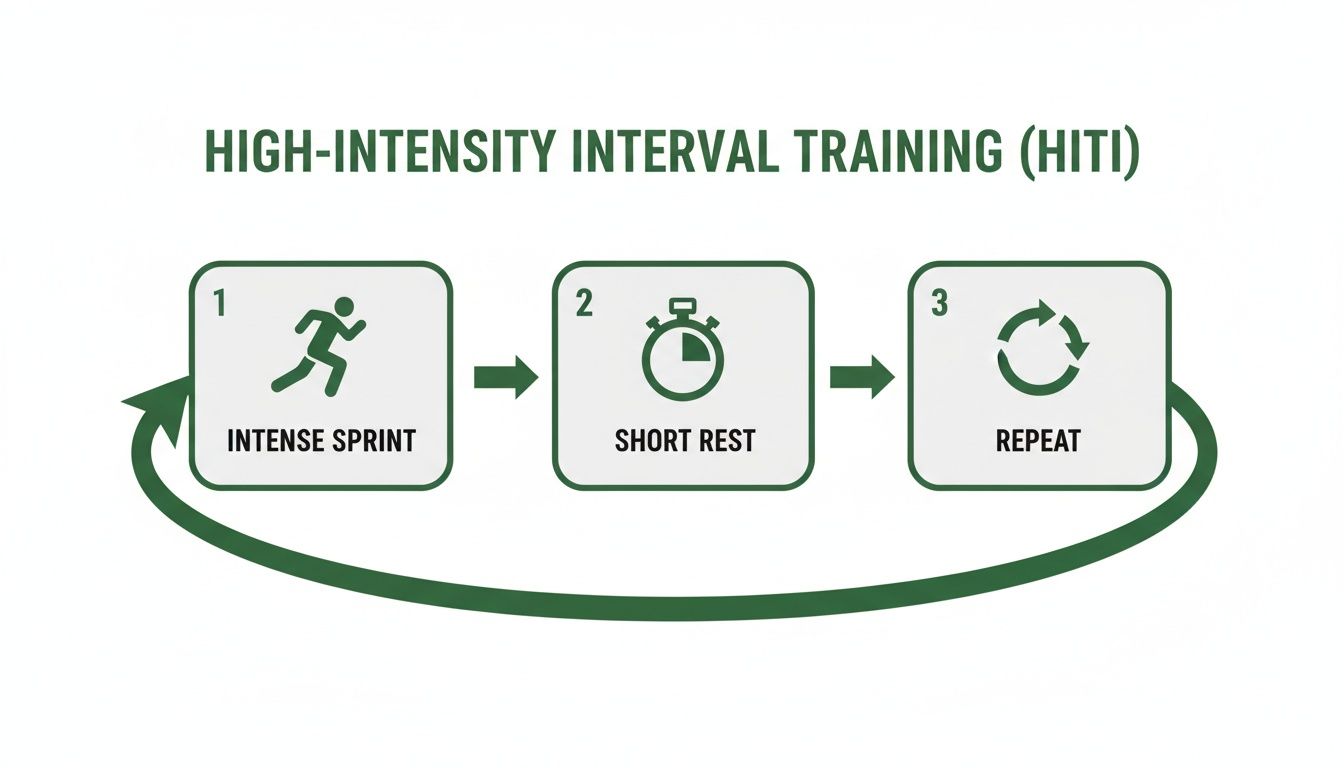
This simple but powerful structure is the engine of that "20%" high-intensity portion of your plan. The cycle of all-out effort followed by a quick recovery is what drives those rapid fitness adaptations we’re after.
Fueling Your Body for Peak Performance
All the intense training in the world is only half the battle. When you push your body hard, you're essentially breaking it down. It's the fuel you put back in that rebuilds it—stronger, fitter, and more resilient than before. Your body is a high-performance engine, and even the best engines sputter out with the wrong kind of fuel.
This isn't just about "eating clean." It’s about being strategic—nailing the timing and getting the right balance of macronutrients. Getting this right is what turns all that sweat and effort into real, tangible gains in your endurance.
Timing Your Fuel for Maximum Impact
What you eat, and just as importantly, when you eat it, can make or break your performance and recovery. For anyone serious about endurance, there are three key windows to focus on: pre-workout, intra-workout, and post-workout. Each one has a specific job to do in your mission to get fit, fast.
A classic mistake is going into a tough session on an empty tank. About 1-2 hours before you start, your goal should be to top off your glycogen stores with some easily digestible complex carbs. This is your body’s go-to fuel for high-intensity work, and having plenty available ensures you can push hard from the get-go.
Think simple: a small bowl of oatmeal with some berries or a banana with a piece of whole-wheat toast. These give you that sustained energy release without weighing you down.
Fueling During Long Sessions
Once your workout stretches past the 90-minute mark, what you consume during the session becomes critical. This is typically when your glycogen stores start to run low, leading to that dreaded feeling of "hitting the wall." To sidestep that, you need to refuel on the move.
Aim to take in 30-60 grams of carbohydrates per hour. You can get this from energy gels, chews, or sports drinks. Don’t forget about electrolytes, either. During long, sweaty efforts, replacing lost sodium and potassium is essential for preventing cramps and keeping your muscles firing properly.
The Critical Post-Workout Window
The clock doesn't stop when your workout does. That 30-60 minute window immediately after you finish is prime time for recovery. Your body is like a sponge during this period, ready to soak up nutrients to replenish energy and repair all that muscle tissue you just worked.
The magic formula for a recovery meal or shake is a carb-to-protein ratio of about 3:1 or 4:1. Carbs are crucial for restocking muscle glycogen, and protein delivers the amino acids needed for muscle repair and growth. A smoothie with fruit and protein powder or a simple meal like chicken and rice works perfectly. For a more dialed-in plan, personalized nutrition consultations can provide strategies built around your specific body and goals.
Skipping post-workout nutrition is like winning a race and walking away from the trophy. You've done the hard part; fueling correctly is how you lock in the gains and show up even stronger next time.
Supplements That Provide an Edge
Your diet should always be built on a foundation of whole foods, but a few evidence-backed supplements can give you a real performance advantage. They aren't shortcuts, but when used strategically, they can help you push harder and bounce back faster.
- Caffeine: A tried-and-true performance booster. Caffeine can actually lower your perception of effort, meaning you can dig deeper for longer. Taking it about 30-60 minutes before a workout can give you that extra gear. Our Peak Performance Pre-Workout contains an optimal dose of organic caffeine for clean, sustained energy.
- Beta-Alanine: This amino acid acts as a buffer against lactic acid buildup in your muscles, which helps delay fatigue during those really intense, all-out efforts. It’s a game-changer for interval training and sprints.
- Beetroot: Packed with nitrates, beetroot is known to improve blood flow and oxygen efficiency—two things that directly support aerobic endurance. To learn more, check out the powerful benefits of our Organic Beet Root Powder.
Peak Performance pre-workout formulas are crafted with ingredients like these to deliver clean energy and focus for your most demanding sessions. By combining a smart whole-foods strategy with targeted supplementation, you create the perfect internal environment to get the most out of every single workout.
Accelerating Gains with Smart Recovery
You can train as hard as you want, but the real magic doesn't happen during the workout. That’s just the stimulus. The actual, lasting gains in your endurance are forged when you rest.
Think of it like this: your workouts are where you place an order for more stamina; recovery is when your body actually builds and delivers it.
Without smart recovery, you're just spinning your wheels and digging yourself into a hole. You’ll rack up fatigue, elevate your risk of injury, and watch your progress grind to a halt. The secret to getting faster, quickly, is learning to recover as hard as you train.
Why Sleep Is Your Ultimate Performance Enhancer
Let’s be clear: no supplement, gadget, or secret hack can come close to the power of quality sleep. It is, without question, the most potent recovery tool you have at your disposal. While you’re sleeping, your body gets to work, pumping out growth hormone to repair damaged muscle and cementing all the hard work you put in.
Shooting for 7-9 hours of quality sleep a night isn’t a luxury—it’s a non-negotiable part of your training. Skimp on it, and you’re disrupting hormones, messing with your ability to store fuel (glycogen), and leaving yourself physically and mentally fried for your next session.
Training breaks you down. Sleep is what builds you back up, stronger and faster than before. If you’re serious about rapid gains, you have to get just as disciplined about your bedtime as you are about your workouts.
Dialing in your sleep hygiene can be a game-changer. Here are a few simple things you can do tonight:
- Make Your Room a Cave: It needs to be pitch-black, quiet, and cool. Blackout curtains, an eye mask, or a simple fan can make a world of difference.
- Power Down Your Screens: The blue light from your phone, TV, and computer directly interferes with melatonin, the hormone that tells your body it's time to sleep. Put them away at least an hour before bed.
- Stick to a Schedule: Going to bed and waking up around the same time—even on weekends—is one of the best ways to support your body's internal clock.
The Power of Active Recovery
Recovery doesn't always mean being a couch potato. On your off days, a bit of gentle, low-intensity movement can actually speed up the healing process. We call this active recovery, and its main job is to get blood flowing to your tired muscles.
This boost in circulation delivers fresh oxygen and nutrients where they're needed most and helps flush out the metabolic junk that leaves you sore. It's a great way to combat DOMS (Delayed Onset Muscle Soreness).
A few solid active recovery options include:
- A light, 20-30 minute jog or easy spin on a bike
- Foam rolling your quads, hamstrings, and glutes
- A gentle yoga or stretching session
- A relaxed swim in a pool
Learn to Listen to Your Body
At the end of the day, the most advanced recovery tool you'll ever have is your own intuition. You have to learn to recognize the signals your body is sending you.
Are you feeling wiped out all the time? Is your motivation in the tank? Is your resting heart rate higher than normal when you wake up? Are you catching every cold that goes around? These are classic signs of overtraining, and your body is screaming for a break.
Don't be a slave to the plan. Sometimes the smartest workout you can do is no workout at all. Taking an extra rest day isn't a sign of weakness—it’s the mark of a smart athlete who knows progress only happens when you give your body the time it needs to adapt and come back stronger.
Your Top Endurance Questions, Answered
Even with the best plan laid out, you're bound to have questions. It's part of the process. Let's tackle some of the most common ones I hear from athletes trying to build endurance on a tight timeline. Getting these answers straight will help you stay the course and get the most out of your training.
How Quickly Can I Expect to See Real Progress?
If you commit to a structured plan like the polarized model we've covered, you’ll likely feel a real, noticeable shift in your stamina and aerobic power within 4 to 6 weeks.
Of course, your personal starting point, how consistent you are, and how well you manage your nutrition and recovery all play a huge role. The magic is in the consistency. Some weeks you'll feel like you can fly, and others, you'll feel like you're running through mud. That's normal. Trust that the adaptations are happening under the surface, even when it doesn't feel like it.
Can't I Just Run Longer to Build Stamina?
Going long and slow is absolutely essential—it builds the foundation, your aerobic base. But if you want to get faster, fast, it's only half the battle.
To really move the needle, you have to inject some high-intensity work. Those interval sessions are what jack up your VO2 max and push your lactate threshold higher. In simple terms, that's what allows your body to hold a faster pace for a longer time without blowing up.
A big aerobic base gives you the capacity to do the hard work. But it's the hard work that actually makes you faster. If you neglect one for the other, you're leaving a ton of speed on the table.
What Are the Biggest Mistakes People Make?
I see two major pitfalls all the time. The first is jumping into a bunch of high-intensity training too soon, without a solid aerobic foundation to support it. That's a fast track to injury and burnout.
The second is spending too much time in that moderate-intensity "gray zone." You know, the pace that's not quite easy but not quite hard. This kind of training just makes you tired without providing much real benefit. An 80/20 polarized approach solves both problems by forcing your easy days to be truly easy and your hard days to be truly hard. No middle ground.
Do I Really Need to Strength Train for Endurance?
One hundred percent, yes. Strength training isn't just for bodybuilders; it’s a game-changer for endurance athletes. It builds muscular endurance, which is just a fancy way of saying it helps your muscles fight off fatigue for longer.
When your muscles are stronger, your running or cycling economy improves—you use less energy to maintain the same pace. Plus, a stronger, more stable body is a more resilient body, which is key to preventing the injuries that can derail your consistency.
To handle this kind of training, you have to give your body the right fuel. High-quality, organic nutrition isn't a luxury; it's a necessity. Peak Performance offers everything from potent superfood blends for energy to clean proteins for recovery, all designed to support your hard work. Check out our full line of USDA Organic supplements and superfoods at buypeakperformance.com.
Also in Blog


The "Ghost Wipe": Top 10 Ways Psyllium Upgrades Your Bathroom Routine


The "Gut Glue": Top 10 Ways CoreBiome Seals Leaky Gut Syndrome


A Practical Guide to the 36 Hour Water Fast in 2026
Unlock metabolic renewal with our practical guide to the 36-hour water fast. Learn how to prepare, what to expect, and how to refuel for optimal results.