


Synthetic vs Natural Vitamins Which Is Better
Walk into any supplement aisle, and the debate hits you immediately: synthetic vs. natural vitamins. It's one of the most fundamental questions in nutrition, and the answer isn't just about where they come from. The real difference is in their complexity.
Synthetic vitamins are isolated nutrients made in a lab. Think of them as a single, standalone ingredient. Natural vitamins, on the other hand, are derived from whole food sources, meaning they come packaged with all the beneficial co-factors your body is designed to recognize. This distinction is everything when it comes to how your body actually absorbs and uses these essential compounds. At Peak Performance, we pride ourselves on exclusively offering Raw Whole Food Vitamins, ensuring our customers receive supplements derived directly from natural sources.
Unpacking The Great Vitamin Debate
Choosing a vitamin can feel like navigating a maze. With endless options staring back from the shelf, just figuring out where to start can be a challenge. The first step to making a smart choice for your health is simple: understand the core differences between synthetic and natural vitamins.
This guide is here to cut through that noise. We’ll break down exactly how each type of vitamin is made, how well your body can actually use them, and what you should be looking for on the label to know what you’re getting.
Defining Natural and Synthetic Vitamins
At the most basic level, it all comes down to the source.
-
Natural Vitamins: These are concentrated directly from whole foods. Imagine Vitamin C pulled from acerola cherries or B vitamins cultured in nutritional yeast. They don't come alone; they're delivered in a complex matrix of enzymes, minerals, and other phytonutrients that all work together. This is the philosophy we live by at Peak Performance, which is why we exclusively offer Raw Whole Food Vitamins—to give you nutrition exactly as nature intended.
-
Synthetic Vitamins: These are built from the ground up in a lab through industrial processes. While they are often engineered to be chemically identical to their natural cousins, they are isolated molecules. They're missing the entire team of supporting nutrients and co-factors that you'd find in a whole food.
This debate has become more important than ever as people demand clean labels and transparent sourcing. We're all asking more questions about what’s going into our supplements and looking for options that fit a more holistic, back-to-basics approach to wellness.
Here's the bottom line: our bodies evolved to get nutrients from food. Natural vitamins arrive with all the other beneficial compounds that help with absorption and utilization, a synergistic benefit that an isolated synthetic vitamin simply can't offer.
To make this easier to follow, let’s start with a quick side-by-side comparison of the key differences we'll be diving into.
Quick Glance: Natural vs. Synthetic Vitamins
This table gives you a high-level look at how these two types of vitamins stack up against each other.
| Attribute | Natural Vitamins | Synthetic Vitamins |
|---|---|---|
| Source | Extracted directly from whole foods like plants, fruits, and yeasts. | Produced in a laboratory through chemical synthesis. |
| Composition | Delivered with a full complex of synergistic co-factors and enzymes. | Isolated chemical compounds without additional food-based nutrients. |
| Bioavailability | Often higher, as the body recognizes the food-based structure. | Can be lower for certain vitamins due to their isolated nature. |
| Labeling | Ingredients list a food source (e.g., "from acerola cherry"). | Ingredients list the chemical name (e.g., "ascorbic acid"). |
As you can see, the differences go far beyond just the source. Now, let’s dig deeper into what this means for your body and your health goals.
How Vitamins Are Sourced and Produced
To really get to the bottom of the synthetic vs. natural debate, you have to go back to the beginning. Where do these vitamins actually come from? The journey from source to supplement is completely different for each, and it’s this distinction that separates an isolated chemical from comprehensive, food-based nutrition. It's truly a tale of two very different paths—one that starts in nature, the other in a lab.
Natural vitamins start their lives as part of a living thing—a plant, fruit, or vegetable. The entire process is about careful extraction and concentration, not chemical creation. This approach honors the complexity of nature, preserving the vitamin in its original state, complete with all the co-factors, enzymes, and phytonutrients that help your body recognize and use it.
At Peak Performance, we’re all-in on this natural process. We exclusively offer Raw Whole Food Vitamins derived directly from nature, ensuring you get nutrition exactly as it was meant to be.
The Whole Food Vitamin Production Process
Making a whole food vitamin isn't really manufacturing; it's more like preservation. The goal is to gently pull the nutrients from their food sources without destroying their integrity.
This usually involves a few key methods:
- Low-Heat Dehydration: Carefully drying whole foods like acerola cherries or broccoli to pack in their vitamin content without killing off the delicate enzymes.
- Cold-Press Extraction: Using pure mechanical force—no heat or chemicals—to squeeze out nutrient-dense juices and oils from things like seeds and fruits.
- Culturing in Yeast: Introducing specific vitamins to live yeast or probiotics. The living cultures absorb the nutrients, integrating them into a food matrix that your body knows how to process.
These gentle techniques make sure the final product isn't just an isolated vitamin—it's concentrated food. The process respects nature's blueprint, delivering a supplement your body can actually recognize.
The Synthetic Vitamin Production Process
Synthetic vitamins, on the other hand, are built from the ground up through industrial chemical processes. Their production starts with materials that are a far cry from food—think coal tar, petroleum byproducts, or corn syrup. These compounds are put through a series of chemical reactions to create a molecule that, in many cases, is structurally identical to the natural version.
For example, synthetic Vitamin B1 is often made from coal tar derivatives. Vitamin C, as ascorbic acid, is commonly synthesized from corn syrup in a complex, multi-step chemical procedure. While the end molecule might look the same on paper, it’s created in a vacuum, stripped of all the supportive compounds found in whole foods.
This industrial approach is great for mass production and consistency, but it fundamentally changes what the vitamin is. It becomes a standalone chemical, not a piece of a complex nutritional puzzle.
The global vitamin market has been dominated by these synthetic sources for years. In fact, they held a 64.71% share of the market, mostly because of massive manufacturing infrastructure and lower costs. You can explore more market insights on Mordor Intelligence to see just how big the scale of synthetic production is. This dominance really underscores why it’s so important to be conscious about where your supplements come from.
A commitment to natural sourcing almost always goes hand-in-hand with tougher quality standards, like those needed for organic certification. When you choose certified organic supplements, you’re guaranteeing the raw ingredients were grown without synthetic pesticides or fertilizers, which keeps things truly natural. If you're curious about what it takes to get that label, you can learn more about USDA organic certification requirements in our detailed guide.
Does Your Body Know The Difference?
So, here’s the million-dollar question in the whole synthetic vs. natural vitamin debate: does your body actually know where its nutrients came from? The answer is a resounding yes, and it all boils down to a concept called bioavailability.
Bioavailability isn't about the number of milligrams on the label; it’s about how much of that vitamin your body can actually absorb and put to good use.
Think about it—our bodies have spent thousands of years learning how to recognize and process nutrients from whole foods. When a vitamin arrives as part of its natural "food matrix"—complete with enzymes, minerals, and other plant compounds—your cells know exactly what to do with it. It's like a key that fits the lock perfectly, allowing for smooth absorption and immediate use.
Synthetic vitamins, on the other hand, are often just isolated molecules. While they might look chemically identical on paper, they show up to the party alone, stripped of all their natural partners. It’s like having the key but none of the other keys on the ring that help you find the right one. Your body has to work a lot harder to make sense of these isolated compounds, and sometimes, it just can't use them as effectively.
The Power of Cofactors and the Food Matrix
Picture a vitamin as the lead singer of a band. Sure, they might have a great voice on their own, but the performance is a hundred times better with the whole band backing them up. In nutrition, those band members are called co-factors.
- Enzymes: These are the catalysts that speed up the chemical reactions needed to unlock and use vitamins.
- Minerals: Trace minerals like zinc or magnesium often act as partners, helping to activate vitamins and support their functions.
- Phytonutrients: Compounds from plants, like flavonoids and carotenoids, provide antioxidant support and can even enhance how well vitamins are absorbed.
Natural, food-based supplements are derived from sources that keep this entire nutritional "band" together. That synergy is something a single, lab-made molecule just can’t replicate. This is a huge reason why natural vitamins often have much better bioavailability.
A Tale of Two Vitamins: E and Folate
Let's look at two clear examples where the difference between natural and synthetic forms is well-documented and genuinely matters.
Vitamin E: Natural vs. Synthetic
When you look at a label, natural Vitamin E is listed as d-alpha-tocopherol. It’s a single, highly active form that the body prefers and easily transports where it's needed.
Synthetic Vitamin E is listed as dl-alpha-tocopherol. This version is actually a mix of eight different molecular shapes (stereoisomers). Only one of those eight is the same as the natural form. The other seven have shapes that our body's transport proteins don't recognize very well, which means they’re much less useful. In fact, studies show that the body retains and uses natural Vitamin E at about twice the rate of its synthetic twin.
What does this mean for you? Even if the label shows the same milligram dosage, you might only be getting half the actual benefit from a synthetic Vitamin E supplement compared to a natural one.
Folate vs. Folic Acid
Natural folate is the B vitamin you find in foods like leafy greens. It’s already in its biologically active form, ready for your body to use.
Folic acid is the synthetic form used in most fortified foods and standard supplements. For your body to use it, folic acid has to go through a multi-step conversion process, mainly in the liver. The problem is, some people have genetic variations that make this conversion process slow and inefficient, which can lead to unmetabolized folic acid building up in the bloodstream.
This distinction is critical for everyone, from expectant mothers to high-performing athletes. For instance, it's just as important to understand the need for optimal B12 levels for athletic performance, another B vitamin where your body's ability to convert and use it effectively is everything.
The evidence keeps pointing to a clear conclusion: your body isn't just looking for an isolated chemical. It's looking for nutrition in the complete, intelligent package that only nature provides.
Comparing Long-Term Safety and Toxicity
When you're choosing a supplement, thinking about its long-term safety is just as critical as its immediate benefits. In the synthetic vs. natural debate, the real safety question comes down to how your body manages these nutrients, especially when you take higher doses. The core difference is their biological context—and how your body deals with any excess.
Vitamins from whole foods come with a built-in safety net. They're delivered inside a complex food matrix that your body has evolved to recognize and regulate. This means your system is way better at absorbing what it needs and getting rid of what it doesn’t, which dramatically cuts the risk of accidental overdose or toxicity.
At Peak Performance, this idea of working with the body's natural systems is at the heart of everything we do. We’re all about offering Raw Whole Food Vitamins that give you nutrition in a form your body actually understands, which ensures both safety and results.
The Risk of Accumulation with Synthetic Vitamins
The biggest safety red flag with synthetic vitamins is their isolated and often super-concentrated form. When you strip away all the natural co-factors, certain synthetic vitamins can completely overwhelm your body's metabolic pathways. This is especially risky with the fat-soluble vitamins: A, D, E, and K.
Unlike water-soluble vitamins that your body can just flush out, these get stored in your fat tissues and liver.
Over time, that excess can build up and lead to a nasty condition called hypervitaminosis, which can cause serious long-term health problems.
- Synthetic Vitamin A (Retinyl Palmitate): Taking too much for too long can lead to liver damage, bone pain, and even issues with your central nervous system.
- Synthetic Vitamin D: Excessive levels can cause hypercalcemia—a buildup of calcium in the blood—which can damage your heart, blood vessels, and kidneys.
- Synthetic Vitamin E (dl-alpha-tocopherol): Overdoing it with this form has been linked to a higher risk of bleeding because it messes with your body's ability to clot blood.
Your body responds to a molecule's chemical structure, not where it came from. The thing is, the structure of natural vitamins inside a food complex allows for much better self-regulation. Isolated synthetic forms completely bypass this natural control system, making it way too easy to hit toxic levels with high-dose supplements.
This is a crucial point. The danger isn't necessarily the vitamin itself, but the isolated, unnaturally high concentration that your body just wasn't designed to handle.
Why Natural Vitamins Offer a Safer Profile
Natural, food-based vitamins just don't carry the same risk of toxicity. The nutrients are bound up in their food matrix, which naturally slows down their absorption and lets your body process them more efficiently. It's almost impossible to reach toxic levels of fat-soluble vitamins just by eating whole foods or taking a whole-food supplement.
Think about it like this: your body has no problem handling the Vitamin A from a bunch of carrots because it comes packaged with fiber, water, and other phytonutrients. It’s a totally different ballgame when you're popping the same amount in a highly concentrated, isolated synthetic pill.
Choosing a whole-food supplement is about more than just better absorption; it’s about respecting your body’s built-in intelligence. Natural supplements deliver nutrients in a balanced, recognizable form that supports your health without overloading your system. This makes them the fundamentally safer choice for long-term health and daily use, letting you build a solid foundation of wellness without worrying about unintended side effects.
How to Read Supplement Labels Like an Expert
Becoming a savvy supplement consumer really boils down to one simple skill: knowing how to read the label. The information printed on that bottle is your most direct line to understanding what’s truly inside. It allows you to confidently tell the difference between a natural, whole-food vitamin and its synthetic lab-made cousin.
This isn't about memorizing a bunch of complex chemical names. It's about learning to spot the key phrases and sources that signal quality. The most important place to look? The ingredient list. This is where the truth about the supplement comes out. A high-quality, natural supplement will always name its food source, leaving no doubt about where the nutrition is coming from.
Spotting Natural vs. Synthetic Ingredients
Identifying the source of your vitamins is probably easier than you think. Natural vitamins are almost always listed with their food origin, while synthetics are listed by their isolated chemical names. It’s a dead giveaway once you know what to look for.
Here’s a quick guide to what you should be scanning for:
- Natural Vitamin C: Instead of just "ascorbic acid," a natural supplement will say "Vitamin C from acerola cherry" or "from organic camu camu."
- Natural Vitamin E: Look for "d-alpha tocopherol from sunflower seed oil" instead of the synthetic "dl-alpha tocopherol."
- Natural Folate: A quality label should specify "Folate from organic spinach" rather than the synthetic "folic acid."
The takeaway is simple: if the label doesn’t list a specific food source, the vitamin is almost certainly synthetic. This small detail makes a massive difference in how your body recognizes and actually uses the nutrient.
Want to dive deeper into the nuts and bolts of a supplement panel? We break down every part of it in our comprehensive guide on how to read supplement labels.
Decoding Your Supplement Label
To make it even easier, here’s a quick-reference table. Think of it as your cheat sheet for spotting the good stuff versus the synthetics on an ingredient list.
| Vitamin | What to Look For (Natural) | What to Look For (Synthetic) |
|---|---|---|
| Vitamin A | Beta-carotene from carrots/spirulina | Retinyl palmitate, retinyl acetate |
| Vitamin B1 | Thiamine from nutritional yeast | Thiamine mononitrate, thiamine HCL |
| Vitamin B2 | Riboflavin from nutritional yeast | Riboflavin |
| Vitamin B6 | Pyridoxine from nutritional yeast | Pyridoxine hydrochloride (HCL) |
| Folate (B9) | Folate from organic spinach/broccoli | Folic acid |
| Vitamin B12 | Methylcobalamin, adenosylcobalamin | Cyanocobalamin |
| Vitamin C | Ascorbic acid from acerola cherry | Ascorbic acid |
| Vitamin E | d-alpha tocopherol from sunflower | dl-alpha tocopherol |
This isn't an exhaustive list, but it covers the most common vitamins you'll encounter. The pattern is clear: natural forms are tied to food, while synthetics are listed as standalone chemicals.
The Importance of Third-Party Testing
Beyond the ingredient list, another critical marker of a trustworthy supplement is a third-party certification. These certifications act as an independent stamp of approval, verifying that what’s on the label is actually what’s in the bottle. It's an extra layer of trust you should look for.
A few of the most reputable seals include:
- USDA Organic: Guarantees ingredients were grown and processed without synthetic pesticides, herbicides, or GMOs.
- NSF International: Confirms the product contains the ingredients listed on the label in the stated amounts and is free from contaminants.
- Good Manufacturing Practices (GMP): Ensures the product was made in a clean, controlled environment according to strict quality standards.
These seals provide an extra layer of confidence, confirming both the purity and potency of your supplement.
This decision tree helps visualize the key safety considerations when choosing between high-dose synthetic or natural vitamins.
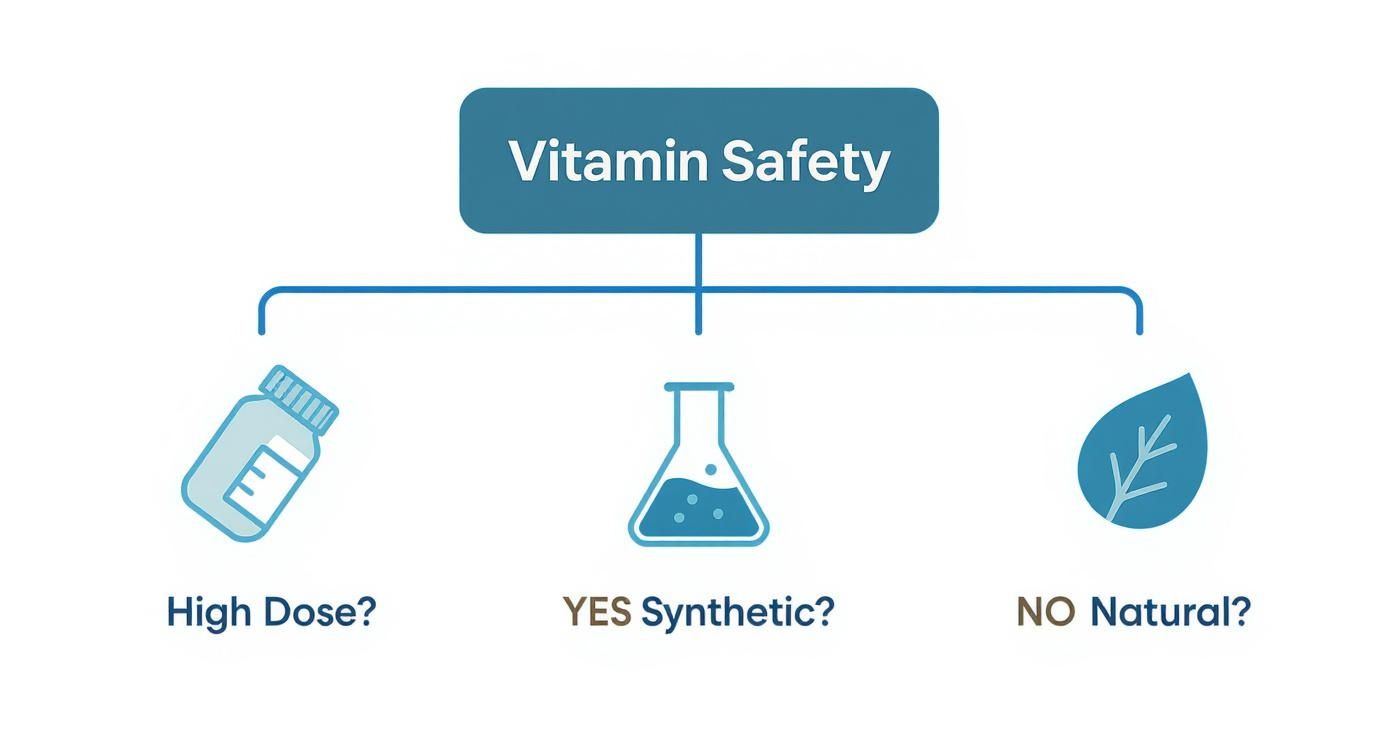
As the visual highlights, natural vitamins tend to have a much lower risk profile. When you start getting into high doses of certain synthetic vitamins, you need to be much more careful due to potential safety concerns.
Quick Visual Guide to a Quality Label
When you're scanning a shelf, you need to be able to identify a quality product in just a few seconds. Here’s a quick mental checklist to help you make an informed choice on the spot.
Red Flags (Likely Synthetic):
- Isolated chemical names (e.g., "pyridoxine hydrochloride" for Vitamin B6).
- Use of the "dl-" prefix, which always indicates a synthetic form (e.g., "dl-alpha tocopherol").
- A long list of artificial colors, flavors, or preservatives.
- A total lack of any third-party testing seals.
Green Flags (Likely Natural):
- Clear identification of food sources for each vitamin.
- Use of terms like "whole food," "food-based," or "raw."
- Prominent third-party certifications like USDA Organic or GMP.
- A clean "Other Ingredients" list, free from unnecessary fillers or binders.
By arming yourself with this knowledge, you can move beyond the marketing hype and choose supplements that genuinely align with your health goals. Your ability to read a label is your best tool for ensuring you’re investing in pure, effective, and natural nutrition.
Why We Champion Raw Whole Food Vitamins
When you stack synthetic vitamins against natural, whole-food-based ones, the choice becomes pretty obvious. The debate isn't just about a single, isolated molecule—it's about the entire nutritional package that comes with it.
Time and again, we see that natural, whole food vitamins deliver superior bioavailability, a complete matrix of synergistic co-factors, and a much better safety profile. Your body is wired to recognize and use nutrients as they appear in nature, not as isolated chemicals cooked up in a lab.
This philosophy is the bedrock of everything we do here at Peak Performance. We are absolutely unwavering in our commitment to providing supplements that are as close to nature as possible. Our goal is to make sure you get your nutrition from real, identifiable food sources that work in harmony with your body’s own intelligence.
Embracing Nature's Blueprint
The move toward natural wellness isn't just a trend; it's a global shift. The global vitamins market was recently valued at USD 15.5 billion, with natural vitamins grabbing the largest market share worldwide. This surge is being driven by health-conscious people like you, who are actively seeking out products derived from whole foods with minimal processing.
Our commitment goes beyond just sourcing ingredients. We believe in providing complete nutritional solutions that support your health from the ground up. For a deeper look at some of our favorites, check out our guide on the best whole food vitamin supplements.
The core principle is simple: nutrition from whole foods provides a complexity that lab-made synthetics just can't replicate. This complexity isn't a flaw; it's the very thing that makes natural vitamins so effective and safe for the long haul.
Ultimately, choosing natural vitamins is about respecting the intricate relationship between what you eat and how you feel. You can get a better handle on this connection by exploring the differences between whole foods versus processed foods and how they impact cellular aging.
We invite you to explore our hand-picked selection of Raw Whole Food Vitamins and feel confident choosing supplements that align with nature for your peak health and performance.
Frequently Asked Questions
Diving into the world of supplements can feel overwhelming. Let's clear up a few of the most common questions about synthetic versus natural vitamins to help you on your health journey.
Are Synthetic Vitamins Bad for You?
"Bad" might be too strong a word, but they are absolutely different. Synthetic vitamins are created in a lab to be chemically identical to the vitamins found in food. They can certainly help correct a specific deficiency.
The problem is, they're isolated. They don't come with all the extra co-factors, enzymes, and other phytonutrients that whole foods provide. Because of this, your body might not absorb or use them as well. Plus, high doses of certain synthetic vitamins (especially fat-soluble ones) can build up and become toxic over time.
Natural vitamins, like those in our Raw Whole Food Vitamins, give your body nutrition in the complete package it was designed to recognize. This minimizes risks and maximizes the benefits you get from every dose.
Can I Get All My Vitamins From Food Alone?
In a perfect world, yes. A balanced, whole-food diet should always be your foundation. But today’s reality makes that harder than ever. Modern farming has led to soil depletion, meaning the fruits and vegetables we eat just aren't as nutrient-dense as they were generations ago.
Your own lifestyle also plays a huge role in your nutrient needs:
- High levels of stress burn through B vitamins and magnesium.
- Intense exercise increases your demand for antioxidants and electrolytes.
- Living indoors or in colder climates often leads to low Vitamin D levels.
This is where a high-quality, whole food supplement comes in. Think of it as an insurance policy to fill in those nutritional gaps, making sure your body is firing on all cylinders.
How Do I Identify Natural vs Synthetic on a Label?
It all comes down to the ingredient list. The trick is to look for the food source. Natural vitamins are almost always listed with the food they came from, while synthetics are usually just listed by their chemical name.
Here's what to look for:
- Natural: "Vitamin C (from organic acerola cherry)"
- Synthetic: "Ascorbic Acid"
Or another example:
- Natural: "Vitamin E (from sunflower seed oil)"
- Synthetic: "dl-alpha tocopherol"
When you're scanning a label, search for terms like "whole food," "raw," or "food-based." Brands that use these terms are transparent about their sourcing. This simple check is the best way to make a confident, informed choice.
At Peak Performance, we believe nature knows best. We're committed to providing only the highest quality whole food vitamins, sourced from real foods to deliver nutrition your body actually recognizes and can use. You can learn more about our commitment to quality and our product philosophy by visiting the link below:
Explore our full range of Raw Whole Food Vitamins and feel the difference that real, food-based nutrition can make.
Also in Blog


Unlock Kids' Concentration: Calm Focus Boosts Learning


Probiotics for Bloating: 10 Ways to Evict Gas Bacteria

