


How to Read Supplement Labels Like a Pro
If you want to understand what's really inside your supplements, you have to learn to ignore the flashy marketing on the front of the bottle. The real story is always on the back, in the Supplement Facts panel and the ingredient list. That’s where you’ll find the truth about what you're putting into your body.
Why You Can't Trust the Front of the Bottle
Walking down the supplement aisle is an exercise in navigating hype. Bottles scream promises from every shelf—"Maximum Strength," "Clinically Proven," "All Natural"—all designed to catch your eye. But the most critical information isn't in those bold claims; it's tucked away in the fine print on the back.
Think of the front of a supplement bottle as a billboard, not a scientific document. It’s designed to appeal to your goals using vague, impressive-sounding language that often lacks any real substance. A product might brag about its "energy-boosting" formula, but a quick flip to the back could reveal it's mostly caffeine with a sprinkle of B-vitamins.
A Booming and Loosely Regulated Market
The dietary supplements market is massive and growing at a staggering pace. It was valued at nearly USD 152 billion in 2021 and is on track to nearly double by 2028. This explosive growth means more products are fighting for your attention, but it also opens the door for mislabeling and low-quality formulas to slip through.
This is exactly why your ability to read and understand the entire label is so crucial. The FDA doesn't approve dietary supplements for safety or effectiveness before they hit store shelves. That responsibility falls squarely on your shoulders. You have to become your own detective.
Your best defense is a good offense. Learning to decode the back of the label transforms you from a passive buyer into an informed consumer who can spot red flags and identify high-quality products.
Moving Beyond the Marketing Hype
Here’s a simple way to think about it: the front of the label tells you what the brand wants you to believe. The back tells you what you need to know.
Shifting your focus is the single most important step you can take to protect your health and ensure you get what you pay for. While the front can be deceptive, you can learn how to read ingredient labels confidently.
This guide will walk you through every part of the label, turning confusing jargon into clear, actionable information. Let's start this journey to becoming a more empowered, educated supplement user.
Decoding the Supplement Facts Panel
Alright, let's flip the bottle over. This is where the real action is: the Supplement Facts panel.
Think of this standardized box as the product's nutritional blueprint. It cuts through the marketing fluff on the front and tells you exactly what’s inside, down to the milligram. Getting comfortable reading this panel is the single most important skill you can develop for choosing supplements that actually work for you.
The details here are everything. It’s your ticket to making choices based on solid data, not just flashy claims. You can actually learn more about the global trends in nutritional labeling and see just how much consumers are pushing for this kind of transparency.
Here’s a quick visual guide to find what you’re looking for.
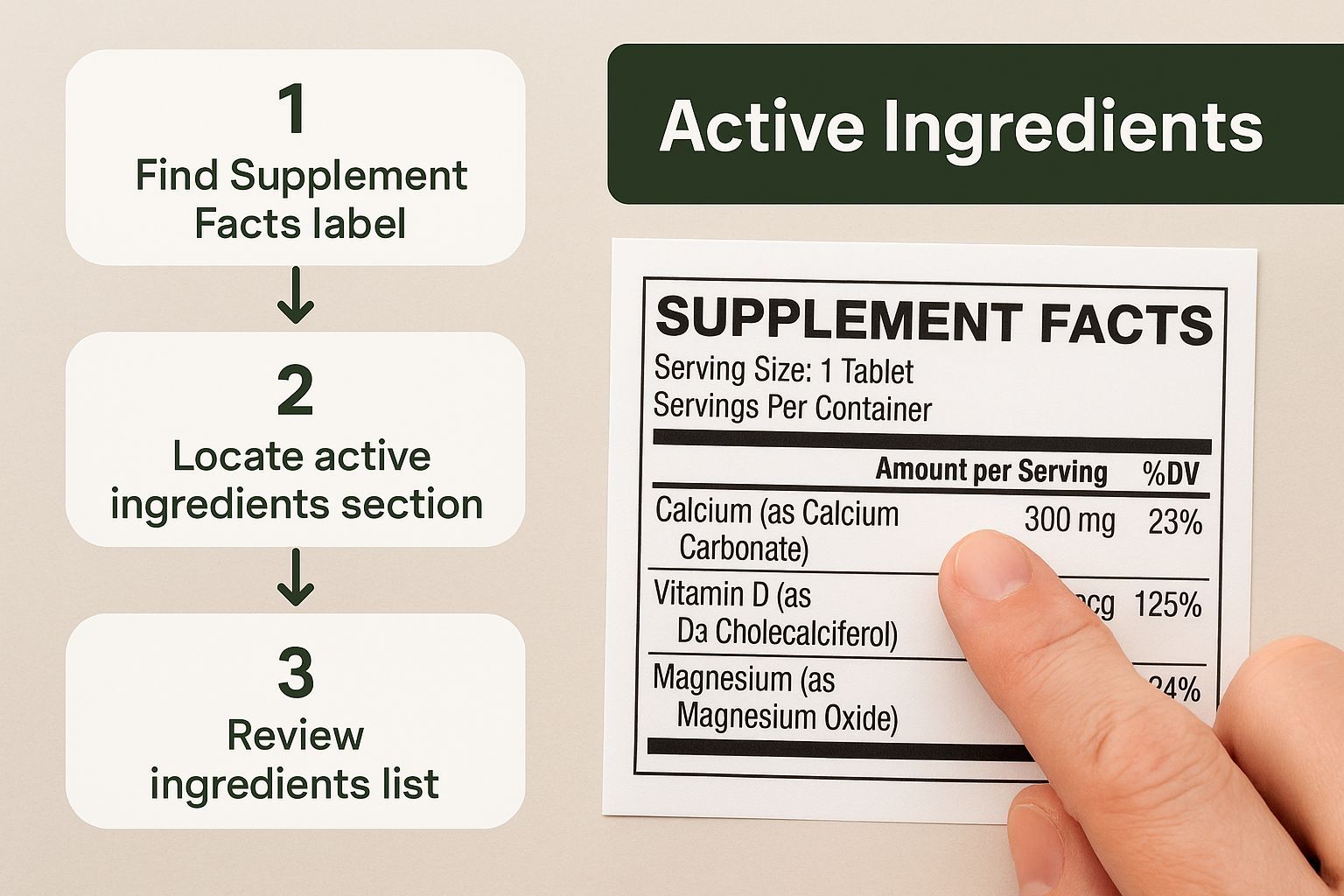
As you can see, the "Amount Per Serving" column is your go-to. This is where you'll find the actual dose of the ingredients that deliver the benefits you're after.
Your First Stop: Serving Size
Before your eyes go anywhere else, find the Serving Size. This one line puts everything that follows into perspective.
It’s a classic industry trick: a brand might boast about huge ingredient amounts, but then you look closer and see the serving size is four giant capsules. A bottle that screams 1000 mg of Vitamin C might only give you 500 mg per tablet if the serving size is two. Always, always check this first. It ensures you're comparing products apple-to-apples and taking the right dose.
Right next to that, you'll spot Servings Per Container. This is simple math that tells you how long the bottle will last. If you have 60 capsules with a serving size of two, that’s a 30-day supply. Easy.
Amount Per Serving and % Daily Value (%DV)
Now for the main event. Below the serving size, you’ll see two columns. The left lists the ingredient, and the right, labeled Amount Per Serving, gives you the exact quantity in one serving. This is where you confirm you're getting the dose you expect.
The final column is the % Daily Value (%DV). This number shows how much a nutrient in one serving contributes to a standard 2,000-calorie daily diet. It's a handy reference, but it's not the final word.
The %DV is a general guide, not a personalized prescription. Your own needs can be much higher or lower depending on your age, activity level, health goals, and even your gender.
A good rule of thumb for %DV:
- 5% DV or less is considered a low amount of that nutrient.
- 20% DV or more is considered a high amount.
For example, don't be alarmed if you see a B-complex vitamin with 300% DV of B12. B vitamins are water-soluble, meaning your body just expels what it doesn’t use. It’s a high dose, but not typically a cause for concern. On the other hand, for fat-soluble vitamins like A, D, E, and K, you'll want to be more mindful about consistently exceeding the DV.
Understanding this difference is key to interpreting these numbers wisely so you get what you need without overdoing it.
To make this even clearer, here's a quick breakdown of what each part of the panel means for you.
Supplement Facts Panel Breakdown
| Label Component | What It Means for You | Pro Tip to Remember |
|---|---|---|
| Serving Size | The amount you need to take at one time to get the listed doses. | Always check this first! A product might look cheaper or more potent until you see the serving size is 3-4 capsules. |
| Servings Per Container | How many servings are in the entire bottle. | This helps you calculate the true cost per day and how long the supplement will last. |
| Amount Per Serving | The specific dose of each ingredient in one serving. | This is the most important column for verifying the potency and comparing different products. |
| % Daily Value (%DV) | How much a nutrient contributes to a general 2,000-calorie diet. | Use this as a quick reference, not a strict rule. High percentages aren't always bad, especially for water-soluble vitamins. |
This table should serve as a handy cheat sheet when you're at the store or browsing online, helping you cut through the noise and focus on what truly matters.
Spotting Unwanted Fillers and Proprietary Blends
So, you’ve analyzed the Supplement Facts panel and feel good about the active ingredients. Don’t stop there. Your detective work isn’t quite finished.
Now it's time to flip to the “Other Ingredients” list. This often-overlooked section is where the true quality of a product often reveals itself. This is where you find everything else packed into that capsule or powder—the good, the bad, and the completely unnecessary.
This list is made up of inactive ingredients, which are compounds that don’t contribute to the supplement’s main job. Some are harmless and even necessary for manufacturing, but many are just cheap fillers you’re better off avoiding.
The Problem with "Proprietary Blends"
Before we get into specific fillers, let's talk about a massive red flag you might find right in the main Supplement Facts panel: the proprietary blend.
You'll see it listed as something like a "Performance Blend" or "Focus Matrix" with a total weight—say, 1,500 mg—followed by a laundry list of ingredients.
Here’s the catch: you have absolutely no idea how much of each ingredient is actually in that blend. The FDA only requires manufacturers to list the ingredients in descending order of weight. This means a blend could be 95% of the cheapest, least effective ingredient at the top of the list, with only a "fairy dust" amount of the good stuff.
A proprietary blend is often a clever way to hide tiny, ineffective doses of the most important ingredients. Always look for products that give you transparent, individual dosages for every single active component.
Common Fillers and Binders to Watch For
Alright, back to that "Other Ingredients" section. Your goal here is to find a product with the shortest list possible. Learning how to read supplement labels like a pro means knowing what to look for. While not all additives are harmful, many offer zero nutritional value.
Here are a few common ones to be wary of:
- Magnesium Stearate: A "flowing agent" used to keep ingredients from clumping and sticking to factory machinery.
- Titanium Dioxide: A colorant used to make capsules and tablets look a pristine, uniform white.
- Artificial Colors (e.g., FD&C Red No. 40, Yellow No. 5): Purely for cosmetic appeal with no health benefits.
- Hydrogenated Oils: These are unhealthy trans fats sometimes used as binders to hold a tablet together.
Seeing one of these on a label doesn't automatically disqualify a product, but a long list of them is a pretty good sign the company is prioritizing cheap production over purity.
Choosing Pure and Effective Formulas
At the end of the day, the best supplements have a short, clean "Other Ingredients" list. The brand's focus should be on delivering potent, active ingredients, not bulking up a product with fluff.
This is especially critical when choosing supplements for the whole family, as certain vitamins and minerals are vital for growing bodies. It's why understanding the risk of malnutrition in children can put the need for pure ingredients into sharp perspective.
When you buy a supplement, you’re voting with your wallet for transparency and quality. Scrutinizing the entire label—proprietary blends and all—ensures you're actually investing in a formula designed for peak performance, not just one with clever marketing.
Finding Trustworthy Third-Party Certifications
In the world of supplements, anyone can make a claim. Proving it is another story. The industry has very little direct oversight, which is why a seal from an independent organization is one of the clearest signs you’ve found a trustworthy product.
Think of these certifications as an unbiased quality check—a stamp of approval confirming that what’s actually in the bottle is what’s printed on the label. These seals aren't just for show; they represent a huge investment in rigorous testing for purity, potency, and safety. A real certification means a group with no skin in the game has audited everything from manufacturing to the final product, ensuring it's free of nasty contaminants and lives up to its claims.
What to Look For on the Label
Here's a hard truth: not all logos are created equal. It’s incredibly easy for a company to slap a fancy-looking "quality-sealed" graphic on their bottle that means absolutely nothing. Your job is to spot the difference between these empty marketing ploys and the legitimate, hard-earned certifications that actually matter.
When you're scanning a label, keep an eye out for these specific, highly respected seals:
- NSF (National Sanitation Foundation): This one confirms the product has exactly what the label says it does, in the amounts listed. It also certifies the product is free from undeclared contaminants.
- USP (United States Pharmacopeia): A USP Verified mark is a gold standard. It means the supplement meets tough criteria for identity, potency, purity, and performance.
- Informed-Choice / Informed-Sport: If you're an athlete, this is your go-to. It guarantees a product has been screened for a huge range of substances banned in sports.
For example, here’s the USP Verified Mark. It's one of the best seals you can find.
Seeing this logo gives you immediate peace of mind. It tells you the supplement contains what it claims and was made following clean, safe manufacturing practices.
Why This Step Is Non-Negotiable
Choosing a product with one of these seals is a simple but powerful way to protect your health. It shifts the burden of proof from you to the manufacturer, who has voluntarily put their product through intense, unbiased scrutiny. To get a better handle on what makes these certifications so reliable, it's worth reading up on understanding third-party supplement testing.
A third-party seal is your assurance that an unbiased expert has already done the detective work for you. It's the closest thing to a guarantee of quality and safety in the supplement industry.
Making certified products a priority helps you cut through all the marketing noise and sidestep low-quality or even dangerous formulas. Once you know which ingredients you need, looking for these seals makes the final decision so much easier.
If you’re still deciding on which supplements to start with, our guide on the top 10 supplements most people should take is a great resource. Just be sure that when you’re ready to buy, you see one of those trusted seals on the label.
Navigating Health Claims and Allergen Warnings
The front of the label is where the promises are made, but the fine print is where the truth lives. After you’ve dissected the ingredients and looked for those key certifications, there's one last step: understanding what a product can legally claim and what it must tell you for your own safety.
Marketing copy is incredibly persuasive. It's often written to suggest benefits that haven't actually been proven scientifically. For example, a phrase like "supports a healthy immune system" sounds fantastic, but it's what's known as a structure/function claim. This kind of general statement doesn't need FDA approval and is a world away from a specific, authorized health claim that directly links a nutrient to lowering the risk of a disease.
The Mandatory FDA Disclaimer
You’ll find that almost every one of these structure/function claims has to come with a very specific sentence, usually tucked away in tiny print near the Supplement Facts panel.
"These statements have not been evaluated by the Food and Drug Administration. This product is not intended to diagnose, treat, cure, or prevent any disease."
It’s easy to gloss over this, but don't. This is a legally required disclaimer telling you the company hasn't submitted its product to the FDA to prove it actually works. Think of it as a clear signal that you’re reading a marketing claim, not a medical fact. This distinction is so important for setting your expectations and making choices based on evidence, not just hype.
Finding and Understanding Allergen Warnings
If you have any food allergies or sensitivities, this is without a doubt the most critical part of the label. Thanks to the Food Allergen Labeling and Consumer Protection Act of 2004, companies are required to clearly state if their product contains any of the eight major food allergens.
You'll usually find this information in one of two places:
- In a "Contains" statement right below or next to the ingredient list (e.g., "Contains: Soy and Milk").
- Listed right within the ingredients themselves, often in parentheses (e.g., "lecithin (soy)").
Always, always double-check this section, even if you’ve bought the product a dozen times. Companies change their formulas without warning. And this skill isn’t just for supplements; learning to navigate confusing labels and 'clean' claims in skincare products can help you become a much more discerning consumer overall.
This kind of careful inspection is even more crucial when you think about how global the supplement market is. The rules are all over the place, and there’s no universal standard. What's a "supplement" in one country could be classified as a food or even a medicine in another, which leads to wildly different labels and health claims. It’s up to you to be vigilant and make sure you’re choosing products based on facts, not just clever marketing.
Putting It All Together: Your Practical Checklist
Alright, you've got the theory down. Now, let's turn that knowledge into a repeatable system you can use every single time you pick up a supplement bottle. This is how you go from being a hopeful buyer to a confident, informed consumer.
Think of it as a mental checklist you can run through in under a minute.
The Fish Oil Test: A Real-World Walkthrough
Let's put this into practice. Picture yourself in the supplement aisle, holding two different bottles of fish oil. They look similar, but the devil is in the details. Here’s how you vet them on the spot.
First, I always look at the Serving Size. Bottle A boasts 2000 mg of fish oil, but a closer look reveals the serving size is four softgels. Ouch. Bottle B lists 1500 mg, but for only two softgels. Right away, you know Bottle B delivers a more concentrated dose.
Next, I check the Active Ingredients. Don't get distracted by the "total fish oil" number. I'm scanning for the non-negotiables: EPA and DHA. A trustworthy brand will list these amounts clearly and proudly. If they're buried in some vague "proprietary blend," that bottle goes right back on the shelf. No exceptions.
Finally, I flip it over to the "Other Ingredients". This is often the most revealing part. I’m looking for a short, clean list. Does it have cheap fillers, artificial colors, or hydrogenated oils? The fewer inactive ingredients, the purer the product.
The whole point of learning to read a supplement label is to build a reliable system. This mental checklist cuts through the marketing noise and gets you to the truth, fast.
The Final Quality Check
After you've nailed the basics, a few final checks separate the decent products from the truly high-quality ones.
-
Hunt for a Third-Party Seal: Does either bottle have a seal from a trusted certifier like USP, NSF, or IFOS? For fish oil, that IFOS (International Fish Oil Standards) seal is the gold standard. This is your best assurance that what's on the label is actually in the bottle.
-
Review Claims and Allergens: I completely ignore vague marketing fluff like "supports brain function." Instead, I look for the required FDA disclaimer and, more importantly, the "Contains" statement. Soy is a common allergen used in softgels, so if you're avoiding it, this is a must-check.
Running through this simple process changes everything. You’re no longer guessing—you’re making a calculated decision that ensures the product you choose is pure, potent, and perfectly aligned with your health goals.
And if you really want to take your health optimization to the next level, you can pair smart supplement choices with personalized data. Find out how to use nutritional testing to improve your diet and create a regimen that's truly built for you.
Got Questions? Let’s Clear Things Up
Even when you feel like you've got the hang of reading a supplement label, some common questions always seem to pop up. Let's tackle a few of the most frequent ones I hear, so you can feel totally confident when you're making a choice.
MFG vs. EXP Dates: What’s the Real Difference?
You’ll usually spot two dates on the bottom of a bottle: MFG (manufacturing date) and EXP (expiration date, sometimes called "Best By"). It’s pretty simple: the MFG date is just when the product was bottled.
The EXP date is the key one to watch. It's the manufacturer’s promise that the supplement will stay at full potency and quality up to that day.
While most supplements won’t become harmful after they expire, their active ingredients definitely start to lose their punch. To get the results you're paying for, always try to use your supplements before they hit that expiration date.
As a general rule, most tablets and capsules are good for about two to three years from their manufacturing date. But remember, things like chewable vitamins and gummies have a much shorter shelf life and can degrade faster.
Is a Higher Price Tag a Sign of Better Quality?
Not always. It’s easy to assume that more expensive means better, but that’s a common pitfall.
Sure, premium ingredients and rigorous third-party testing add to the cost, but a high price can also just mean a massive marketing budget and fancy packaging. Some brands pour more money into celebrity endorsements than they do into the actual formula inside the bottle.
Instead of letting price be your guide, go back to the basics we've covered:
- Honest Dosing: Are the amounts for every single active ingredient clearly listed?
- Clean Ingredients: Is the "Other Ingredients" list short and free of unnecessary junk?
- Trusted Certifications: Do you see seals from reputable organizations like USP or NSF?
A reasonably priced product that checks all these boxes is almost always a smarter buy than an overpriced one hiding behind proprietary blends and slick marketing.
How Do I Make Sense of mg, mcg, and IU?
Seeing a jumble of different measurement units can feel like you’re back in science class, but it’s actually pretty straightforward.
- Milligrams (mg): This is a standard unit of weight. Simple enough.
- Micrograms (mcg or µg): You’ll see this for highly potent ingredients, like Vitamin B12, where you only need a tiny amount. There are 1,000 micrograms in one milligram.
- International Units (IU): This one is a bit different. It measures a vitamin’s potency or biological effect, not its weight. It’s almost always used for fat-soluble vitamins like A, D, and E.
The good news? You don't need a calculator to convert them. Just use the numbers to compare apples to apples when looking at the same ingredient across different products. For example, a supplement with 2,000 IU of Vitamin D is stronger than one with 1,000 IU—plain and simple. Understanding these little details is what separates a confused buyer from a confident one.
At Peak Performance, we’re all about transparency. Our labels are designed to be crystal clear, our ingredients are USDA Organic, and our formulas are always third-party tested. We want you to know you're getting the purest and most effective supplements possible.
Explore our full range of products designed for your peak well-being at https://buypeakperformance.com.
Also in Blog


How to Increase Stamina Naturally and Boost Energy


How to Increase Energy Naturally

