


Acacia Powder Explained: Benefits, Uses and Safety
The most common advice about acacia powder is to start with a teaspoon, work up to 15 grams a day, and wait for your gut to reset. That advice bundles three different things: a starting dose, a studied dose, and a specific outcome. They aren't the same number, and they don't come from the same trial.
Acacia is a soluble fiber with a real evidence base. It's also a regulated food additive with defined ceilings in the US food supply. Both facts matter, and neither turns the powder into a cleanse, a weight-loss aid or a treatment for irritable bowel syndrome.
What Acacia Powder Is and Where It Comes From
Picture an acacia tree in the dry Sahel with a split in its bark. The tree seals the wound with a gummy sap that hardens in the air. Growers collect those hardened lumps from the stems and branches, dry them and mill them into the fine, off-white powder sold as acacia powder.
That picture explains the ingredient but not the label. Most acacia powder on the market is gum arabic from Acacia senegal or closely related species. In the United States the ingredient is legally recognized as “acacia (gum arabic)” and regulated as a direct food additive, a status that separates the botanical story from the standardized product.
The label distinction that matters: the front of the tub says acacia powder, while the ingredient line should identify acacia (gum arabic). Same substance, but only one of those names carries a defined specification.
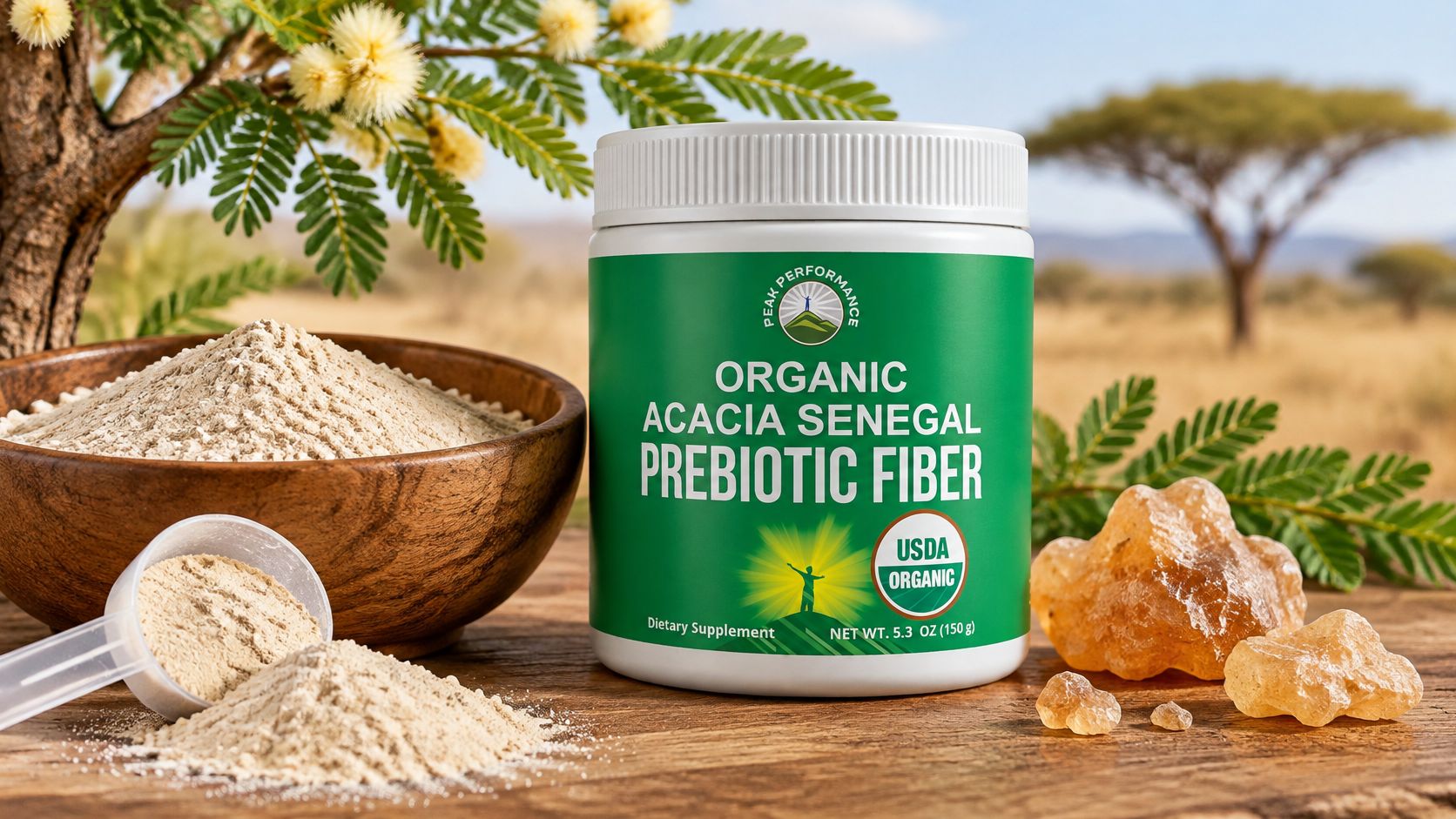
Here's the retail form people meet first, a plain unflavored powder that dissolves in water rather than thickening into a gel.
One ingredient, two jobs
Acacia earns its place in food manufacturing because it works as a soluble dietary fiber and as a emulsifier, stabilizer, thickener, texturizer and formulation aid at the same time. The permitted ceilings in the federal food additive rule for acacia show how differently it gets used: up to 35% in grain-based bars such as granola and breakfast bars, 20% in alcoholic beverages where it thickens or stabilizes, 6% in breakfast cereals, 3% in cakes, pastries, biscuits, muffins and cookies, and 2.5% in soups and soup mixes. Those percentages describe food manufacturing, not supplement doses, which is why a granola bar and a fiber scoop are not comparable servings.
Two tubs of “acacia powder” can still behave differently. Color, solubility, purity, moisture and particle size all shift with the source and the milling method, so a powder that dissolves cleanly in cold water and one that clumps into a paste may be the same species and different grades.
Hold onto this: acacia powder is a fiber ingredient first. What it does for you depends on dose, product quality and your own gut, not on the word acacia printed on the front.
Evidence-Backed Benefits at a Glance
Acacia powder's benefits depend on the outcome being measured. Improved stool frequency, changes in gut bacteria and lower blood glucose are different findings, each tied to a particular study population and dose.
Studied uses, doses and results for acacia powder
| Use | Study context | Dose studied | What the result shows |
|---|---|---|---|
| Occasional constipation (IBS-C) | 180 adults, 4-week placebo-controlled 2024 IBS-C trial | 5 g daily | Stool frequency improved versus placebo |
| Fullness and post-meal glucose | Healthy adults, randomized crossover | Higher-dose intake | A possible short-term benefit; bloating limits the practical appeal |
| Prebiotic effect on gut bacteria | 10-day human prebiotic study | 10-15 g daily | Higher fecal bifidobacteria and lactic-acid-producing bacteria; overall aerobic and anaerobic counts largely unchanged |
| Blood pressure and fasting glucose | 80 adults at metabolic risk, 12-week randomized trial | 20 g daily | Reductions occurred alongside lower energy and carbohydrate intake; an independent effect remains uncertain |
| Heart failure tolerability | 51 patients, 12-week heart-failure study | 5 or 10 g daily | Well tolerated; no change in heart-failure biomarkers or microbiome composition |
The dose column is a study reference, not a starting-dose recommendation. A larger serving does not automatically deliver a stronger version of the same benefit.
- Check the dose against the outcome. The prebiotic study measured changes in particular bacterial groups. That is more specific than saying acacia “improves the microbiome.” A shift in the bacterial mix also does not establish better blood glucose control or relief from digestive symptoms. These are separate endpoints, like separate readings on a dashboard.
- Check the population. The regularity finding came from adults meeting criteria for constipation-predominant IBS. It is most relevant to that group, rather than a promise that anyone taking acacia will notice more frequent stools. The heart-failure trial answers a different question: whether participants tolerated the supplement. Good tolerability did not translate into improved disease biomarkers.
- Treat a single trial as a signal. The metabolic-risk trial reported changes in blood pressure and fasting glucose alongside changes in food intake. That makes the findings harder to interpret as a direct effect of acacia alone. Likewise, possible fullness at higher intake needs to be weighed against bloating, rather than treated as a reason to take more.
The honest summary: bowel regularity in IBS-C has the clearest practical support here. Prebiotic changes are measurable, while fullness and metabolic findings need more cautious interpretation. None of these results establishes acacia powder as a disease treatment.
Separating Proven Effects From Wellness Claims
Acacia powder works as a soluble fiber first, and that simple role explains most of what the evidence supports. The gut is more like a garden than a drainpipe. Fiber changes what grows there, how often things move, and what byproducts appear. That does not automatically mean every downstream wellness promise follows.
A 12-week randomized, placebo-controlled crossover study in 65 adults aged 45 to 70 with increased metabolic risk tracked a daily mixture containing acacia gum. Gut-microbiome beta-diversity changed significantly (p < 0.001), yet fecal short-chain fatty acids, metabolic and inflammatory resilience, and fasting metabolic and inflammatory markers showed no significant change, according to the crossover trial report. The 2025 randomized trial report described a similar pattern: acacia gum and resistant starch produced distinct microbiome and short-chain-fatty-acid shifts, with no direct link between those shifts and physiological outcomes. That distinction matters. A fiber can feed microbes without producing a measurable health result in every person.
Supported by human data
- Regularity for occasional constipation: the IBS-C evidence is the most concrete result in the literature.
- A modest daily fiber contribution: a practical way to close a fiber gap when food sources fall short.
- Possible fullness at higher doses: reported in a crossover study, short-term and in healthy adults.
Claims that need more support
- Detoxification: no study measured a toxin-removal endpoint.
- Weight loss: the metabolic trial reported energy and carbohydrate intake shifts, not pounds lost.
- IBS symptom control: four-week stool-frequency improvement is a specific outcome, not proof for every IBS subtype.
- Broad systemic health: microbiome shifts rarely arrive with matching changes in clinical markers.
The gap comes down to variables that simple marketing copy tends to flatten: baseline fiber intake, existing microbiome composition, dose, whether the product is pure acacia or a blend, and the reader's health status. A scoop of acacia is closer to adding compost to soil than adding a cleaning fluid to a pipe. It changes the environment gradually, and the visible result depends on what was already there.
If you add fiber to a shake, know what else the shake is doing. The Providers for Healthy Living shake guide is a useful check before you treat a blended drink as a fiber strategy. Different fibers also behave differently in the gut, and our breakdown of organic inulin powder explains why a faster-fermenting fiber asks more of you than acacia does.
The research direction is personalized fiber nutrition, including a registered trial testing 5 g and 10 g acacia doses against placebo for occasional constipation while measuring stool frequency, stool consistency and microbiota composition. Until that kind of data lands, match each use to the study and dose behind it.
Side Effects and How to Ease Them
The safety record here is more settled than the efficacy record. In a 2013 rulemaking, the FDA stated it did not establish a numerical acceptable daily intake for acacia because the evidence indicated the ingredient was non-carcinogenic and poorly absorbed, and that mild physiological responses in human studies appeared only at high intakes above 50 g per day. The same review noted that the Joint FAO/WHO Expert Committee on Food Additives assigned acacia an ADI of “not specified” for use according to good manufacturing practice, and that acacia must meet specifications from the Food Chemicals Codex, 8th edition, published in 2012, as described in the 2013 FDA rulemaking on gum arabic. A “not specified” limit means a precise daily ceiling wasn't needed for food uses at effective amounts. It doesn't mean any quantity is sensible.
Acacia powder symptoms, causes and fixes
| Symptom | Likely cause | What to do |
|---|---|---|
| Gas and bloating | Dose raised too fast or too high | Drop to the last tolerated dose and increase more slowly |
| Rumbling or loose stools | Dose above your tolerance; the 40 g study showed more of these symptoms | Reduce the dose and keep it there for a week |
| Hard stools despite the fiber | Too little fluid with the fiber | Drink more water through the day; reassess after two weeks |
| Abdominal pain, blood in stool or unexplained weight loss | Possible condition that needs evaluation | Stop self-treatment and see a doctor |
The symptom pattern is dose-dependent, not product-dependent. A randomized, double-blind crossover study in healthy adults tested 20 g and 40 g daily; at 40 g, participants reported more bloating, flatulence and gastrointestinal rumbling than under control conditions, while overall gastrointestinal-tolerance scores stayed low and consumer acceptability was high, per the crossover tolerance study. Acacia may influence fullness and post-meal glucose, and it isn't symptom-free at large doses.
Some readers should move more cautiously than the label suggests. If you have IBS, inflammatory bowel disease or a motility disorder, trials in your group are limited and a prebiotic can still provoke symptoms. Pregnancy and childhood are similar: food-grade status is reassuring, but specific clinical trials are thin, so raise the question with your clinician rather than copying a study dose.
Timing matters with medication. A soluble fiber can change how and when some oral medicines are absorbed, so take acacia at least two hours apart from prescription drugs, and ask a pharmacist to check anything with a narrow therapeutic window.
Stop and get checked if: constipation persists despite fiber, or you have abdominal pain, blood in the stool, or weight you can't explain losing.
How to Choose a High-Quality Acacia Powder
A tub of acacia powder can look identical to the one used in a study and still be a different product inside. The research you just read describes a specific ingredient at a specific dose, so run this checklist before you buy.
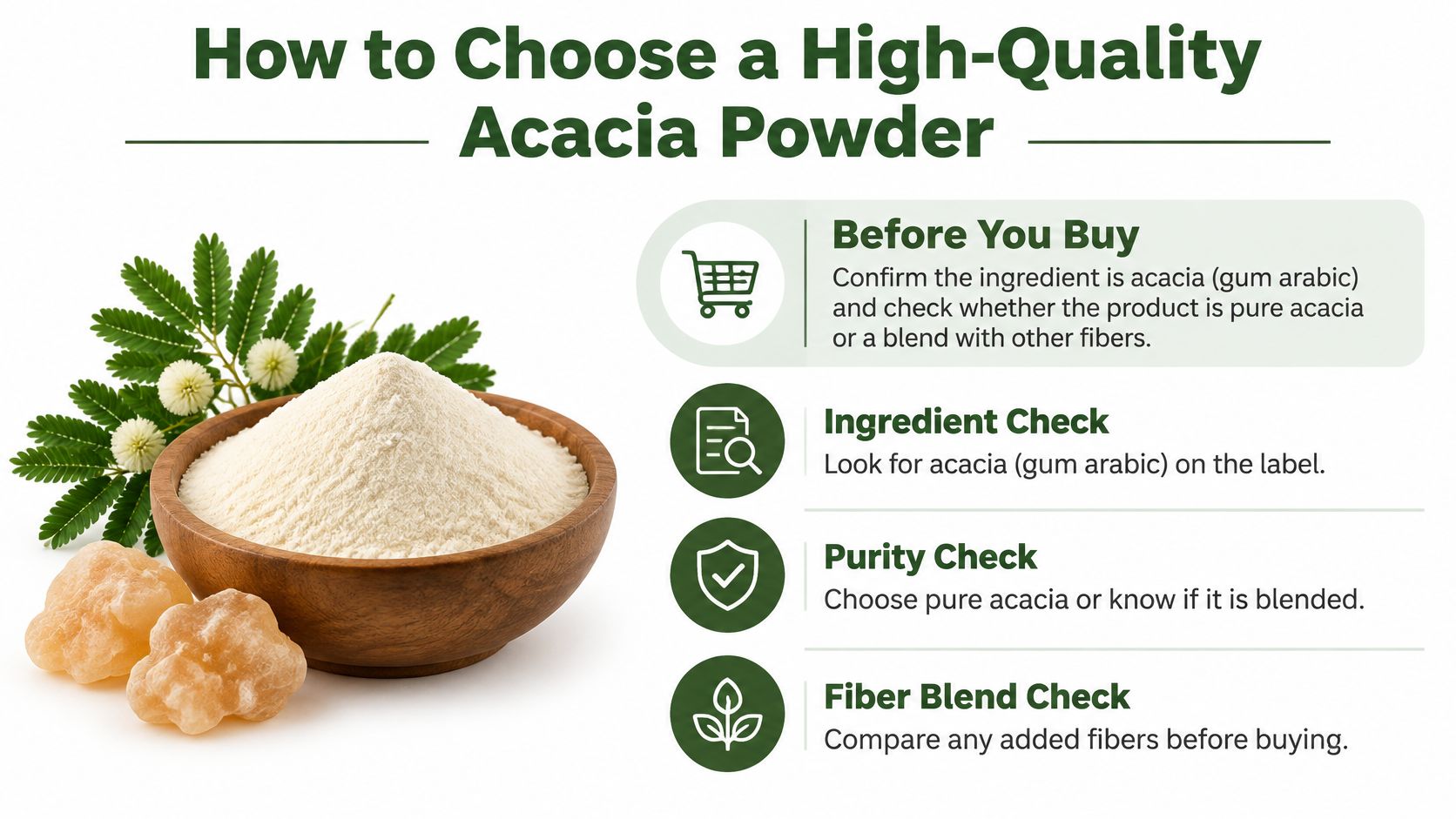
- Confirm the standardized name. The ingredient line should identify acacia (gum arabic), the identity the specification and safety reviews describe.
- Check whether it's pure or blended. Study results often involve acacia blended with other fibers, so a blend can't be matched to a single-fiber dose. A single-ingredient powder is the only kind you can line up against the trial evidence.
- Read fiber per serving, not scoop weight. You need grams of fiber to compare against the 5 to 20 g intakes in the literature, and total powder weight tells you nothing about that.
- Look for independent testing. A reputable brand has its product tested by an outside lab rather than grading its own homework. Here's what third-party testing verifies and what a certificate doesn't cover.
- Treat organic certification as a sourcing claim, not a safety claim. It tells you how the plant material was grown, not whether the powder is free of insoluble matter.
- Read the allergen statement. Tree-gum sensitivity exists, and unnecessary additives narrow the number of people who can use the product comfortably.
- Count servings per container. Powder density varies between brands, so the same tub size can deliver very different numbers of days at your target dose. Divide total fiber grams in the container by your planned daily dose to get the cost per week.
Format adds its own variable. If you're weighing a powder against a capsule of the same ingredient, the creatine format guide for busy lifters covers why delivery format changes what you absorb and how much you have to take. For fiber, capsules also mean swallowing a large number of pills to reach even the low end of studied doses, which is why powders dominate this category.
Tested against that list, Peak Performance Organic Acacia Senegal Prebiotic Fiber Powder is a single-ingredient, unflavored powder from acacia Senegal, USDA organic and vegan, priced at $19.95. It goes through third-party lab testing for safety and potency, which is the check that matters most for a powder you take every day. Because it's unflavored and dissolves without much fuss, it also fits the mixing routine described in the next section without changing the taste of whatever you stir it into.
How to Start Acacia Powder Without Bloating
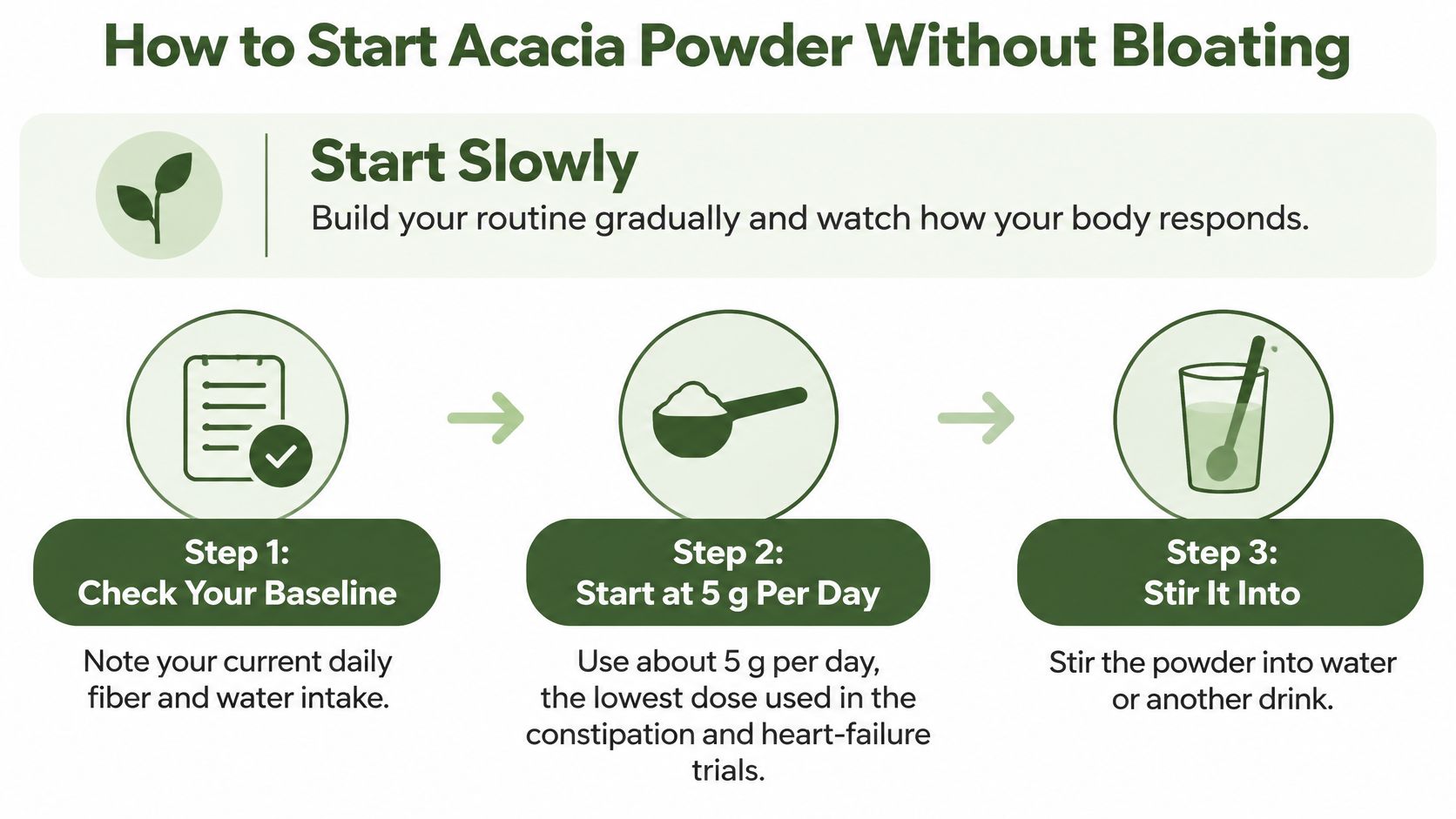
Ramp slowly enough that you can tell which dose caused which symptom. The order below does that.
- Note your baseline first. Write down your current daily fiber and water intake so a change later means something, otherwise you can't tell whether the powder or the week did the work.
- Start at 5 g per day. That's the low end of the doses used in the constipation and heart-failure trials, and a starting point you can feel your way up from.
- Stir it into 200 to 250 ml of water until it dissolves fully. Acacia disperses easily, and a full glass gives the fiber liquid to work with instead of pulling water from your gut.
- Hold that dose for one week and log stool frequency, gas and comfort. One week is long enough for fermentation patterns to settle, and your log becomes the evidence you act on.
- If you feel fine, add 5 g and hold again. A 5 g step is small enough to keep symptoms traceable; a jump from 5 to 20 g isn't.
- Stop climbing at the dose that feels comfortable. Studied intakes ran from 5 g to 20 g daily, and the 40 g dose produced more symptoms in healthy adults. More fiber past your tolerance buys nothing.
- Drop back when symptoms appear. Return to the last tolerated dose for several days rather than pushing through, because a fermentable fiber that's outrunning your gut will keep doing so.
- Give it four weeks before you judge it. That matches the window used in the IBS-C trial, and shorter trials of patience tend to end in a discarded tub.
The stop rule: if a new dose gives you gas for more than a few days, go back to the last dose that didn't and stay there.
If you plan to combine acacia with inulin, guar or a blended product, read our comparison of prebiotic fiber supplements first, since stacking fibers multiplies the fermentation load before it multiplies the benefit.
Decide Whether Acacia Powder Fits Your Routine
Three groups, three different answers. Match the fiber to the job you want done. Acacia is soluble, low in grit, and best understood as a tool for regularity and gentle fiber intake, not as a catch-all wellness product.
Good fit to try. Adults with occasional constipation who want a soluble fiber, and anyone who wants to add fiber to drinks without gritty texture. Acacia dissolves cleanly, tastes of nothing, and has human data behind regularity. Use the ramp in How to Start Acacia Powder Without Bloating, then judge the result on comfort and stool pattern.
Talk to a clinician first. People with IBS, inflammatory bowel disease, a motility disorder, pregnancy, children, and anyone taking medication on a timed schedule. The evidence in these groups is thin, and the interaction question is practical rather than theoretical: spacing doses two hours apart from prescriptions solves most of it, but a pharmacist should confirm the specifics for you.
Not a substitute for care. Persistent constipation, abdominal pain, bleeding or unexplained weight loss belongs in a clinic, not in a supplement order. No fiber powder diagnoses anything.
Four weeks is a fair trial if your goal is regularity. Success usually looks like stools that are easier to pass, less straining, and a routine you can repeat without trading bloating for bowel movement. If nothing changes, a higher dose may only add fermentation, so reconsider whether acacia is the right fiber for you. Skip the blends if you want to compare your result to a single-fiber study, and don't buy a tub whose label can't tell you fiber per serving or the botanical source. Choose the lowest dose that gives you the result you want while staying comfortable.
Peak Performance sells USDA organic Acacia Senegal Prebiotic Fiber powder for 19.95 USD. Each purchase funds a year's supply of essential vitamins for at-risk children through Vitamin Angels. If you'd rather compare fibers side by side, our prebiotic fiber range covers the options. Visit Peak Performance to see the acacia powder and the rest of the line.


