


Best Grass Fed Bone Broth: How to Evaluate It Right
Grass-fed bone broth isn't automatically a reliable collagen source. In a 2019 peer-reviewed bone broth analysis, standardized broths contained significantly less hydroxyproline, glycine, and proline than a 20-gram reference collagen dose, with p = .003; hydroxylysine, leucine, and lysine were also significantly lower, with p = .004. Commercial broths contained lower concentrations of every measured amino acid than self-prepared varieties.
That doesn't make broth a bad food. It makes the front-label promise an incomplete buying guide. If you're looking for the best grass fed bone broth, start with sourcing, but make your final decision using the serving label and the testing documentation.
Why Grass Fed Is Not the Whole Story
A cattle-feeding claim tells you about the animal's diet. It doesn't tell you how much protein the manufacturer extracted, how heavily the broth was diluted, or what you'll consume in your cup.
The opening study makes that distinction concrete. Researchers examined commercial and laboratory-prepared broths and found substantial variability among nonstandardized recipes. That's a warning against treating every carton, concentrate, or powder as a nutritionally equivalent product.
My recommendation is straightforward: use grass-fed as a sourcing filter, not a quality verdict. Once a product meets your sourcing preferences, stop admiring the pasture imagery and start reading the serving information.
Separate the animal from the finished product
The animal, the bones, the preparation method, and the concentration all affect the finished broth. A sourcing claim describes only part of that process.
Consider what you're buying. A ready-to-drink broth includes its preparation water, while a powder asks you to add water yourself. Comparing the package descriptions without examining the prepared servings can leave you comparing unlike products.
- Animal sourcing: Ask what the feeding claim covers and how the supplier substantiates it.
- Finished-product composition: Look for declared protein and, when available, collagen or amino-acid measurements.
- Your actual serving: Use the amount you'll prepare and consume, not the most impressive phrase on the package.
Practical rule: Buy the sourcing standard you want, then demand evidence for the nutrient dose you expect.
Don't turn an ingredient into a treatment claim
A broth containing collagen-derived amino acids isn't automatically equivalent to a standardized collagen supplement. Nor does its grass-fed status demonstrate that it will deliver a particular recovery or connective-tissue outcome.
That distinction matters if you're buying broth for more than flavor. An athlete trying to manage protein intake needs a measurable serving. A home cook choosing a soup base may care more about taste, ingredients, and preparation.
Neither buyer needs an exaggerated promise. They need a product that clearly matches the intended job.
My editorial preference is for a plainly labeled product over an elaborately marketed one. If a seller provides extensive lifestyle language but little usable nutritional information, I wouldn't pay a premium on that basis alone.
What Grass Fed Actually Means on a U.S. Label
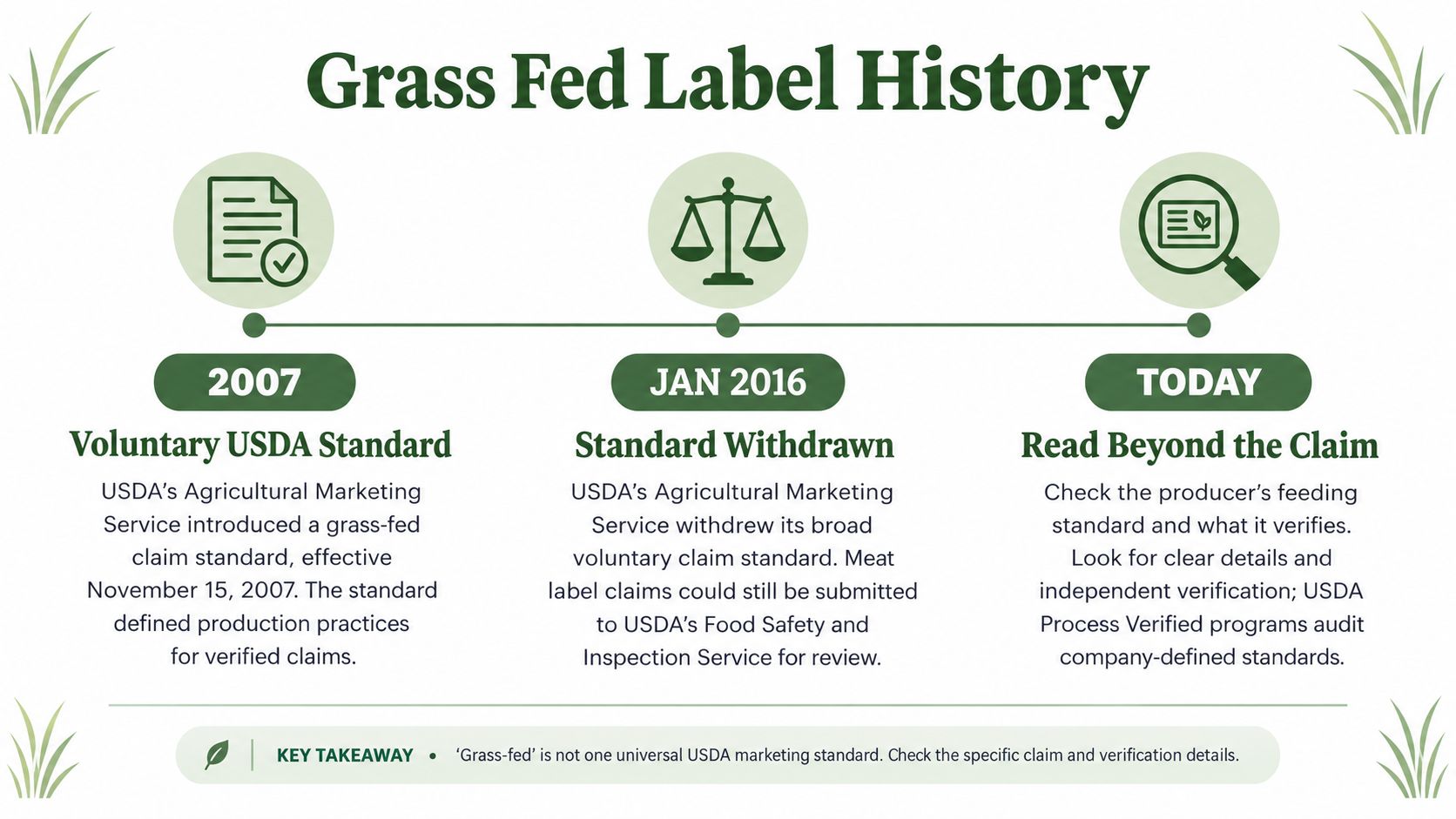
The regulatory history matters because shoppers can mistake familiar wording for a particular certification. USDA established its grass-fed claim standard in 2007, then revoked the formal USDA Grass-fed label on January 12, 2016, citing enforcement limitations; producers could continue making claims through feeding-program affidavits, while independent certification remained a separate verification route, as described in Penn State Extension's grass-fed production overview.
Revocation didn't mean grass-fed claims disappeared. It means you shouldn't assume that the phrase alone establishes the same oversight as an independent certification.
Read the feeding claim precisely
USDA FSIS guidance on animal-raising claims treats Grass Fed, Grassfed, Grass-Fed, and 100% Grass-Fed as synonymous claims for cattle fed only forage after weaning. It excludes grain and grain by-products and requires continuous pasture access during the growing season until slaughter.
Acceptable forage isn't limited to fresh pasture grass. The guidance includes grasses, legumes, other forbs, browse, vegetative-stage cereal crops, hay, haylage, baleage, silage, corn silage, grain-free crop residue, and other roughage. Routine vitamin and mineral supplementation is permitted.
That's why a pastoral illustration isn't enough. Ask whether the feeding claim describes the animal's full post-weaning feeding program, rather than merely a period spent on pasture.
Look beyond familiar wording
Treat grass-fed, grass-finished, organic, and independently certified as different questions, not interchangeable reassurance. If you want more context on cattle sourcing, the discussion of the important differences between grass-fed and conventional meat is a useful companion to label reading.
For a broth purchase, ask for documentation that connects the sourcing description to the beef-derived ingredient you're buying.
- Certification identity: Find the certifier's name and ask what its standard covers.
- Country of origin: Request the origin of the bones or collagen ingredient, not just the packaging location.
- Batch traceability: Ask whether the supplier can connect a finished batch to its ingredient records.
A label can be concise and still be transparent. The problem isn't a short label. It's a supplier that can't explain the claim behind it.
Six Criteria That Predict a Better Broth
Grass-fed describes a sourcing specification, not the quality of the broth in your cup. Compare nutrition, sourcing records, and safety evidence separately. A strong result in one category does not establish a strong result in the others.
USDA's grass-fed program FAQ describes a forage-based feeding specification that excludes milk before weaning and grain and grain by-products. It does not measure the finished product's collagen concentration, amino-acid composition, or sodium. Read the sourcing claim, then check the product itself.
The six criteria at a glance
| Criterion | What to Look For | Why It Matters |
|---|---|---|
| Protein per serving | Protein grams alongside an unambiguous serving size | Lets you judge what you'll consume |
| Collagen content and form | Declared collagen amount, hydrolyzed collagen identification, or relevant amino-acid testing | Helps distinguish a measured collagen serving from a general broth description |
| Sodium per serving | Sodium on the Nutrition Facts panel for the prepared serving | Lets you fit the product into your own dietary requirements |
| Sourcing and certification | Clear feeding language and identifiable verification | Gives you something to check beyond a front-label assertion |
| Bone-source traceability | Animal source, ingredient origin, and batch-linked records | Connects the finished product to its raw materials |
| Independent contaminant testing | A relevant laboratory report or certificate of analysis | Provides evidence about the tested sample rather than a general purity promise |
Set your requirements before shopping
Start with a readable serving declaration. If you can't tell how much liquid or powder the nutrition panel covers, you can't compare products reliably. Set that aside and choose a label that makes the serving clear.
Then decide what you want from the product. For a measured collagen serving, look for collagen-specific information instead of treating all protein as collagen. An amino-acid panel can clarify the composition, but only if its reporting basis is clear enough to compare with the stated serving.
Sodium requires a separate check. Grass-fed sourcing, savory flavor, and product format do not tell you how much sodium a serving contains. Read the Nutrition Facts panel and assess it against your own dietary needs, particularly if a clinician has advised you to limit sodium.
A product can meet your sourcing preferences and still be the wrong nutritional fit.
Check testing evidence, not just the claim
A laboratory logo or “third-party tested” statement is a reason to ask for details, not proof on its own. Find out what was tested, which laboratory did the work, and whether the report covers the finished product.
A relevant contaminant panel can show results for the sample tested. It does not confirm protein content or prove grass-fed sourcing. Likewise, a protein result says nothing about contaminant levels.
Keep the evidence categories separate. Choose suppliers that identify what each report covers and can connect it to the product being sold. Ignore broad assurances that everything has been verified unless the supplier can show you the relevant records.
Protein and Collagen Dose in Real Servings
The serving declaration is where a nutritional purchase becomes measurable. Before you compare price, flavor, or packaging, establish how much protein you'll get from the amount you'll use.
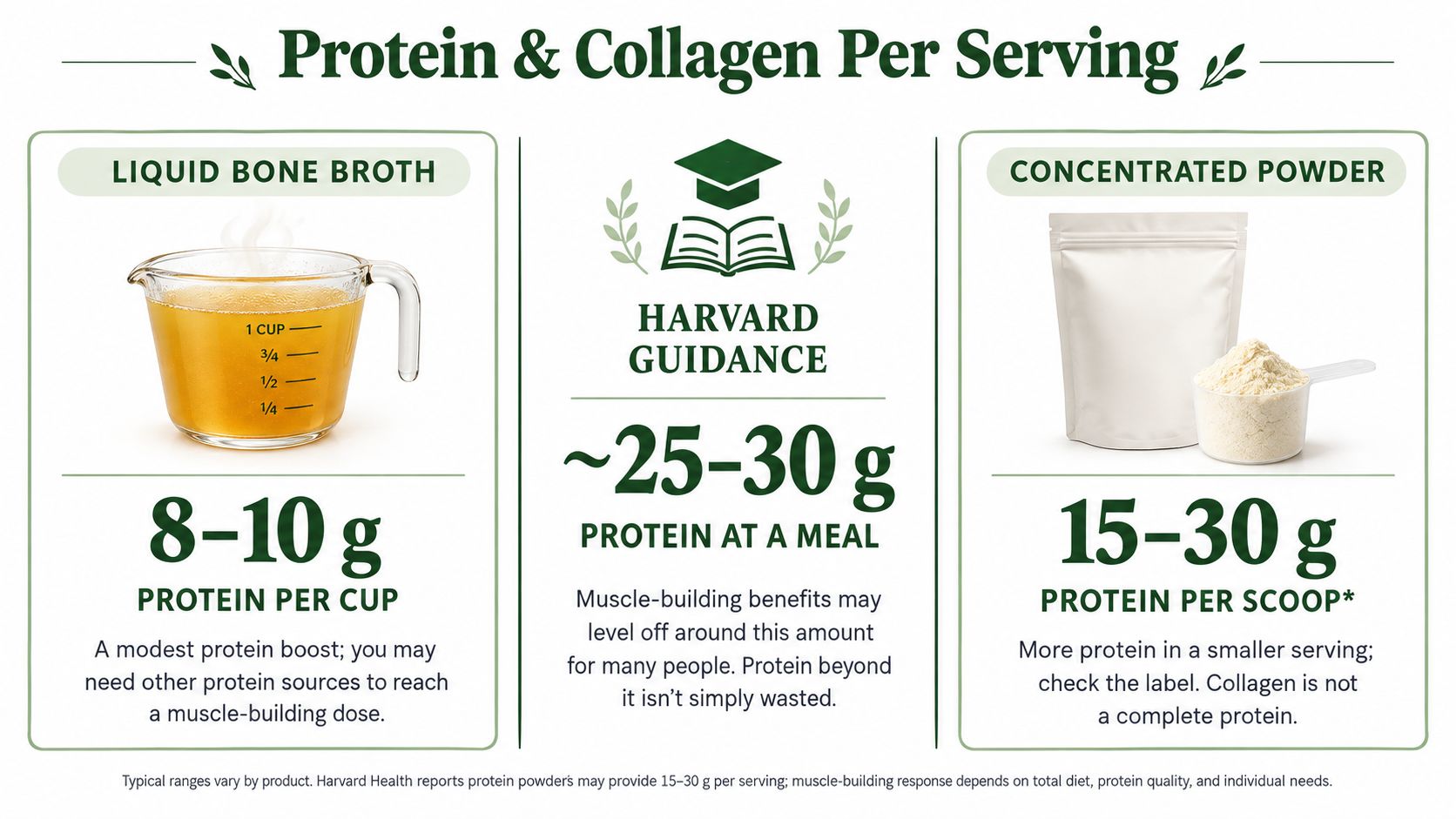
Harvard's nutrition review of collagen and bone broth reports that broth typically supplies approximately 5–10 g of protein per cup, primarily from gelatin; it also notes a study in which calcium and magnesium were below 5% of the recommended daily allowance. The review identifies acidity, cooking time, cooking temperature, and bone type as extraction variables and notes trace heavy metals, including lead and cadmium, in tested broths.
Buy broth for the contribution it makes. Don't treat a broad mineral-rich claim as a reason to use it as a calcium supplement.
Compare the serving, not the container
For daily protein accounting, I'd favor a clearly labeled broth toward the upper end of the reviewed protein range over one that supplies no useful serving detail. That's a purchasing preference for transparency and contribution, not a clinical efficacy threshold.
With powder, check the amount of powder specified on the label and the preparation instructions. Adding more water changes the drink's concentration, but it doesn't change the amount of protein contained in the powder you measured.
- Protein declaration: Record the grams supplied by your intended serving.
- Collagen declaration: Check whether the seller provides a separate amount or only total protein.
- Preparation basis: Determine whether the panel describes dry powder or the prepared drink.
Amino-acid patterns aren't interchangeable
In a study comparing collagen, dairy proteins, and beef broth, collagen produced a higher plasma glycine peak than dairy protein, 683 ± 166 versus 260 ± 65 micromoles per liter, while dairy produced a higher leucine peak, 267 ± 77 versus 189 ± 65 micromoles per liter; the beef-broth serving produced a lower, more sustained amino-acid profile.
Those findings describe different nutritional responses, not a universal winner. They're a reason not to replace a standardized protein or collagen serving with broth and assume you've made an equivalent substitution.
If you're using broth around training, count its labeled contribution. Keep the broader meal plan separate from the promise on the pouch.
Traditional Broth vs Hydrolyzed Collagen Powder
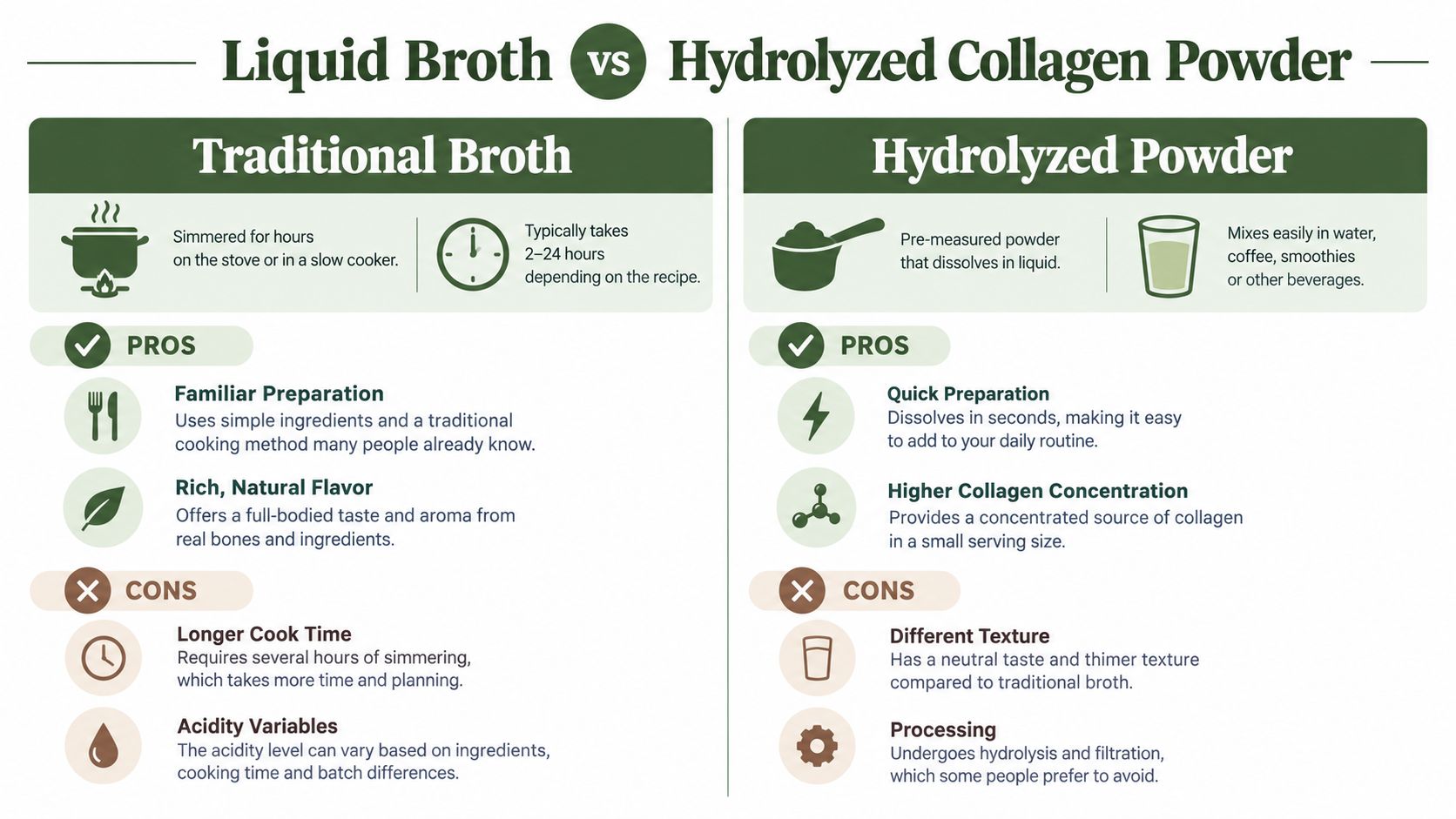
Choose the format that suits the job. Traditional broth is a food and cooking ingredient; hydrolyzed collagen powder is a different way to prepare a collagen-containing serving. Neither deserves an automatic quality advantage.
The extraction variables described earlier help explain why simmered broths vary. A powder still needs a clear ingredient identity and serving declaration, regardless of how convenient its preparation looks.
Choose traditional broth for culinary use
I'd choose liquid broth when the purpose is sipping something savory or building a soup, stew, or sauce. You're buying a food experience as well as its labeled nutrients, so taste and ingredient compatibility matter.
For those uses, there's no need to force a supplement-style comparison. A cooking base can be useful without matching a concentrated collagen product.
If you prefer meals to drink mixes, Gym Snack's take on real food provides another way to think about that preference. Use the resource as context for choosing how you want to eat, not as evidence that any broth can replace your usual protein foods.
Choose the product you'll use consistently for its intended purpose, not the format that sounds more advanced.
Choose powder when preparation convenience matters
For a coffee, smoothie, or shake routine, investigate a powder whose directions explicitly support that use. Don't assume every savory broth powder will suit coffee, or that every collagen powder will recreate a traditional broth's flavor.
Hydrolyzed collagen identifies a processed collagen form rather than a cattle-feeding standard. For a closer explanation of the terminology, consult what hydrolyzed collagen means, then check the actual product directions instead of relying on the category name.
Your decision can be simple:
- Savory meal preparation: Favor broth with ingredients and seasoning appropriate for the recipe.
- Measured drink preparation: Favor a clearly defined powder serving with directions that match your intended beverage.
- Post-workout use: Evaluate the labeled contribution without assuming recovery benefits from convenience alone.
I wouldn't abandon traditional broth because a powder is easier to carry. I also wouldn't simmer broth solely to pursue a nutrient amount that the recipe doesn't establish. Match the format to the task, then verify the composition.
A Real-World Buying Walkthrough
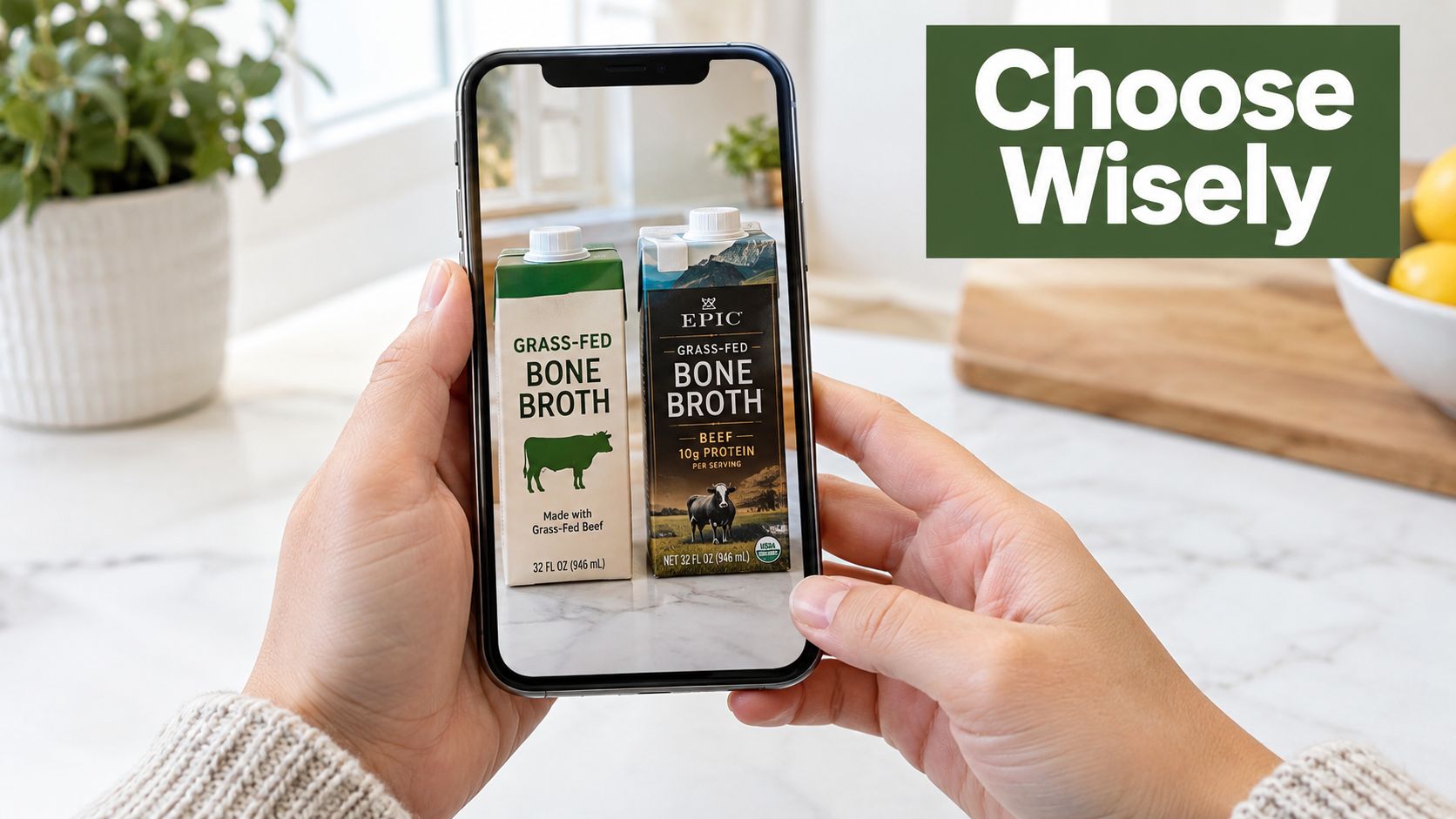
A grass-fed carton and a hydrolyzed bone broth collagen powder can both suit an athlete's routine, but neither label earns a pass on sourcing language alone. Compare what each serving provides and what documentation supports its claims.
Peak Performance's hydrolyzed grass-fed bone broth collagen is one powder option to evaluate alongside traditional broth. Treat it like any other product: record the serving basis, protein, sodium, and available testing documentation before deciding. Don't infer a nutrient amount or test result that the label and records don't show.
Read both labels in the same order
Start with each Nutrition Facts panel. Check the serving size, then compare protein and sodium for the amount you would consume. Keep the comparison tied to those serving amounts.
Review the ingredient lists next. For a collagen-focused purchase, check whether the powder identifies hydrolyzed collagen and declares its amount. A carton's total protein does not establish its collagen dose.
- Save the serving details: Keep label images together so you can compare the products directly.
- Identify missing information: An undeclared amount is unknown, not proof of a low or high amount.
- Request supporting records: Ask for relevant testing and sourcing documentation before treating a claim as verified.
Make the decision without filling in blanks
A carton may describe appealing sourcing while offering little detail beyond its basic label. That does not prove poor quality. It does leave you with less evidence if you're choosing specifically for collagen.
A powder may be convenient, but convenience says nothing about purity or nutritional superiority. Look for a clear label and relevant supporting records before drawing conclusions.
My recommendation: buy only when you can state why the product fits your intended use, what its serving contributes, and which important claims have support. Grass-fed describes sourcing; protein per serving, amino-acid information, and contaminant testing help you judge what ends up in the cup.
If information you need is missing, ask the manufacturer before reordering. Don't fill in the gaps on its behalf.
Verifying Any Claim and Common Buyer Questions
A certificate of analysis is useful only when you understand what it covers. Look for the product or sample identity, batch reference, laboratory identity, test date, analytes, units, results, and any stated limits.
The explanation of what third-party testing means can help frame your questions. Request testing relevant to contaminants and label accuracy rather than assuming a single report covers everything.
Can you use bone broth daily?
Treat it as an optional food contribution, not a mandatory protocol. Use the labeled serving, account for sodium and protein, and don't let it replace the varied foods you need; if you have dietary restrictions, review routine use with your clinician.
Will hydrolyzed collagen mix better in hot drinks?
Check the specific product's preparation directions and suggested uses. Hydrolyzed collagen and gelatin-heavy broth aren't identical formats, but don't assume every powder will dissolve cleanly, taste neutral, or work in your preferred drink.
Does a certificate prove grass-fed sourcing?
Don't expect a contaminant result to establish a cattle-feeding history. Ask for sourcing records or certification separately, and confirm that the laboratory report addresses the claims you're trying to verify.
Buying standard: A trustworthy purchase lets you distinguish what's measured, what's documented, and what remains unknown.
Peak Performance offers hydrolyzed grass-fed bone broth collagen for readers considering a powder rather than traditional liquid broth. Visit Peak Performance, locate the product listing, and check its serving information, ingredients, and available testing details against your buying criteria before ordering.
Also in Podcasts


