


Organ Complex Supplements: Benefits, Evidence, and Usage
Most advice about organ complex supplements starts in the wrong place. It treats the bottle like a magic shortcut, then asks biology to catch up. The better question is simpler, and more honest: what does organ complex mean in anatomy, what does it mean on a label, and what can it realistically do when you put it into a nutrition routine?
What an Organ Complex Actually Means
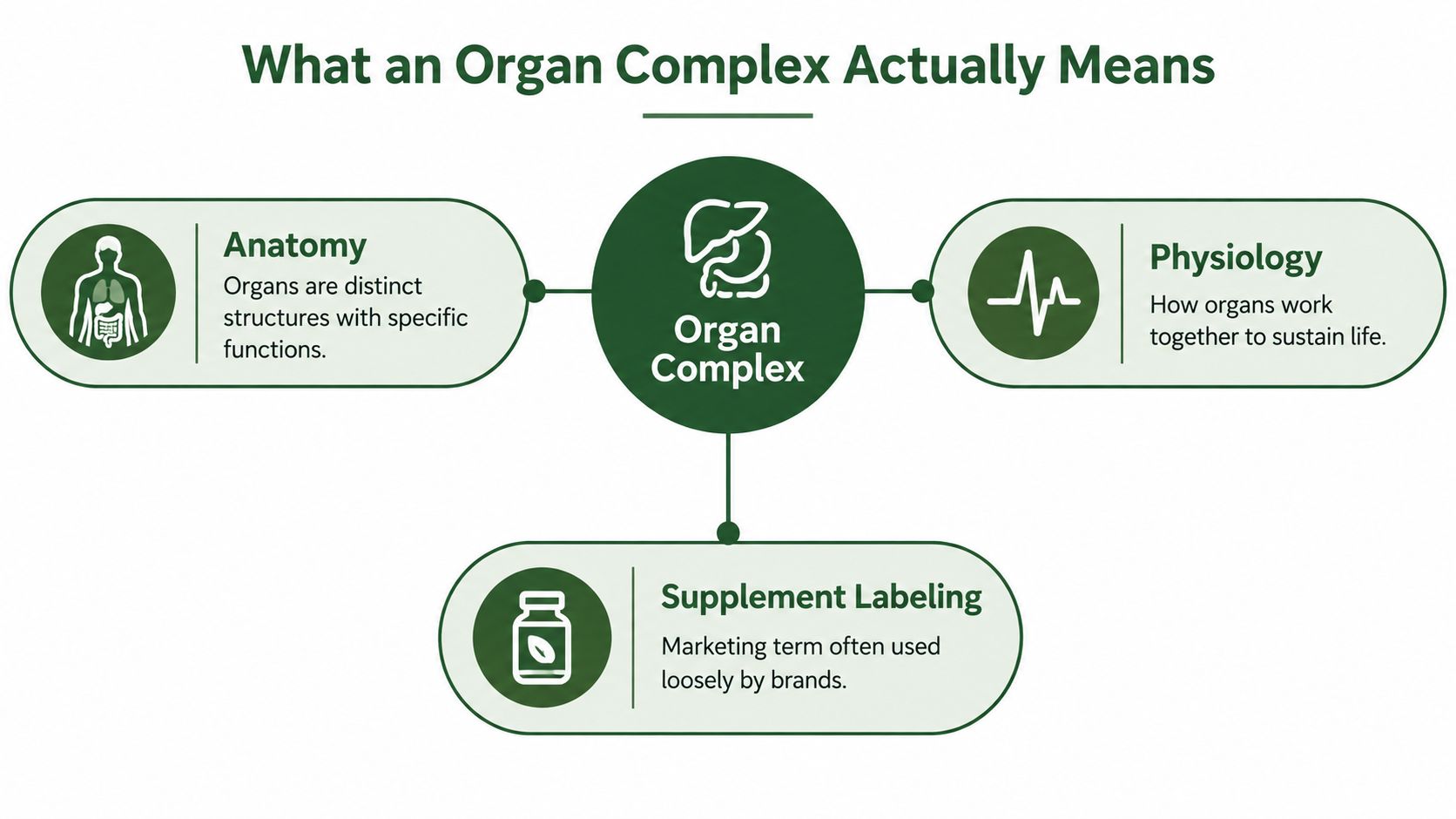
In anatomy, an organ is a distinct structure made of at least two tissue types that cooperate to perform a specific function, and an organ complex can mean either a structurally continuous system or multiple organs coordinated around a shared physiological task, as defined in standard physiology teaching Khan Academy. That matters because the supplement aisle often uses the term much more loosely.
A label might call a blend of freeze-dried organs an organ complex, but that bottle is not a living anatomical system. It doesn't contain circulation, nerve signaling, immune traffic, or tissue architecture. It contains ingredients, and those ingredients may carry nutrients, but that's a different claim from recreating an organ network.
Why the definition matters
If you're reading a label, the key question is whether the product name describes biology or marketing language. Biology asks how organs relate to one another in the body, while marketing often asks how many organs sound impressive on a front panel.
A good way to think about it is this. In physiology, organs work together in coordinated systems. In supplementation, you're buying a concentrated input, not a functioning body part. That difference is why claims like “supports the whole body because it contains several organs” sound intuitive but still need evidence.
For a broader nutrition framework, it helps to compare labels with a neutral guide such as Vitamin Planet health topics, which is useful for understanding how supplement quality, not just ingredient hype, should be judged.
Practical rule: if a product uses a biological term, ask whether it describes structure, function, or just a blend of ingredients.
The Biology Behind the Bottle
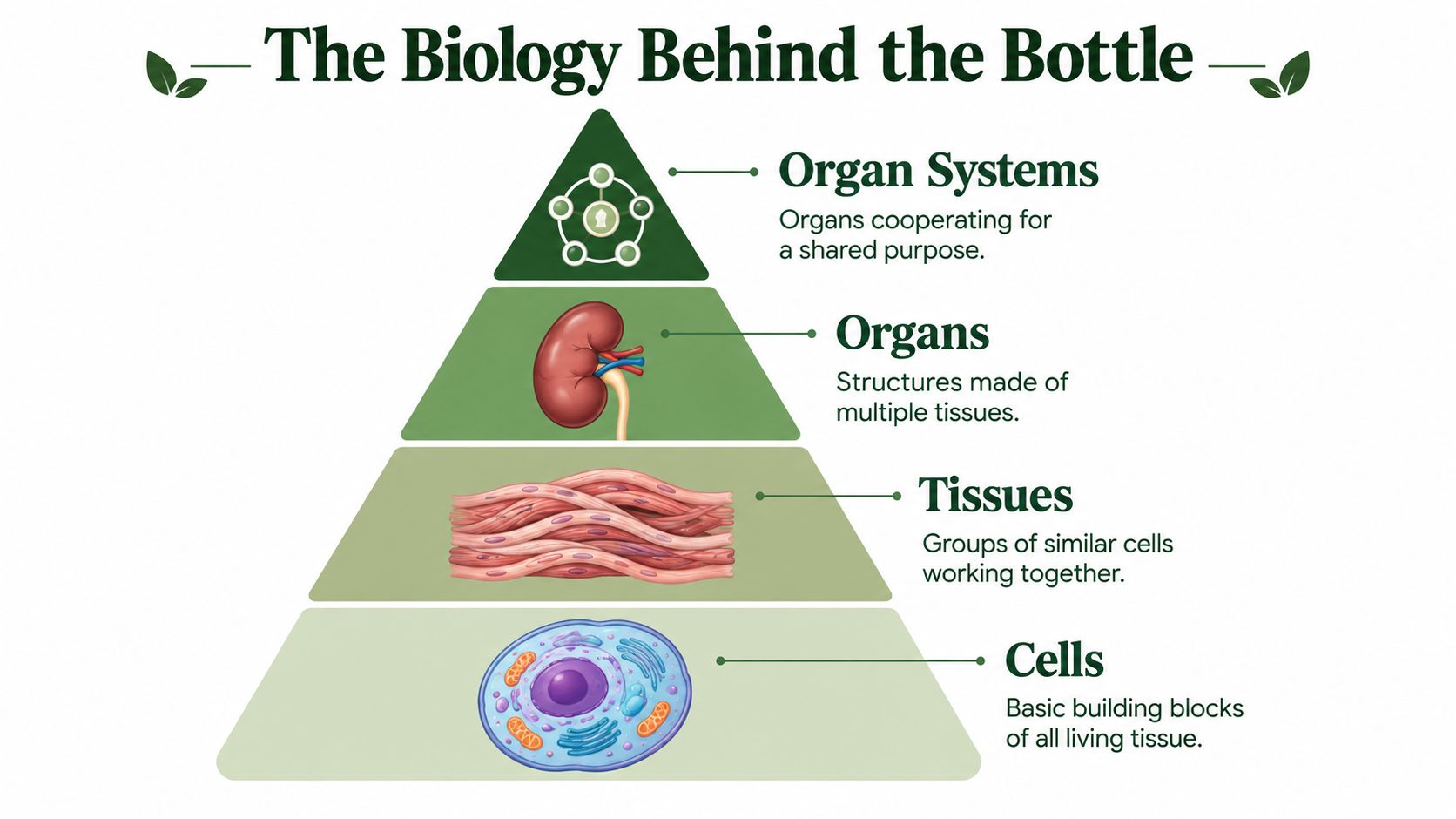
The body is built in layers. Cells form tissues, tissues form organs, and organs work together in organ systems OpenStax. That hierarchy provides the backdrop for any claim that one ingredient blend can influence something larger than the sum of its parts.
A kitchen works the same way. Flour, salt, and vegetables matter, but they are not dinner on their own. The meal happens because each station has a role, the stove, sink, prep area, and oven all coordinate, and a failure in one place slows everything else down. Organ systems depend on that kind of coordination too. The cardiovascular system moves oxygen and nutrients, the digestive system breaks food down, and the endocrine and nervous systems help regulate what happens next.
A powdered organ blend can supply nutrients that came from liver, heart, kidney, or other tissues. It cannot reproduce blood flow, hormone signaling, or immune coordination inside the body. That is why “like supports like” is a weaker claim than it sounds, because the living system is not the same thing as the tissue used as an ingredient.
A nutrient can be present without recreating the function of the organ that contained it.
That matters most when a product is marketed as whole-body support. The body's major organ systems work through coordinated interactions, not through isolated ingredients dropped into the stomach. A claim about one ingredient rarely maps cleanly onto a claim about a whole system.
Typical Ingredients in an Organ Complex Supplement
Most organ complex formulas use a predictable set of bovine tissues. The headline ingredients usually start with liver, heart, kidney, spleen, and pancreas, then sometimes add brain, bone marrow, thymus, or testes. The appeal is straightforward: each organ is associated with a different nutrient profile, so the blend looks broad rather than narrow.
| Organ | Headline Nutrients | Proposed Role |
|---|---|---|
| Liver | Vitamin A, B12, iron, folate | Nutrient density and micronutrient support |
| Heart | CoQ10, taurine | Cellular energy support |
| Kidney | Selenium, B vitamins | Enzymatic and metabolic support |
| Spleen | Iron, immune-related compounds | Immune support and mineral contribution |
| Pancreas | Digestive enzymes | Digestive support |
| Brain | Phospholipids, DHA | Structural fats for neural tissue |
| Bone marrow | Lipids and marrow-derived nutrients | Broad nutrient support |
| Thymus | Immune-related nutrients | Immune-focused positioning |
| Testes | Sterol-related compounds | Hormone-adjacent marketing claims |
Why brands combine organs
The formula logic is usually breadth. A single organ can be tied to one or two nutrients, while a blend lets a brand suggest whole-body coverage without saying it too bluntly. That's also why these products often get framed as “ancestral” or “complete,” because they appear to bundle multiple nutrient sources into one capsule.
The catch is that “multiple ingredients” doesn't automatically mean “better outcomes.” A label can list several organs and still leave you guessing about dose, sourcing, and processing. The only safe starting point is to separate what the ingredient list contains from what the product does.
If you're reading a label, focus first on the organ names, then on whether the formula gives you enough detail to judge quality. A long ingredient list can be useful, but it's not proof of benefit.
Proposed Benefits and the Evidence Behind Them
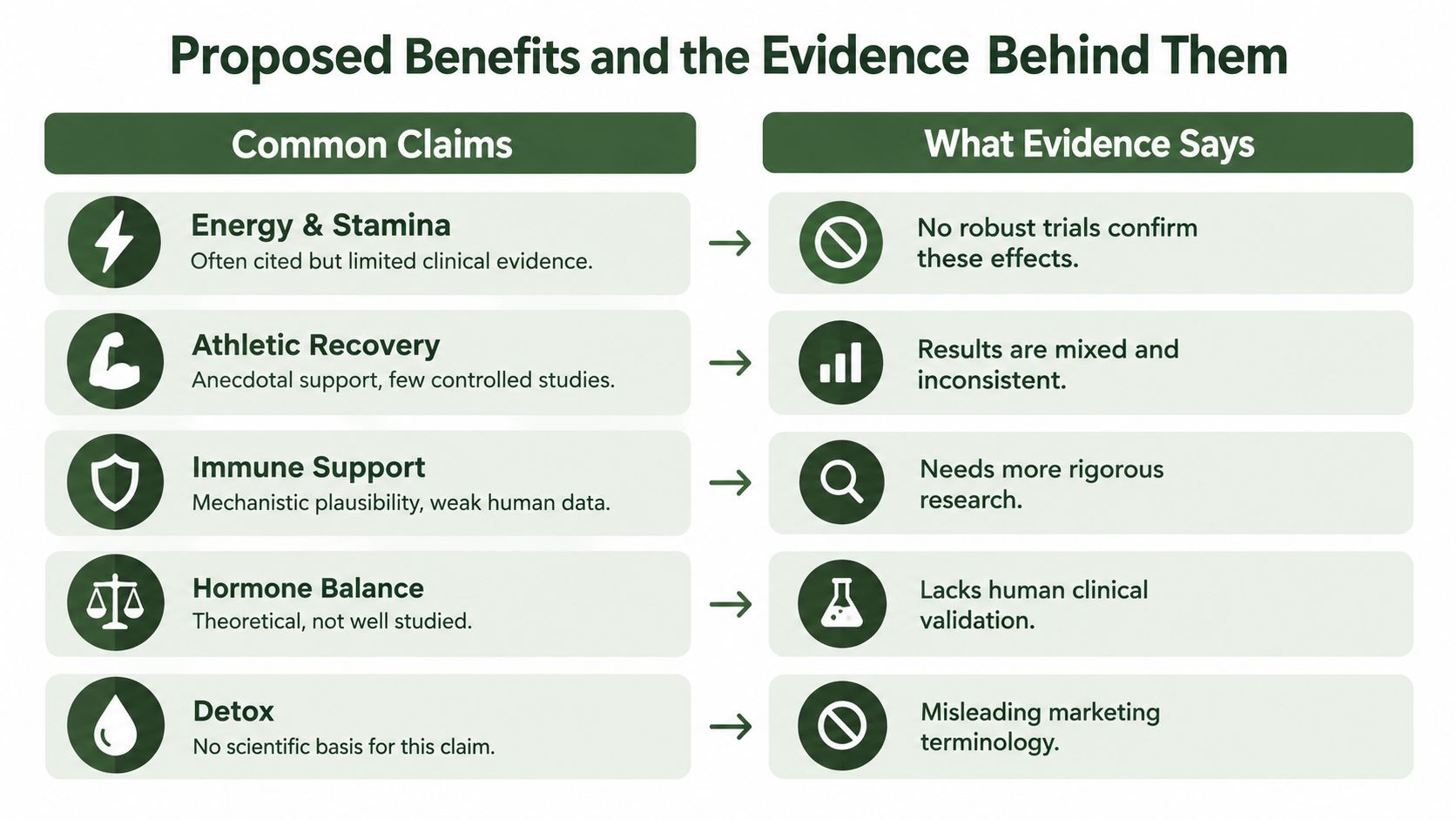
The strongest case for organ complex supplements is also the most modest one. Organ meats are nutrient-dense foods, and freeze-drying can help preserve sensitive nutrients, but that still doesn't prove the supplement delivers the outcomes people buy it for. Independent expert commentary notes that no controlled human trials have specifically assessed the bioavailability of nutrients from beef-organ supplements, and human efficacy and safety studies are currently lacking for this category Yahoo Health.
Common claims versus what evidence can actually support
Energy and stamina get mentioned a lot because liver and other organs contain nutrients tied to metabolism. That sounds plausible, but plausibility isn't proof.
Athletic recovery is often marketed through the same nutrient-density argument, yet a product can be nourishing without being performance-enhancing.
Immune support sounds reasonable when the formula includes spleen, thymus, or nutrient-rich liver, but the leap from nutrient presence to immune outcome is still a leap.
Hormone balance is a common theme when formulas include reproductive tissues, but the mechanism usually stays theoretical.
Detox is the weakest claim of all, because the term itself is usually a marketing shortcut rather than a scientifically useful endpoint.
Simple test: if the label says a nutrient is present, ask whether the brand also shows that the nutrient survives processing, is absorbed, and improves a real outcome in humans.
That's the core evidence gap. Organ complex products may provide useful nutrients, but contains a nutrient is not the same as improves a health outcome. For a cautious reader, that's the most important distinction in the whole category.
How to Evaluate Product Quality Before You Buy
Quality varies a lot here, so label reading matters more than brand storytelling. A useful starting point is how to evaluate wellness supplements, because the same checks apply here, sourcing, testing, and transparency.
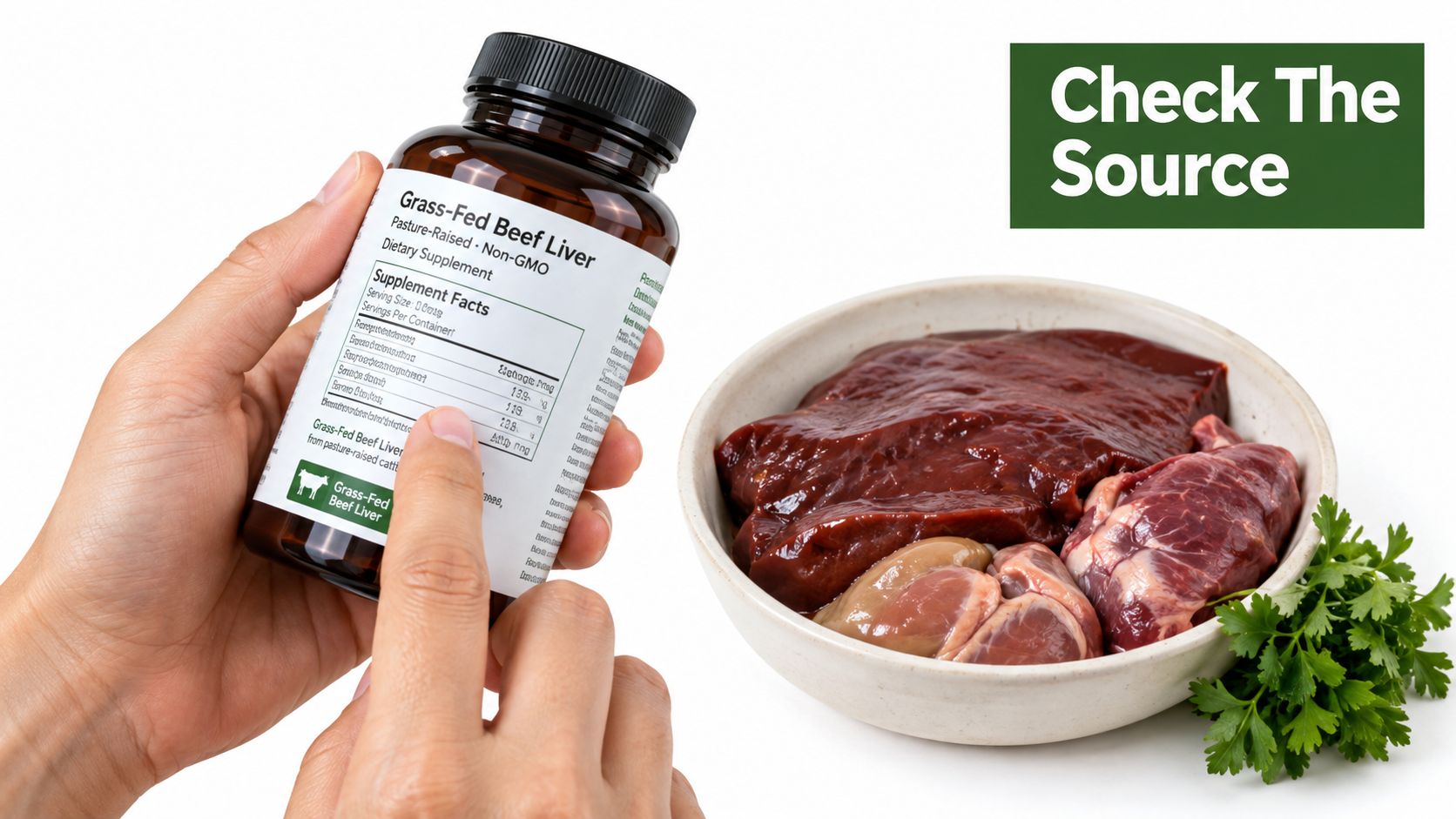
Start with the processing method. Freeze-drying is a common way to help preserve heat-sensitive nutrients, so treat it as a basic expectation rather than a bonus. Third-party testing should also be easy to find, with clear batch-level information on safety, potency, and contaminants such as heavy metals.
What to check on the label
- Source details: look for species names, sourcing claims, and country of origin instead of vague wording.
- Processing method: freeze-dried is better aligned with nutrient preservation than heat-heavy processing.
- Testing language: third-party testing should be specific, not just implied by a clean-looking package.
- Form factor: capsules are convenient, powders offer flexibility, and tablets can vary in how much tissue they deliver.
- Serving clarity: if the serving size is tiny and the formula is packed with many ingredients, the actual organ amount may be harder to judge.
Good labels answer the boring questions first.
For label reading, the plain-English guide on how to read supplement labels is a useful companion. If a brand is confident in its quality, it should make those details easy to find.
Organ Complex Compared to Whole-Food Organs and Superfood Protocols
This is the actual decision most buyers face. Eat liver occasionally, take a capsule, or build both into a broader nutrition plan? Each option has strengths, but they solve different problems.
For a deeper discussion of nutrient density and food-first thinking, the podcast conversation at Eat Like a Human is a useful side note, especially if you want a food-history lens rather than a supplement-only view.
| Option | Strength | Limitation | Best Fit |
|---|---|---|---|
| Organ complex supplement | Convenient, concentrated, shelf-stable | Less context than whole food | People who want a simple daily add-on |
| Whole-food organs | Culinary form, broader food matrix | Less convenient and not everyone tolerates the taste | People comfortable cooking organ meats |
| Superfood protocol | Broader plant-based nutrient variety | Doesn't replace organ-specific nutrients | People building a wider daily nutrition base |
Where each one fits
Whole-food organs bring the full food matrix, which matters more than people think. Supplements bring convenience and consistency, which also matters. A superfood protocol adds a different layer, especially when the goal is to round out polyphenols, greens, and other plant compounds alongside nutrient-dense animal foods.
The smartest approach is usually not duplication. It's coverage. An organ complex can sit beside a collagen source and a superfood blend without pretending to do every job at once.
If you already eat nutrient-dense meals, the supplement should complement that pattern, not replace it.
Practical Dosing, Timing, and Safety
Organ complex supplements are concentrated, so more is not automatically better. Many people do better starting with half a serving for the first week, then adjusting based on tolerance and the rest of their diet. Timing often comes down to digestion and convenience, not magic.
The timing guide at best time to take vitamins is a helpful reminder that supplements work best when they fit a routine you can keep.
A simple safety-first approach
- Take with food: this usually improves tolerance, especially if the formula contains fat-soluble nutrients.
- Start low: a smaller starting dose can help you notice how your body responds.
- Use caution with iron load: organ blends can be a poor fit for people who already need to limit iron.
- Check medication conflicts: if you use prescription medications, talk to a clinician before adding a concentrated organ blend.
- Stop if symptoms show up: digestive upset, unusual reactions, or headaches are reasons to reassess.
Pregnant people, children, and anyone with a medical condition should be extra careful, especially because organ meats can concentrate nutrients such as vitamin A and iron. People who avoid animal products will also want to skip this category entirely.
Safety first: a nutrient-dense supplement can still be the wrong supplement for your situation.
The best use case is thoughtful, not aggressive. Start low, pair it with food, and treat it as one part of a broader nutrition plan rather than a one-stop fix.
Putting It All Together
An organ complex works best as a concentrated nutrient add-on, not as a fantasy version of a whole body system. Anatomy gives the term a real definition, physiology shows why the body depends on coordinated networks, and supplement science reminds us that a bottle can carry nutrients without carrying all the functions of living tissue.
The most sensible frame is simple. Use the biology to decode the label, use the evidence to keep your expectations grounded, and use quality standards to separate serious products from glossy marketing. If you already build around nutrient-dense meals, a well-made organ complex can play a supporting role alongside a superfood blend and a collagen source, but it shouldn't be treated like a stand-alone fix.
A good rule is this. If a product sounds like it can replace diet, sleep, and basic medical care, it's overpromising. If it fits into a broader protocol and earns its place through quality and fit, it's much more believable.
If you want a cleaner way to build a daily nutrition stack, Peak Performance offers organic superfood powders, collagen, vitamins, and quality-tested supplements that fit naturally alongside an organ complex. If you're comparing options for a broader wellness protocol, start there and look for products that make quality, sourcing, and transparency easy to verify.


