


Bovine Desiccated Thyroid: Top 10 Myths Finally Busted
Most of what circulates about bovine desiccated thyroid comes from two camps that never check each other. One calls it a gentle, natural glandular supplement that supports a sluggish thyroid. The other calls it an unstable, unapproved relic that no sensible clinician would touch. Both descriptions fail the same test: each treats a single word, natural on one side, animal on the other, as though it settled a question about dose, potency and oversight.
The verdict that survives a fact-check sits between them, and it's more useful than either. Several of the oldest fears about desiccated thyroid stopped being true decades ago, when potency testing changed. A few of the newer fears are not just valid but understated, especially anything resting on the assumption that "bovine" means "standardized."
What follows is a myth-by-myth audit of ten claims you're likely to meet in a forum thread, a relative's warning, or an article written before the current testing standards existed. Each one gets a verdict, the evidence behind it, and a plain answer about what to do next.
Top 10 Myths at a Glance
Bovine desiccated thyroid is an animal-derived thyroid extract. Glands are dried, powdered and formed into tablets or capsules, and the finished material carries both thyroxine (T4) and triiodothyronine (T3). Bovine, ovine and porcine glands have all been used historically, though most contemporary animal-derived thyroid products are porcine. That definition already explains why the myths cluster where they do. People argue about the species on the label, while the clinical question is about the hormone content inside the tablet.
Most of the fears attached to the product are outdated. A few are not, and those concern manufacturing control rather than the raw material itself.
| Myth | Verdict | Key Evidence |
|---|---|---|
| Desiccated thyroid is an unproven new fad | Mostly false | Glandular thyroid therapy has a long clinical record, and U.S. prescribing of animal-derived thyroid products continues at scale |
| Dosing is automatically unstable because it comes from an animal gland | Mostly false | The modern USP standard measures T3 and T4 directly rather than relying on iodine content |
| It is totally unregulated | Partly true | The products are unapproved, and FDA warns that potency can vary between tablets and between batches |
| Bovine means standardized and safer | False | Bovine is a species label, not a potency guarantee, and most animal-derived products are porcine |
| It is just a harmless glandular supplement | False | It is a pharmacologically active hormone product, not an ordinary supplement |
| Its hormone ratio matches the human thyroid | False | Conventional extracts carry a much higher share of T3 than the human gland produces |
| Research proves it is universally superior | False | The evidence is limited and mixed, and randomized trials found no clear quality-of-life advantage |
| Research proves it is universally unsafe | False | No blanket danger finding exists, but dose variability and T3 exposure are real concerns |
| A normal TSH proves the dose is right | False | TSH can stay within range while T3 rises transiently after a dose |
| Doses convert easily between bovine, porcine and synthetic products | False | Conversion belongs under medical supervision, not a ratio copied from a forum |
Read the verdicts this way. False means the evidence contradicts the claim outright. Mostly false means the claim rests on an outdated basis, usually a testing standard that changed. Partly true means a real basis exists, but the claim overstates it.
The ten fall into five themes, and they run in this order: history and dosing stability, where the most outdated fear lives; regulation and quality, where the valid concerns live; natural status and hormone ratio; what the research proves; then blood testing and dose conversion, where most self-inflicted harm happens.
One boundary applies to everything below. Nothing here replaces assessment by a qualified clinician who can read thyroid blood tests and review your history, medications and symptoms. The point is to make you a better-informed participant in that conversation, not to substitute for it.
Myths About Its History and Dose Stability
Two claims get tested here, and they pull in opposite directions. The first says desiccated thyroid is an unproven fad that arrived with the wellness aisle. The second says its dosing is unstable because the raw material comes from an animal gland. The prescribing record defeats the first, and the assay record defeats the second.
In 2024, approximately 1.5 million U.S. patients received prescriptions for animal-derived thyroid medications, including desiccated thyroid extract, according to the FDA's summary of its actions on unapproved thyroid medications. A therapy used at that scale, prescribed by clinicians and dispensed through pharmacies, isn't a novelty item. Glandular thyroid therapy was established clinical practice long before synthetic levothyroxine existed, and it never left the formulary. Calling it a fad confuses a trend in the supplement aisle with the prescription product that came before it.
The useful question about any thyroid product is not its age but its measured hormone content, and that's where the second myth runs into trouble.
Before 1980, the U.S. Pharmacopeia assessed thyroid and thyroid-extract tablet potency primarily through iodine content. In 1985 the standard shifted toward direct measurement of T3 and T4, per a review of thyroid hormone regulation. That change matters because iodine content tells you how much glandular material is present, not how much active hormone the tablet will deliver.
The analogy that makes it click: judging a thyroid tablet by iodine is like judging a cake by counting one ingredient. Weighing the flour, sugar and butter separately tells you what the slice will actually do to you.
Direct assay makes standardization technically possible. It doesn't make it automatic, because an unapproved product still has to be tested batch by batch to earn the word. A label that lists no T4 or T3 values gives you nothing to check.
- Look for a standardization statement. If the label doesn't claim measured hormone content, assume none was measured.
- Find the per-tablet T4 and T3 values. A serious product states them. A vague one says "thyroid concentrate" and stops there.
- Treat missing values as unverified potency. Raise it with your prescriber before the first dose, not after.
Myths About Regulation and Bovine Quality
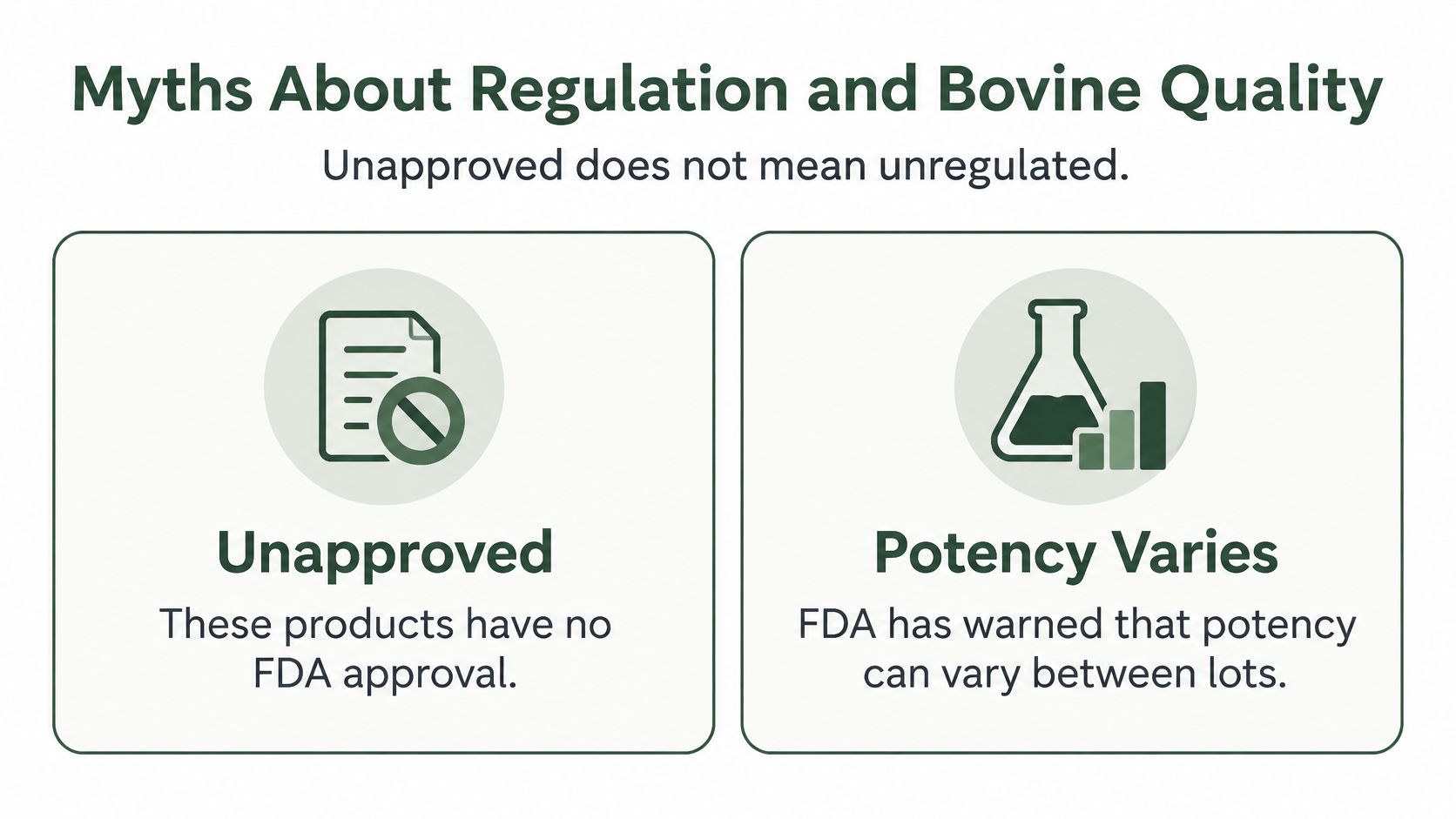
Unapproved and unregulated are not synonyms, and blurring them is how both sides of this argument go wrong. Animal-derived thyroid products don't carry FDA approval, which is a regulatory status. They're also the subject of active FDA enforcement, which is oversight of a different kind. The FDA's information on animal-derived thyroid products identifies potential problems with potency and content uniformity and states that unapproved products can vary substantially both between batches and within individual batches.
That phrase carries the weight. Variation inside a single batch means two tablets from the same bottle can differ in hormone content. Thyroid replacement has a narrow therapeutic index, so relatively small changes in delivered hormone can produce clinically important under-replacement or excess exposure. This is the fear that holds, and it holds for a reason most consumer articles skip: the manufacturing record, not the animal.
Then there's the assumption that bovine equals better. Bovine is a species label, nothing more. It tells you which animal the gland came from and says nothing about how much T4 or T3 the finished tablet carries. Since most contemporary animal-derived thyroid products are porcine, a bovine product is usually a pork-free alternative rather than a tighter manufacturing standard.
So what should a buyer demand? A defensible specification looks like this:
- Species and tissue sourcing, documented rather than described in marketing copy.
- Validated T3 and T4 potency assays, not a total iodine figure dressed up as potency.
- Homogeneity testing across tablets and across lots.
- Stability data that runs through the expiry date on the bottle.
- Contaminant and pathogen controls, including the source-country questions that matter for glandular tissue.
- A certificate of analysis traceable to an independent laboratory, with the lab named.
Ask for all six. A supplier who produces five and stalls on the sixth has told you something useful. Independent verification is the piece buyers skip most often, and a plain explanation of what third-party testing actually checks is worth reading before you accept a certificate at face value.
Bring that list to your prescriber, not just to the seller. A physician can tell you whether the documentation standard matches the risk your history carries.
Myths About Natural Status and Hormone Ratio
Natural describes where a molecule came from. It says nothing about how gently it behaves once it's circulating in your blood, and wellness framing does the most damage at that point. This material isn't a nutritional adjunct to thyroid function. It's a pharmacologically active hormone product carrying both T4 and T3 in a fixed physical form.
The ratio is where the difference becomes concrete. Conventional desiccated thyroid preparations provide an approximately 4.2:1 T4 to T3 ratio, while the human thyroid produces roughly 14:1, according to the American Thyroid Association's statement on desiccated thyroid extract.
| Source | Approximate T4:T3 Ratio | What It Means |
|---|---|---|
| Conventional desiccated thyroid | about 4.2:1 | T3 is relatively higher, so post-dose T3 can rise transiently |
| Normal human thyroid secretion | about 14:1 | The reference proportion the body produces itself |
Because T3 is the more potent and rapidly acting hormone, that relative surplus can produce transient post-dose T3 elevations even when TSH sits within a target range. A blood draw timed hours after a dose can look acceptable while the hours right after swallowing the tablet look nothing like natural secretion.
Think of it as a recipe with the strong spice tripled. A small change in quantity changes the whole dish, and the person eating it notices before the cook does.
Three practical consequences follow.
Do not use it as a general wellness supplement. There's no dose at which a hormone product becomes a tonic, and "supportive" on a label is a marketing word, not a pharmacological category.
Treat any use as a prescription decision. That means a named prescriber, baseline labs, and scheduled retesting rather than a bottle bought on a recommendation.
Ask whether T3 testing is clinically indicated. Monitoring TSH and free T4 alone won't show a post-dose peak, which is why clinician-directed monitoring sometimes adds T3 to the panel.
Iodine deserves a mention here because it's the raw material the gland uses to build these hormones, and readers often assume more iodine solves a thyroid problem. The relationship between iodine intake and thyroid hormone production is more conditional than most supplement copy admits. The American Thyroid Association doesn't recommend desiccated thyroid extract as routine first-line therapy either, favoring levothyroxine because its dose and pharmacokinetics are more standardized.
Myths About What the Research Proves
Two mirror-image claims fail on the same evidence. One says the trials prove desiccated thyroid is superior. The other says the trials prove it is dangerous. The literature supports neither verdict, because the body of work behind both is small and uneven.
The most-cited inventory is the American Thyroid Association's review, which identified nine nonrandomized studies, two randomized clinical trials and three case reports, with overall study quality ranging from moderate to low in its clinical thyroidology review for patients. In the two randomized trials, researchers found no clear differences in quality of life or symptom control, and TSH effects were inconsistent across studies.
That mix cuts against both camps. The fear that trials established harm is outdated: nothing in that review produced such a finding. The defense rests on equally thin ground, though, because moderate-to-low quality evidence cannot certify a product's consistency the way its advocates imply.
Preference is where the argument lives. Earlier randomized crossover studies found that many patients preferred desiccated thyroid extract, even though symptom and psychometric testing showed no measurable difference between it and levothyroxine. That gap between what patients choose and what tests can measure is the genuine finding, and both sides misquote it.
The evidence base has grown without resolving. A 2024 systematic review of treatment preferences covered 11 clinical trials involving 1,135 patients, with 543 receiving levothyroxine and 592 receiving combination therapy including T3 or desiccated thyroid extract, per the American Thyroid Association's summary of that review.
A stated preference is not proof of superiority, and it isn't proof of harm either. It is proof that patients differ.
The honest verdict is more regulatory than clinical. When the trial count is low and quality is moderate at best, what gets exposed is how little the evidence specifies about the product. Individual preference occurs, sometimes strongly, and a clinician should take it seriously. A preference reported in a trial is still not a measured advantage, and it cannot carry a universal claim in either direction. For the patient-facing account of how thyroid symptoms get misread long before a trial enters the picture, this conversation with Elle Russ on thyroid issues covers that ground in more detail than a study summary can.
Myths About Blood Tests and Dose Conversion
A lab result is a snapshot of one signal, not a certificate that the dose is correct. Each test answers a different question, and knowing which is which stops you from reading a single number as a verdict.
| Test | What It Measures | Why It Matters |
|---|---|---|
| TSH | Pituitary signal that drives the thyroid | Can stay in range while T3 rises after a dose |
| Free T4 | Circulating unbound thyroxine | Shows the T4 part of the dose in the blood |
| T3 | Active thyroid hormone | Checked when clinically indicated to reveal post-dose peaks |
The conversion myth is the more dangerous of the two. Bovine, porcine and synthetic products differ in their T4 to T3 proportions and in their potency, so no simple rule moves a dose from one product to another. A number that was correct on one label can be an overshoot or an undershoot on the next. That's a medical decision with follow-up testing attached, not arithmetic.
What to do instead of self-converting:
- Bring the actual label to the appointment. Product name, stated T4 and T3 per tablet, and the batch number if there is one.
- Get baseline labs before any switch. A change made without a starting point can't be evaluated afterward.
- Retest on the schedule your clinician sets, and report symptoms rather than adjusting the dose to match how you feel.
Know the signs that mean a phone call rather than a dose tweak: palpitations, unexplained weight loss, disrupted sleep and new anxiety. Those are reasons to contact a clinician promptly. They're not reasons to halve a dose on your own, because the next lab result will then reflect two changes instead of one.
Anyone weighing hormone therapy more broadly, including who may consider bioidentical hormones, should apply the same discipline: baseline testing, a named prescriber, and a retest date in the calendar.
Questions to Ask Before You Try Desiccated Thyroid
The label question is the one buyers skip, and it's the one that matters most. A 2025 clinical review notes that bovine thyroid formulations are not FDA-approved, are not standardized, may have inconsistent dosing, and generally are not available through retail pharmacies, as published in the Cleveland Clinic Journal of Medicine. That makes the conversation before purchase more valuable than any review you'll read afterward.
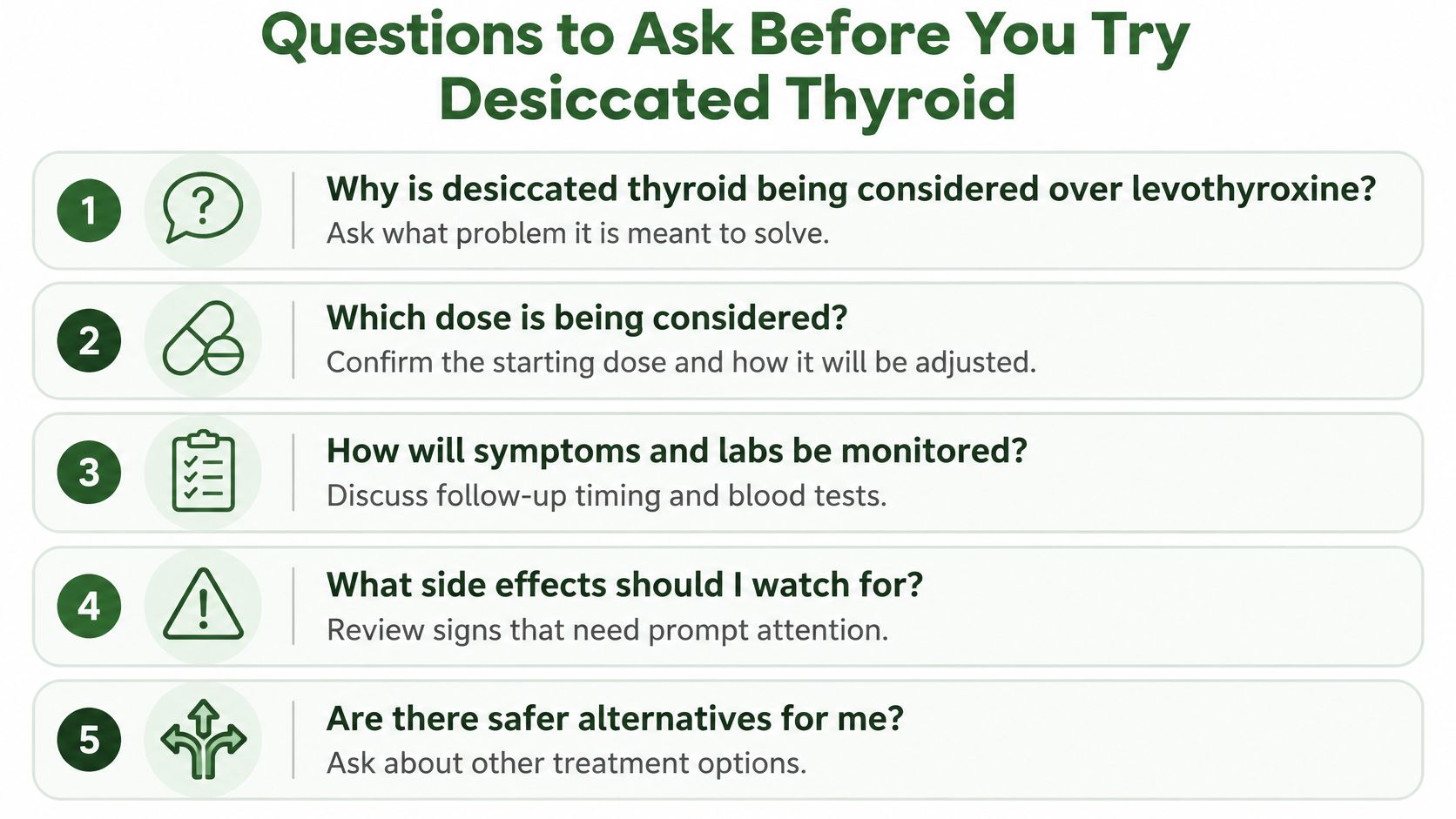
Take these five questions to a qualified healthcare professional:
- Why desiccated thyroid rather than levothyroxine? Ask what problem it's meant to solve that a standardized product can't.
- Which monitoring tests will be used, and when? Get the follow-up date, not just the test names.
- Can the T4 and T3 values per tablet be shown? If not, potency is unverified.
- Who adjusts the dose if a result comes back abnormal? Name the person and the route to reach them.
- Has the batch documentation been reviewed? Potency, homogeneity, stability, contaminants and independent verification, in writing.
The stakes shift by person. For athletes, older adults and people with cardiovascular disease, an overshoot matters more than a small undershoot, so documentation and monitoring carry extra weight.
If you're comparing what's sold rather than what's prescribed, the Raw Desiccated Thyroid Capsules listing is one option to hold against those five questions. A listing is not a prescription, and the label plus batch documentation should be checked before any purchase. The decision belongs to a qualified clinician who has seen your history and your labs.
Peak Performance was built for readers who want the sourcing question answered before the label question, which is why every batch of our organic superfood powders, vitamin D and K formulas, and our Grass Fed Beef Organ Complex from New Zealand goes through third-party lab testing for safety and potency. That complex is a 180-capsule blend of desiccated beef liver, heart, kidney, pancreas and spleen, the kind of tissue product where species, country of origin and verification should be on the page rather than in a footnote. If this article changed how you read a glandular label, visit Peak Performance to see what each formula is tested for before it ships.


