


DAO Enzyme Explained: What It Does and How It Works
Could a meal trigger symptoms even when the food itself isn't an allergy? One possible piece of the puzzle is how well your body clears histamine in the gut. The DAO enzyme is part of that process, but a gene result or blood test can't, by itself, tell you whether histamine is causing your symptoms.
DAO is best understood as a gut-localized first-pass defense, not a general digestive enzyme. Its activity can be shaped by inherited variation, the condition of the intestinal lining, and other exposures. Understanding those influences helps separate what the biology explains from what tests and supplements can confirm.
What the DAO Enzyme Actually Is
Someone who reacts to one meal but not another may hear, “Look into DAO.” That advice can sound vague until you know what the enzyme does and where it works.
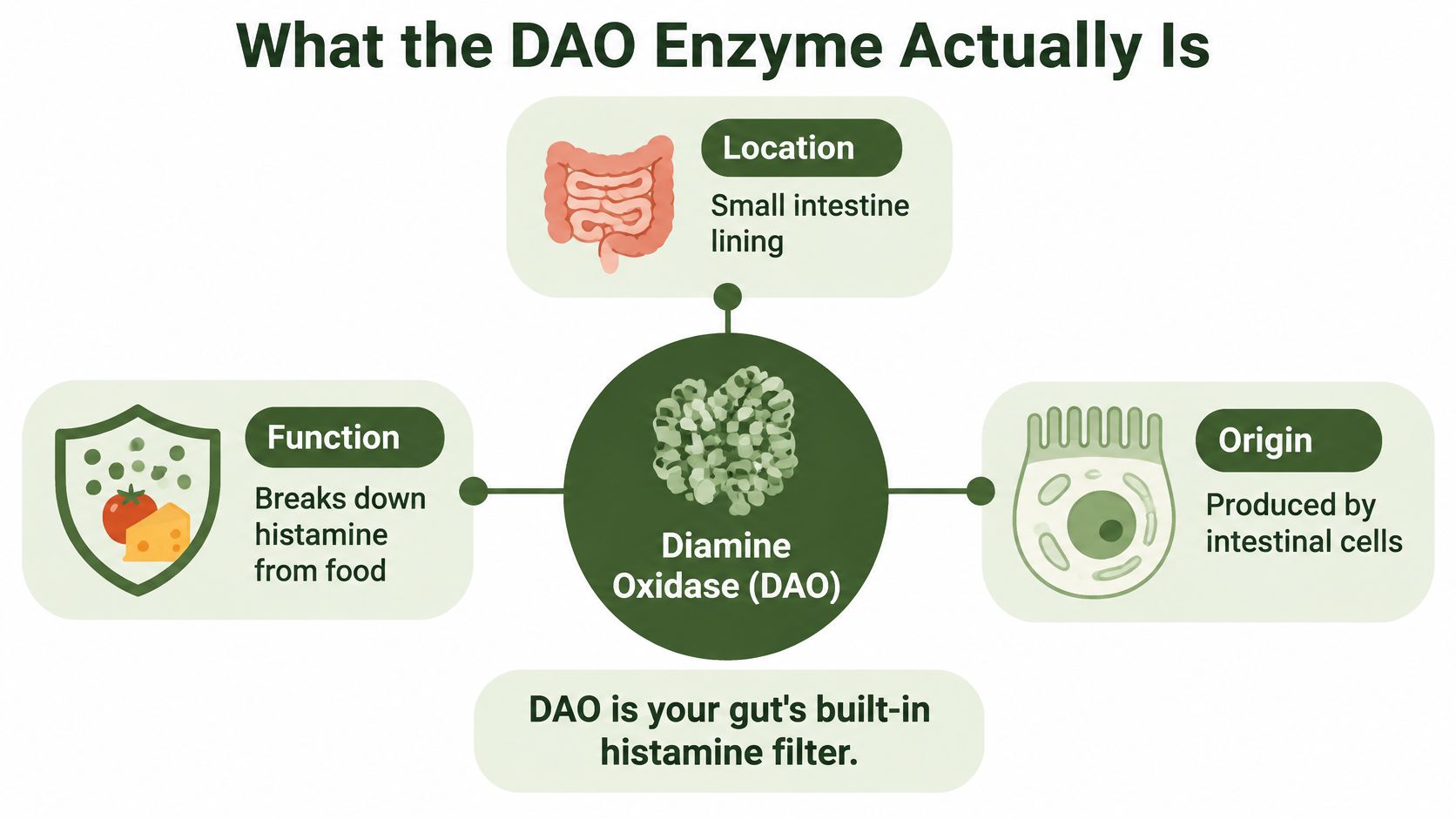
Diamine oxidase (DAO) is a copper-dependent enzyme encoded by the AOC1 gene. Its job includes breaking down histamine, a compound that can come from food and intestinal microbes. DAO converts histamine into imidazole-4-acetaldehyde, hydrogen peroxide, and ammonia, as described in this overview of DAO's role in histamine metabolism.
The enzyme's location matters. DAO is produced mainly by specialized cells called enterocytes in the small-intestinal lining, and it's also found in the kidneys. At the gut surface, it can encounter extracellular histamine before that histamine crosses the intestinal barrier. Think of it as a checkpoint near the entrance, rather than a general-purpose digestive tool circulating everywhere.
Why the gut location changes the story
A digestive enzyme usually helps break down components of food. DAO has a narrower role: it helps clear certain amines, including histamine. Its position at the intestinal lining means it can act on histamine in the gut before more of it reaches the rest of the body.
That doesn't mean DAO is the only way the body handles histamine, or that every food-related reaction points to a DAO problem. It does explain why scientists focus on the intestinal lining when studying DAO activity. If the lining is inflamed or injured, the local environment where DAO works may change.
DAO is therefore better pictured as a specialized filter at the gut wall than as a broad “detox” or digestion enzyme. That distinction helps make sense of why genetics, intestinal health, symptoms, and supplement claims need to be considered together.
How DAO Breaks Down Histamine Step by Step
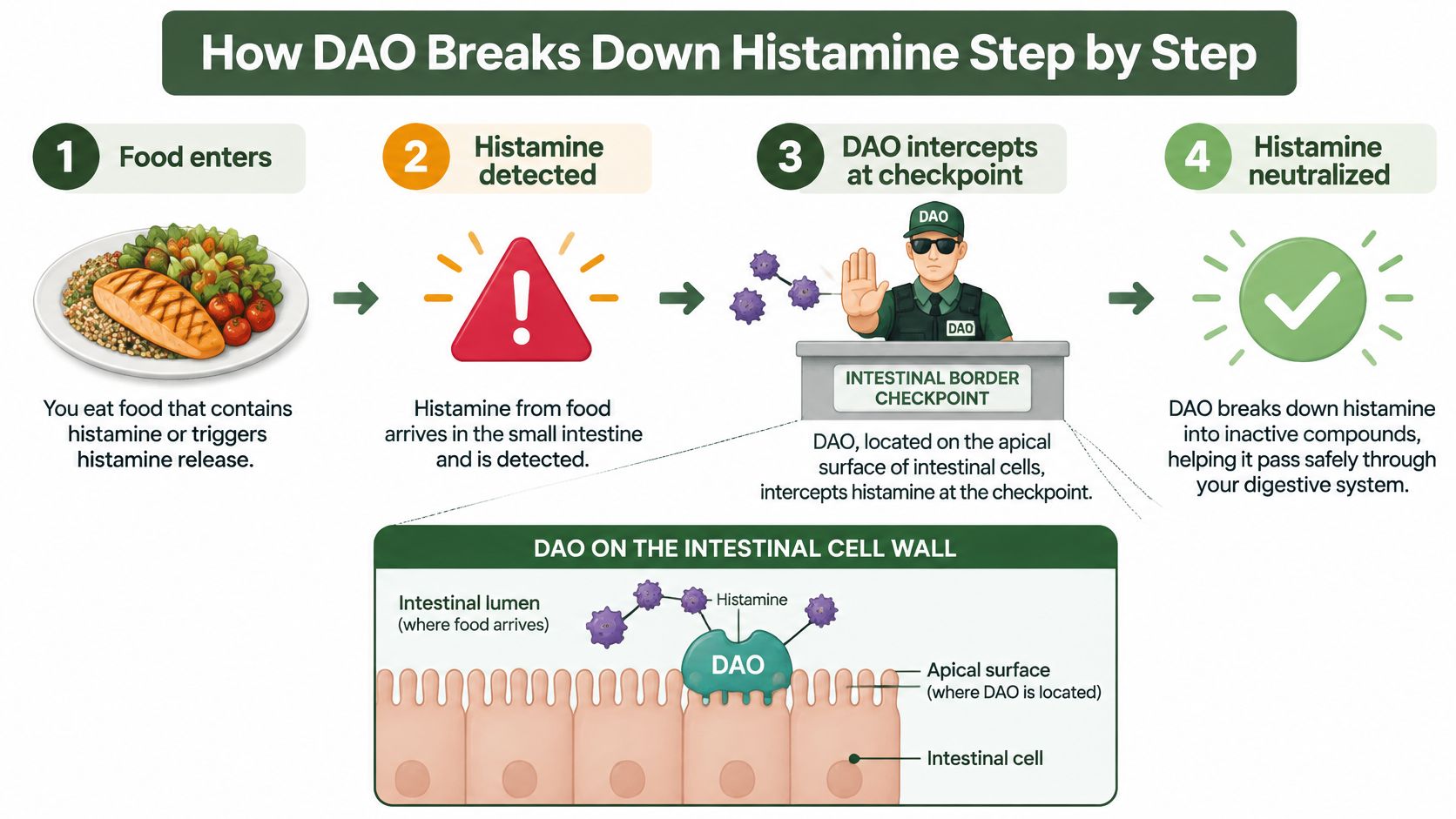
Think of the small intestine as having a security checkpoint. Histamine from food or intestinal microbes approaches the boundary between the gut and the body. DAO is positioned near that boundary, where it can act on extracellular histamine before it crosses.
Here's the sequence in plain language:
- Histamine is present in the gut. It may come from what a person eats or from intestinal microbes.
- DAO encounters the histamine. The enzyme is produced mainly by differentiated intestinal cells and has greatest activity toward the apical villous region of the small intestine.
- DAO carries out oxidative deamination. In everyday terms, it changes the histamine molecule through an enzyme-driven reaction.
- The reaction produces other compounds. The products include an aldehyde, hydrogen peroxide, and ammonia. The breakdown products then enter other metabolic processes.
DAO and HNMT work in different places
DAO isn't the only enzyme that metabolizes histamine. Histamine-N-methyltransferase (HNMT) acts on intracellular histamine, meaning histamine inside cells. DAO, by contrast, is secreted and primarily handles extracellular histamine near the intestinal barrier. This difference in location is why DAO is often described as a first-pass defense for histamine encountered in the gut.
A description of DAO's position and function in the small intestine helps clarify the checkpoint analogy: DAO can intercept some histamine before it crosses the barrier, but it isn't a guarantee that all histamine will be removed. How much reaches the enzyme, how much activity is available, and the state of the intestinal lining all matter.
The basic mechanism is well defined. What remains less certain is how much a measured DAO value or a particular supplement changes symptoms in an individual. The enzyme's biological role is one question; diagnosing a cause of symptoms and predicting treatment response are separate questions.
Three Factors That Shape DAO Activity in Real Life
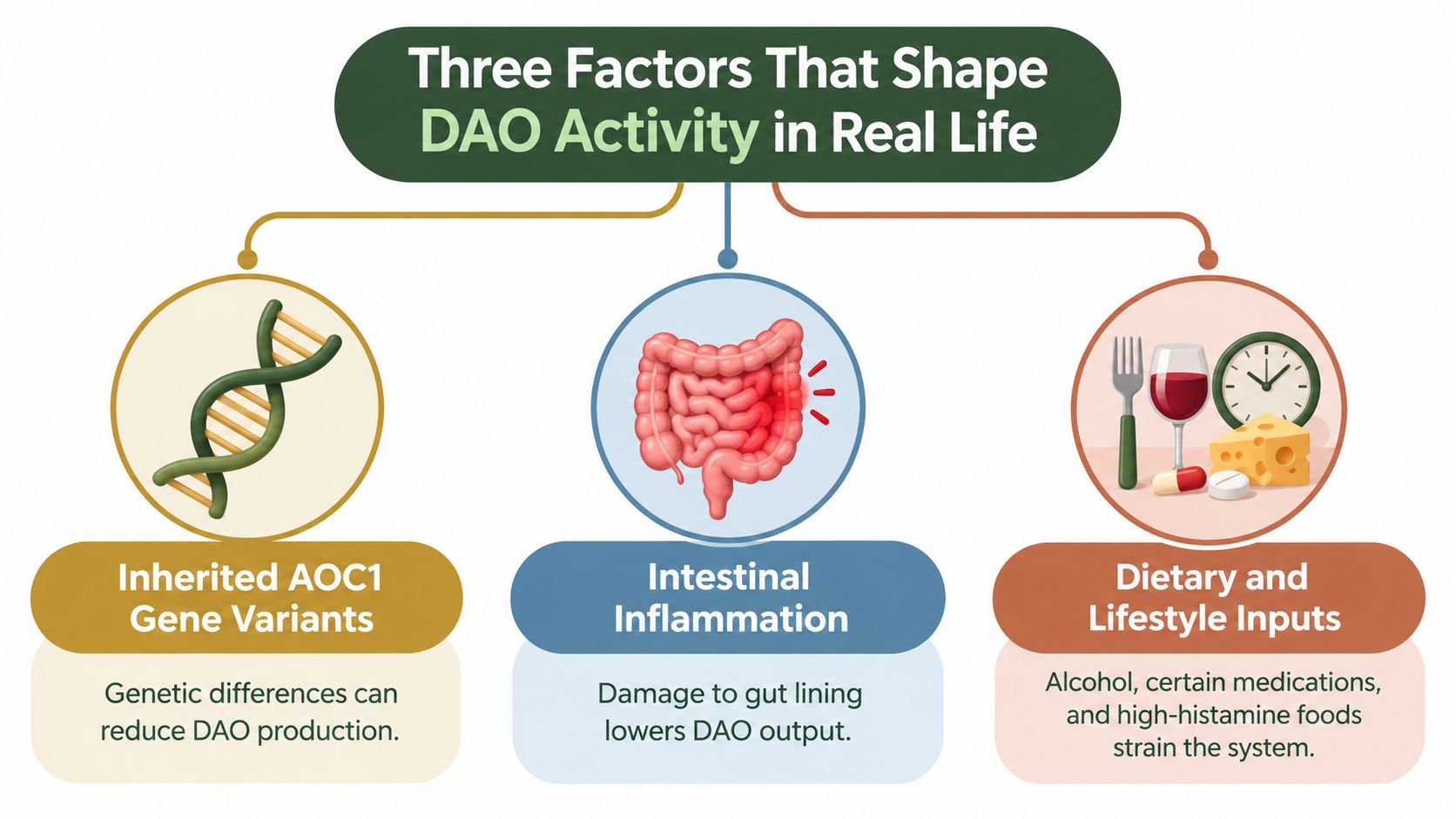
DAO activity isn't determined by genes alone. A useful way to think about it is as the combined result of inherited variation, intestinal condition, and exposures. That helps explain why two people with a similar genetic result may not experience the same symptoms.
Inherited AOC1 variants
Researchers have studied several AOC1 variants, including rs10156191, rs1049742, rs1049793, and rs2052129. Reported frequencies for three of these variants in Caucasian populations are approximately 24.5% for rs10156191, 6.3% for rs1049742, and 30.6% for rs1049793. These figures describe variant frequencies, not the proportion of people with a clinical diagnosis.
A 2023 study of 98 women aged 33 to 60 found that 74.5% had at least one of four analyzed AOC1 variants associated with reduced DAO activity. The reported individual frequencies were 53.1% for p.Thr16Met, 49% for c.691G>T, 48% for p.His664Asp, and 19.4% for p.Ser332Phe (study details). A variant can indicate susceptibility, but it doesn't prove that a person has clinically significant DAO deficiency.
The intestinal lining and other exposures
DAO is produced mainly by cells in the small-intestinal lining. Inflammation or injury in that tissue may affect the local enzyme environment. Medication or alcohol exposure can also be relevant, but their effects depend on the person and the specific circumstances. Don't stop a prescribed medication on your own; discuss concerns with the clinician who prescribed it.
These influences are why a gene result shouldn't be treated as destiny. A useful next step for readers interested in the broader foundations is this guide to supporting gut health naturally. The practical point is not to assume a single cause, but to consider inherited variation alongside gut health and exposures.
Why Reduced DAO Activity Shows Up as Histamine Intolerance
When histamine enters the gut, DAO can help break it down near the intestinal barrier. If less histamine is cleared there, more may cross the barrier and contribute to symptoms. A simple analogy is a bucket with a drain: histamine adds to the bucket, while DAO helps drain it. If incoming histamine outpaces clearance, the bucket can overflow.
Symptoms associated with histamine intolerance can include headaches or migraines, gastrointestinal disturbances, and allergy-like reactions. Changes in intestinal motility and visceral sensitivity may also be involved. But these experiences aren't unique to histamine intolerance. Similar symptoms can occur with other conditions, so a checklist alone can't establish the cause.
Symptoms can overlap
| Symptom Area | Typical Experiences | Why It Happens |
|---|---|---|
| Head | Headaches or migraines | Histamine-related symptoms can involve the nervous system |
| Gastrointestinal | Digestive disturbances | Histamine may affect gut activity and sensitivity |
| Skin or allergy-like reactions | Itching, flushing, or similar reactions | Histamine participates in immune signaling |
DAO can also act on other biogenic amines. In an in-vitro study, researchers tested histamine alongside putrescine, cadaverine, tyramine, spermidine, and spermine at mixture ratios of 1:0.25, 1:1, 1:4, and 1:20. The experiments showed that competing substrates can alter the rate of histamine breakdown, but they don't establish a dietary threshold or predict what will happen after a real meal (laboratory study of competing amines).
Practical rule: Treat a symptom pattern as a reason to investigate, not as proof of a diagnosis.
A dated record of meals and symptoms can help people discuss patterns with a clinician. Parents trying to notice possible food-related patterns may find this food and symptom diary for parents useful for organizing observations. If you're exploring other options for symptom support, read about stinging nettle capsules, and discuss persistent or complex symptoms with a healthcare professional.
What DAO Blood Tests and Genetic Panels Can and Cannot Tell You
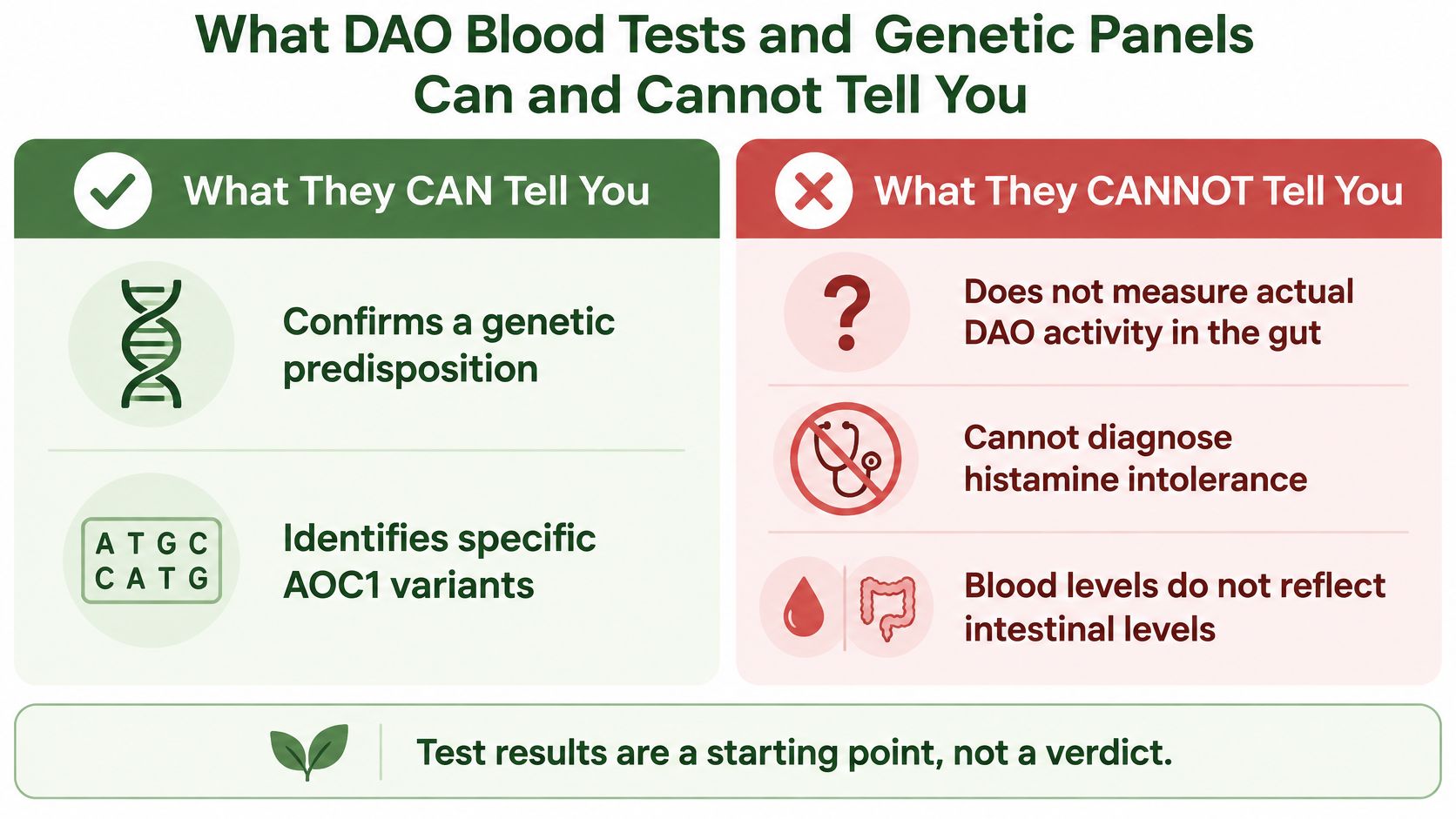
A 2022 German allergy guideline goes further than many people expect: it states that blood DAO activity has no diagnostic value for histamine intolerance. That conclusion can feel abrupt when a lab report is sitting in your hand with a number flagged as low. So what can a test like that say?
Part of the answer is geography. DAO does its main job at the intestinal lining, where it degrades dietary histamine before that histamine crosses into circulation. A blood draw samples the enzyme after it has left that workspace, giving an indirect snapshot rather than a reading of DAO at work where it counts. In a large observational analysis, DAO values below suggested normal cutoffs turned out to be common, yet only a small share of the people below those cutoffs reported reactions after histamine intake. The gap between a common lab finding and a rare clinical pattern is exactly why a single number cannot carry a diagnosis.
A genetic clue isn't a diagnosis
A genetic panel reads the AOC1 gene, which holds the instructions for building the DAO enzyme. In a 2024 pilot study, reduced-function variants were common among people with histamine-related symptoms, but appeared nearly as often in healthy participants. A variant can tilt the odds toward lower enzyme output. It cannot confirm that histamine is causing any particular symptom.
A case-control study of 484 German participants, including people with symptoms attributed to histamine intolerance and controls, linked DAO gene variants to serum DAO activity. The same researchers cautioned that inherited effects do not account for the full clinical picture, since mucosal health and environmental factors also shape the outcome (case-control study of DAO variants).
Where the science is firm: no blood value or gene result, taken alone, establishes that histamine is behind a person's symptoms. Where it stays fuzzy: how much weight a low value should carry when the symptom pattern fits. A clinician places results next to history, medication use, possible gastrointestinal conditions, and observed reactions, and may suggest a structured dietary evaluation or supervised challenge. For anyone deciding which testing route fits that process, it can help to compare lab panel vs function health services before ordering. For context on how far genetic data can steer supplement choices, this podcast on personalizing supplements with DNA testing lays out the limits in plain terms.
What Oral DAO Supplements Can Realistically Do
The reasoning behind a DAO pill makes sense once you picture where the enzyme does its job. If DAO acts as a cleanup crew stationed at the small-intestinal surface, a supplement aims to send in temporary reinforcements that work locally, in the gut lumen, before histamine crosses the barrier. The idea is biologically plausible. Controlled conditions show the enzyme can degrade histamine in a test system. Whether that translates into fewer symptoms after a real meal remains unproven.
A randomized, double-blind Phase I study reported in December 2024 enrolled 30 healthy volunteers and tested single fasting doses of 42 mg, 84 mg, and 210 mg. Participants completed the study without serious adverse events or clinically significant changes in vital signs, ECGs, or laboratory measures (Phase I study report). That tells us about short-term tolerability in healthy adults. It says nothing about whether DAO treats histamine intolerance, prevents migraines, or improves symptoms in people with a confirmed condition.
From the test tube to the dinner table
In a simulated-intestinal-fluid experiment, a DAO tablet was tested against an initial histamine concentration of 1.35 mM, equivalent to 150 mg/L or 75 mg in the test system. After 90 minutes at 37 °C, the histamine concentration fell by 29.3% ± 0.8% (in-vitro experiment). That result shows the enzyme stayed active and did its job in a lab setup designed to mimic the intestine. Inside a living person, acid exposure, transit time, and how much enzyme reaches the right stretch of gut all remain open variables.
Human evidence is thinner still. A small, open-label pilot involving 28 people over four weeks, described in the review cited in the previous section, reported improvement across the symptoms assessed. Because it had no placebo control, the results cannot separate a possible DAO effect from expectation, dietary changes, or natural symptom variation.
Passing a short-term safety study answers one narrow question: can healthy adults take this dose without harm? Whether a product eases symptoms is a separate experiment that has yet to be run at scale.
For readers thinking about supplements in the context of shifting hormonal cycles, The Axelrad Clinic on cycle supplements offers a practical starting point. Anyone who is pregnant, weighing DAO for a child, or managing complex gastrointestinal or allergic symptoms should ask a healthcare professional first. An oral product never substitutes for investigating triggers, reviewing medications, or assessing gut health.
Putting It All Together for Your Next Step
If you're curious about DAO, start with the basic biology: it helps break down histamine near the small-intestinal barrier. If you're tracking symptoms, keep a clear record and bring it to a clinician rather than diagnosing yourself from a food list. If you're considering a blood test, genetic panel, or supplement, ask what decision the result would change.
A sensible checklist:
- Record patterns: Note meals, symptoms, and timing.
- Review context: Discuss medications and gastrointestinal concerns with a clinician.
- Interpret tests cautiously: Treat results as clues, not a diagnosis.
- Approach supplements carefully: Ask about suitability, especially for children, pregnancy, or complex symptoms.
Genetics may influence DAO activity, but gut condition and exposures matter too. The most useful next step is the one that helps you investigate those factors without assuming a single cause.
For broader daily nutrition support, Peak Performance offers organic superfood blends, supplements, protein products, and coffee, with third-party testing and a Vitamin Angels partnership. Explore the options at Peak Performance and choose products that fit your needs alongside evidence-based care.


