


Essential Amino Acid Supplement Guide for 2026
More than 99% of U.S. adults aged 19 and older met the Estimated Average Requirement for each essential amino acid, according to findings reported in 2024 by the Pennington Biomedical Research Center. That's a useful starting point before buying an essential amino acid supplement: needing these nutrients doesn't automatically mean you need them in capsules.
A better buying test starts with your meals, your body weight, and the actual amino-acid amounts on the label. A small serving can be useful in particular circumstances, but it isn't a proven shortcut to more muscle.
Why Most Adults Already Meet Essential Amino Acid Needs
Say you eat a protein-containing breakfast, a substantial lunch, and dinner with a complete protein source. You see an amino-acid supplement advertised for recovery and wonder whether you're missing something. The first question isn't how quickly it absorbs. It's what your current food intake fails to supply.
Essential amino acids, or EAAs, are amino acids your body can't make in sufficient quantities. International nutrition guidance identifies isoleucine, leucine, lysine, methionine, phenylalanine, threonine, tryptophan, and valine as the adult core group; modern frameworks also generally treat histidine as essential.
Think of food as the packed lunch
Complete dietary protein is like a packed lunch containing the ingredients you need together. An EAA supplement is more like a small package of ingredients you can't assemble from scratch. That package may solve a specific shortage, but it doesn't reproduce everything in the lunch.
Meeting an average requirement also isn't the same question as arranging meals for exercise or managing poor appetite. Someone can consume enough across the day while eating a breakfast that contains very little protein.
Start with the meal, not the marketing claim. Identify what's missing before deciding what to add.
For a practical food-first starting point, our guide to the best foods for athletic performance can help you think about meals rather than isolated ingredients.
The useful distinction is between basic daily requirements, meal-level opportunities, and outcomes you can notice, such as strength or function. A laboratory signal after a supplement isn't interchangeable with those outcomes.
Before choosing a product, put your body weight alongside an amino-acid requirement table. That gives you a clearer reference than a promise about the best ratio or fastest absorption.
Adult Targets for Each Essential Amino Acid
Adult essential amino acid requirements
The figures below come from the FAO adult requirement table; the final column multiplies each per-kilogram amount by 70 kg.
| Amino acid | mg per kg per day | Amount for 70 kg |
|---|---|---|
| Isoleucine | 10 | 700 mg |
| Leucine | 14 | 980 mg |
| Lysine | 12 | 840 mg |
| Methionine plus cystine | 13 | 910 mg |
| Phenylalanine plus tyrosine | 14 | 980 mg |
| Threonine | 7 | 490 mg |
| Tryptophan | 3.5 | 245 mg |
| Valine | 10 | 700 mg |
| Histidine | Not listed separately | See note in text |
| Combined essential amino acids | About 84 | About 5.9 g |
These are daily reference requirements, not instructions to take the entire amount as a supplement. Food contributes toward them, and the combined total is approximate because the underlying figures are rounded.
Histidine is widely treated as essential, but this FAO adult pattern doesn't give it a separate line. The paired entries also matter: methionine plus cystine and phenylalanine plus tyrosine shouldn't be read as individual requirements for each member of the pair.
Check individual amounts before the total
Start with body weight in kilograms, then multiply it by the relevant daily requirement. Next, examine how your usual protein-containing foods contribute before treating any difference as a supplement need.
For a hypothetical label check, suppose an adult matching the table's example sees a 6 g mixed serving. That's numerically close to the combined daily reference only if the serving contains the relevant amino acids. Flavoring, capsule materials, or other ingredients don't fill an amino-acid requirement.
Even an amino-acid total doesn't establish balance. A mixture can contain plenty of leucine while providing little of another indispensable amino acid.
- Check the units. Compare milligrams with milligrams, not scoop weight with an individual amino-acid amount.
- Check the full serving. A serving may require several capsules rather than the single capsule pictured on the bottle.
- Check what food already supplies. The table describes total intake, not an additional daily supplement allowance.
Don't confuse adequacy with a training target
The same FAO guidance places adult safe protein intake at approximately 0.75 g/kg/day when protein is sufficiently digestible and supplies adequate essential amino acids. That's a basic safe-intake reference under those conditions, not an exercise-optimization target or a ceiling.
Keep the requirement table beside the Supplement Facts panel. Use it to understand the product's contribution, not to replace meals with a matching weight of isolated amino acids.
How to Judge Dose Safety and the Label
Talk with a clinician before starting if you have kidney or liver disease, are pregnant, take medication, or use several overlapping supplements. Safety depends on the specific amino acids, dose, duration, diet, and your health status, not whether the packaging says natural.
The FDA's dietary supplement guidance explains that supplements aren't approved for safety or effectiveness before sale. A clean marketing claim isn't a clinical verdict.
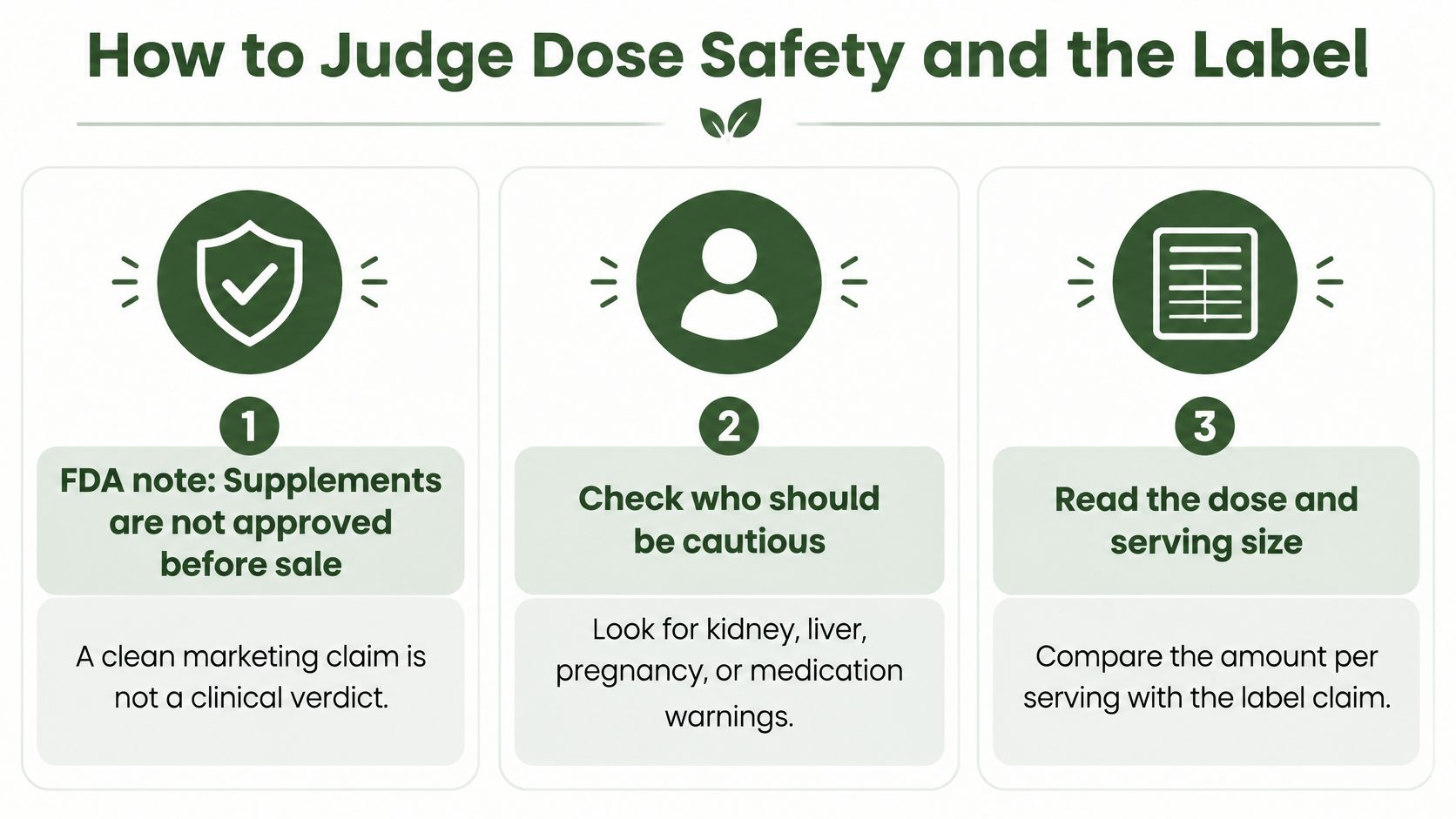
Read the panel in a useful order
The FDA supplement-labeling guide specifies serving size, servings per container, dietary ingredients, and amounts per serving, alongside other required label information. It also states that a product containing only amino acids may not declare protein on its label.
That means amino-acid milligrams aren't interchangeable with the protein grams printed on a protein powder.
- Serving information. Establish how many capsules make up the listed dose.
- Ingredient transparency. Look for the complete essential-amino-acid profile and visible leucine amounts; don't infer amounts hidden within a blend.
- Product identity. Check the dietary supplement designation, net contents, ingredient list, and manufacturer, packer, or distributor.
- Quality assurance. Separate regulatory compliance from third-party contaminant testing. Neither a listed ingredient nor compliant packaging proves clinical benefit.
Our guide to how to read supplement labels provides additional context for interpreting the panel.
For a hypothetical example, a 6 g serving listing 2.5 g leucine would place that serving's leucine within the meal-level range discussed below. It wouldn't establish safety, prove that the remaining amino acids are balanced, or show that your meal needs the addition.
A label can describe what you're taking without establishing whether you should take it.
The evidence discussed here doesn't provide a full side-effect profile. Clinical review is the safety step, particularly when health conditions or medications complicate the decision.
What Muscle Studies Show About Small Doses
Small-dose studies are interesting because some people struggle to finish a full protein portion. Their findings still need to be read according to who participated and what investigators measured.

Older women and acute muscle building
In a controlled study of older women, a leucine-enriched EAA dose containing 1.5 g leucine produced an acute muscle-protein-synthesis response comparable to 40 g whey protein; the research also tested a 6 g EAA dose. That's evidence about short-term synthesis, not proof that the smaller serving replaces dietary protein over time.
A clinical review of leucine-enriched EAAs also describes older women receiving 3 g EAAs containing 1.2 g leucine, with muscle anabolism comparable to 20 g whey at rest and after exercise. In the review's separate 36-participant metabolic study, a mixture with approximately 41% leucine stimulated synthesis in older adults whereas one with approximately 26% didn't produce the same response.
Those proportions don't establish a universal threshold. Age, total dose, and health context can change the interpretation.
Exercise signals and rehabilitation outcomes
In a randomized trial of 20 healthy young men, participants took 5 g leucine-enriched EAAs or placebo before three sets of leg extensions and curls at 70% of one-repetition maximum. Reported post-exercise phosphorylation increases included 77.1% for mTOR, 1,067.4% for p70S6K, 171.3% for ribosomal protein S6, and 33.4% for 4EBP1.
These are molecular signaling results, not equivalent percentage increases in muscle or strength.
A rehabilitation trial studied adults 45 and older after intensive or pre-intensive care, using a glutamine-plus-EAA drink twice daily for three months alongside a structured physiotherapy program. The combined intervention produced the largest gains in six-minute walking distance, with P < 0.0001, but it tested a recovery package rather than a capsule alone.
A stronger short-term muscle-building signal isn't a promise of lasting strength.
A 2025 scoping review covering 80 trials and 5,290 older adults found inconsistent protein-supplement effects on strength and body composition and inconclusive physical-performance effects. For calorie restriction, Trim's guide to minimising lean mass loss when dieting offers practical context for considering nutrition and training together.
Results depend on age, appetite, illness, calorie intake, and the exercise surrounding the dose.
Essential Amino Acids Compared with Protein and BCAAs
An older FAO protein analysis estimated an adult male's daily requirement at about 5.2 g essential amino acids, compared with approximately 19 g high-quality protein when broader nitrogen losses were included. The comparison shows why essential amino acids are only part of protein nutrition.
An essential amino acid supplement provides those indispensable amino acids directly. Complete protein also supplies nonessential amino acids and nitrogen, while protein-containing foods bring calories and other nutrients. The trade-off is simple: a compact serving can be easier to manage, but it does not replace the wider nutrition in food.
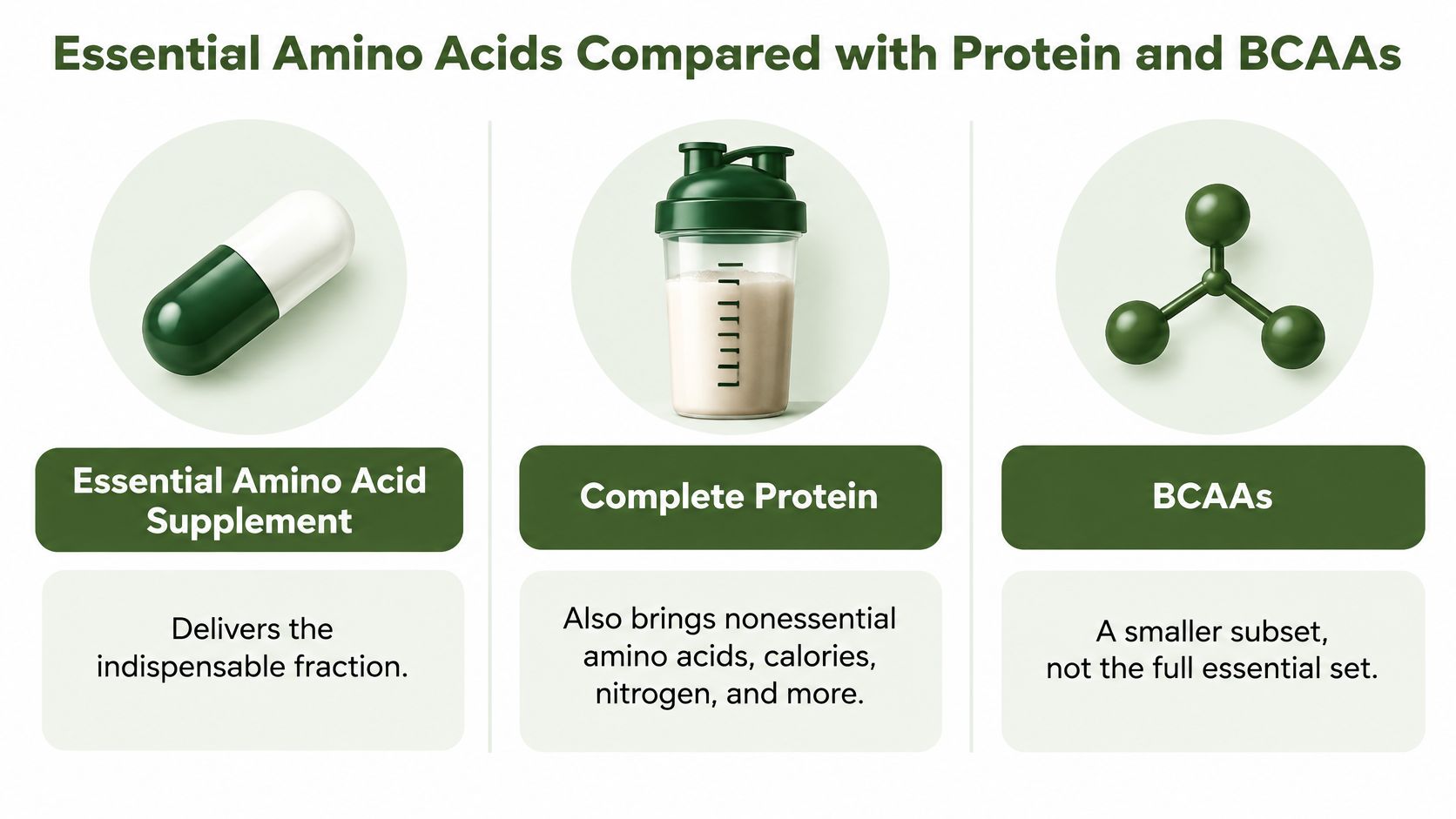
Food protein, essential amino acids, and BCAAs
| Option | What it supplies | Best fit | Main limit |
|---|---|---|---|
| Complete protein foods | Essential and nonessential amino acids, calories, and other nutrients | Daily eating that covers protein needs | Appetite, illness, or calorie limits can make portions difficult |
| Essential amino acid supplement | Indispensable amino acids in a small serving | A low-protein meal, low appetite, or exercise when a full meal is impractical | No broader food nutrients; not proven better than enough protein |
| Branched-chain amino acids only | Leucine, isoleucine, and valine | A narrow interest in those amino acids | They do not provide the full set of essential amino acids |
BCAAs are three of the essential amino acids, not a complete EAA formulation. A product's amino-acid ratio alone does not show whether it addresses a real dietary gap. Check its label against the per-kilogram requirements discussed earlier, then consider whether a meal falls short in leucine. Protein researcher Luc van Loon discusses protein type, timing, and daily intake.
Protein quality isn't a capsule recipe
FAO scoring patterns compare the indispensable amino acids in food protein with human requirements. They serve as a protein-quality yardstick, not a formula for designing a supplement or proof that a particular ratio absorbs faster.
For runners weighing a complete powder against other options, Swift Running's guide to choosing protein powder for post-run recovery offers a use-case comparison. In practice, food is a sensible starting point; consider a complete EAA product when a specific gap makes a full meal impractical.
Decide When a Capsule Fits Your Day
Before adding an essential amino acid supplement, check daily protein, meal composition, and unresolved health concerns. A review of protein and EAA interventions reported the most consistent benefits below approximately 1.6 g/kg/day protein or when meals supplied less than about 2 to 3 g leucine, with benefits generally diminishing as protein approached roughly 2.0 g/kg/day.
Those are decision aids, not hard biological cutoffs or a universal safety ceiling. If your diet already supplies ample protein and well-proportioned meals, the case for another supplement is weaker.
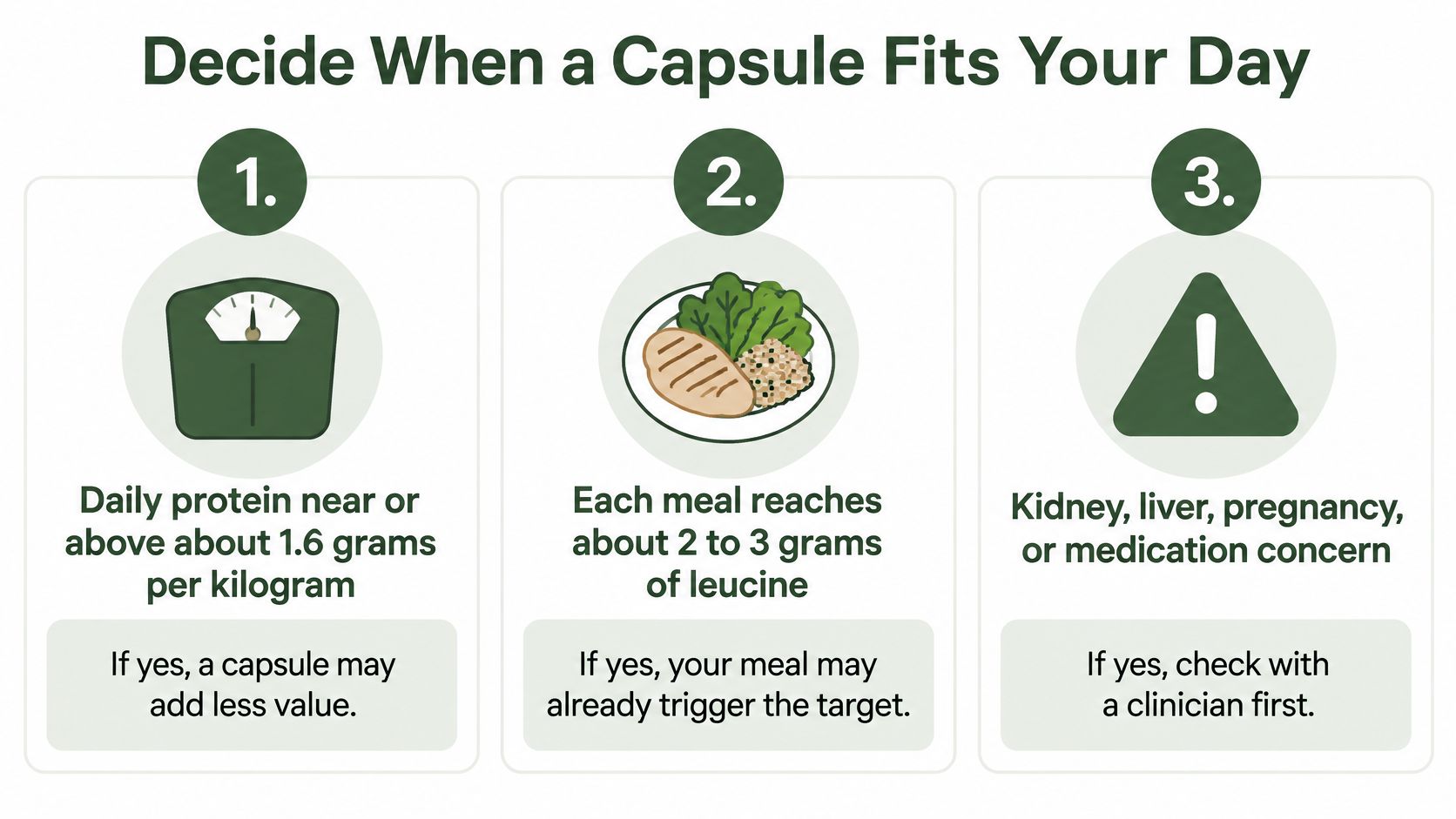
Situations where a compact serving may help
- A breakfast with little protein. Start by considering a protein-containing food. A complete EAA serving becomes relevant if a fuller breakfast isn't practical, not just because breakfast was small.
- A calorie-restricted day. Examine whether your eating plan still provides adequate protein and broader nutrition. Don't use amino acids to justify removing the foods you need.
- An older adult who can't finish a protein portion. A compact serving may be easier to accommodate, but persistent low appetite deserves nutritional and medical assessment.
Resistance exercise provides the mechanical stimulus, EAAs supply indispensable building materials, and leucine supports mTORC1-related protein-building signals. Timing a capsule doesn't replace the exercise stimulus.
Match the serving to the actual gap
Write down the meal you're trying to improve. Then check the capsule serving's amino-acid profile, leucine milligrams, and capsule count against that specific purpose.
Don't assume a leucine-enrichment claim identifies the best ratio for you. The older-adult comparisons demonstrate that composition can matter, but they don't establish a percentage that works best across ages, illnesses, and doses.
Buying rule: If you can't name the gap, postpone the purchase.
If kidney, liver, pregnancy, or medication concerns haven't been reviewed, pause supplementation until a clinician has assessed the product and your circumstances. If the gap is mainly inconvenience, compare the capsule with a manageable food portion or complete protein option before spending money.
For an identified gap, our Peak Performance Essential Amino Acids capsules cost 21.95 USD. Evaluate the current Supplement Facts panel rather than assuming the capsule format matches a formulation used in a trial.
Buy only when the need is real, the listed serving addresses it, and the choice fits safely within your overall diet.
Peak Performance offers Essential Amino Acids capsules for readers considering a convenient addition to their nutrition routine. Visit Peak Performance to review the product information and compare the serving with your meal-level needs before purchasing. For every bottle purchased, our partnership with the non-profit Vitamin Angels supplies a child at risk of malnutrition with vitamins for 1 year.


