


Green Superfood Capsules: Top 10 Micronutrients You Need
Roughly 4,000 supplement products were on the U.S. market when the Dietary Supplement Health and Education Act took effect in 1994. Twenty years later the count had passed 90,000, a more than twentyfold jump, as a Congressional Research Service report on dietary supplements sets out. Nothing in that expansion required a manufacturer to prove a product worked. Supplements still reach shelves without FDA premarket approval for safety or effectiveness, so the label is the only contract you get.
The green category is still expanding. Future Market Insights projected the global green supplement market at USD 580.33 million in 2025, rising to USD 960.30 million by 2035 in a 2025 market release. More bottles, in other words, and the same thin requirement to show what's inside them.
That's why this breakdown ranks ten micronutrients by how much a greens capsule can realistically contribute to an adult's daily intake, not by how often they appear in marketing copy. Each one gets the same treatment: the job it does in the body, the number that defines adequacy, and the label line that tells you whether the capsule delivers it.
The Top 10 Micronutrients at a Glance
A green superfood capsule earns its place in your day for one reason: the nutrients it measurably supplies that your meals don't. Everything else on the bottle, the alkalising language, the detox promise, the 25-ingredient list, tells you nothing about milligrams.
The table is a legend, not the route. It shows where each nutrient usually appears and which label line decides value; adequacy is still set by the official adult reference value for your age, sex and life stage.
| Rank | Micronutrient | Role in energy or bone health | Typical greens source | Label line to trust |
|---|---|---|---|---|
| 1 | Vitamin K | Blood clotting and bone protein activation | Spinach, kale | Vitamin K amount on the panel |
| 2 | Magnesium | Muscle and nerve function, energy release, bone formation | Spinach and other leafy greens | Magnesium in mg; chlorophyll is pigment data |
| 3 | Iodine | Thyroid hormones T3 and T4 that set metabolic rate | Nori, kelp and other sea greens | Iodine listed separately, ideally from a named sea green |
| 4 | Iron | Oxygen transport in haemoglobin | Spirulina, spinach | Iron in mg plus the form used |
| 5 | Vitamin C | Collagen formation and iron absorption | Acerola, kale | Vitamin C in mg from a named source |
| 6 | Vitamin A (from beta-carotene) | Vision and immune function | Spinach, kale, barley grass | Vitamin A as RAE or beta-carotene amount |
| 7 | Zinc | Immune function, protein and DNA synthesis | Blend-dependent; often low | Zinc in mg, not a vague greens total |
| 8 | Calcium | Bone mineral structure and muscle contraction | Leafy greens; usually a small share | Calcium in mg; expect a modest contribution |
| 9 | Folate | DNA synthesis and red blood cell formation | Spinach, asparagus, greens blends | Folate as DFE, with form if stated |
| 10 | Vitamin B12 | Nerve function and red blood cell formation | Few plant sources | B12 in mcg; absence on the panel means absence in the dose |
Those are general adult categories; age, sex, pregnancy and breastfeeding change the target, with iodine needs rising during pregnancy and again during breastfeeding. The greens source column is a starting point only, because the amount a specific capsule delivers appears on its Supplement Facts panel.
Read it in two passes. First, circle rows where the panel gives a measurable amount in mg or mcg instead of folding the nutrient into a general greens blend. Then ask whether that amount can plausibly close a gap or whether the serving is too small to matter. When food has to do the work, a clinical nutritionist's overview of natural ways to fill nutrient gaps is a better starting point than a supplement aisle.
If the panel is silent, the capsule is silent too.
Magnesium, Iron, B12 and Folate for Daily Energy
Magnesium lets muscles and nerves contract and settle, and it sits inside the reactions that turn food into usable energy. The NIH Office of Dietary Supplements magnesium fact sheet lists its roles as muscle and nerve function, blood-glucose regulation, blood-pressure regulation, protein synthesis, bone formation and DNA production, and names green leafy vegetables such as spinach, along with legumes, nuts, seeds and whole grains, as sources.
Greens marketing gets slippery at exactly this point. Chlorophyll does hold a magnesium atom at its centre. Reading a chlorophyll figure as a magnesium figure, though, is like judging a battery's charge by the colour of its casing.
Chlorophyll trap: a capsule that advertises chlorophyll tells you about a pigment, not about milligrams of magnesium. Only the Supplement Facts panel states the amount per serving.
A capsule format fixes the serving for you, so the panel becomes the exact record of what you swallow.
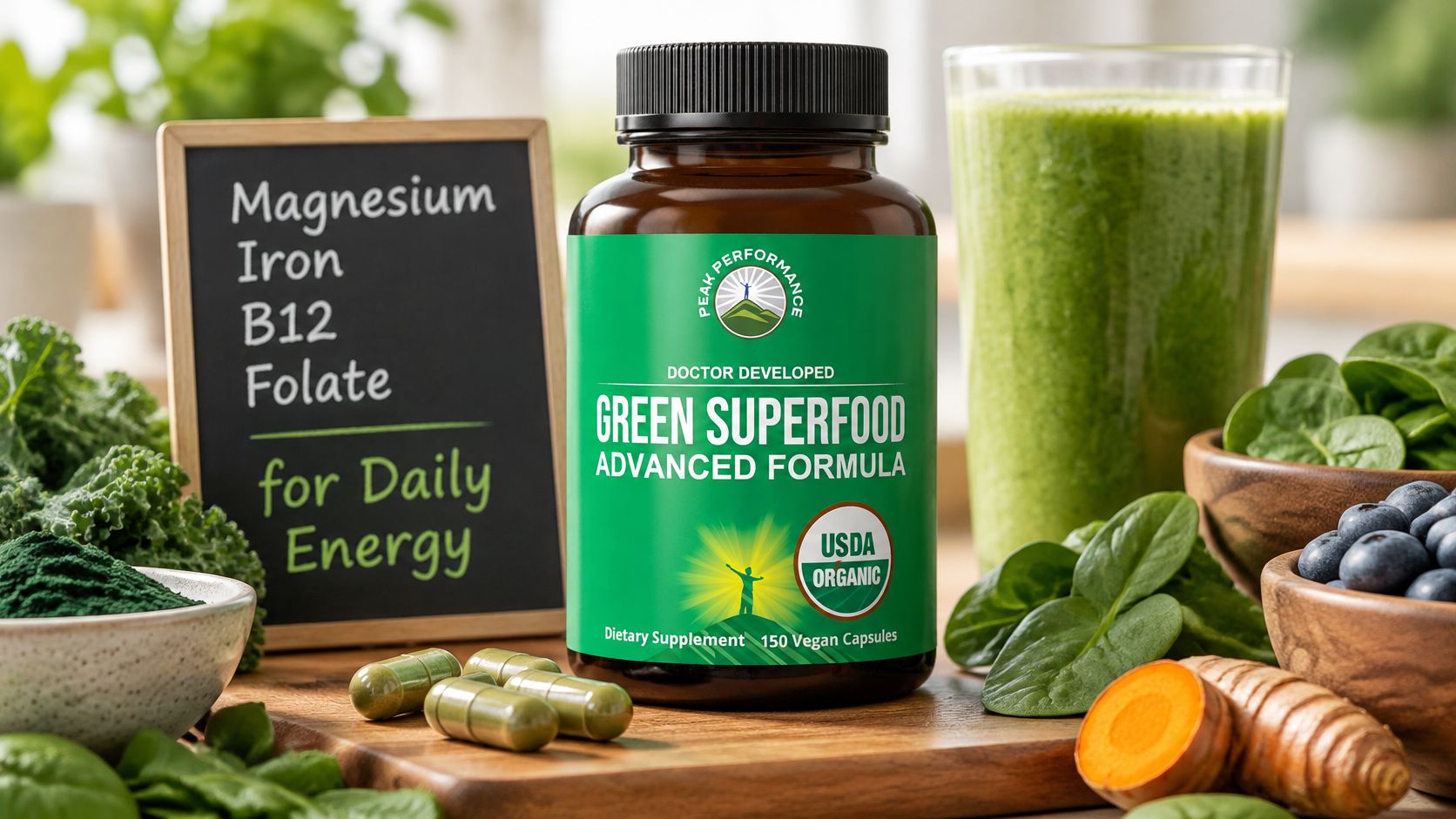
Iron carries oxygen, and haemoglobin is the vehicle. Haemoglobin inside red blood cells moves oxygen from your lungs to working muscle, which is why low iron shows up as fatigue rather than a number on a bottle. Plant iron absorbs better alongside vitamin C, so a blend built around acerola or kale is a better bet than one with no vitamin C source at all.
The NIH folate fact sheet sets the adult target at 400 mcg DFE a day, and folate is the nutrient red blood cells are built from, the same cells that ferry that oxygen. Vitamin B12 covers nerve function and red blood cell formation, with an adult target of 2.4 mcg a day on the NIH vitamin B12 fact sheet. It's also the nutrient plants are worst at supplying, so a vegan greens capsule that omits a B12 figure hasn't shown you it closes that gap.
Read the label for four numbers, each per serving:
- Magnesium in mg: the panel amount, not a chlorophyll figure printed elsewhere on the bottle.
- Iron in mg: and whether a vitamin C source sits beside it in the blend.
- Folate in mcg DFE: the panel amount held against the 400 mcg daily target.
- Vitamin B12 in mcg: if a plant-based formula leaves this out, assume nothing.
Tiredness alone doesn't confirm a shortfall. A blood test is what tells you whether iron or B12 is low before you supplement. One timing detail matters: a large calcium dose from food or another supplement reduces iron absorption, so take it at a different meal from the greens capsule.
Vitamin K and Calcium for Bone Strength
Take a hypothetical example: a capsule whose label lists 40 micrograms of vitamin K per serving. Against the 120 microgram Daily Value, that's about a third of a day's vitamin K in one swallow. The NIH vitamin K fact sheet sets the adequate intake for women at 90 micrograms, so that same capsule would cover roughly 44% of it.
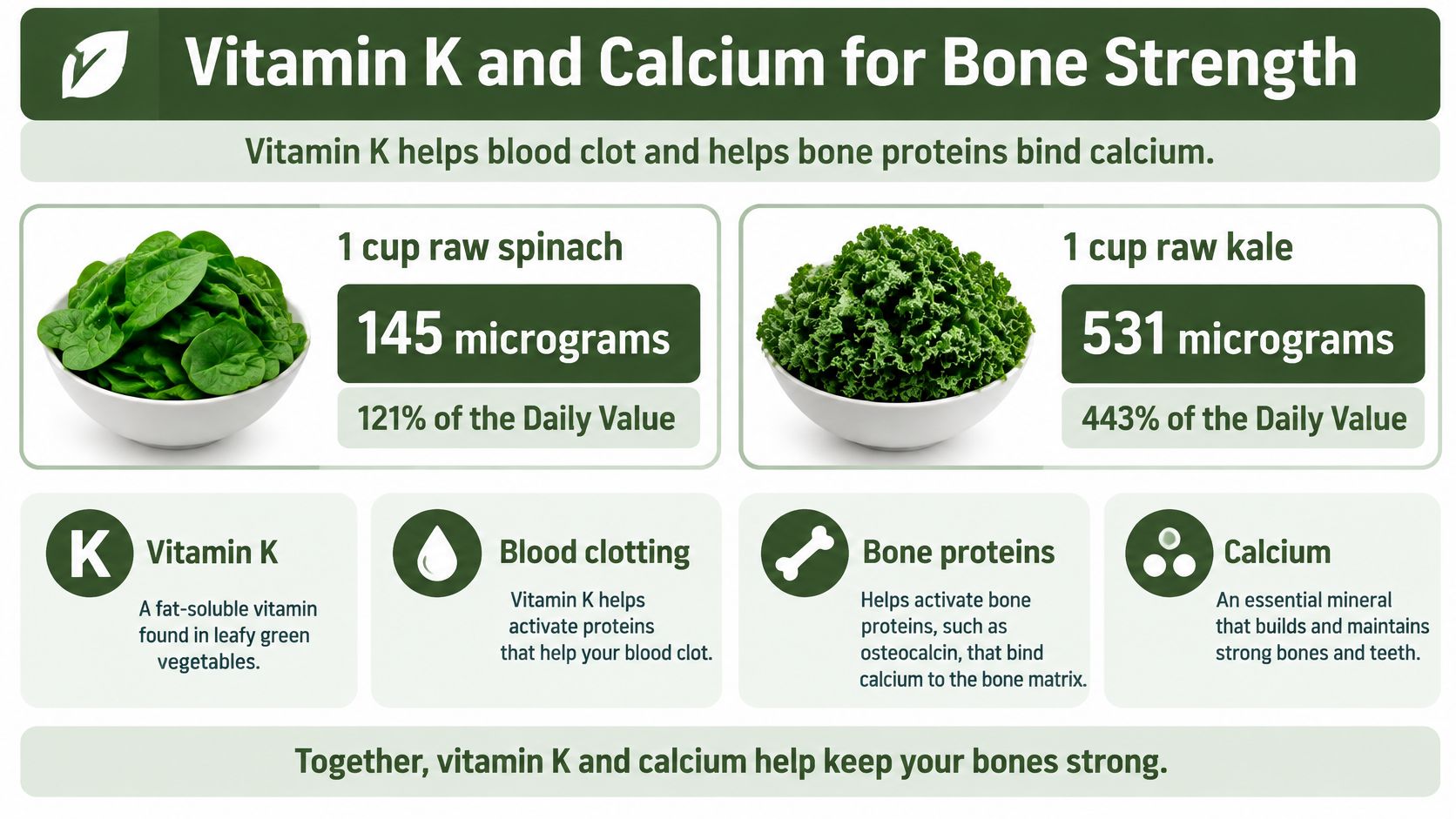
That arithmetic matters because vitamin K does two jobs here. It lets blood clot, and it activates the proteins that bind calcium into bone. Food makes the scale obvious: the same fact sheet reports that one cup of raw spinach provides 145 micrograms, or 121% of the Daily Value, while one cup of raw kale provides 113 micrograms, or 94%. It also notes that deficiency may reduce bone strength and increase osteoporosis risk.
Calcium is a different story. It's the mineral bone is built from, and the NIH calcium fact sheet puts the daily target for adults aged 19 to 50 at 1,000 mg. A greens capsule supplies only a small share of that, so calcium stays a dietary job: dairy, fortified plant milks, tofu set with calcium, tinned fish with bones. Magnesium supports bone formation too, so the magnesium figure on the panel earns a second look next to the vitamin K one.
Vitamin D governs how much calcium you absorb, which is why the two are usually discussed as a pair. This explainer on vitamin D and K benefits covers how they work together.
What to check on a greens capsule label:
- Vitamin K in micrograms per serving: a stated figure, because a generic "kale blend" or "leafy greens" line leaves the quantity unknown.
- Realistic calcium expectations: treat any capsule amount as a small top-up, since the daily target is measured in milligrams rather than micrograms.
Iodine From Sea Greens and Thyroid Function
The thyroid runs on iodine. Your body uses it to build thyroxine (T4) and triiodothyronine (T3), the hormones that help regulate metabolism and support normal development.
The NIH iodine fact sheet sets the adult requirement at 150 micrograms a day and the tolerable upper limit at 1,100 micrograms, so the working range is wide, with a firm ceiling at the top.
Seaweed is among the richest natural sources and also one of the most variable. Concentration shifts by species and by serving, which is why the same fact sheet reports that 5 grams of dried flaked nori contains 116 micrograms, or 77% of the Daily Value. Kelp can run far higher than nori, and a blend that includes both is harder to predict than either alone.
Iodine also stacks across products. A kelp capsule, iodised salt, and a multivitamin can converge on that ceiling faster than expected, because each source contributes on its own schedule. If you would rather take iodine as a standalone, this guide to how to choose sea kelp tablets covers the form and dose questions worth asking first.
Anyone with a thyroid condition, or taking thyroid medication, should speak with a clinician before adding a sea-greens supplement. The physiology is dose-sensitive in both directions: too little iodine and the thyroid slows its hormone output, too much and the same gland can falter. For the deeper clinical picture of how iodine supplements are dosed, this iodine supplement guide goes further.
The practical rule: a label that lists kelp or seaweed without an iodine figure has told you nothing about the dose.
Antioxidant Support From Vitamin C, Vitamin A and Zinc
Vitamin C, vitamin A and zinc carry most of the antioxidant claims in greens marketing, and each one has a defined daily target you can hold a label against.
Vitamin C supports collagen formation and improves iron absorption. The daily target is 75 mg for women and 90 mg for men, according to the NIH vitamin C fact sheet. Acerola cherry and kale are the usual sources in greens formulas.
Vitamin A reaches you partly as beta-carotene, which the body converts into the active form. The target is 700 mcg RAE for women and 900 mcg RAE for men per the NIH vitamin A fact sheet, and the vitamin supports vision and immune function.
Then there's the part marketing skips. A controlled 2005 trial put 40 young healthy adults on green leafy vegetables for three weeks at a defined dose of 100 grams a day, and the group eating them with 10 grams of oil saw plasma beta-carotene rise 51% and haemoglobin rise 9%. The green-vegetable-plus-vitamin-E group recorded increases of 40% in plasma beta-carotene, 8% in haemoglobin and 6% in plasma vitamin C, as reported in the 2005 leafy vegetable supplementation study.
That study used whole vegetables at a weighed 100 gram portion, not a capsule blend. A capsule serving of a gram or two can't be assumed to match a plate of greens.
Zinc supports immune function and the protein and DNA synthesis that underpin repair, at 8 mg a day for women and 11 mg for men, according to the NIH zinc fact sheet. Most greens blends list zinc in small amounts, often as a token line near the bottom of the panel.
A capsule's green colour is chlorophyll, a pigment, and it tells you nothing about the vitamin C, vitamin A or zinc inside. The numbers do. Put a capsule's dose of beta-carotene, vitamin C and zinc next to that 100 gram vegetable portion, and you'll see quickly whether it's a meaningful contribution or a rounding error.
Check the Label and Proof Before You Buy
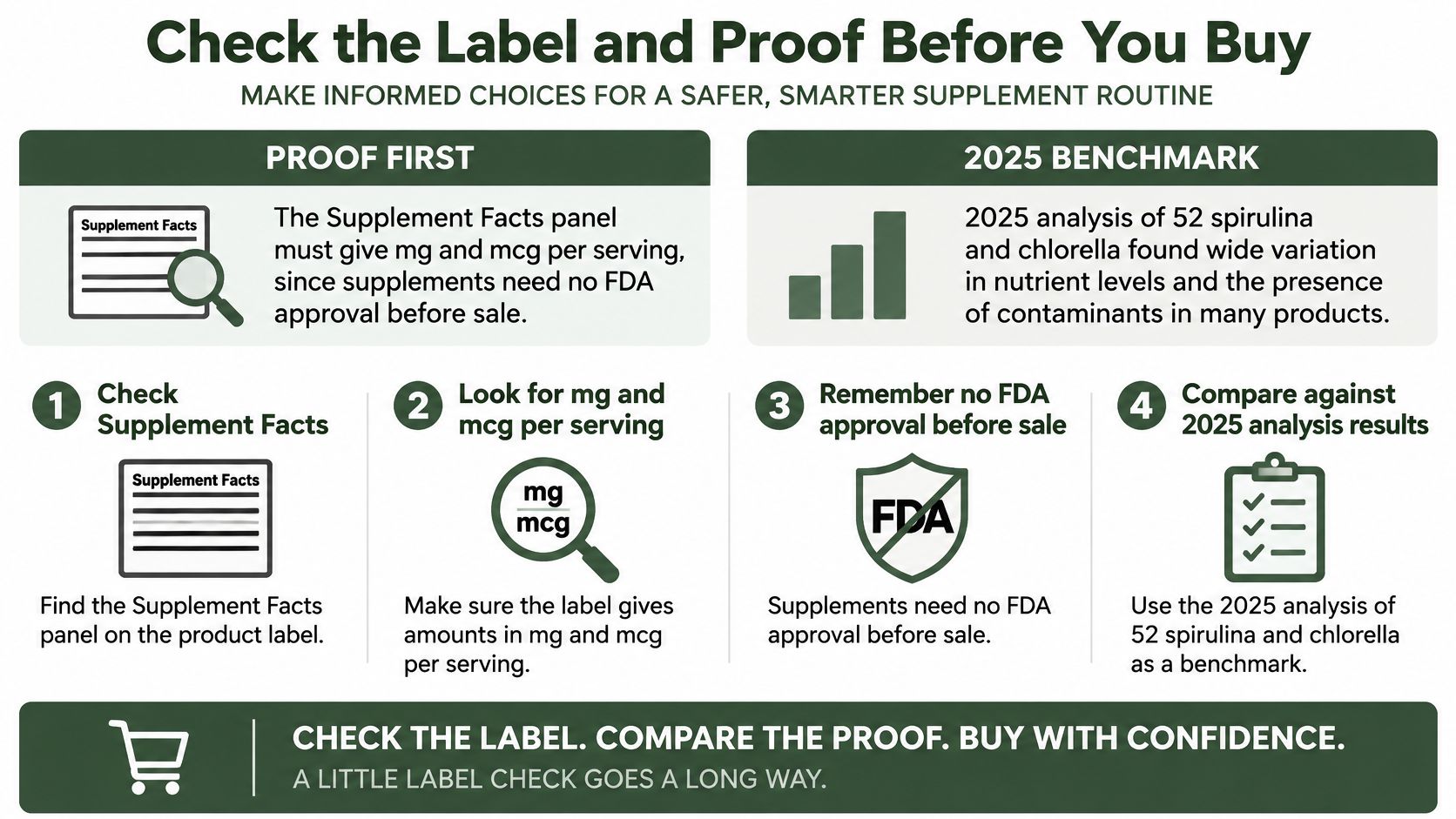
Every number that matters sits on the Supplement Facts panel: serving size, servings per container, dietary ingredients and amounts per serving. Supplements reach the market without FDA premarket approval for safety or effectiveness, so that panel plus the maker's testing records are the evidence you get. Label reading is its own skill, and this guide to how to read supplement labels walks through the difference between serving size and ingredient amount.
Contaminants are the second half of the story. In a 2025 analysis of 52 commercial spirulina and chlorella products, every sample complied with European Union limits for toxic metals such as lead and cadmium, yet aluminum, manganese, strontium and zinc were the dominant trace elements, and the researchers detected a wide range of pharmaceutical residues. Compliance sets a floor, and daily exposure to even legal levels accumulates, particularly for aluminum.
Mineral content itself drifts from label to bottle. A mineral analysis of commercial spirulina and chlorella products found most declared values broadly matched lab measurements, while copper in some chlorella products exceeded label values by more than 130%, and selected products contained higher levels of aluminum, lead and inorganic arsenic.
Organic certification doesn't cover pathogens. A January 2026 public-health investigation reported 65 Salmonella infections across 28 U.S. states linked to recalled nutritional products containing moringa leaf powder, with 88% of interviewed patients reporting a moringa-containing product, per the outbreak investigation summary. Recalls travel through shared ingredients, so the lot number printed on your bottle matters more than the logo.
Absorption raises a separate question. A 2026 double-blind crossover trial in just 16 healthy adults found one 13-gram serving of a greens powder raised circulating folate, calcium, zinc, vitamin C, biotin, thiamine, riboflavin, nicotinamide and hesperidin, with pyridoxine showing only a non-significant trend, as NutraIngredients reported. Higher blood levels are an intermediate measure, and a 13-gram powder serving can't be squeezed into a few capsules without cutting ingredient amounts or raising the capsule count.
Comparing several formulas at once gets easier when brands publish dose and testing detail side by side, and you can browse Revive longevity supplements to see how another catalogue lays that information out.
Four checks before you buy
- Carry over your gap map. The list of foods you rarely eat, built in the first section, decides which micronutrients deserve your attention.
- Match each gap to its target. Hold the gap against the daily number in the table above so you know what a useful serving would need to deliver.
- Check amounts per ingredient. Each line on the panel should show mg or mcg per serving, because a proprietary blend with one grand total hides every number you need.
- Demand batch proof. Look for third-party testing for heavy metals and pathogens, plus a lot-specific certificate of analysis you can match to the lot number on the bottle.
The rule that saves money: a botanical blend listed without amounts is a marketing document, not a nutrition one.
Peak Performance's Organic Super Greens Capsules are one option to run through those checks: a 150-capsule bottle with 25 organic ingredients including spirulina, spinach and kale, priced at $35.95. Read the mg and mcg lines on its panel against the targets above before deciding.
One final caution: if you're pregnant or breastfeeding, or you take thyroid medication or a blood thinner, speak with a clinician first. Vitamin K and iodine both interact with those medicines.
Peak Performance makes certified organic greens in both capsule and powder form, and every purchase supports a partnership with Vitamin Angels that provides at-risk children with a year's supply of essential vitamins. If you'd rather count a fixed capsule serving than guess at a scoop, take the four checks above to the Peak Performance label and compare the numbers against your own gap list.


