


Irish Sea Moss Made Simple Upgrade Your Routine in 5 Seconds
You're rushing out the door, your coffee's getting cold, and the idea of soaking, blending, and refrigerating sea moss gel just doesn't fit before the first meeting. That's why Irish sea moss capsules make sense for busy people, they turn a messy marine ingredient into a 5-second habit you can keep on weekdays, travel days, and early gym mornings.
If you want the convenience angle in one place, the routine-friendly format is laid out in the green superfood capsules guide, and the same logic applies here. You get the traditional ingredient without the prep station on your counter, which matters more than hype when your real goal is consistency.
Why Busy Routines Need a 5 Second Superfood Upgrade
Monday mornings are already crowded with small tasks. You answer one text, find your keys, refill your water bottle, and realize breakfast has turned into coffee and a compromise.
That's where Irish sea moss fits the modern routine differently from a jar of gel. Gel can work for people who like kitchen prep, but it asks for soaking, blending, storage, and a fridge routine that many busy adults won't repeat every day.
The convenience problem is the real barrier
A supplement only helps if you use it. Capsules remove the biggest friction points, taste, texture, refrigeration, and cleanup, so the habit doesn't depend on motivation.
Practical rule: the easier the ritual, the more likely you are to keep it going on your busiest days.
For a direct product example, the Organic Sea Moss Capsules fit that on-the-go style because they're built for quick use, not kitchen prep. That's useful for people who already have a greens powder, coffee, or vitamin routine and just want one more step that doesn't slow them down.
Why this ingredient still gets attention
Irish sea moss isn't a new wellness fad. Its history as a food and medicinal seaweed stretches back through long documented traditional use, including food use in the British Isles around 400 BC and later household use in Ireland during the 1800s Irish moss history and carrageenan roots. That timeline matters because it helps separate a traditional marine ingredient from trend-chasing marketing.
By the end of this guide, you'll be able to tell what Irish sea moss is, what it's known for, how capsules differ from gel, and what to check before you buy.
What Irish Sea Moss Really Is and How It Differs From Other Seaweeds
Irish sea moss is the common name for Chondrus crispus, a red seaweed. It's known for a texture that can thicken liquid, which is why it shows up in foods, gels, and supplements.
When it's processed, its hydrocolloid compounds help create a gel-like texture, similar to how a chia seed mixture changes a drink, except the chemistry comes from sulfated galactans rather than seed fiber.
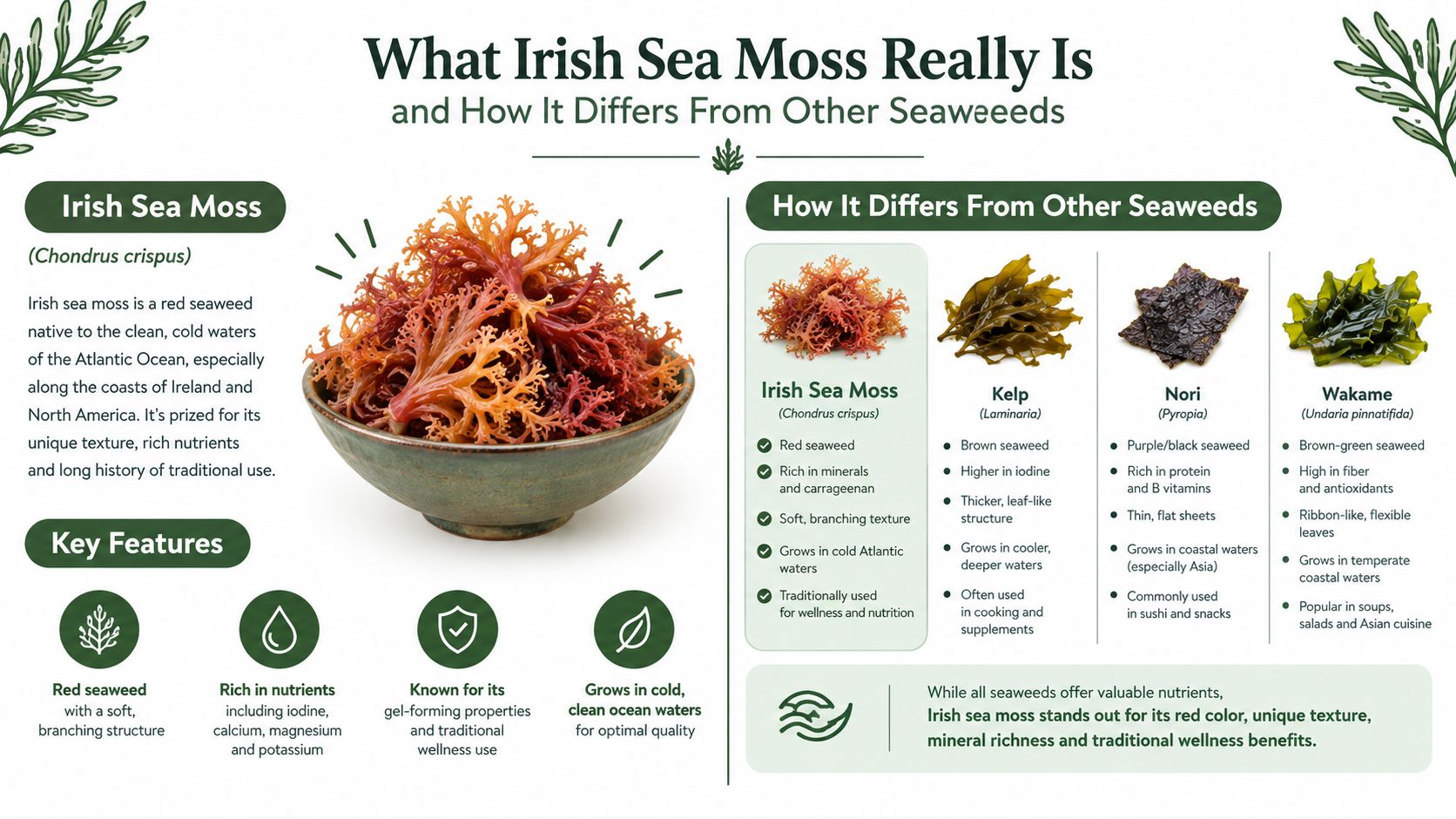
The name covers more than one shopping habit
People often use “sea moss” as a broad label, but product quality and texture can vary. What matters most is whether the product clearly identifies the species, how it was harvested, and how it was processed.
The historical side also helps explain why this seaweed got so much attention. Traditional use goes back centuries, and industrial use grew later when carrageenan demand in food processing made Irish moss a commercial ingredient at scale Canadian Encyclopedia on Irish moss production. That's a very different story from a brand-new internet wellness trend.
Why texture matters in food and supplements
The practical reason Irish sea moss became valuable is simple, it behaves like a functional ingredient. A seaweed that can thicken, stabilize, and carry minerals can be used in recipes, gels, and capsules for different kinds of routines.
Simple takeaway: if the ingredient is listed as Chondrus crispus, you're looking at the classic Irish sea moss species, not a vague ocean blend.
For shoppers, that identity matters because the product name alone doesn't tell you how much of the original structure is preserved, how much processing happened, or whether the seaweed is being used as a food ingredient or a convenience supplement.
Nutrition Inside Irish Sea Moss and What Science Actually Supports
The useful way to think about Irish sea moss nutrition is to focus on what dominates it, not on miracle claims. A FAO review reports that extracted Irish moss is typically 70 to 79% gelatinous carrageenan by weight, with about 15% minerals and 7% proteins, and another review describes carrageenan as making up roughly 55% of dry weight in the plant FAO and review summary on composition.
That composition explains why the ingredient behaves the way it does. The hydrocolloid polysaccharides drive the texture, while the mineral fraction can vary a lot depending on harvest location and processing.
What the label can't tell you at a glance
A supplement label may look simple, but the same sea moss can deliver very different nutritional realities. That's because seaweeds vary with growing conditions, handling, and drying methods. You're not buying a fixed lab formula, you're buying a natural marine ingredient with natural variation.
The science conversation also needs a safety lens, not just a benefit lens. Human evidence for broad wellness claims is limited, and a lot of the online marketing goes far beyond what's been established. Recent expert coverage notes that brands are increasingly adding third-party testing and thyroid warning labels, which tells you the market is paying more attention to verification and safety than to dramatic promises sea moss safety and iodine variability.
Why minerals and polysaccharides get most of the attention
If you want a plain-English summary, here it is. The seaweed is valued for its gel-forming polysaccharides and its mineral content, but those minerals are not standardized across every product. That means the same serving style can behave differently from one brand to another.
Useful framing: traditional use shows the ingredient belongs in the food world, but the modern consumer still needs to check quality, not just trust the headline claim.
For readers who want a deeper look at one specific nutrient issue, the iodine supplement guide is a helpful companion topic because iodine is one of the main reasons sea moss deserves careful label reading.
How to Use Irish Sea Moss From Gel Prep to 5 Second Capsules
The classic version of sea moss use starts with dried seaweed, water, soaking, and blending. The result is a gel that can be stirred into smoothies, mixed into recipes, or kept in the fridge for short-term use.
That works for people who enjoy a kitchen routine. It doesn't work as well for people who leave home early, travel often, or don't want another container taking up refrigerator space.
The practical difference between gel and capsules
Gel has a texture and a prep step. Capsules skip both. That makes capsules easier to repeat at the same time every day, which is often the challenge with supplements.
A simple routine can look like this:
- Morning coffee pairing: keep the capsule bottle near your coffee so the habit is tied to something you already do.
- Travel bag routine: put the bottle with your vitamins so you're not relying on refrigeration or a blender.
- Desk drawer backup: if you work from an office, a shelf-stable capsule is easier to remember than a jar of gel.
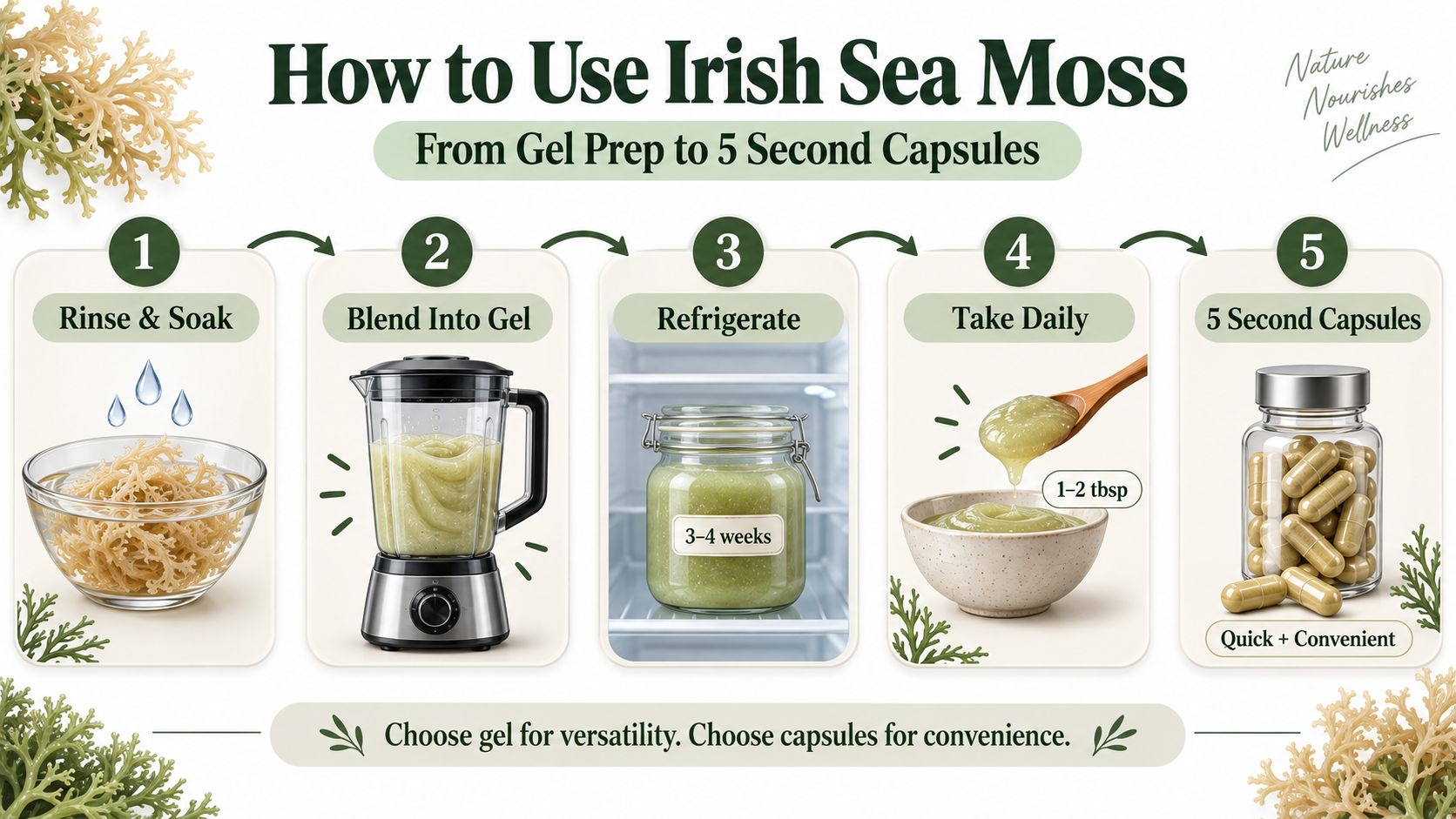
Where capsules fit best
Capsules make the most sense when the goal is consistency, not culinary experimentation. They're also useful if you already use greens powders, collagen, or a simple morning supplement stack and want to add one more habit without adding prep.
If you want a product built around that convenience-first use case, the Organic Irish Sea Moss Capsules are the relevant format to compare against gel. They're the kind of option busy adults can remember to take.
Bottom line: if the ingredient matters more to you as a routine than as a recipe, capsules are the easier path.
How to Choose High Quality Irish Sea Moss and Avoid Common Pitfalls
A busy shopper often runs into the same two mistakes: buying on a vague wellness promise, or skipping the details that show how the sea moss was sourced and tested.
That matters because sea moss can bioaccumulate heavy metals such as arsenic, cadmium, lead, and mercury, so quality control is part of the decision sea moss contamination and market context. Iodine deserves the same attention, since seaweed is a major source and levels can vary widely.
A quick comparison checklist
| What to check | Why it matters |
|---|---|
| Species name | Shows whether the product clearly identifies Chondrus crispus. |
| Third-party lab testing | Helps verify contaminant screening and quality transparency. |
| Clear serving information | Makes it easier to judge how the product fits your routine. |
| Iodine or thyroid warning language | Signals that the brand recognizes safety concerns, not just marketing. |
| Organic and sourcing details | Gives you a better sense of how the seaweed was handled and packaged. |
What a careful shopper notices first
A good product page answers basic questions without making you search for them. Where was it sourced? Is the testing independent? Does the label explain what the product is and how to use it? Those answers matter because they show whether the brand treats sea moss as a supplement with safety checks, or just a trend item.
A market still growing can also attract uneven labeling, thin testing, and unclear serving directions. That is why the checklist above matters in practice. It points you toward products that make verification easier, instead of leaving you to guess from the packaging.
A simple rule helps here. Choose the product that makes safety easy to confirm, not the one that relies on the biggest promise.
For a convenience-focused option, Peak Performance's Organic Irish Sea Moss Capsules are positioned around wild-harvested sea moss and third-party testing, which fits the kind of quality checklist busy shoppers should be using.
Safe Daily Use Dosing and Making Irish Sea Moss Part of Your Routine
A sea moss routine sounds simple until iodine enters the picture. Adults generally want total iodine near 150 mcg per day and below the 1,100 mcg tolerable upper limit to reduce thyroid-risk concerns Northwestern Medicine on sea moss risks.
That is why a capsule routine is easier to manage than a gel routine. A capsule gives you a steadier serving, while gel portions can change from spoon to spoon.
Who should be cautious
Some people should be more careful with sea moss, especially those with thyroid disease, people who are pregnant or breastfeeding, and anyone taking thyroid medication WebMD sea moss guidance. That does not automatically mean sea moss is off-limits, but it does mean the ingredient deserves a real conversation with a clinician if any of those situations apply.
A 2019 review reported 4 grams daily as generally safe, but that figure should be treated as context, not a personal dosing target.
A simple routine that stays realistic
A routine that works is usually the one people can repeat without thinking.
- Take it with breakfast: pairing the capsule with an existing habit helps with consistency.
- Keep one bottle visible: out of sight usually means out of mind.
- Watch your whole iodine intake: sea moss should fit alongside the rest of your diet, not compete with it.
Independent consumer guidance also notes that some sea moss products can deliver roughly 40 mcg to 180 mcg of iodine per serving depending on format ConsumerLab on carrageenan and iodine variability. That range is wide enough to make label reading worth your time, especially if you want a steady daily pattern without guessing at dose.
Peak Performance offers Organic Irish Sea Moss Capsules alongside other daily nutrition products, so you can build a shelf-stable routine without adding prep to your morning. If you want a convenient way to compare the capsule format and read the product details carefully, visit Peak Performance and see how it fits your day.


