


Kids Calm Bedtime Reset That Actually Works
If you're reading this after another bedtime that turned into tears, stalling, clinginess, and a child who somehow looks both exhausted and wide awake, you're not alone. A lot of parents search for kids calm help when what they really need is a better way to handle the hour before sleep.
Bedtime battles usually aren't a sign that your child is “being difficult.” More often, they're a predictable collision of tired brains, big feelings, and a body that doesn't know how to downshift yet. That's why the most helpful reset usually isn't a harsh sleep aid or a pile of random calming tricks. It's a simple system.
Introduction to Calmer Nights Without the Battle
You finish dinner, start the pajamas routine, and then it begins. One child suddenly needs a different cup of water. Another remembers a scary thought from earlier. Someone cries when you leave the room. Someone else gets silly, loud, and almost wild right when you hoped the house would settle down.
That stretch of the evening can make parents feel like they're doing everything wrong. Usually, they aren't. Bedtime meltdowns often happen when a child's nervous system is overloaded and sleep pressure is rising faster than their ability to cope.

What a reset looks like
A good bedtime reset does three things at once:
- It lowers stimulation so the body gets a clear message that the day is ending.
- It builds a repeatable routine so your child knows what comes next.
- It uses gentle support wisely so calming tools fit into the routine instead of replacing it.
That last part matters. Parents often ask whether ingredients like Vitamin B6, Magnesium, and L-Theanine can help. They may have a place, but they work best as supporters of a bedtime system, not as a shortcut around one.
What this can and can't do
This kind of reset can help with common bedtime friction, especially when evenings are shaped by overtiredness, clinginess, worry, or overstimulation. It won't solve every sleep problem overnight, and it won't replace professional care when a child has severe anxiety, persistent sleep disruption, or symptoms that spill into daytime life.
Practical rule: Aim for “calmer and more predictable,” not “perfect and silent.”
You don't need a complicated plan. You need a steady one. The rest of this guide walks through why evenings unravel, what to do before the meltdown starts, how to respond when it does, and where nutrition support fits in.
Why Bedtime Feels So Hard for Kids
Bedtime can bring out struggles that barely show up during the day. A child who seemed mostly fine at breakfast may fall apart at night because evening puts stress on all the weak spots at once. Tiredness rises. Separation becomes more noticeable. Noise, screens, and transitions catch up with them.
Many families searching for Kids Calm ideas are dealing with a sleep and anxiety knot, not a simple “calm down” problem. That distinction matters because a systematic review found that across 21 intervention and experimental studies, sleep interventions reduced anxiety symptoms or the onset of anxiety disorders in children and adolescents (sleep interventions and anxiety review).
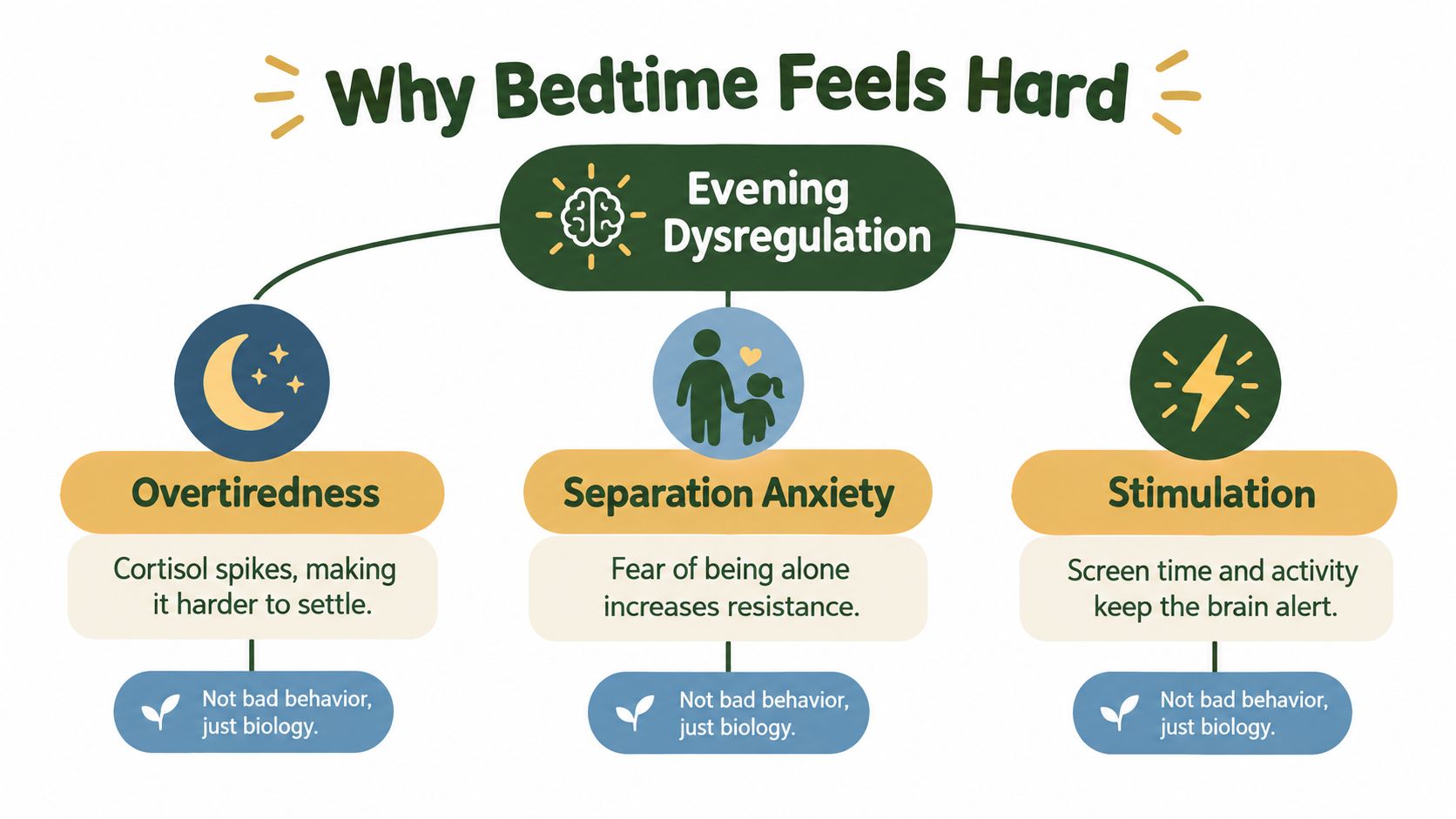
Three common bedtime drivers
-
Overtiredness
An overtired child doesn't always look sleepy. Some get louder, more oppositional, or more emotional. Parents often mistake this for defiance when it's really dysregulation. -
Separation anxiety or bedtime fear
Nighttime makes distance from a parent feel bigger. A preschooler may fear being alone. A school-age child may start looping on worries or ask repeated safety questions. -
Too much stimulation too late
Bright lights, rough play, fast transitions, or a screen right before bed can keep the brain in “alert mode” instead of “settling mode.”
A simple way to sort out the real problem
Ask yourself which pattern sounds most familiar:
- Sleep onset struggle means your child seems activated, restless, or “not tired” when it's time to settle.
- Nighttime fear means resistance centers on being alone, darkness, scary thoughts, or repeated checking.
- Daytime carryover means unresolved stress from school, transitions, sensory overload, or conflict shows up once everything gets quiet.
If you need a deeper parent-friendly walkthrough on solving child sleep problems, that resource does a nice job of separating routine issues from bigger sleep concerns. For a closer look at how calming drops fit into evening support, Peak Performance also has a plain-language overview of calming drops for kids.
Bedtime resistance often makes more sense when you stop asking, “Why won't my child cooperate?” and start asking, “What's making it hard for my child to feel safe enough to power down?”
Your Calm Evening Routine That Actually Sticks
A calm bedtime routine works because it reduces decision-making. Your child doesn't have to guess what's next, and you don't have to invent a new response every night. Keep the order the same. Keep the mood boring in the best possible way.
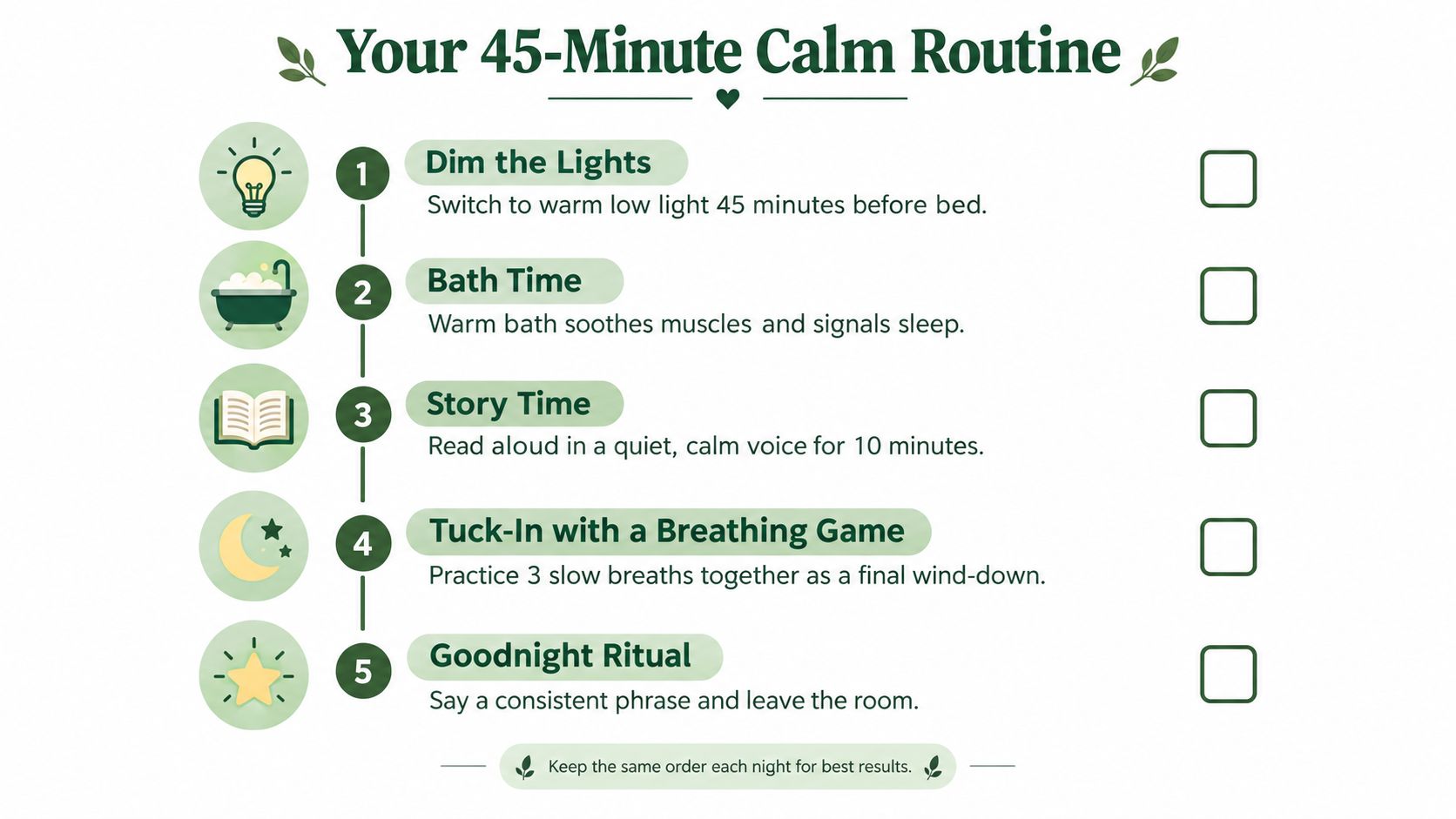
A simple 30 to 45 minute wind-down
Try this sequence:
- Start with light. Dim overhead lights and switch to warm, lower lighting.
- Lower the pace. Move from active play to bath, washing up, or quiet cleanup.
- Use one connecting activity. Reading, cuddling, or a calm story works well.
- End with one short settling ritual. A breathing game, song, or same goodnight phrase every night helps.
The power is in the repetition, not the complexity.
What to say during transitions
Children often resist bedtime less when the adult sounds calm, clear, and unsurprised.
“It's bedtime now. I'll help you through the same steps we always do.”
“You don't have to feel sleepy yet. You only need to do the routine.”
Those scripts work because they don't argue with feelings. They set the limit and keep moving.
Age-based tweaks that help
Toddlers usually do best with very few choices. Try “blue pajamas or green pajamas?” instead of open-ended questions.
Preschoolers often need a stronger bridge between connection and separation. A short story, one song, then one consistent goodnight ritual helps.
School-age kids may need a place to “park” worries before bed. Keep paper nearby for a quick worry note, then move into the routine instead of discussing every fear at length.
When the routine keeps derailing
If bedtime feels cluttered, the room often does too. Reducing visual chaos can make the evening feel less buzzy, especially for kids who get overstimulated easily. If that's your house right now, these ideas for smart storage for children's spaces are practical and easy to adapt to bedrooms and play areas.
Use this short checklist for one week before changing everything again:
- Track the same bedtime window on weekdays and weekends as closely as family life allows.
- Notice the hardest point. Is it bath, lights out, your exit, or the first wake-up?
- Change one thing at a time so you can tell what helped.
A routine doesn't have to feel magical to work. It just has to be repeatable.
Quick Calming Techniques for Meltdown Moments
Prevention is ideal, but real families still get the hard moments. When your child is crying, clinging, or spiraling at bedtime, your job isn't to erase the feeling. It's to help them move through it without feeding the loop.
A 2020 meta-analysis found that cognitive-behavioral interventions for pediatric anxiety reduced symptoms with SMD = -1.34 versus baseline and SMD = -0.81 versus control, with effects still significant after publication-bias correction at SMD = -0.89 and maintained at follow-up (pediatric anxiety intervention meta-analysis). In plain language, structured calming and coping skills work better than endless reassurance alone.

Three quick tools for the hot moment
Balloon breathing
Keep it short. Long lectures won't land in a meltdown.
“Smell the flower. Blow up the balloon.”
Do three slow rounds together. If your child refuses, do it beside them instead of demanding they copy you.
For parents who want a simple explanation of why this helps, this short piece on the power of deep breathing for health and wellbeing fits nicely into a bedtime plan.
Grounding through the senses
For a child stuck in fear, bring attention back to the room:
- Name what's real. “I see your blanket, your lamp, and your stuffed bear.”
- Add touch. “Press your feet into the bed.”
- Use one sound. “Let's listen for the fan together.”
This works well for bedtime worries because it shifts the brain away from imagined threat and back toward the present.
Audio-guided settling
Some kids relax better when they don't have to make eye contact or answer questions. Quiet music, a short sleep story, or another predictable audio cue can help them stop fighting the process. Families working on regulating the nervous system with sensory tools often find that touch, sound, and body-based supports are more effective than verbal persuasion in the moment.
The pitfall most parents hit
Too much reassurance can accidentally keep the cycle going. If a child asks the same fear question over and over, answering it ten different ways rarely brings lasting calm. Parent-involved programs for younger children are promising, and one pilot CALM Program for ages 3 to 8 used parent coaching across separation anxiety, social anxiety, generalized anxiety, and specific phobias in a small sample of 9 families (parent-involved CALM program study).
The useful takeaway is simple. Stay warm, but don't turn bedtime into a long negotiation. Comfort your child, then guide them back into the same settling steps.
Nutrition and Gentle Supplement Support for Bedtime Calm
Food, routine, and emotional support do most of the heavy lifting. Still, many parents want to know where Vitamin B6, Magnesium, and L-Theanine fit into a kids calm bedtime plan. The honest answer is that these ingredients may support relaxation, but they don't replace a steady routine, and the evidence is stronger for some ingredients than others.
What the three ingredients mean in practical terms
Magnesium is often discussed for relaxation, but dosing matters. The NIH upper limit for supplemental magnesium is 65 mg/day for ages 1 to 3, 110 mg/day for ages 4 to 8, and 350 mg/day for ages 9 to 18 (magnesium upper limits for children). Those limits apply to supplements and medications, not food.
L-Theanine has direct pediatric evidence, but it's narrow. In one randomized trial, 98 boys ages 8 to 12 with ADHD took 400 mg/day for six weeks, split into two 200 mg doses, and showed improved actigraphy-based sleep measures with no adverse events reported (pediatric L-theanine sleep trial). That's useful, but it does not prove L-Theanine is a universal bedtime solution for all children.
Vitamin B6 comes with a different kind of caution. The EFSA opinion states there are no data to support deriving a UL for children, so there is no established child-specific tolerable upper intake limit in that opinion (EFSA opinion on vitamin B6 safety). That makes label clarity and dose discipline especially important.
Bedtime Calm Support Compared
| Support Type | Best For | Evidence Note |
|---|---|---|
| Consistent bedtime routine | Most children with common bedtime resistance | Strong practical foundation for reducing evening activation |
| Parent-led calming techniques | Meltdown moments, separation struggles, worry loops | Structured coping approaches are better supported than reassurance alone |
| Sleep-focused behavior changes | Kids whose “calm” problem is really a sleep problem | Sleep support can reduce anxiety symptoms in many children |
| Ingredient support with Magnesium, L-Theanine, and Vitamin B6 | Families who want an added layer within an existing routine | Use carefully, with age-appropriate dosing and realistic expectations |
One more reality check matters here. A review of sleep supplements noted that a combination with magnesium, multiple B vitamins, rhodiola, and green tea/L-theanine improved stress and depression in adults but showed no difference in sleep quality (review of supplements for sleep). Stacks can influence stress without proving bedtime benefit, especially in children.
If you want a parent-friendly overview of what to look for, this guide to supplements for kids is a useful place to start. One kid-focused option in this category is Kids Calm Liquid Drops, which includes Vitamin B6, Magnesium, and L-Theanine as part of a broader calming formula. If you explore any supplement, keep it in the role of support, not substitute.
When to Keep Going and When to Get Extra Help
Most bedtime resets need repetition before they feel natural. Give your new system about two weeks of steady practice before deciding it “isn't working,” unless your child's distress is intense enough that you need help sooner.
What progress usually looks like
Look for small shifts:
- Faster settling even if your child still protests a little
- Shorter meltdowns with less escalation
- Fewer repeated reassurance requests
- More predictability in how the evening unfolds
That's real progress. Calm is a skill, and skills build gradually.
When it's time to ask for support
Talk with your pediatrician or a child mental health professional if bedtime fear is severe, sleep problems are persistent, or evening distress spills clearly into school, mood, or daily functioning. It's also worth reaching out if you feel your family is walking on eggshells every night and nothing is getting easier.
You are not failing if you need help. You're noticing that your child needs more support than a home routine can provide on its own.
If you're trying a sleep-first Kids Calm approach, keep the formula simple. Use one consistent routine, one or two in-the-moment calming tools, and careful nutritional support only if it fits your child and your pediatrician's guidance. Tonight, start smaller than you think. Dim the lights earlier, shorten the talking, and repeat the same ending.
Peak Performance offers kid-focused wellness support, including Peak Performance products designed for families who want straightforward options alongside healthy routines. If bedtime has turned into meltdown hour, their kids calming support can be one part of a steadier evening plan built around consistency, connection, and gentle support.
Also in Podcasts


