


Primavie Shilajit: 5 Signs You Need More Energy
You're doing a lot “right” and still feeling wrung out. You sleep enough. You eat decently. You train a few times a week. You drink the coffee, then maybe another coffee, and by midafternoon your body still feels like it never fully plugged in.
That's where most supplement advice gets sloppy. It jumps straight to buzzwords like energy, vitality, testosterone, or adaptogens without answering the more useful question: what if the issue isn't only what you're taking, but how well your cells can use it?
That's why PrimaVie Shilajit is worth a closer look. Not because it's mystical mountain resin. Because fulvic acid, the main active fraction in aqueous shilajit extracts, is widely considered the core driver behind many of shilajit's biological effects, according to a peer-reviewed review on shilajit's composition and activity in PMC. If you understand fulvic acid, the rest of the conversation gets much less fuzzy.
The 5 Signs Your Body Is Starving for Fulvic Acid
A familiar pattern shows up in clinic-style conversations. Someone says they're “just stressed,” but the picture is more specific than that. Their body isn't bouncing back well. Their focus slips. Their output is inconsistent. And they can't figure out why the basics aren't helping.
This checklist is a simple way to sanity-check what's going on.
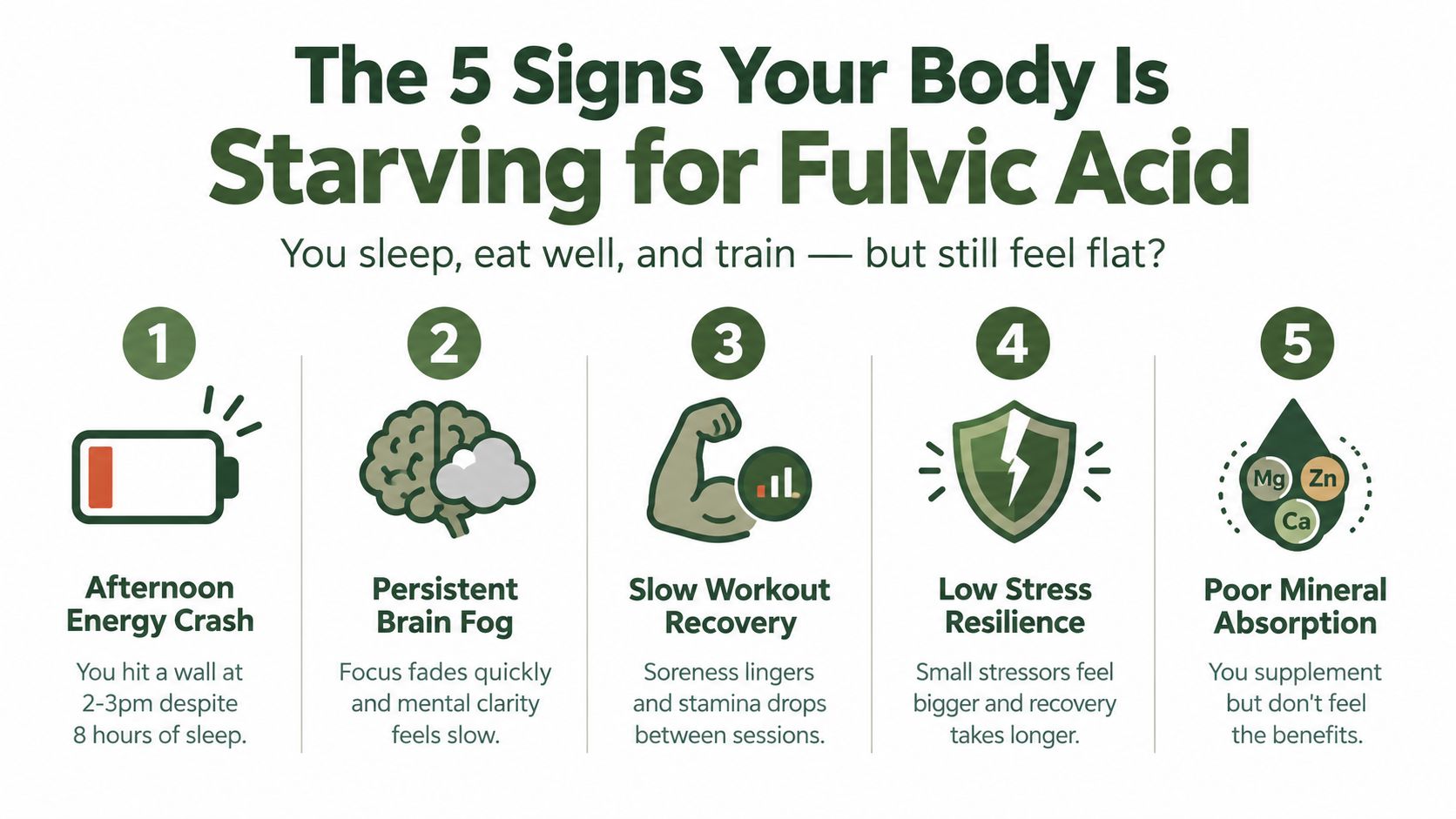
Your afternoon energy falls off a cliff
You're fine until early afternoon, then you hit a wall. Not sleepy exactly. Just flat, dull, and weirdly unmotivated.
That kind of crash often gets blamed on willpower or cortisol. Sometimes it's simpler. Your cells may not be handling nutrient delivery and energy production efficiently, so the fuel is there on paper, but the “use” side feels poor.
Your brain works, but slowly
You can still do your job. It just takes longer to lock in. You reread emails. You lose the thread mid-task. A second cup of coffee helps, but only a little.
Readers often get confused. Brain fog doesn't always mean you need a stronger stimulant. Sometimes it means the underlying machinery for cellular energy feels underpowered.
Your recovery is dragging
You didn't suddenly become fragile, but your body feels slower between training sessions. Soreness hangs around. Your top-end strength feels less reliable. One hard workout seems to cost you more than it used to.
That doesn't automatically mean overtraining. It can also point to a body that's struggling to restore itself efficiently.
Practical clue: If energy, focus, and recovery all dip together, look beyond surface-level “fatigue” language. A shared bottleneck is often more useful than three separate guesses.
Your skin, nails, or general “healthy look” feels off
You eat reasonably well, but your skin looks dull and your nails feel brittle. That's easy to dismiss as cosmetic, yet it can be another sign that you're not making the most of what you take in.
Visible tissues often show stress when deeper nutrient handling is less than ideal.
Your drive feels flatter than usual
This can mean libido. It can also mean plain old motivation. You're not dramatically depressed. You just feel less switched on.
That matters because many people chase hormone supplements before they ask a more basic question: are the nutrients and compounds involved in energy and recovery getting where they need to go well enough to matter?
How Fulvic Acid Drives Shilajit's Effects
A lot of readers come into shilajit expecting a hormone story. The more useful starting point is simpler. Fulvic acid is one of the main reasons shilajit can matter at all, because it helps explain absorption at the cellular level.
A review on shilajit describes fulvic acid as water-soluble across different pH conditions and notes its low molecular weight, which the authors connect to intestinal absorption and elimination within hours in this PMC review. That matters because a supplement cannot do much if its active compounds are poorly handled from the start.
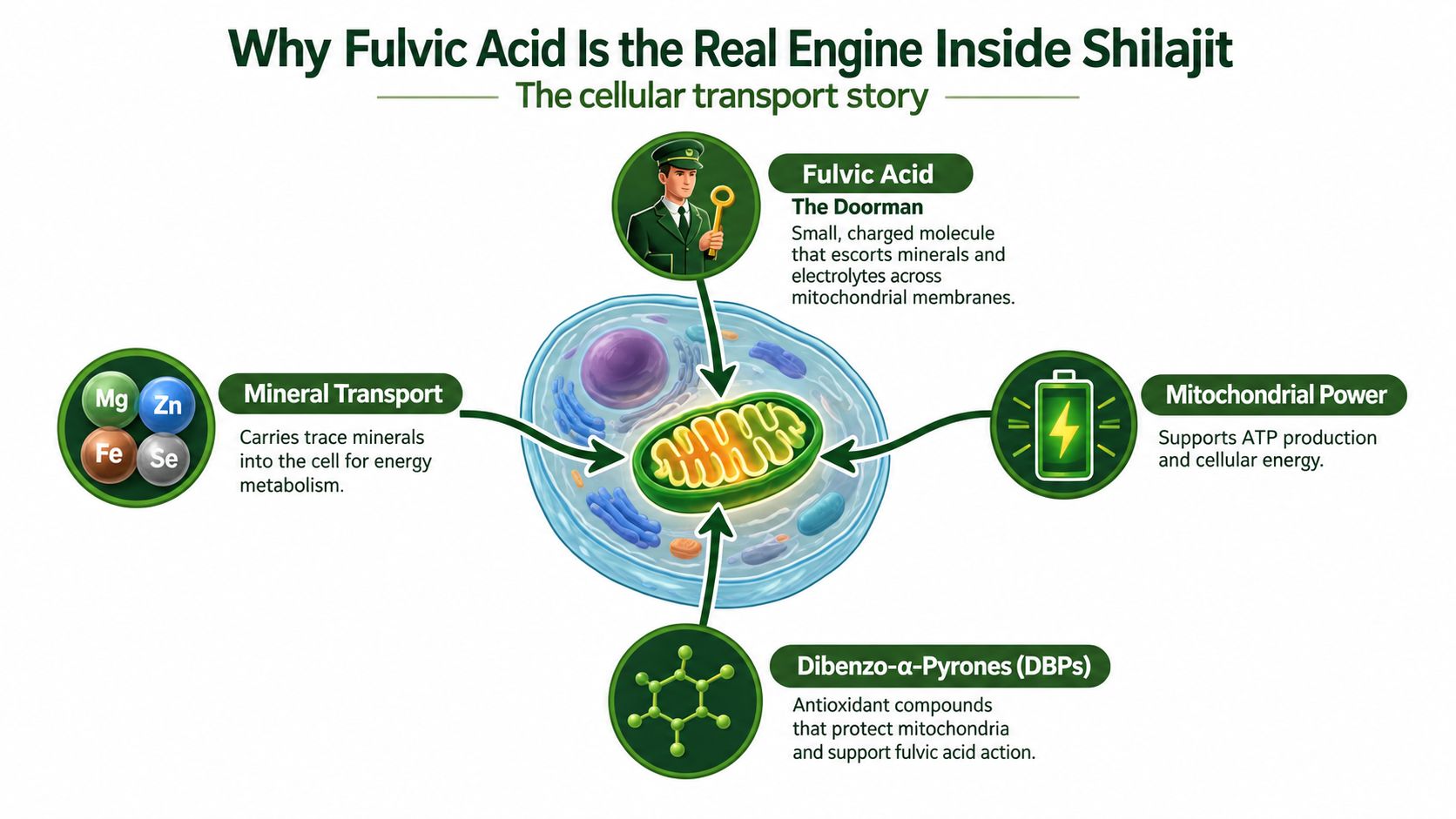
A useful analogy is a delivery system. You can have nutrients on board, but if they are not getting carried, exchanged, or used efficiently, the result still feels like low energy. That is why fulvic acid deserves more attention than the usual sales copy about testosterone or “natural vitality.”
Fulvic acid is the mechanism worth paying attention to
Fulvic acid works a bit like a shuttle for small compounds and minerals. That does not make it magical. It means absorption and transport may be part of why some people notice steadier energy, better resilience, or less of that flat, underpowered feeling that stimulants only partly cover.
If you have been trying to understand mitochondrial support in more practical terms, Peak Performance's guide to the best mitochondria supplement is a useful companion because it explains energy support without drifting into vague wellness language.
Why PrimaVie being standardized changes the conversation
This is also where generic shilajit talk often falls apart. Raw resin can vary a lot in composition, purity, and active content. A standardized extract gives you a clearer target.
Product documentation for PrimaVie commonly describes a 500 mg serving standardized to 50% fulvic acid, which means about 250 mg of fulvic acid per serving, and it also lists dibenzo-α-pyrones plus over 40 different minerals in the PrimaVie ingredient document. That kind of standardization matters because “shilajit” by itself is too broad to tell you much.
What that can mean in everyday terms
For a tired reader, the practical takeaway is straightforward:
- Energy support: better transport and handling of compounds tied to cellular function can feel more like stable output than a stimulant spike.
- Mineral usefulness: the goal is not only taking in trace minerals. The goal is helping the body use what is there.
- Recovery support: fulvic acid is part of a broader PrimaVie profile that also includes dibenzo-α-pyrones, which helps explain why shilajit keeps showing up in recovery discussions.
Shilajit makes more sense once you stop treating it like mountain folklore and start treating it like a standardized fulvic-acid delivery system.
What the PrimaVie Clinical Evidence Actually Shows
This is the part that deserves a little discipline. Not all shilajit is the same, and not all claims come from studies on the same type of material. PrimaVie Shilajit has branded human research behind it, which already puts it in a smaller category than most generic shilajit products.
A public PrimaVie development page says the patented extract had been studied in 10 randomized, double-blind, placebo-controlled human clinical trials, and it also identifies US patents 6,969,612 and 6,440,436 as part of its standardized platform in this PrimaVie background page.
What has actually been studied
One randomized, double-blind, placebo-controlled trial in healthy men used 500 mg/day for 90 days and found significant increases in total testosterone, free testosterone, and DHEA compared with placebo, while luteinizing hormone and follicle-stimulating hormone did not significantly change, as summarized on this PrimaVie ingredient evidence page. That pattern suggests the effect may be more peripheral than central.
A separate eight-week randomized, double-blind, placebo-controlled study in recreationally active men used 500 mg/day and found that PrimaVie Shilajit helped preserve maximal muscular strength after a fatiguing protocol and lowered baseline hydroxyproline, a marker tied to collagen breakdown, according to the full paper in JISSN on PMC.
There's also newer product-specific clinical positioning around skin. Clinical coverage notes that Natreon's patented PrimaVie ingredient was tested in a randomized, double-blind, placebo-controlled study published after research at Ohio State University Wexner Medical Center, which gives the product a more concrete clinical-development pedigree in this PRWeb release.
PrimaVie clinical trial summary
| Study Focus | Daily Dose | Duration | Primary Outcome |
|---|---|---|---|
| Androgen status in healthy men | 500 mg/day | 90 days | Significant increases in total testosterone, free testosterone, and DHEA |
| Strength and recovery in recreationally active men | 500 mg/day | 8 weeks | Better preservation of maximal muscular strength after fatigue and lower baseline hydroxyproline |
| Skin-health clinical positioning | Qualitatively referenced | Qualitatively referenced | Evidence-based product development pedigree around skin outcomes |
What the evidence does not prove
The data is promising, but keep your feet on the ground.
- The strongest evidence is short-term.
- The research is tied to a specific standardized extract.
- Long-term daily use is still less clear than shoppers often assume.
That last point is the one marketing pages often glide past.
How to Dose and Time PrimaVie for Daily Energy
For most readers, the practical range is straightforward: 250 mg to 500 mg per day of purified PrimaVie Shilajit. That range lines up with the short-term human evidence summarized in current coverage of purified shilajit use, which notes it has generally been well tolerated at 250 to 500 mg/day for about 8 to 12 weeks, while long-term continuous use beyond 6 months remains poorly studied in this safety-focused review article.
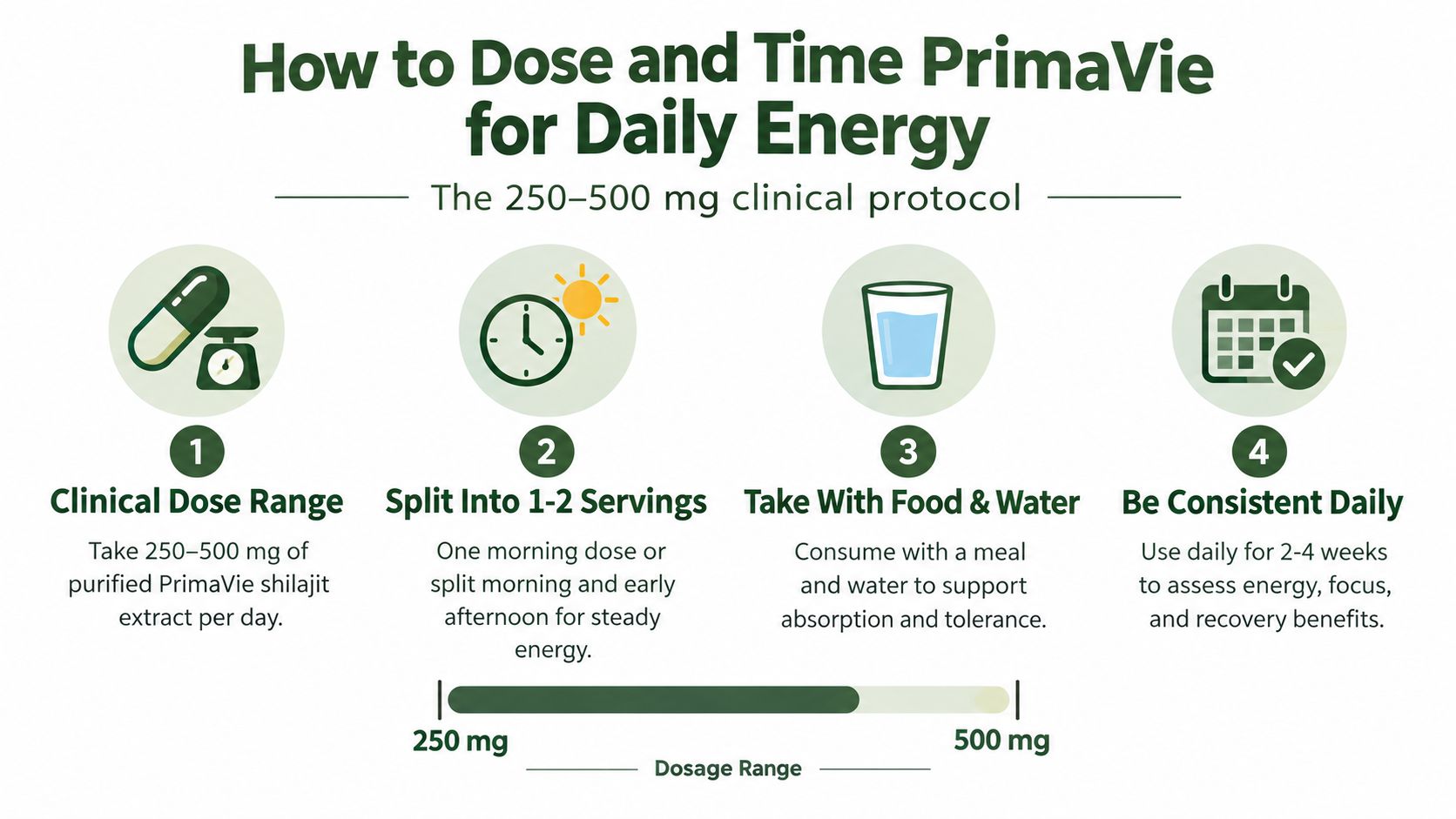
A simple way to start
You don't need a complicated protocol. You need consistency.
- Start low: Begin with 250 mg daily.
- Build if needed: Move toward 500 mg daily if you tolerate it well and want to match the dose used in the testosterone and performance studies.
- Take it early: Morning is the cleanest fit.
- Split the dose if preferred: Some people do better with one serving in the morning and one earlier in the day.
Common timing questions
Taken with coffee? Usually fine, though if caffeine already makes you jittery, pairing both may not be your best idea.
Taken with food? Also fine. On an empty stomach may suit some people, but a meal can make new supplements easier to tolerate.
Late in the day? I'd be cautious if you're sensitive to anything that increases alertness. Better to keep it earlier.
If you like comparing non-stimulant strategies for low energy, PepFlow's energy research is worth reading because it lays out a broader framework for fatigue support and helps separate mechanism from marketing.
A one-week ramp-up that's realistic
Here's the plain version.
- Days 1 to 7: take 250 mg once daily.
- After that: consider 500 mg daily if you feel fine and want the studied benchmark.
- Stay consistent: don't judge it after two random doses.
Good rule: Match your expectation to the study window. PrimaVie Shilajit is not a pre-workout. It's a daily input.
One practical product example is PrimaVie Purified Shilajit Capsules, which is relevant here because it uses the standardized PrimaVie form rather than an unspecified raw resin.
Safety, Cycling, and the Long-Term Use Gap
I'd rather be boring than breathless.
Short-term use of purified shilajit looks much better than the online folklore around raw resin. The main issue isn't whether the ingredient sounds ancient or natural. The issue is whether you're using a purified, standardized extract and whether anyone has checked the batch for contaminants.
A 2024 PubMed-indexed review found that shilajit can contain heavy metals, that levels in most tested samples were below WHO and FDA limits, but that some studies exceeded those limits, and the review concludes that consuming shilajit without knowing permissible metal levels is not safe in this PubMed review.
What short-term safety seems to support
The human evidence summarized earlier points to short study windows, usually around 8 to 12 weeks, with purified shilajit generally well tolerated in that range.
That is reassuring, but it is not the same thing as proving year-round use is fully mapped out.
Why cycling is a reasonable middle ground
If you're a cautious adult using PrimaVie Shilajit for energy, recovery, or general vitality, a practical approach is to use it for a period, then take a break. That isn't because the ingredient is known to be dangerous. It's because the long runway of continuous use hasn't been studied as thoroughly as many people assume.
People who should be more careful include those managing iron overload, active gout, or complex medication regimens. Pregnant or breastfeeding women and children should skip it unless a qualified clinician says otherwise.
Flip the buying question
Don't ask only, “Does shilajit work?”
Ask, “Who tested this batch, and what exactly was tested?”
That question cuts through a lot of vague wellness copy.
The biggest risk with shilajit often isn't the concept of shilajit. It's poor-quality material sold with big promises and thin documentation.
How to Verify a Purified Shilajit Before You Buy
Shilajit is a category where labels can sound impressive while telling you almost nothing useful. A decent buying decision comes down to verification, not adjectives.
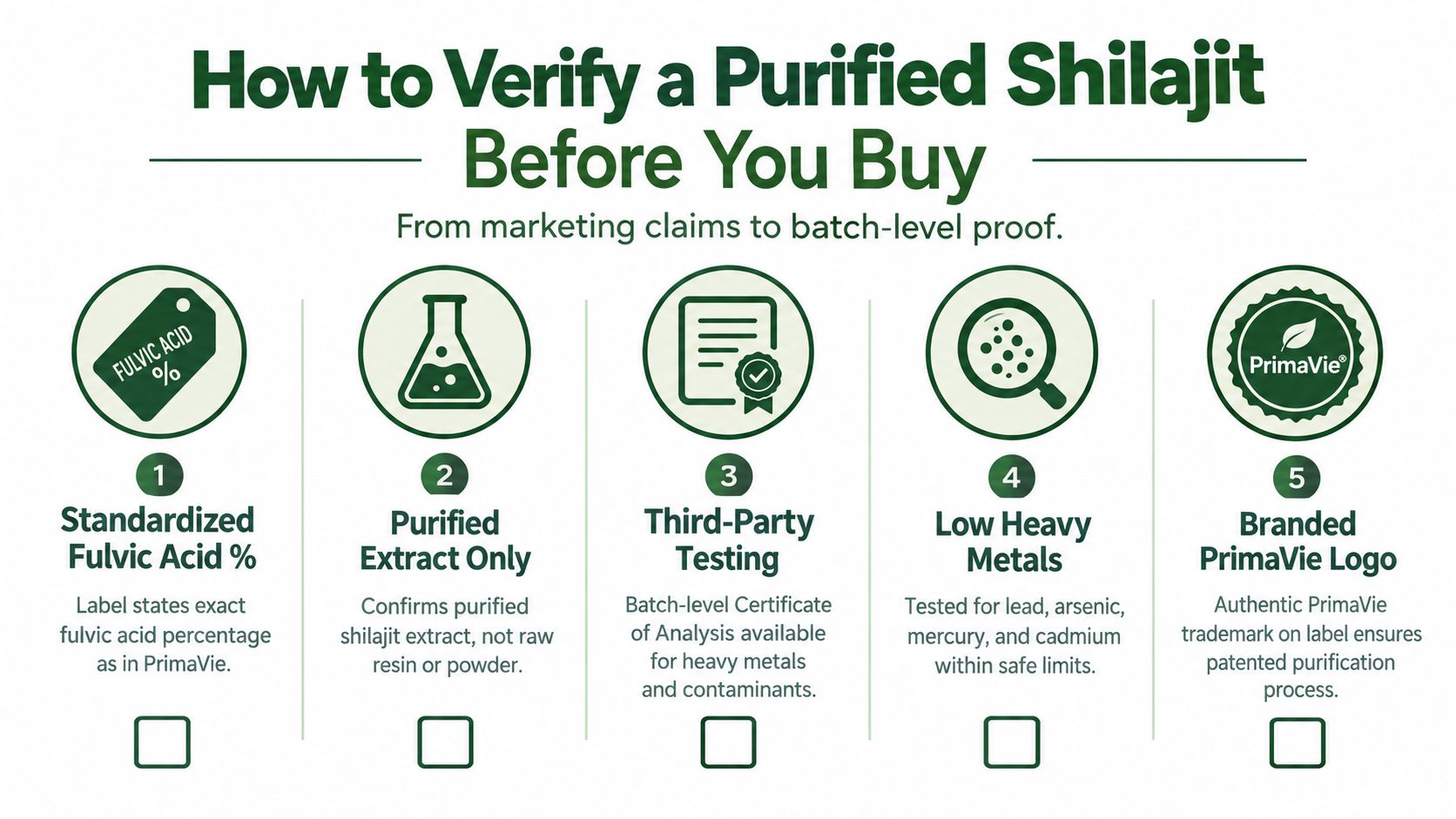
The short pre-purchase checklist
Use this before you buy anything marketed as Primavie Shilajit or purified shilajit.
- Check the form: it should clearly say purified extract, not just raw resin or vague “mountain mineral.”
- Check standardization: the label or supporting material should state the fulvic acid percentage.
- Check traceability: look for a lot number and expiration date.
- Check testing: the brand should make a recent Certificate of Analysis available.
- Check the lab language: independent testing carries more weight than a broad in-house claim.
If you want a plain-English walkthrough of what third-party verification means, Peak Performance's article on what is third-party testing is useful and not overloaded with jargon.
What matters more than hype
A polished product page isn't proof. Real proof looks boring.
It looks like documentation, standardization, and contaminant screening.
For PrimaVie specifically, the strongest quality signal is that it's positioned as a more controlled ingredient for the global nutraceutical market because of its standardized composition and purification profile, as described in the earlier linked ingredient document.
Red flags worth taking seriously
- No fulvic acid standardization listed
- No batch or lot details
- No accessible heavy metals testing
- Vague sourcing language
- A product sold as “authentic resin” with no clear purification story
That last one catches a lot of people. Traditional sounding isn't the same as safe.
PrimaVie vs Generic Shilajit Resin Compared
This comparison gets simpler when you stop asking which one sounds more natural and start asking which one gives you a repeatable dose, a cleaner safety profile, and human data you can track back to a product type.
The head-to-head view
| Criterion | PrimaVie (purified extract) | Generic Shilajit Resin |
|---|---|---|
| Purity | Purified and standardized | Variable, depends heavily on source and processing |
| Fulvic acid consistency | Defined standardization profile | Often inconsistent or undisclosed |
| Clinical evidence | Human studies tied to the branded extract | Usually not backed by product-specific human data |
| Buying confidence | Easier to verify if documentation is provided | Requires more buyer-side detective work |
| User experience | More predictable dosing in capsules | Traditional format, but less precise |
Who should choose which
If you want reproducible dosing, PrimaVie Shilajit is the cleaner fit. That's especially true if you care about using something similar to what has been studied in people.
If you're drawn to resin for traditional reasons, fine. Just understand that the burden of proof shifts toward you. You'll need to verify quality more aggressively.
For readers comparing delivery formats, this overview of shilajit capsules is useful because capsules remove much of the guesswork around serving size and consistency.
The simplest rule
Choose a standardized extract if you want your dose to mean something.
Choose resin only if you're comfortable doing more verification work and accepting more variability.
That's the whole story in plain English.
Peak Performance offers a practical route into this category with transparent supplement education and a relevant PrimaVie capsule option for readers who want a purified, standardized shilajit format instead of a vague resin claim. If you want to compare products, read more, or shop from the broader wellness lineup, visit Peak Performance.
Also in Podcasts


