


Top 10 Ways Vitamin a Capsules Transform Skin Inside Out
If you already use a topical retinol at night, why would swallowing Vitamin A do anything your cream doesn't, and could taking both push you past a safe limit? That's the gap most skincare content skips. Oral Vitamin A isn't a stronger serum. It's a fat-soluble nutrient with a daily ceiling, a clear role in normal skin maintenance, and real risks when you stack it with other products.
You'll get the most from this guide if you read labels the way a clinician would. Check the form first, then the amount, then everything else you're already taking. That order protects your skin and your liver.
Preformed Vitamin A and Carotenoids Compared
Preformed vitamin A and carotenoids at a glance
| Form | Found in | Absorption | Upper limit |
|---|---|---|---|
| Preformed Vitamin A (retinol, retinyl esters) | Beef liver, cod liver oil, eggs, dairy, Vitamin A capsules | About 70-90% | 3,000 mcg RAE per day for adults |
| Beta-carotene (provitamin A carotenoid) | Carrots, sweet potato, spinach, kale, mango | Roughly 3.4-90%, varies by person | No upper limit set |
| Other provitamin A carotenoids | Red palm oil, pumpkin, apricots | About 5-65% from plant sources | No upper limit set |
Your body uses preformed Vitamin A directly. It has to convert beta-carotene and other carotenoids first, and that conversion step is where predictability breaks down. A capsule label can state a known amount of preformed Vitamin A. A serving of greens can't promise you the same output.
Where Each Form Comes From
Beef liver and cod liver oil carry dense amounts of preformed Vitamin A, so a small serving covers a lot of your daily need. Eggs and dairy add smaller amounts that still count toward your total. Carrots, sweet potato, spinach, and kale supply carotenoids instead, which is useful nutrition but not the same as retinol on a label.
Readers who want a pregnancy focused overview of food sources can compare this distinction in Feed Mom & Me's vitamin A guide, which puts those sources in a life stage context. That context matters because need and risk change together.
Why the Same Carrot Doesn't Give Everyone the Same Result
Two people can eat the same carrot serving and produce different amounts of retinol. Fat in the meal helps absorption, while fiber, food processing, gut health, nutritional status, and genetics can lower or raise it. The review of human conversion in PMC research on beta-carotene absorption reports beta-carotene absorption ranging from 3.4% to 90% in human studies, compared with roughly 70-90% for preformed Vitamin A.
Eat carotenoid rich foods with a fat containing meal, and don't assume the label math matches what your body made.
That doesn't make plant foods ineffective. It means they're variable. If you're relying on them alone, your intake is mixed and less predictable than a measured preformed dose.
Top 10 Ways Vitamin A Capsules Support Your Skin
This list runs from core biology to claims with the weakest support, so you can see where confidence drops. According to the NIH Office of Dietary Supplements consumer fact sheet on Vitamin A, Vitamin A supports maintenance of normal skin through retinoic acid, which influences gene expression for epithelial cell growth, and adults need 900 mcg RAE per day for men and 700 mcg RAE per day for women.
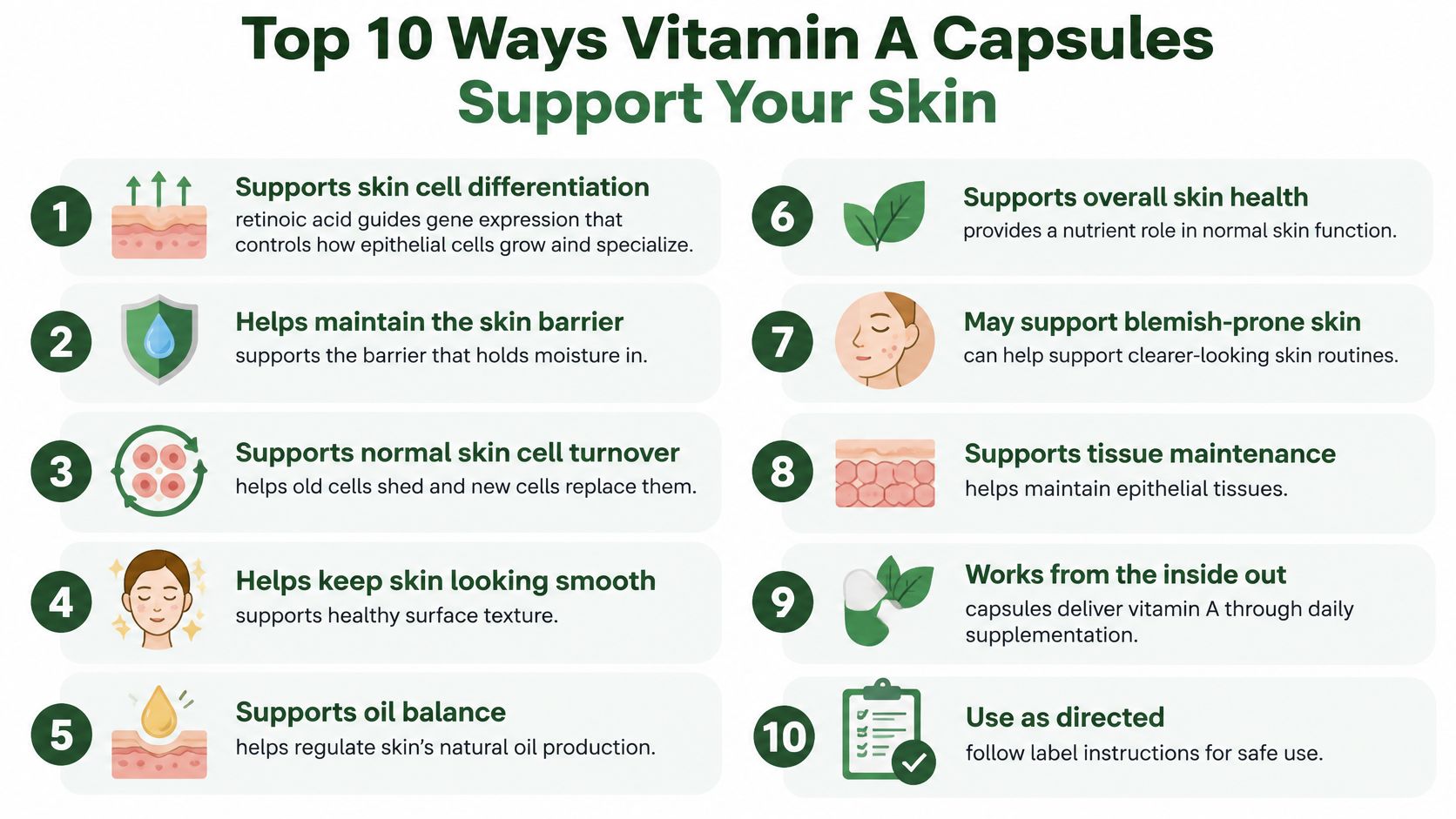
- Supports skin cell differentiation. Retinoic acid guides how epithelial cells grow and specialize into mature surface cells. That's basic skin maintenance, not a cosmetic guarantee.
- Helps maintain the skin barrier. Those specialized cells form the outer barrier that holds moisture in and keeps irritants out. If you're deficient, that barrier suffers first.
- Supports normal epidermal renewal. Your surface cells shed and replace themselves on a steady cycle. Adequate Vitamin A supports that normal pace. It doesn't speed healthy skin beyond normal just because you take extra.
- Aids wound healing after minor damage. Epithelial growth is part of closing and resurfacing damaged tissue. Correcting low status helps that process. Taking more when you're already replete isn't the same claim.
- Supports the immune and inflammatory response in skin. Repair needs immune signaling to coordinate cleanup and rebuilding. Vitamin A participates in that regulation, which is broader than simple cell turnover.
- Corrects dry, rough skin caused by true deficiency. Evidence is strongest here. If dryness comes from cold air, harsh cleansers, or eczema, a capsule won't automatically fix it.
- Supports epithelial linings beyond visible skin. The same tissue type lines your eyes, airways, and gut. Healthy linings there affect comfort and infection resistance, even if you can't see them in a mirror.
- May contribute to collagen related repair. The link is plausible through tissue repair pathways, but evidence for firmer healthy skin from oral Vitamin A alone is limited. Readers comparing nutrients often ask about collagen itself, so our guide to what collagen peptides are and how they work helps separate a protein supplement from a vitamin's role.
- Works best alongside food, not instead of it. Capsules can fill a measured gap, but they don't replace protein, essential fats, or other nutrients your skin uses daily. If you're weighing broader nutritional options for aesthetic wellness, use the same rule and judge each product by form, dose, and need.
- Is not equivalent to prescription retinoids. Oral nutritional Vitamin A shouldn't be presented as a guaranteed cosmetic treatment. Prescription retinoids are drugs with different potency, monitoring, and risks.
Expect maintenance, not transformation. If you're already meeting your daily need, extra Vitamin A doesn't create extra glow. It creates extra exposure.
Daily Vitamin A Targets and Upper Limits
Vitamin A intake by life stage
| Group | RDA (mcg RAE/day) | Upper limit (mcg RAE/day) |
|---|---|---|
| Children 1-3 years | 300 | 600 |
| Children 4-8 years | 400 | 900 |
| Children 9-13 years | 600 | 1,700 |
| Teens 14-18 years, boys | 900 | 2,800 |
| Teens 14-18 years, girls | 700 | 2,800 |
| Adult men, 19 and over | 900 | 3,000 |
| Adult women, 19 and over | 700 | 3,000 |
| Pregnancy | 770 | 3,000 |
| Lactation | 1,300 | 3,000 |
The RDA is the daily target that the majority of adults need. The upper limit is the ceiling for preformed Vitamin A from food and supplements combined, above which harm becomes more likely. The NIH health professional fact sheet on Vitamin A sets that adult ceiling at 3,000 µg RAE per day, and notes it doesn't apply to beta-carotene.
If your label uses IU, convert before you add anything up. 3,000 mcg RAE equals 10,000 IU, so divide an IU figure by about 3.33 to estimate mcg RAE for preformed Vitamin A. Don't skip this step. IU numbers look larger and hide how close you are to the ceiling.
A Worked Example
Say you eat a 3 oz serving of beef liver at lunch. That single food can exceed your daily preformed limit on its own. Add a multivitamin in the morning and a Vitamin A capsule at night, and you've stacked three sources without noticing.
Find your row, total every source for the day, and compare that total with the ceiling. Pregnancy and lactation raise the need, but they don't raise the ceiling.
Who Should Avoid Oral Vitamin A and Why
More isn't better with Vitamin A, and the form on your label decides which risk you're taking. The NIH consumer guidance on Vitamin A warns pregnant or potentially pregnant people against high dose preformed Vitamin A supplements because excess intake can cause birth defects, and it reports beta-carotene supplements aren't recommended for the general population.
Situations that change the risk of Vitamin A capsules
| Situation | Why it matters | Safer step |
|---|---|---|
| Pregnant or may become pregnant | Excess preformed Vitamin A can cause birth defects | Avoid high dose preformed supplements unless a clinician supervises |
| Current smoker | High dose beta-carotene is linked with higher lung cancer risk | Avoid beta-carotene supplements |
| Using topical retinoids | Oral intake adds to total retinoid exposure | Check with a clinician before combining |
| Taking a multivitamin, cod liver oil, or retinoid medicine | Sources stack beyond the upper limit | Add up totals from every label |
| Liver or kidney disease, or a diagnosed deficiency | Dosing needs medical oversight and blood test guidance | Follow a clinician's plan |
Smokers face a different problem from pregnant readers. High dose beta-carotene supplements have been associated with increased lung cancer risk in smokers, even though beta-carotene from foods doesn't carry the same supplement warning. Form and dose both matter.
Topical retinoid users often miss the overlap. Your cream already gives you retinoid exposure, so adding oral preformed Vitamin A raises your total load. Multivitamins and cod liver oil do the same. A dose that looks normal on one bottle can become excessive once you count everything.
No capsule decision is complete until you've checked the form, the dose per serving, and every product you already use.
If you're pregnant, smoking, living with liver or kidney disease, or taking regular medicines, get a clinician's review first. Don't self prescribe around those risks.
Deficiency and Excess Signs to Recognize
Signs You May Be Getting Too Little
- Night blindness: You adjust slowly to dim light or struggle to see at dusk.
- Dry eyes and dry, rough skin: Surface tissues lose normal maintenance. For persistent eye dryness with many possible causes, the Style Site Optical dry eye guide is a useful reminder not to blame one nutrient without an eye exam.
- More frequent infections: Weakened epithelial barriers and immune function leave you more vulnerable.
Severe deficiency can progress to lasting eye damage. That's rare where fortified foods and varied diets are common, but it's why deficiency remains a serious public health issue in some regions. Our overview of common signs of nutrient deficiency can help you sort overlapping symptoms before you guess.
Signs You May Be Getting Too Much
Acute toxicity usually follows one or several very large doses. Watch for severe headache, blurred vision, nausea, dizziness, muscle pain, and poor coordination. Chronic excess builds slowly and can show up as dry skin, bone or joint pain, fatigue, mood changes, and abnormal liver tests.
Two confusions cause needless worry. Orange skin from eating lots of carotenoid rich foods isn't Vitamin A toxicity. It's pigment in skin, and it fades when intake drops. Dryness also has many causes, so don't attribute it to Vitamin A without checking your products, environment, and health history.
Blood retinol helps assess populations, but infection, inflammation, and liver changes can shift your result. Read it with symptoms and history, not alone. Stop the supplement and contact a clinician for persistent symptoms, and seek urgent care for a severe headache with vision changes.
How to Take Vitamin A Capsules Safely
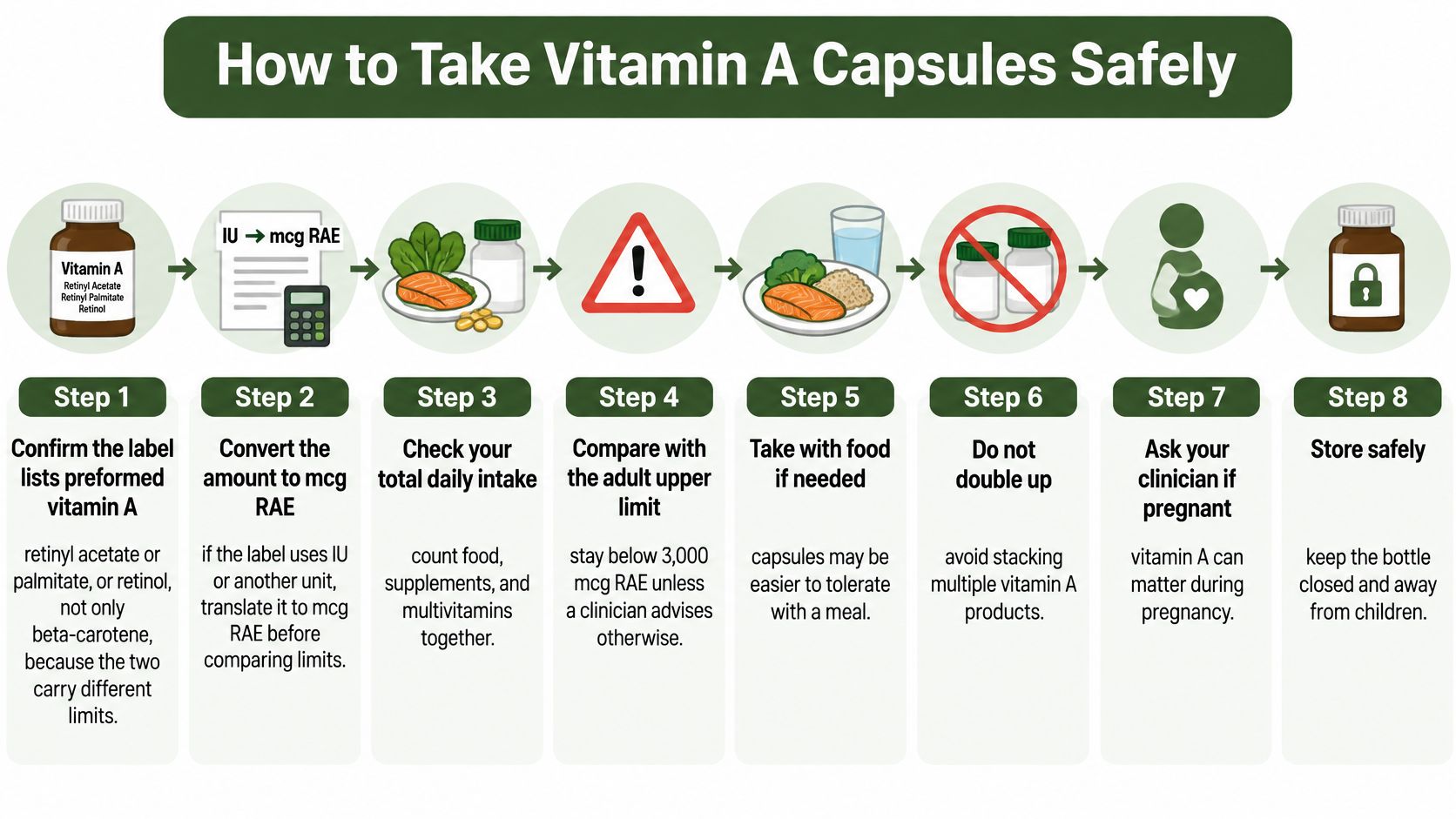
- Confirm the form. Look for retinyl acetate, retinyl palmitate, or retinol if you intend to take preformed Vitamin A. Beta-carotene only products carry different limits.
- Convert to mcg RAE. If the label lists IU, translate it before comparing anything. You can't judge safety in mixed units.
- List every other source. Write down your multivitamin, cod liver oil, liver meals, fortified foods, and retinoid medicines for the same day.
- Total and compare. Add the preformed amounts and keep the adult total below 3,000 mcg RAE unless a clinician advises otherwise.
- Check combinations. Ask a clinician if you use topical retinoids or regular medicines. Timing won't fix an excessive total, though our practical guide on the best time to take vitamins can help you build a tolerable routine once the dose is right.
- Start low and change one thing. Use the lowest labelled dose and one new product at a time, so you can trace any reaction.
- Track for several weeks. Note skin dryness, headaches, eye changes, and pain. Stop and seek advice if vision changes or severe headaches appear.
Decide If Vitamin A Capsules Fit Your Routine
Your Vitamin A total works like a weekly budget: food, a multivitamin, cod liver oil, fortified products, and any capsule all spend from the same allowance. Capsules fit when you are an adult who has added those sources, stays under the 3,000 mcg RAE ceiling, and has no risk factor that needs medical supervision. Skip them when the total is unclear. Wait for a clinician's review if pregnancy, smoking, liver or kidney disease, topical retinoids, or regular medicines apply to you.
A cosmetic goal by itself is a weak reason to swallow more retinoid. Oral Vitamin A can support normal skin function inside your daily needs; prescription or topical retinoids act through different mechanisms and dosing. It cannot stand in for sunscreen, gentle cleansing, adequate protein, or varied meals.
If you pass that check and want a measured preformed option, compare the label amount and form on our USDA Organic Liquid Vitamin A drops against your seven day total before your first dose.
Peak Performance makes USDA certified organic supplements and superfood blends with transparent sourcing and third party lab testing, and every purchase supports our Vitamin Angels partnership supplying a child at risk of malnutrition with vitamins for one year. Visit Peak Performance to review labels and choose only what fits your total.


