


Best Supplements for Workout Recovery
When you nail a tough workout, your job is only half done. The best recovery supplements are designed to give your muscles exactly what they need to repair damage, quiet down soreness, and get you back in the game faster.
Think of them as your post-workout pit crew. You've got superstars like whey protein for lightning-fast muscle repair, creatine monohydrate to top off your energy tanks, and EAAs to get the whole recovery engine started. They’re the key to bouncing back stronger, so your next session is even better than the last.
Why Workout Recovery Is Your Untapped Advantage

Think of your workout as drawing up the blueprint for a stronger body. You push your limits, challenge your muscles, and lay the foundation for growth. But the actual construction—the part where you really get stronger, faster, and more resilient—happens entirely during recovery.
Recovery isn't just about kicking your feet up. It’s an active, biological process where your body gets to work rebuilding and adapting. Every intense training session creates tiny, microscopic tears in your muscle fibers. This isn't a bad thing; it's the signal your body needs to start repairing and reinforcing those fibers, making them tougher than before. This whole process is called muscle protein synthesis (MPS).
The Science of Soreness and Growth
That all-too-familiar ache you feel a day or two after a killer leg day? That’s got a name: Delayed Onset Muscle Soreness (DOMS). It’s a pretty clear sign you’ve pushed your muscles enough to kick off that adaptation process.
But without a smart recovery plan, that good stress can turn against you, leading to frustrating plateaus or even nagging injuries.
Imagine your muscles are like a brick wall. Each workout is like strategically knocking out a few bricks. Effective recovery isn’t just about putting those bricks back—it’s about using stronger, better materials to rebuild the wall, making it more solid for the next challenge.
Without proper recovery, your efforts in the gym are like a construction crew that demolishes a building but never rebuilds it. The true gains are realized when you give your body the tools it needs to build back stronger.
Fueling the Rebuilding Process
This is exactly where targeted nutrition and the right supplements for workout recovery come in. They’re the high-grade materials and skilled crew you need to speed up that rebuilding project. The right supplements make sure your body has a steady supply of amino acids for repair, energy to power the process, and compounds to manage inflammation.
People are catching on. The global market for muscle recovery supplements hit around $695 million in 2025 and is only expected to climb. This isn't just hype; it reflects a deeper understanding that recovery is the key that unlocks your true fitness potential. You can dive into more details on this growing market over at datainsightsmarket.com.
At the end of the day, making recovery a priority transforms it from an afterthought into your most powerful tool.
Top Supplements for Faster Recovery
Here’s a quick look at the most effective supplements for workout recovery, their core benefits, and when to take them for the best results.
| Supplement | Primary Recovery Benefit | Optimal Timing |
|---|---|---|
| Whey Protein | Rapidly delivers amino acids to kickstart muscle repair and growth. | Within 30-60 minutes post-workout. |
| Creatine | Replenishes ATP (energy) stores and reduces muscle cell damage. | Daily, can be taken pre- or post-workout. |
| EAAs & BCAAs | Reduces muscle soreness (DOMS) and decreases exercise-induced fatigue. | Before, during, or immediately after training. |
| Tart Cherry | Contains powerful antioxidants that help lower inflammation and soreness. | Daily, especially on intense training days. |
| L-Glutamine | Supports immune function and helps repair the gut lining after stress. | Post-workout or before bed. |
Choosing the right combination from this list can make a huge difference in how you feel and perform day after day.
Protein: The Foundation of Muscle Repair

If you think of your muscles as a construction site, protein is the truckload of raw materials—the bricks, mortar, and steel beams—that shows up to rebuild everything bigger and stronger than before. It’s the undisputed cornerstone of recovery.
Every tough workout creates tiny micro-tears in your muscle fibers. Protein provides the amino acids your body needs to patch them up. Without enough of it, the whole rebuilding process just stalls out, leaving you sore, tired, and not getting the full return on your effort.
Basically, a hard training session sends out an emergency signal. Protein is the first responder that rushes to the scene to kick off what’s known as muscle protein synthesis. Having enough high-quality protein on hand ensures your repair crew has everything it needs to not only fix the damage but also to reinforce the structure for next time. That’s how you get stronger.
The Fast and Slow Responders: Whey vs. Casein
Not all protein is created equal, especially when it comes to timing. The two main players from dairy, whey and casein, work on completely different timelines, and knowing the difference can make your recovery strategy much more effective.
Whey Protein is your rapid-response team. It’s famous for being digested and absorbed incredibly fast, flooding your muscles with amino acids almost immediately after you drink it. This makes it the go-to choice for that post-workout shake when your muscles are screaming for nutrients.
Casein Protein, on the other hand, is the slow-and-steady overnight crew. It digests at a snail’s pace, forming a gel in your stomach that releases amino acids over several hours. This provides a sustained drip-feed of building blocks, making it a perfect choice right before bed to prevent muscle breakdown while you sleep.
Choosing Your Whey: The Right Tool for the Job
Dive into the world of whey, and you'll see a few different options. They're all processed a bit differently, which changes their purity, how fast they’re absorbed, and what they cost.
- Whey Concentrate: This is the most common, least-processed version. It’s typically 70-80% protein, with the rest made up of some lactose (milk sugar) and fat. For most people, it's a fantastic, cost-effective choice.
- Whey Isolate: This one goes through an extra filtering step to strip out most of the lactose and fat. The result is a purer protein, usually 90% or higher. If you're sensitive to lactose or are watching every last calorie, this is your best bet.
- Whey Hydrolysate: Think of this as pre-digested protein. It’s broken down into smaller pieces (peptides) for the absolute fastest absorption possible. It’s the most expensive of the three, but for elite athletes needing an immediate recovery kick, it can be worth it.
For a much deeper dive, check out our guide on finding the best protein powder for muscle recovery to match the right type to your specific training style.
That "anabolic window"—the old idea that you had a rigid 30-60 minute window to chug a protein shake post-workout—is a lot more flexible than we used to think. While getting protein in after a workout is definitely a good idea, hitting your total daily protein goal consistently is what really moves the needle.
How Much Protein Do You Really Need?
So, what’s the magic number? It really depends on how active you are. Someone who is sedentary doesn't need nearly as much as an athlete who is training hard every day.
As a general rule, active people should aim for 1.2 to 2.0 grams of protein per kilogram of body weight (that’s about 0.5 to 0.9 grams per pound). The key is to spread this intake out across several meals and snacks during the day. This gives your muscles a constant, steady supply of amino acids to work with.
Plant-Based Protein Power
If you're on a plant-based diet, don't worry—you have some seriously good options. Today’s plant-based protein powders are lightyears ahead of the old chalky stuff.
Most top-tier brands now blend several different sources, like pea, rice, and hemp, to create a complete amino acid profile that rivals whey. They deliver the exact same muscle-repairing benefits, so everyone can get the tools they need to recover like a pro.
Creatine Monohydrate: Your Recovery Powerhouse
Most people hear "creatine" and immediately think of building strength and power. And they're not wrong. But what often gets missed is creatine's incredible role in workout recovery. It’s not just about pushing harder during your workout; it’s about rebuilding smarter and faster after your workout.
Think of your body’s energy system like a smartphone battery. Every single thing you do—especially intense exercise—drains that battery. That energy currency is called ATP (adenosine triphosphate). Creatine acts like a high-speed portable charger, helping your cells rapidly regenerate ATP.
This means you feel less gassed between sets, but the real magic happens between training sessions. When your energy stores get topped off quickly, your body can shift its focus to the important stuff: repairing and growing muscle tissue.
How Creatine Speeds Up Muscle Repair
Creatine's recovery benefits go way beyond just refueling your energy tank. It creates the perfect environment inside your muscle cells for healing and getting stronger.
It tackles this from two key angles:
- Boosts Muscle Protein Synthesis: Creatine helps flip the switch on the biological pathways responsible for building new muscle. Essentially, it makes sure the protein you’re eating is put to work more efficiently to repair the damage from your last workout.
- Super-Hydrates Your Muscle Cells: Creatine pulls water into your muscle cells. This is a process called cell volumization, and it does more than just give your muscles a fuller, more pumped look. This hydrated state is inherently anabolic (muscle-building), which helps kickstart repair and prevent muscle breakdown.
By recharging your energy and optimizing your cells for growth, creatine becomes an absolute non-negotiable for anyone who’s serious about bouncing back from tough training.
Decades of research have shown, time and again, that supplementing with creatine leads to greater muscle strength during the recovery process. You don't just heal; you come back measurably stronger for your next session.
Finding the Right Creatine Dose
Getting the most out of creatine is simple. There are two main ways to get your muscles fully saturated, and both work perfectly well. It really just comes down to how patient you are.
- The Loading Phase: This is the fast track. You’ll take a higher dose—typically 20 grams per day—for about 5-7 days. To make it easier on your stomach and improve absorption, you'd split this into four 5-gram servings spread throughout the day. After this initial week, you drop to a smaller maintenance dose.
- The Maintenance Dose: This is the slow and steady approach. Just take a simple 3-5 grams per day, every day. It’ll take longer for your muscles to become fully saturated (around 3-4 weeks), but you’ll get to the exact same place in the end. This method is often preferred by people with sensitive stomachs.
No matter which path you choose, consistency is king. Taking your creatine daily keeps those muscle stores full, ensuring you get all the recovery benefits, day in and day out. For a highly pure and effective option, our Peak Performance Creapure Creatine Monohydrate Powder is engineered for maximum absorption and results.
A Safe and Studied Supplement
Creatine monohydrate isn't some new, trendy supplement. It's one of the most heavily researched and scientifically validated sports supplements on the planet. Its safety and effectiveness have been proven over and over for everyone from elite athletes to weekend warriors.
With such a strong safety record, you can add it to your daily routine with confidence. By helping your body manage energy and rebuild more efficiently, creatine has more than earned its spot as one of the best recovery supplements you can get.
BCAAs and EAAs: The Amino Acid Advantage
If you think of protein as the complete set of building materials for muscle repair, then amino acids are the individual, specialized tools in that kit. While your body needs a whole workshop full of them, a few are absolutely critical for kicking off the recovery process.
This is where Branched-Chain Amino Acids (BCAAs) and Essential Amino Acids (EAAs) steal the spotlight. These aren't just passive building blocks; they are active signalers that tell your body when to start rebuilding. That distinction is everything when it comes to a smart recovery strategy.
Leucine: The Ignition Key for Muscle Growth
Among all the amino acids, one reigns supreme as the primary trigger for muscle repair: leucine. It’s one of the three BCAAs, along with isoleucine and valine.
Picture your body’s muscle-building machinery as a high-performance engine. It has all the potential in the world, but it won’t do a thing until you turn the key. Leucine is that key.
When leucine hits your bloodstream after a workout, it directly activates a powerful pathway called mTOR, which is basically the master switch for muscle protein synthesis. It’s the biochemical equivalent of telling your body, "Alright, the damage is done. Time to stop breaking down tissue and start building it back bigger and stronger."
BCAA vs. EAA: Which Is Better for Recovery?
For a long time, BCAAs were the undisputed king of intra-workout and post-workout drinks. And for good reason—they’re great at taking the edge off muscle soreness and helping you push through the mental fog of a long, grueling session.
But the science and the conversation have evolved. While leucine (a BCAA) is the key that starts the engine, you still need the spark plugs, pistons, and fuel to actually build horsepower. Those other parts are the rest of the Essential Amino Acids (EAAs).
BCAAs are like having the foreman and two elite carpenters on a construction site. They can direct the work and handle key tasks. A full EAA profile is like having the entire skilled crew show up, ensuring every single job gets done correctly and completely.
Here’s the bottom line: your body needs all nine essential amino acids to synthesize new muscle protein. If even one is missing, the whole process grinds to a halt. A BCAA supplement gives you just three. An EAA supplement gives you all nine, including the BCAAs, making sure the construction site is fully staffed and ready to build.
To get a full rundown on these critical nutrients, check out our in-depth guide on the 9 essential amino acids supplement and what each one does.
The demand for these ingredients is exploding for a reason. The global sports supplements market, valued at around $25.3 billion in 2025, is on track to hit a massive $43.6 billion by 2032. You can discover more insights about sports supplement market trends to see just how much this space is growing.
Making the Right Choice for Your Goals
So, which one should you choose? It really comes down to your diet and your specific needs.
- Choose BCAAs if: Your diet is already packed with high-quality, complete protein (think whey, meat, and eggs) and you mainly want something to sip on during your workout to fight fatigue and preserve muscle.
- Choose EAAs if: You want a complete insurance policy for muscle repair. They ensure your body has every single tool it needs, right when it needs them, which is especially useful if your post-workout meal isn't perfectly timed.
Ultimately, for maximizing recovery, a full spectrum of EAAs is the more robust strategy. It guarantees that when leucine turns the key in the ignition, the entire engine roars to life, ready to get to work.
Beyond Protein: Carbs and Micronutrients for Real Recovery
Protein and amino acids get all the glory, but a truly effective recovery plan goes much deeper. Think of it like this: if protein is the crew that rebuilds your engine after a race, carbs are the high-octane fuel, and micronutrients are the specialized lubricants and coolants that keep everything running smoothly.
Without all the pieces in place, your performance is going to stall out. To really optimize how you bounce back, you need to complete the puzzle.
Carbohydrates: Fuel for Your Engine
Your muscles store energy in a "fuel tank" of sorts, filled with something called glycogen. Every time you hit a grueling workout—whether it's lifting, sprinting, or crushing a HIIT session—you're draining that tank.
After you're done, that tank is on empty. That's a big part of why you feel wiped out. The first order of business for recovery is to fill it back up, and fast.
This is where fast-digesting carbohydrates come in. They get into your system quickly, spiking insulin, which acts like a key to unlock your muscle cells. This allows not just glucose, but all those important amino acids from your protein to flood into the muscles where they're needed most.
Skipping carbs after a workout is like telling a race car driver to win the next lap on an empty tank. It doesn't matter how powerful the engine is if it has no fuel.
Taming Inflammation for Faster Healing
Let's be clear: a little inflammation after a workout is a good thing. It’s the signal that tells your body to start the repair process. The problem is when that inflammation gets out of control, leading to excessive soreness that keeps you out of the gym longer than necessary.
This is where specific micronutrients with anti-inflammatory properties can be game changers. They help manage the inflammatory response so you can heal efficiently without the extra pain.
Two of the heavy hitters are:
- Tart Cherry Extract: This stuff is loaded with powerful antioxidant and anti-inflammatory compounds. Studies have consistently shown that tart cherry can seriously cut down on muscle pain and the loss of strength that follows a tough workout.
- Omega-3 Fatty Acids: Best known from fish oil, these healthy fats are pros at fighting inflammation all over the body. Taking them consistently not only helps with post-workout soreness but also supports your joint health for the long haul.
Beyond supplements, digging into natural methods for reducing inflammation can give your body an even bigger advantage. A holistic approach is almost always the winning strategy.
Electrolytes: The Unsung Heroes of Recovery
They aren't as sexy as protein or creatine, but electrolytes are the true unsung heroes of muscle recovery. These critical minerals—especially magnesium, potassium, and sodium—are the foundation for how your muscles work.
You lose a ton of them through sweat. Even a small deficit can lead to muscle cramps, fatigue, and dehydration. And proper hydration isn't just about water; it's about getting this mineral balance right.
Here's why they're so critical:
- Magnesium: Think of magnesium as the muscle relaxation mineral. It's involved in both contraction and, crucially, relaxation. With estimates that nearly 50% of the U.S. population is deficient, adding magnesium can be a simple fix for preventing cramps and improving repair.
- Potassium: This mineral works hand-in-hand with sodium to manage fluid balance and nerve signaling. It ensures the electrical impulses telling your muscles what to do are firing correctly.
Topping off your electrolyte stores after training keeps your muscles hydrated, functioning properly, and far less likely to cramp up. They're a simple, non-negotiable part of any serious recovery stack.
Building Your Personal Recovery Stack
Alright, you know the major players. Now it's time to build your own team. Creating an effective supplement stack isn't about grabbing everything off the shelf and hoping for the best. It's about being strategic—choosing the right tools for your specific goals, training load, and let's be real, your budget.
Think of it this way: supplements are there to enhance the hard work you’re already putting in. They support a solid foundation of consistent training, smart nutrition, and quality sleep, but they never replace it. The best approach is to start with the essentials and then thoughtfully add other components based on how your body responds and what your performance demands.
This decision tree gives you a great visual starting point based on what you're training for.
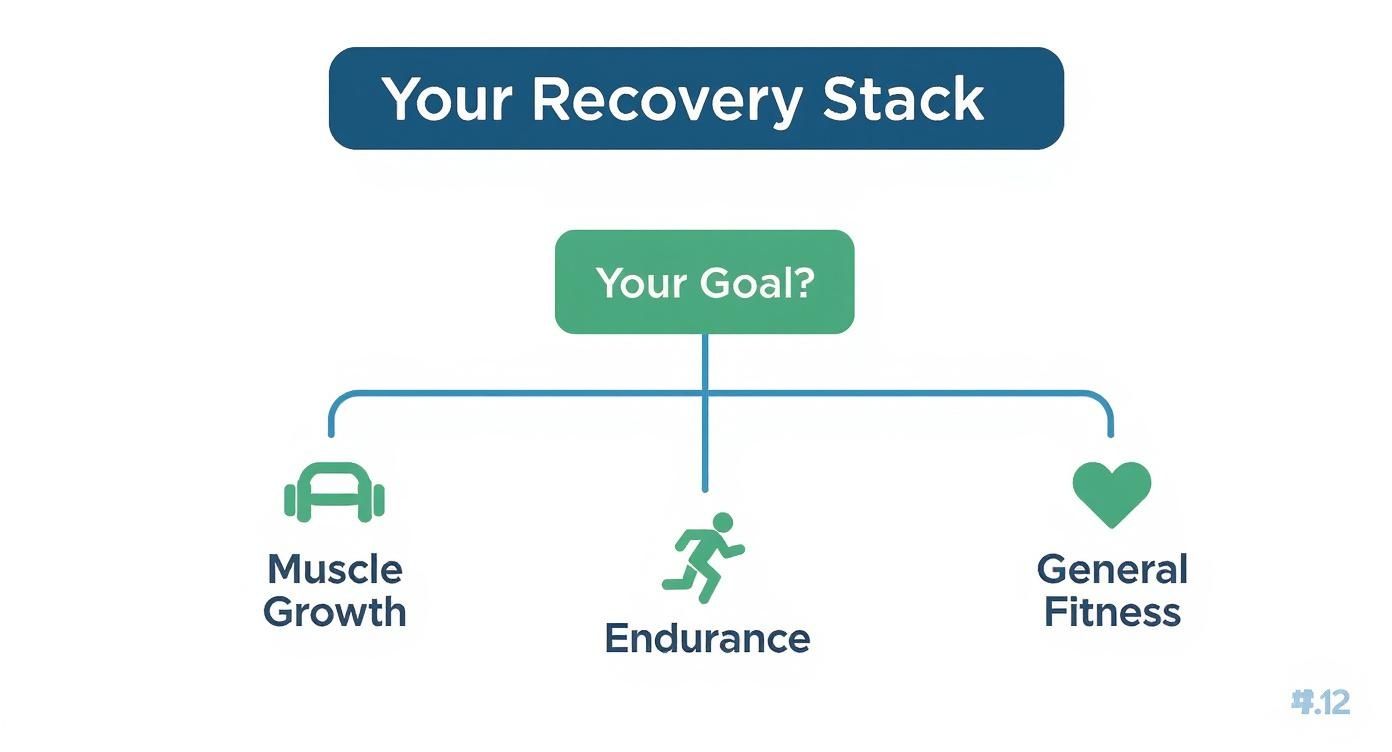
As you can see, the foundation is pretty consistent, but the emphasis shifts whether your main goal is building muscle, pushing endurance, or just overall wellness.
Tailoring Your Stack to Your Goals
Your stack should be a reflection of your unique needs. Someone gearing up for a marathon has completely different recovery demands than someone trying to hit a new squat PR. Here are three sample blueprints to give you an idea of how to match your stack to your goals.
1. The Foundational Stack (For the General Fitness Goer)
This is perfect for anyone who trains consistently to stay healthy, strong, and feel good. It covers the essential bases without getting too complicated.
- Whey Protein: One scoop right after your workout to get the muscle repair process started.
- Creatine Monohydrate: A daily 5-gram dose keeps your energy stores topped off and supports lean muscle.
- Magnesium: Take it before bed to help your muscles relax and seriously improve your sleep quality.
2. The Muscle Growth Stack (For the Strength Enthusiast)
This one is for those focused on packing on muscle and getting stronger. We’re adding a few things to maximize muscle protein synthesis and prevent breakdown.
- Whey Protein: One scoop immediately post-workout.
- Casein Protein: A scoop before bed provides a slow, steady drip of amino acids overnight.
- Creatine Monohydrate: A consistent 5 grams daily is non-negotiable for fueling powerful lifts.
- EAAs: Sip on these during your workout to fight muscle breakdown and keep soreness at bay.
3. The Endurance Stack (For the Athlete)
Here, the priority is refueling glycogen, managing inflammation, and supporting your joints so you can handle high-volume training day after day.
- Whey Protein & Fast-Digesting Carbs: A 2:1 carb-to-protein shake post-workout is clutch for rapidly restocking glycogen.
- Tart Cherry Extract: Taking this daily helps keep exercise-induced inflammation and soreness in check.
- Electrolytes: Add to your water during and after long sessions to stay hydrated and ward off cramps.
The effectiveness of these strategies is reflected in the market itself. The global post-workout supplements industry is on track to hit $21.26 billion in 2025, a clear sign that people are serious about optimizing their recovery. If you're someone dealing with a lot of high-impact training, you might also look into supplements that boost collagen production to give your joints and connective tissues some extra love.
Your Questions Answered
Diving into recovery supplements can feel a bit overwhelming, so let's tackle some of the most common questions that come up.
If I Eat a Healthy Diet, Do I Really Need Supplements?
This is a great question. Think of your diet as the solid foundation of a house—it's absolutely essential. Supplements are the specialized tools you bring in to do a specific job faster and more efficiently.
While whole foods are king, they can't always deliver a high dose of specific nutrients, like whey protein or creatine, right when your muscles are screaming for them post-workout. Supplements give you a concentrated, targeted shot of what you need, precisely when you need it, which can dramatically speed up the recovery process.
Can I Mix and Match Different Recovery Supplements?
You bet. In the fitness world, we call this "stacking," and when done right, it’s a powerful strategy.
For instance, combining protein for muscle repair with simple carbs to restock your glycogen stores in a single post-workout shake is a classic, effective stack. The trick is to be smart about it—build a stack where the ingredients work together to support your specific goals, rather than just throwing a bunch of random products into the mix.
How Long Before I Actually See Any Results?
Patience and consistency are your two best friends here. While you might feel a difference in muscle soreness within the first week of using something like tart cherry, the real magic happens over time.
For supplements like protein and creatine that build strength and muscle, you're playing the long game. Give it a solid 4-6 weeks of consistent use, and you'll start to see tangible improvements in your strength, how quickly you bounce back, and your overall performance.
Ready to stop feeling sore and start building strength? Peak Performance delivers a full line of clean, potent supplements designed to get you back in the gym faster. Check out our premium formulas and find the right tools to maximize your hard work at https://buypeakperformance.com.
Also in Blog


How to Increase Stamina Naturally and Boost Energy


How to Increase Energy Naturally

