


Best Time to Take Vitamins: Maximize Benefits & Absorption
So, what’s the best time to take your vitamins? The short answer is: it depends entirely on the vitamin.
The big divide is between fat-soluble vitamins (like A, D, E, and K), which you should always take with a meal that has some fat in it, and water-soluble vitamins (like B-complex and vitamin C), which are usually best on an empty stomach with a glass of water.
Your Quick Guide to Vitamin Timing

Figuring out when to take your vitamins can feel unnecessarily complicated, but the core idea is actually pretty simple. It all boils down to how your body absorbs different types of nutrients.
Think of it as setting the stage for your supplements to do their best work. Taking them at the right time and in the right conditions ensures you’re not just swallowing pills, but actually absorbing and benefiting from them.
This guide is your cheat sheet to get started. We'll give you the quick, actionable advice you need to build a better routine right away. Once you nail these basics, you’re well on your way to a smarter supplement strategy.
The Two Golden Rules of Timing
At its heart, vitamin timing really comes down to just two main categories: those that need food and those that don't. Getting this right is the single most important factor.
-
Rule 1 - Take with Fat: Fat-soluble vitamins absolutely require dietary fat to be absorbed into your system. Taking them alongside a meal with healthy fats—think avocado, nuts, olive oil, or fatty fish—is non-negotiable if you want them to work.
-
Rule 2 - Take with Water: Water-soluble vitamins dissolve in, you guessed it, water. They get absorbed directly and are generally best taken on an empty stomach, since food can sometimes get in the way of their uptake.
For a quick reference, here’s a simple table that lays out these core principles.
At-a-Glance Vitamin Timing Guide
This little chart is perfect for a quick reminder of the "what" and "why" behind proper vitamin timing.
| Vitamin Type | Best Time to Take | Key Reason |
|---|---|---|
| Fat-Soluble | With a meal containing fats (e.g., lunch or dinner). | These vitamins (A, D, E, K) need dietary fat for your body to absorb and utilize them effectively. |
| Water-Soluble | On an empty stomach, 30 minutes before a meal or 2 hours after. | These vitamins (B-complex, C) dissolve in water and are absorbed best without food competition. |
With this foundational knowledge, you can stop just taking supplements and start strategically timing them for a much bigger impact on your health.
Fat-Soluble vs. Water-Soluble Vitamins Explained
To really get your supplement routine dialed in, you first need to understand the two families of vitamins. Think of it like trying to mix oil and water—they just don't play well together, and your body handles these two types of vitamins in a similarly distinct way. Nailing this core difference is what determines the best time to take vitamins to actually see the benefits.
Vitamins fall into two camps: fat-soluble and water-soluble. Each group gets absorbed, used, and stored completely differently by your body. Getting this right is the first and most critical step in making your supplements work for you, not against you.
The Special Keys: Fat-Soluble Vitamins
The fat-soluble crew includes vitamins A, D, E, and K. The easiest way to think about them is as special keys that can only unlock doors in your body with the help of fat. If there's no dietary fat around, these keys can't get into the lock, and all their potential benefits stay out of reach.
This is exactly why you must take fat-soluble vitamins with a meal that contains some healthy fats. When you eat something like avocado, a handful of nuts, or even just some olive oil, it signals your body to release the enzymes and bile needed to break down those fats. The vitamins essentially hitch a ride on these fat molecules, which allows them to pass through your intestinal wall and get into your bloodstream where they can do their job.
Because they get stored in your body's fatty tissues and liver, you don't need to top them off as often as the water-soluble kind. But that storage capacity also means you can build up too much of a good thing, so sticking to the recommended dosages is important. If you want to dive deeper, our guide on how to get the vitamin D you need as we head into winter has a lot more detail on this crucial fat-soluble nutrient.
This infographic breaks down a simple way to start your day with the right nutrients.
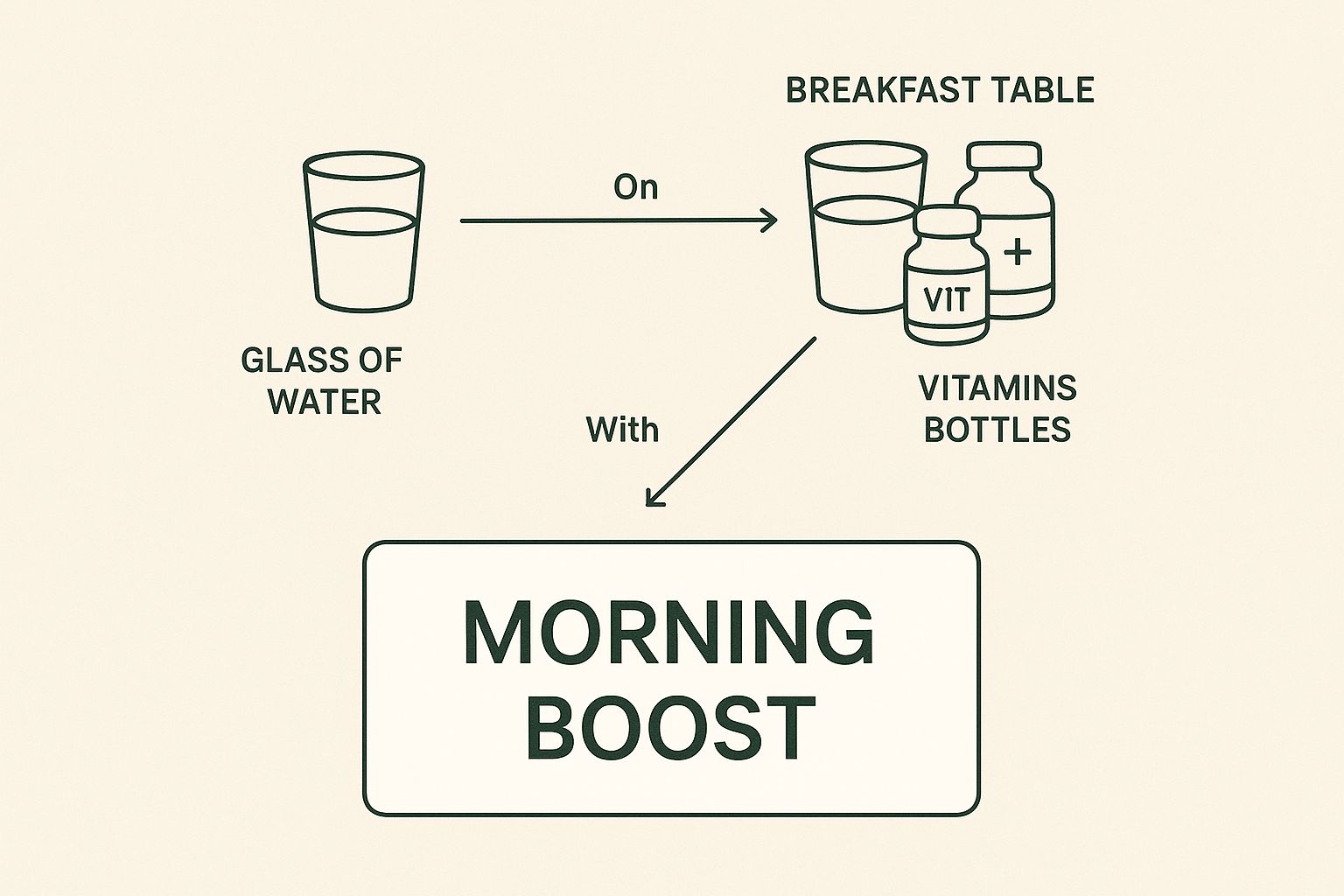
As the image shows, a healthy breakfast can be the perfect time to get certain supplements in, setting the tone for the rest of your day.
The Fast Pass: Water-Soluble Vitamins
On the other side of the coin are the water-soluble vitamins: Vitamin C and the entire B-complex family (think B12, B6, and folate). Unlike the fat-soluble keys, these guys don't need a special escort. They dissolve directly in water, meaning they get absorbed into your bloodstream fast—often best on an empty stomach.
Your body uses what it needs from water-soluble vitamins and then excretes the rest through urine. It doesn't keep a reserve, which means you need a consistent daily supply to maintain optimal levels.
This "use it or lose it" reality has a couple of big implications for your supplement timing:
- Timing is Flexible but Consistency is Key: Since they’re absorbed so quickly, taking them first thing in the morning with a glass of water, about 30 minutes before you eat, is usually a great strategy.
- Splitting Doses Can Be More Effective: For certain vitamins like Vitamin C, taking smaller doses a few times a day can keep your blood levels more stable than one single mega-dose.
Once you understand this fundamental oil-and-water difference, you’re no longer just guessing. You're making smart, informed choices about when and how to take your vitamins to get the absolute best results.
Getting the Most Out of Your Fat-Soluble Vitamins

When it comes to your fat-soluble vitamins—that’s A, D, E, and K—there's one simple, non-negotiable rule you have to follow: they need fat to be absorbed.
Think of these vitamins like a key, but your bloodstream is the lock. Dietary fat is the hand that turns the key. Without it, the key just sits there, unable to do its job.
This isn’t just a helpful tip; it's basic biology. When you eat fats, your body gets the memo and releases bile and special enzymes. These guys break down the fats and bundle up the vitamins inside them into little packages called micelles, which can finally pass through your intestinal wall.
This is exactly why popping your vitamin D pill with a glass of water first thing in the morning isn't doing you many favors. That vitamin has no ride into your system, so most of it just passes right through.
Smart Food Pairings for Better Absorption
So, what does this actually look like day-to-day? It's way simpler than it sounds. You just need to pair your supplement with a meal or snack containing some healthy fats. You don't need a huge, greasy meal, either—even a small amount makes a massive difference.
Here are a few easy ways to make it happen:
- Avocado Toast: The healthy monounsaturated fats in avocado are the perfect partner for your morning vitamins.
- A Handful of Nuts: Almonds, walnuts, or a spoonful of chia seeds are a quick and easy source of fat to take with your vitamin E.
- Salad with an Olive Oil Vinaigrette: That drizzle of olive oil does more than add flavor; it ensures you absorb the vitamins A and K from your greens and your supplement.
- Full-Fat Yogurt or a Smoothie: Tossing your vitamins in with some full-fat yogurt or adding a scoop of nut butter to your smoothie is a brilliant strategy.
Thinking about the best time to take vitamins often comes down to your meal schedule. Since lunch and dinner are typically our largest meals, they naturally become the most effective windows for taking your fat-soluble supplements.
The Science Doesn't Lie
The difference a little fat makes isn't small—it's huge. Study after study confirms that the context of your supplement matters.
For example, one fascinating piece of research found that vitamin E absorption was all over the place depending on how it was consumed. When people took a vitamin E pill with skim milk, their blood levels barely moved. But when that same vitamin was part of a fortified cereal, absorption went through the roof. It’s a powerful reminder that a whole-food delivery system is just better. You can read the full research about these vitamin E findings for yourself.
The takeaway is simple: Taking your fat-soluble vitamins with food isn't just a pro-tip—it's the only way to unlock their full power. With one tiny tweak to your routine, you can finally get the full value out of the supplements you’re paying for.
Timing Your Water-Soluble Vitamins
Alright, let's switch gears and talk about the B-complex vitamins and Vitamin C. These guys play by a completely different set of rules than their fat-soluble friends.
Unlike the fat-loving vitamins, water-soluble ones dissolve right in water. This means they don't need a fatty meal to get absorbed into your system. In fact, taking them with food can sometimes just slow things down.
Think of it like an express lane at the supermarket. For these vitamins, an empty stomach is that express lane—it lets them get absorbed quickly and directly into your bloodstream without any traffic from a big meal you're digesting. This is why the best time to take vitamins like B and C is usually first thing in the morning with a glass of water, about 30 minutes before breakfast.
This simple strategy lets your body grab them and put them to use immediately, which is a huge advantage, especially when it comes to the B vitamins.
Kickstart Your Day with B Vitamins
The B-complex family—think B6, folate, and B12—is legendary for its role in energy metabolism. These vitamins are the spark plugs that help your body turn food into usable, cellular fuel.
Taking them in the morning lines up perfectly with your body's natural rhythm. You're basically giving your system the tools it needs for energy production right as your day is getting started.
On the flip side, taking B vitamins at night is generally not the best idea. Because they're so involved in creating energy, some people find that a late-day dose can mess with their ability to wind down and get a good night's sleep.
A morning routine for B vitamins is a simple yet powerful way to support your energy levels throughout the day, ensuring you're getting the most out of their metabolic benefits without disrupting your sleep.
It's all about working with your body's natural clock, not against it.
The Power of Divided Doses
Here's another crucial thing about water-soluble vitamins: your body doesn't store them. It uses what it needs right away and then flushes out the rest through your urine.
Because of this "use it or lose it" system, slamming one single, massive dose isn't very effective. A good chunk of it could end up being wasted before your body even has a chance to absorb it all.
This is where divided doses become a game-changer. By splitting your total daily amount into smaller portions throughout the day, you help maintain more stable levels of these vitamins in your bloodstream.
For example, instead of one giant 1,000 mg dose of Vitamin C, taking two 500 mg doses—one in the morning and another in the early afternoon—is far more efficient.
The same idea applies to B vitamins. Vitamin B12, in particular, is absorbed much better in smaller, divided doses than all at once. If you want to dive deeper into how your body absorbs different nutrients, this piece on vitamin bioavailability from Cleveland Clinic is a great resource. This approach ensures your body has a steady supply to pull from all day long.
Building Your Personal Vitamin Schedule
Alright, let's turn all this theory into a practical, real-world plan. Knowing when to take your vitamins is one thing, but making it fit into your unique daily rhythm is where the magic happens. A perfect schedule is one you can actually stick with, whether you work a traditional 9-to-5, do shift work, or practice intermittent fasting.
Creating a personal vitamin schedule means taking an honest look at your day and finding the best windows of opportunity for absorption. It’s all about syncing your supplements with your meals, your energy needs, and even your sleep cycle to get the most out of every single capsule.
Creating Your Daily Blueprint
Let's design a simple, effective schedule. The core idea is to pair energizing vitamins with your morning and fat-soluble vitamins with your largest meal. That simple structure forms a rock-solid foundation, no matter what your lifestyle looks like.
A typical day might kick off with B-complex vitamins to fuel your morning and wind down with magnesium to help you relax before bed. This approach works with your body's natural clock, not against it.
Key Takeaway: The goal here is consistency over complexity. A simple, well-timed schedule you follow every single day is far more powerful than a complicated one you keep forgetting.
Let’s dig into what this looks like for a few different routines.
Sample Daily Vitamin Schedules
Your daily grind dictates the best timing for your supplements. We've put together a few examples in the table below to help you map out a personalized plan that works for you. Think of these as templates you can tweak to fit your own life.
| Time of Day | Traditional 9-to-5 Routine | Intermittent Fasting (16:8) Routine |
|---|---|---|
| Morning | Take B-Complex & Vitamin C on an empty stomach to kickstart your energy for the day ahead. | Take B-Complex & Vitamin C with water before your eating window starts to support energy while fasting. |
| Midday / First Meal | Take Vitamin D & K2 with your lunch, making sure it has some healthy fats for optimal absorption. | Take all Fat-Soluble Vitamins (A, D, E, K) with your first meal to ensure they're paired with dietary fat. |
| Afternoon | An Iron Supplement (if needed) is best taken between meals to avoid competing with other minerals. | Take Iron or other minerals at least two hours after your first meal to maximize their uptake. |
| Evening / Last Meal | Take Magnesium & Probiotics with dinner or right before bed to support relaxation and gut health. | Take Magnesium after your last meal of the day to promote restful, deep sleep. |
These are just starting points, of course. The key is to find the rhythm that feels effortless and becomes a natural part of your day.
Navigating Crucial Nutrient Interactions
Just as important as when you take your vitamins is what you take them with. Some nutrients are like competitive siblings—they fight for absorption in your body, meaning taking them together can make both of them less effective.
The classic example is the rivalry between calcium and iron. They use the same absorption pathways, so taking them at the same time is like sending two trains down a single track—it just creates a traffic jam. To avoid this, take your iron supplement at least two hours apart from any calcium-rich foods or supplements.
Other minerals can get in each other's way, too. High doses of zinc, for example, can interfere with copper absorption over time. If you’re supplementing with specific minerals, like a top iodine supplement for optimal thyroid health, it’s smart to space them out from other major minerals.
As you build out your routine, it can be helpful to see what else is out there; looking into options like top Japanese health supplements can offer a wider perspective. By being mindful of these interactions, you ensure every nutrient gets the best possible chance to do its job.
Other Factors That Influence Vitamin Absorption
Figuring out the best time to pop your vitamins goes way beyond just timing them with meals. Your body is an incredibly complex machine, and a handful of personal factors can totally change how well you absorb nutrients.
It’s not a passive process. Think of it more like an active, managed system run by your body's own internal logic.
Your age, for instance, plays a huge role. As we get older, our digestive systems often become less efficient. That can mean lower stomach acid production, which is a big deal for absorbing key minerals like calcium and vitamin B12.
Your Gut Health and Cellular Pathways
The health of your gut is probably one of the most important pieces of the puzzle. A happy, balanced gut microbiome creates the perfect environment for nutrient absorption to happen.
If your gut is out of whack, your ability to pull vitamins and minerals from both food and supplements can take a nosedive. For anyone focused on digestive wellness, our guide on 8 surprising wormwood uses and benefits for detox and cleansing might be worth a look.
On a much deeper level, absorption is controlled by some pretty sophisticated cellular machinery. These internal pathways can ramp up or slow down depending on what your body needs—and even your age.
For example, biotin (vitamin B7) absorption can actually get better as we age because the body learns to activate more of the specific transporters that pull it in. It's a fascinating glimpse into how our bodies adapt, as you can see in this scientific review.
This cellular-level control means absorption isn't just about what you eat, but also about your unique internal physiology. Two people could follow the exact same supplement schedule and experience different results.
Medications and Health Conditions
Finally, certain health conditions and medications can throw a wrench in things. Common acid-reducing drugs, for example, can get in the way of absorbing vitamin B12 and magnesium. Likewise, any condition that affects the digestive tract can create major absorption roadblocks.
This is exactly why a one-size-fits-all approach to vitamin timing just doesn't work.
Consulting a healthcare provider is essential to build a plan that’s tailored to your unique health profile. That's the only way to ensure your supplement routine is both safe and actually doing its job.
Common Questions About Vitamin Timing
Even with a solid plan, you're bound to have some questions. It's totally normal. Let's dig into a few of the most common ones we hear to help you get your routine dialed in.
Can I Just Take All My Vitamins at Once?
I get it, tossing everything back at once is tempting and definitely convenient. But it’s not the best move for getting the most out of your supplements.
Fat-soluble and water-soluble vitamins are like two different kinds of guests—they have completely different needs. One group needs a meal with some fat to show up, while the other prefers to arrive on an empty stomach. If you throw them all in at the same time, you’re pretty much guaranteeing that one group won't get absorbed properly.
What If I Forget to Take My Vitamin D with a Meal?
First off, don't sweat it. Life happens.
If you miss that perfect window, just take it with your next meal. Even a snack with some healthy fat—like a handful of almonds or a slice of avocado—will do the trick. Taking it a little late with some food is way better than taking it on an empty stomach, where most of it will just go to waste.
The most important thing is pairing fat-soluble vitamins with fat. Consistency over perfect timing is key, so just aim for the next available opportunity.
Should I Take My Multivitamin in the Morning or at Night?
For most people, the morning is going to be your best bet.
Multivitamins are often packed with B-complex vitamins, which play a big role in your body's energy production. Taking them in the morning helps fuel your day. Pop them at night, and you might find they mess with your ability to wind down and get to sleep.
At Peak Performance, we create supplements designed to fit seamlessly into your life, helping you get the most out of every single nutrient. Explore our USDA Organic formulas to build a routine that works for you. Learn more at Peak Performance.
Also in Blog


How to Increase Stamina Naturally and Boost Energy


How to Increase Energy Naturally

