


Calcium Vitamin D3 and K2 for Bone and Heart Health
When it comes to your health, calcium, Vitamin D3, and K2 is the ultimate dream team. They work in perfect concert, kind of like a specialized construction crew for your bones and heart, where every member has a critical, non-negotiable job to do.
The Synergy That Builds Stronger Bones
Building a rock-solid skeleton isn't just about piling on more of one material—it’s about working smarter. Just chugging milk or popping calcium pills is only step one. For your body to actually use that calcium, it needs a sophisticated support system to get it absorbed and sent to the right address. This is where the powerful partnership between calcium, D3, and K2 truly shines.
Let's stick with the construction analogy. Think of calcium as the bricks—the raw material you absolutely need for strength. But a pile of bricks sitting on the curb is useless. You need a way to get them inside the job site.
How Vitamin D3 Acts as the Gatekeeper
This is where Vitamin D3 comes in. It’s essentially the security guard for your intestines, holding the keys to the gate. D3's main job is to unlock that gate, allowing calcium to move from your gut into your bloodstream where it can be put to work.
Without enough D3, most of the calcium you eat just passes right through you. It's a missed opportunity. In fact, research shows that having adequate vitamin D can boost your calcium absorption by a staggering 30% to 40%.
- Calcium: The essential building block for your skeleton.
- Vitamin D3: The gatekeeper that gets calcium into your bloodstream.
- Vitamin K2: The traffic cop that directs calcium to your bones and away from your arteries.
This is the whole process in a nutshell.
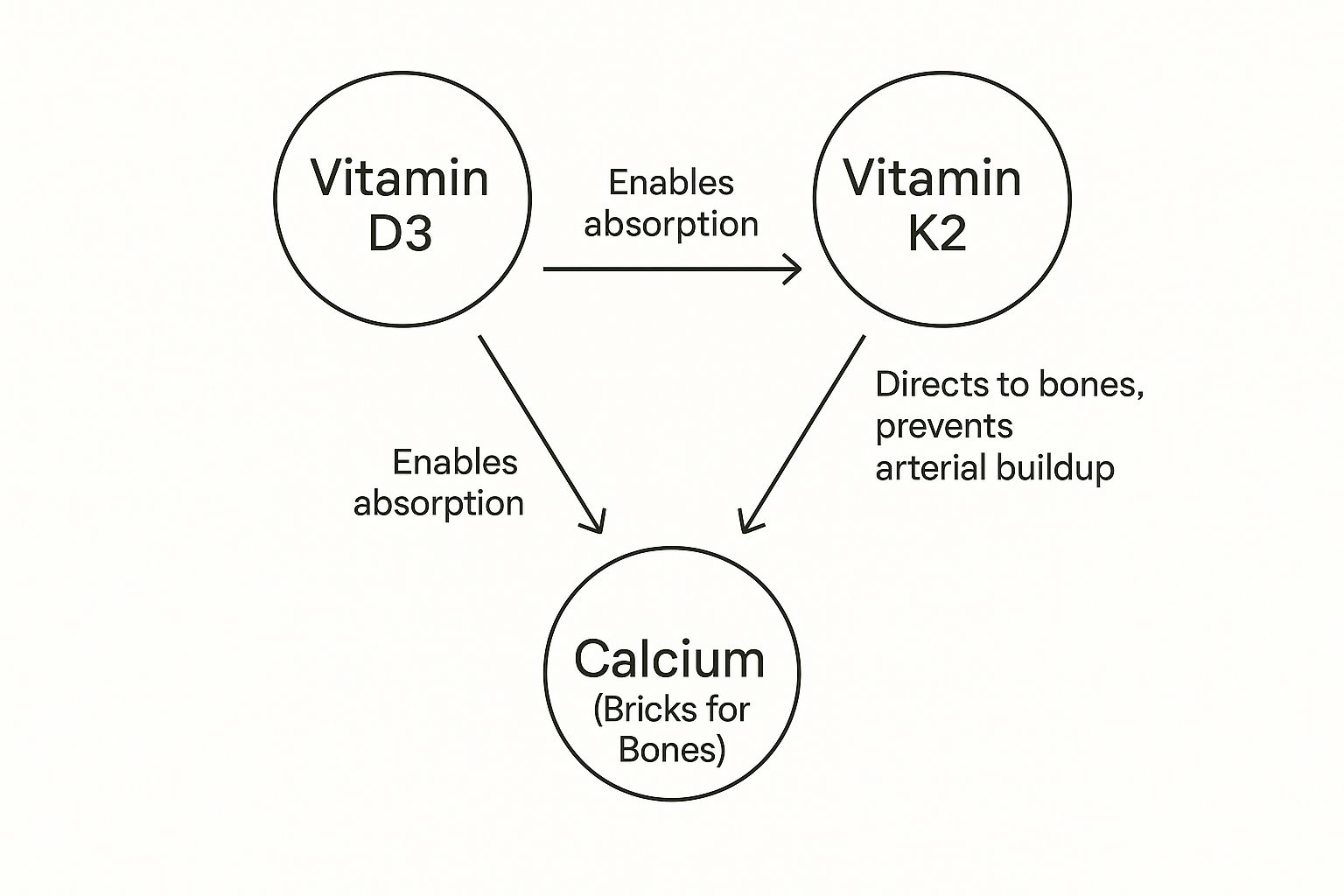
As you can see, D3 gets the calcium on board, but K2 is the one telling it where to go. They're completely dependent on each other to get the job done right.
Why Vitamin K2 is the Project Manager
Once D3 gets calcium into the bloodstream, Vitamin K2 takes over as the project manager, and its role is arguably the most crucial for your long-term health. K2 essentially activates a GPS system for calcium, making sure it goes directly to your bones and teeth.
Vitamin K2 does this by "switching on" two key proteins. First, it activates osteocalcin, which acts like glue, binding calcium into your bone matrix. At the same time, it activates Matrix Gla Protein (MGP), which is a powerful inhibitor of calcification in your soft tissues, like your arteries.
This one-two punch is what makes the calcium, Vitamin D3 and K2 trio so brilliant. It’s not just about building strong bones. It’s also about actively protecting your cardiovascular system from arterial calcification—the dangerous buildup of calcium that can make arteries hard and brittle.
This incredible synergy ensures the right nutrient gets to the right place, for the right reason.
Understanding Calcium: The Foundational Mineral

When you hear "calcium," your mind probably jumps straight to strong bones and teeth. And you're not wrong—about 99% of your body's calcium is stored right there in your skeleton. But this mineral is so much more than just a building block.
Think of calcium as your body’s master switch. It’s the spark that lets your nerves fire, your muscles contract, and your blood clot when you get a cut. Without it, these basic life-sustaining processes would simply stop. Your heart wouldn't beat and your brain couldn't send signals.
It's such a big deal that your body obsessively keeps the calcium levels in your blood within a razor-thin, non-negotiable range. It's a matter of minute-to-minute survival.
The Body's Calcium Balancing Act
So what happens if you don't get enough calcium in your diet? Your body has a brilliant, if a bit ruthless, backup plan. It turns to its own internal "calcium bank": your bones.
If blood calcium dips, your body releases hormones that signal your bones to release just enough of the mineral to bring things back to normal. This is a fantastic short-term fix to keep you alive.
But when this becomes a daily habit, the problems start. You're constantly making withdrawals from your bone bank without ever making a deposit.
This constant "borrowing" is the very essence of bone density loss. Over time, these withdrawals hollow out your skeletal structure from the inside, making bones porous and fragile. This is what sets the stage for conditions like osteopenia and osteoporosis.
This is exactly why just eating calcium isn't enough. You need the right partners, like calcium, Vitamin D3 and K2, to make sure it gets put to good use.
Finding Calcium-Rich Foods
Getting enough calcium from your diet is always the best place to start. While dairy is the classic go-to, there are plenty of other fantastic sources, especially if you're lactose intolerant or eat a plant-based diet.
Here are some of the top food sources to work into your meals:
- Dairy Products: Milk, yogurt, and cheese are the well-known calcium powerhouses.
- Leafy Greens: Collard greens, spinach, and kale pack a serious plant-based calcium punch.
- Fortified Foods: Check the labels on cereals, plant milks (like almond or soy), and orange juice—many are fortified with extra calcium.
- Fish with Edible Bones: Canned sardines and salmon are amazing sources because you're eating the soft, calcium-rich bones.
But even with a perfect diet, getting that calcium into your bones requires more than just swallowing it.
The Risk of Misplaced Calcium
Here’s the part of the puzzle most people miss: loading up on calcium without the right co-factors can backfire. If calcium isn't absorbed correctly (Vitamin D3's job) and then guided to the right place (Vitamin K2's job), it can end up where it definitely shouldn't be.
This "lost" calcium floats around in your bloodstream and can get deposited in soft tissues like your artery walls, heart valves, and even your kidneys.
This misplacement, known as arterial calcification, can lead to stiffening of your blood vessels—a major concern for long-term cardiovascular health. It’s precisely why the team of calcium, Vitamin D3, and K2 is so critical. They work in sync to ensure this foundational mineral builds you up without causing damage elsewhere. If you're looking to cover all your bases, a well-formulated supplement like Peak Performance Calcium with D3 & K2 can provide these key nutrients in balance to support your body's needs.
Vitamin D3: Your Body's Calcium Gatekeeper

While calcium is the raw material for your skeleton, it’s basically useless without a key partner to put it to work. That partner is Vitamin D3, often called the “sunshine vitamin.” A better way to think of it is as your body’s official calcium gatekeeper. Its main job is to open the door that lets calcium move from your gut into your bloodstream.
Picture this: every time you eat calcium-rich food, that calcium shows up at a locked gate in your intestines. Vitamin D3 is the only key that can open it. Without enough D3, almost all of that precious calcium stays locked out, eventually getting flushed from your body without ever being used.
This is exactly why getting enough Vitamin D3 is the first critical step in the bone health puzzle. It doesn’t matter how much calcium you consume—if you’re low on D3, you’ve created a bottleneck that prevents the mineral from ever getting where it needs to go.
How Your Body Gets Vitamin D3
Your body has a brilliant system for making its own Vitamin D3. When your skin is exposed to UVB sunlight, it kicks off a chemical reaction that creates this essential nutrient. This is, by far, our most natural and powerful source.
But modern life gets in the way. Things like living in northern climates, spending most of our days indoors, and using sunscreen (which is still crucial for skin health) can tank our ability to produce enough D3. In fact, studies show that nearly 42% of adults in the U.S. are deficient in Vitamin D.
Because of this gap, most of us need to look to other sources.
Food and Supplementation Sources
While the sun is king, a few foods do contain Vitamin D3, though usually in smaller quantities. Still, they can certainly help bump up your levels.
- Fatty Fish: Salmon, mackerel, and tuna are fantastic natural sources.
- Fortified Foods: Many everyday items like milk, orange juice, and cereals have Vitamin D3 added to them.
- Egg Yolks: A modest amount of D3 is found right in the yolk.
For many people, though, diet and the occasional bit of sun just aren't enough to stay in the optimal range. This is where a high-quality supplement becomes a game-changer. It takes the guesswork out of the equation and ensures you’re getting a consistent, reliable dose day in and day out.
To really grasp the full picture, you need to understand how vitamins D and K work as a team. You can dive deeper into the combined benefits of Vitamin D and K in our detailed guide.
Simply put, adequate Vitamin D3 is non-negotiable for bone health. It single-handedly controls calcium absorption, turning what you eat into a resource your body can actually use to build and maintain a strong skeleton.
The relationship between calcium, Vitamin D3, and K2 is a perfect chain of command. D3 acts as the gatekeeper, making sure calcium gets into the bloodstream. But once it's in circulation, it needs a director to tell it where to go—and that’s where Vitamin K2 steps in, which we’ll cover next.
Vitamin K2: The Smart Nutrient for Calcium Placement

If Vitamin D3 is the gatekeeper that gets calcium into your bloodstream, Vitamin K2 is the intelligent traffic director telling every single particle where to go. It’s the unsung hero of the trio, playing a sophisticated role that’s absolutely critical for both bone strength and cardiovascular health.
Without enough K2, calcium can become a bit of a wanderer, ending up in places it has no business being.
Vitamin K2’s main job is to activate specific proteins that are in charge of calcium placement. Think of these proteins as dormant workers just waiting for instructions. K2 is the supervisor who walks onto the job site and flips the "on" switch, bringing them to life.
Once activated, these proteins get to work and fundamentally change how your body uses calcium. This activation process is the missing link for unlocking the full potential of your calcium and Vitamin D3 intake, making sure it builds you up without causing unintended harm.
Putting Calcium Into Bones
The first critical protein Vitamin K2 switches on are called osteocalcin. You can think of osteocalcin as a kind of "bone glue." In its inactive state, it can't do much. But once K2 gives it the green light, osteocalcin suddenly becomes sticky for calcium.
This activated protein then grabs calcium from the bloodstream and binds it directly onto your bone matrix. This is the crucial final step in building strong, dense bones. It ensures the calcium you consumed and absorbed actually becomes part of your skeleton, reinforcing it against fractures.
Keeping Calcium Out of Arteries
At the exact same time, Vitamin K2 is busy with another equally important job. It activates a second protein known as Matrix Gla Protein (MGP). If osteocalcin is the bone glue, MGP is like a calcium-repellent shield for your soft tissues.
Its primary role is to patrol your arteries and blood vessels, actively preventing calcium from depositing on their delicate walls. This is an incredibly important protective function. When calcium builds up in arteries—a process called arterial calcification—it can cause them to become stiff and inflexible, which is a major red flag for long-term heart health.
Vitamin K2 is the nutrient that draws the line between beneficial and potentially harmful calcium. It intelligently directs calcium to your bones while actively blocking it from your arteries, making it an indispensable part of the bone health equation.
Here’s a quick rundown of what Vitamin K2 does behind the scenes:
Vitamin K2 At A Glance
| Function | Protein Activated | Benefit for the Body |
|---|---|---|
| Bone Mineralization | Osteocalcin | Binds calcium to the bone matrix, increasing bone density and strength. |
| Arterial Protection | Matrix Gla Protein (MGP) | Prevents calcium from accumulating in arteries, promoting cardiovascular flexibility. |
Essentially, Vitamin K2 ensures calcium helps you where you need it and doesn't hurt you where you don't.
What's the Difference Between Vitamin K1 and K2?
It's really important to know that not all Vitamin K is the same. The two main forms, K1 and K2, have completely different jobs in the body.
- Vitamin K1 (Phylloquinone): This is the one you get from leafy green vegetables like spinach and kale. Its main job is related to blood clotting, and very little of it ever reaches tissues beyond the liver.
- Vitamin K2 (Menaquinone): Found in fermented foods (like natto), egg yolks, and certain cheeses. This is the form that is most active in your bones and arteries, responsible for switching on the proteins that manage calcium.
Within the K2 family, there are different forms, with MK-7 (Menaquinone-7) being one of the most effective and bioavailable. MK-7 stays active in the body for a lot longer than other forms, giving it more time to activate osteocalcin and MGP to properly manage calcium.
The synergy between calcium, D3, and K2 is absolutely vital for maintaining strong bones and preventing disorders like osteoporosis. The International Osteoporosis Foundation reports that a staggering 37 million fragility fractures occur annually in people over 55, which really highlights the need for effective bone health strategies.
The growing recognition of Vitamin K2's role has led to a surge in demand for supplements that include it alongside calcium and vitamin D3, as the market for these health solutions continues to expand. You can explore more data on the growing Vitamin K2 market and its health implications.
The combined action of calcium, Vitamin D3, and K2 is what creates a complete system for bone support. While D3 ensures absorption, K2 ensures proper placement—making it the smart nutrient that completes this powerful trio.
Finding The Right Balance For Dosage And Safety
Knowing how calcium, vitamin D3, and K2 work together is the first step. But the real magic happens when you get the amounts just right.
Figuring out dosages can feel like a guessing game because there's no single magic number. Your ideal intake is a moving target, shifting with your age, sex, diet, and unique health needs.
Think of it like tuning a guitar. Too little of one nutrient, and the whole chord sounds off. Too much of another, and you get a jarring, unpleasant sound. Finding that perfect balance allows each player—calcium, D3, and K2—to do its job, creating harmony for your bones and your cardiovascular system.
The goal isn't just to take these nutrients; it's to give your body just enough to thrive. That’s why a personalized approach, ideally with some guidance from a healthcare professional, is always the best path forward. They can help you figure out where you're starting from and dial in the sweet spot for your body.
General Dosage Guidelines
While nothing beats a personalized plan, general guidelines are a great place to start. They give you a solid reference point for what a balanced daily intake looks like. Just remember to treat these as a baseline, not a rulebook.
For instance, if your diet is packed with leafy greens and dairy, you might need less supplemental calcium than someone who avoids those foods. Likewise, where you live and how much sun you get will have a huge impact on your vitamin D3 needs.
Here's a quick look at typical daily recommendations for adults:
| Nutrient | General Daily Dosage Range for Adults | Key Considerations |
|---|---|---|
| Calcium | 1,000 - 1,300 mg (from all sources, including food) | Needs go up for post-menopausal women and older adults. It's best absorbed in smaller doses of around 500 mg at a time. |
| Vitamin D3 | 1,000 - 4,000 IU (25 - 100 mcg) | If you have limited sun exposure or darker skin, you may need more. A doctor should monitor any higher doses. |
| Vitamin K2 (as MK-7) | 100 - 200 mcg | This is the most bioavailable form that stays active in your body longer. It's the critical director for calcium. |
This table really highlights how interconnected the trio is. When you have enough D3 and K2, your body can use calcium way more efficiently—and that's the whole point.
The Critical Importance of Safety
When you’re supplementing with calcium vitamin d3 and k2, more is definitely not better. The real danger isn't taking too much but creating an imbalance.
The biggest risk? Taking high doses of calcium and D3 without enough K2 to manage where it all goes.
Remember, D3 supercharges calcium absorption, flooding your bloodstream with it. Without K2 acting as the traffic cop, that extra calcium doesn't know where to go. It can end up getting dumped in soft tissues, like the walls of your arteries. This is known as arterial calcification, and over time, it can lead to stiff arteries—a major red flag for heart health.
This is the central safety principle: Vitamin K2 is the essential safeguard that makes calcium supplementation both effective for bones and safe for your heart. It’s the nutrient that keeps the entire system in check.
This isn't just theory; it's being reflected in market trends. The global market for calcium and vitamin D supplements was valued at around USD 5.3 billion in 2023. Meanwhile, the Vitamin K2 market is projected to hit over USD 602.0 million by 2030, growing at a blistering 13.5% CAGR. People are catching on. You can discover more insights about the rising demand for Vitamin K2 and see how crucial it's becoming for preventive health.
Personalizing Your Supplement Plan
Building the right supplement plan is a personal journey. There's no one-size-fits-all answer, because several factors change the equation for you.
Here are a few key things to think about:
- Your Diet: Be honest with yourself. Are you getting calcium-rich foods like dairy, fortified milks, or dark leafy greens every day?
- Your Lifestyle: How much sun are you actually getting? Your location, the season, and even your skin tone affects how well your body makes its own Vitamin D3.
- Your Age and Gender: Our nutrient needs are not static. For women, calcium needs jump after menopause to help protect against bone loss.
- Existing Health Conditions: Some health issues can interfere with how your body absorbs and uses these critical nutrients.
The best way to get a clear picture is to talk to a healthcare professional. They can run simple blood tests to check your vitamin D levels and give you advice based on your full health profile.
Finally, when you take your supplements can matter, too. For more on that, check out our guide on the best time to take vitamins to really maximize their impact.
How To Choose a High Quality Supplement
When you're staring at a wall of supplements, the devil is truly in the details. The label is what separates a formula that actually works from one that your body will barely absorb. Not all forms of a nutrient are created equal, and picking the right ones is everything.
You want to look for ingredients that are "bioavailable"—a fancy way of saying your body can easily put them to work.
Take calcium, for instance. Calcium citrate is a fantastic option because it doesn't need a lot of stomach acid to be absorbed. That means you can take it anytime, even on an empty stomach, and still get the benefits. For its partners, you want Vitamin D3 (cholecalciferol), which is the exact form your body naturally produces when you get some sun.
Prioritizing Bioavailability
And here’s the real pro tip: for Vitamin K2, always look for MK-7 (menaquinone-7). This specific form has a much longer-lasting effect in your body compared to other types, giving it more time to do its crucial job of directing calcium where it belongs.
Choosing a supplement that combines all three simplifies your life and ensures you’re getting the right balance.
A well-designed formula gives you the synergistic trio of calcium, D3, and K2 in one go. It takes all the guesswork out of supporting your bones and heart, making sure these critical nutrients work together like a team.
To really get into the weeds on calcium and its most effective forms, you should check out our complete guide on choosing the right calcium supplement.
Your Questions, Answered
Stepping into the world of supplements can feel a bit overwhelming, so let's clear up some of the common questions about the powerful calcium, Vitamin D3, and K2 trio. My goal is to help you feel confident as you take charge of your long-term bone and heart health.
Can I Really Get All This from Food Alone?
In a perfect world, yes. But reality is a bit more complicated. While a healthy diet is your non-negotiable foundation, hitting the optimal levels of all three nutrients consistently from food alone is a tall order.
Vitamin D3, for instance, is notoriously hard to find in food, and most of us aren't getting nearly enough sun. And when was the last time you ate natto? Modern diets are often seriously lacking in great Vitamin K2 sources like fermented foods.
Think of a high-quality supplement as your nutritional insurance policy. It’s a reliable way to bridge the gap, ensuring you get effective doses day in and day out without any guesswork.
A supplement is meant to complement your diet, not replace it. It ensures your body has all the raw materials it needs to build strong bones and keep your cardiovascular system running smoothly.
When’s the Best Time of Day to Take This Trio?
For these supplements to do their job, you need to take them with a meal that includes some healthy fat.
Why? Because both Vitamin D3 and Vitamin K2 are fat-soluble vitamins. They need fat to be properly absorbed and put to work by your body. A little avocado, a handful of nuts, or some olive oil will do the trick.
Some people also find it helps to split their calcium dose. You could try taking half with your breakfast and the other half with dinner. This can sometimes improve how much your body is able to absorb at once.
Are There Any Medications I Should Worry About?
Absolutely, and this is a big one. It's crucial to be aware of potential interactions.
Vitamin K2 plays a key role in blood clotting, so it can interfere with blood thinners.
Other medications that might interact include:
- Thyroid medications
- Certain types of antibiotics
- Some diuretics (water pills)
This is precisely why you must talk to your healthcare provider before starting any new supplement. They know your health history and can give you the green light, ensuring it's a safe and smart choice for you.
How Long Until I Notice a Difference?
Building better bone health is a marathon, not a sprint. This isn't like taking a painkiller where you feel immediate relief. The magic here is happening quietly, behind the scenes.
Think of it as a long-term investment in your body's structural integrity. Consistently giving your body, a steady supply of calcium, Vitamin D3, and K2 helps preserve bone density and support your heart for years to come. The real "results" are seen over months and years, and regular check-ups with your doctor will help you track that progress.
Ready to give your bones and heart the smart, synergistic support they need? Peak Performance has a high-quality, perfectly balanced formula designed to help you hit your wellness goals.
Check out our Calcium with D3 & K2 supplement and take the next step on your health journey today.
Also in Blog


How to Increase Stamina Naturally and Boost Energy


How to Increase Energy Naturally

