


What Is Third Party Testing? Ensure Product Safety & Trust
At its core, third-party testing is simply an unbiased check-up. An independent organization steps in to verify that a product actually meets the safety, quality, and performance standards it claims to. This process is all about making sure what a company says about its product is accurate and trustworthy, giving you a crucial layer of protection.
Understanding Third Party Testing as Your Unbiased Ally
Think about it like this: a company creates a new supplement and runs its own tests, declaring it safe and effective. That’s a good start, but it’s kind of like a student grading their own homework—you can't completely rule out bias. This is exactly where third-party testing shines.
The process is straightforward. A company sends samples of its product to an independent lab that has zero financial stake in the outcome. This lab is a neutral referee, running a battery of tests to see if the product holds up to its claims. Their only job is to give the straight facts, good or bad.
First Party vs Second Party vs Third Party Testing At A Glance
To really get a feel for why third-party testing is the gold standard, it helps to see how it stacks up against other types of quality control. Each has its place, but only one offers true, unbiased verification for the consumer.
Here’s a quick breakdown of the key differences between the main testing types.
| Testing Type | Who Performs The Test | Level Of Bias | Primary Goal |
|---|---|---|---|
| First-Party | The manufacturer themselves (in-house) | High | Internal quality control, product development |
| Second-Party | A direct partner or buyer | Medium | Verify specs for a business transaction |
| Third-Party | An independent, unaffiliated lab | Low | Unbiased consumer safety & claim verification |
As you can see, first and second-party tests are mostly for the business's own benefit. Third-party testing, on the other hand, is all about protecting you, the end user.
The Core Purpose of Independent Labs
The whole point of a third-party lab is to validate a product’s claims without any conflict of interest. They don't care if the product sells a million units or zero. This impartiality is what makes their findings so powerful.
This unbiased check is critical for a few big reasons:
- Ensuring Safety: The lab is looking for nasty stuff you don't want in your body—heavy metals, pesticides, microbes, and other contaminants.
- Verifying Potency: They confirm that the active ingredients on the label are actually in the bottle at the levels promised. No more guessing if your supplement is potent enough.
- Confirming Purity: The analysis hunts for cheap fillers, unlisted ingredients, or other junk, ensuring you’re getting exactly what you paid for.
For instance, a premium product like our Hydrolyzed Grass-Fed Bone Broth Collagen goes through this exact process to make sure every single batch is pure, potent, and safe.
"Third-party testing transforms a brand's promise into proven fact. It's the ultimate demonstration of transparency and a company's commitment to quality, giving consumers the confidence to make informed choices about their health."
Why This Matters in the Supplement Industry
Let's be real—the supplement industry runs on trust. Without a neutral outsider signing off on a product, it’s tough to know which brands are legit and which are just making empty promises. An independent lab’s Certificate of Analysis (CoA) is like a transparent report card that anyone can look at.
To get a deeper look at what these labs actually do—from the specific tests they run to how you can read the results—check out our detailed guide on third-party supplement testing. It’s this commitment to accountability that truly separates the great brands from the rest of the pack.
Why Independent Verification Builds Unbreakable Consumer Trust

In a market overflowing with flashy labels and bold promises, how do you know if a product is actually safe and does what it claims? This is where independent verification becomes your most trusted ally. It’s the difference between what a “company says” and what has been “independently proven.”
Third-party testing cuts through the marketing fluff. It’s a powerful way for a brand to stand out, especially in a crowded space like supplements. When a company voluntarily sends its products out for an unbiased review, it’s making a pretty clear statement: "We believe in our product, and we have nothing to hide."
For us as shoppers, that external stamp of approval is a huge signal of integrity. It’s a reliable shortcut to finding high-quality stuff. Seeing a certification from a lab you can trust means you don’t have to just take the company’s word for it—an impartial expert has already done the legwork for you.
The Risk of Unverified Claims
Let's be real: relying only on a manufacturer's own internal tests can be a gamble. Without an objective third party checking their work, you’re left exposed to a few potential problems. These issues aren't always intentional, but they can have a major impact on your health and wallet.
Here are some of the biggest risks:
- Misleading Potency: The product might have way less of the active ingredient than the label claims, meaning you're not getting the benefits you paid for.
- Hidden Contaminants: Nasty stuff like heavy metals, pesticides, or even bacteria could slip through the cracks without independent screening.
- Inaccurate Labels: What's on the label might not be what's in the bottle, which is a serious issue for anyone with allergies or sensitivities.
- Safety Flaws: This goes beyond supplements. In things like electronics or kids' toys, unverified claims can hide design flaws that pose real safety hazards.
This is exactly why we insist on rigorous independent analysis for products like our Organic Greens Superfood Powder. We have to know for sure that their purity and potency are what we say they are.
By adding an objective layer of accountability, third-party testing completely changes the game. It builds a level of trust between a brand and its customers that slick marketing campaigns just can't buy.
A Growing Market Built on Integrity
The proof is in the numbers. The global third-party testing industry isn't just big; it's booming. This growth is fueled by people like you and me demanding more transparency and by tougher safety regulations coming into play.
The market for these testing agencies is massive, with projections hitting $150 billion in 2025 and expected to keep climbing. This isn't just for supplements—it spans pharmaceuticals, cosmetics, and everyday household items, showing a universal demand for verified quality.
This trend highlights a huge shift in how we shop. We're more informed than ever about what we put in and on our bodies. We actively look for brands that can back up their claims with solid, impartial proof. If you want to get smarter about your own health data, check out our guide on the essential tests you need to measure your health.
The Power of a Certification Seal
At the end of the day, a third-party certification seal is way more than just a logo on a box. It’s a symbol of a company’s commitment to doing things right and keeping you safe. It’s a promise that has been checked and verified, turning a simple purchase into a confident one.
When you choose a product that's been independently tested, you’re not just buying a supplement or a gadget. You’re investing in peace of mind. You’re choosing a brand that respects your right to know exactly what you’re getting, ensuring both your safety and your money are well spent.
The Journey of a Product From Lab Sample to Certified Seal
That seal of approval you see on a supplement bottle doesn't just magically appear. It’s earned. To really get what third-party testing is, you have to follow the product’s journey from the moment a sample leaves the manufacturer to the second it gets that certified seal.
It’s a journey defined by intense scrutiny, precision, and complete objectivity.
This whole process is built to remove any chance of bias, ensuring the final results are based on nothing but hard science. The brand can't nudge the results, and the lab’s entire reputation is on the line with every single test. It's this strict, arm's-length relationship that gives the final certification its power.
Step 1: Receiving and Documenting the Sample
It all kicks off when a manufacturer sends a product sample to an accredited lab. This isn't just dropping a package in the mail; it's a formal, highly documented process. The lab immediately logs the sample, giving it a unique tracking number to establish a chain of custody.
This paper trail is critical. It makes sure the sample is tracked at every single stage, so there are no mix-ups or chances for tampering. From here on out, the sample is just a code, not a brand name, which keeps the entire testing process anonymous and honest.
Step 2: Developing a Rigorous Testing Plan
With the sample securely logged, lab experts get to work designing a specific testing plan. This isn’t some cookie-cutter checklist. The plan is tailored to the product itself—its ingredients, the claims on the label, and the industry standards it needs to meet.
Let's say it's a high-quality Vitamin D3 + K2 supplement. The testing plan would be designed to answer a few key questions:
- Identity: Are the vitamins actually D3 and K2?
- Potency: Does it contain the exact amount of each vitamin promised on the label?
- Purity: Is it clean? We're talking screens for heavy metals, microbes, and residual solvents.
This blueprint makes sure the analysis is deep, relevant, and gives a definitive thumbs-up or thumbs-down on the product's quality.
The infographic below breaks down the key stages in this demanding process.
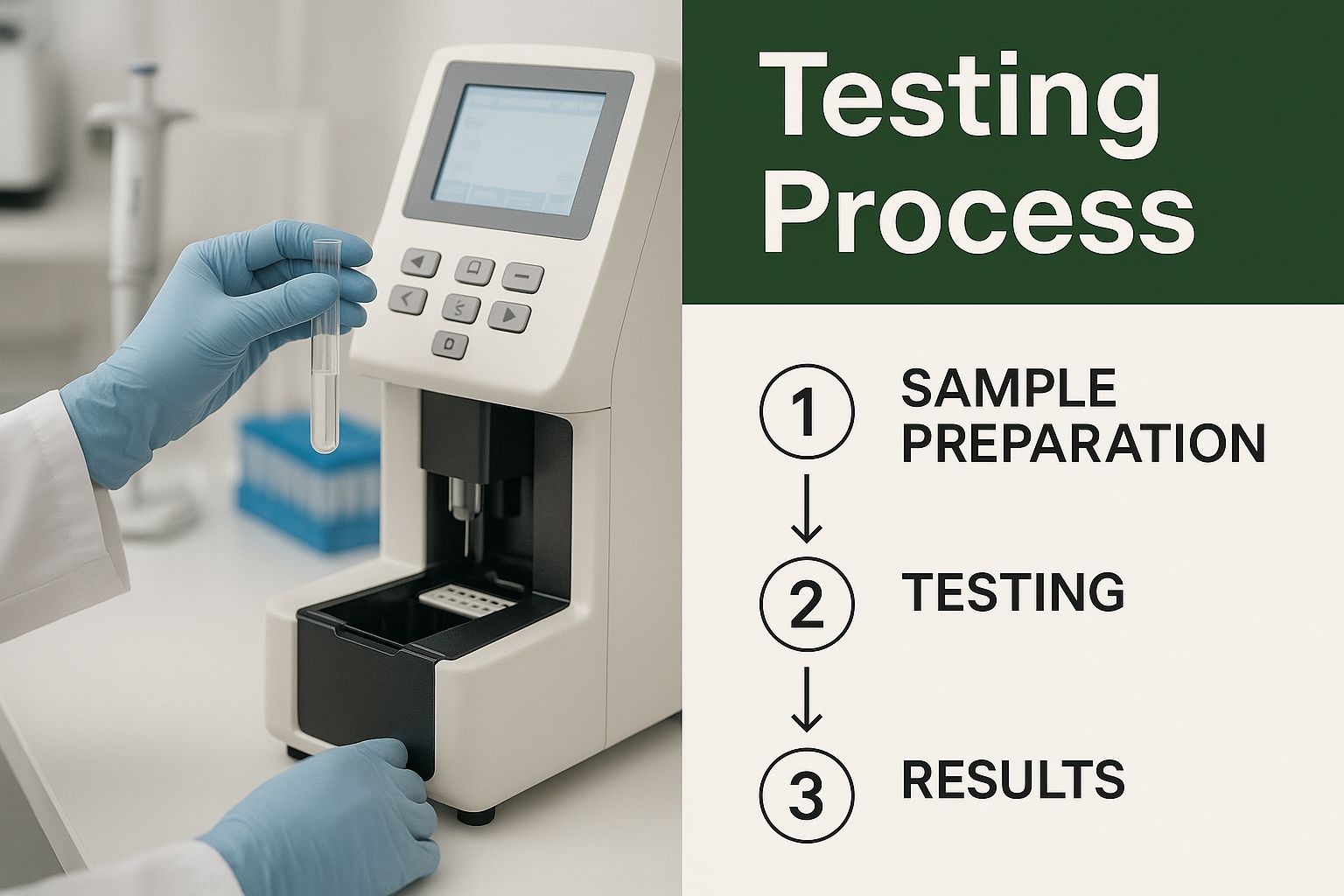
As you can see, each step logically builds on the last, creating a comprehensive and totally unbiased evaluation from start to finish.
Step 3: Conducting the Scientific Analysis
Plan in hand, it's time for the real science to happen. Highly trained technicians use seriously advanced equipment—think mass spectrometers and chromatographs—to pull apart the sample. These machines can identify and measure every single compound with incredible accuracy.
This is where the rubber meets the road. Is the product free from dangerous levels of lead or mercury? Does it really have the 1000mg of an active ingredient it claims, or is it closer to 800mg? The data that comes out of these machines is raw, objective, and forms the basis for the final verdict.
Step 4: Interpreting Data and Issuing the Verdict
Once the tests are done, the raw data goes to senior scientists for interpretation. They cross-reference the results against established safety standards and the manufacturer's own product claims. It’s a dual-check to ensure the product meets both regulatory rules and its marketing promises.
If the product aces every single test, the lab issues a Certificate of Analysis (CoA).
A Certificate of Analysis is the official report card. It’s the transparent, unbiased document that summarizes all the test results, proving a product has been independently verified for purity, potency, and safety. It’s the ultimate proof of quality.
This CoA is the final piece of the puzzle. It's a clear, data-driven document that a brand can share with its customers as undeniable proof that they stand behind their product. That journey, from a simple lab sample to a certified seal, is what turns a marketing claim into a trusted fact.
How Independent Testing Impacts Your Everyday Products
Third-party testing isn't some abstract concept cooked up in a boardroom; it's a very real shield that protects you and your family in countless ways, every single day. This is where the rubber meets the road—where a product moves from a lab bench into your home, ensuring what you rely on is safe, effective, and free from nasty surprises.
Think of independent verification as a silent guardian. From the supplements you take each morning to the toys your children play with, it ensures that what's printed on the label is exactly what’s inside the package. It provides a critical layer of safety in a world flooded with complex supply chains and flashy marketing claims.
Protecting Your Health With Verified Supplements
The dietary supplement industry is a prime example of why this matters so much. Without a neutral third party, you’re basically left to trust a brand’s own claims about purity and potency. That’s a huge gamble with your health. Independent labs step in to provide the unbiased proof you deserve.
For instance, when a product like our premium Organic Coffee gets tested, labs are looking for very specific things:
- Absence of Mycotoxins: These are nasty molds that can grow on coffee beans and pose serious health risks.
- Pesticide Residue Analysis: The lab verifies that the product is free from harmful agricultural chemicals, confirming its organic integrity.
- Heavy Metal Screening: They check for contaminants like lead, mercury, and arsenic, which can build up in your body over time.
This rigorous screening ensures that every cup is not just energizing but also genuinely clean and safe. That level of detail is what builds real trust and protects your health.
"Independent testing transforms a product from a simple purchase into a confident choice. It's the assurance that every ingredient has been scrutinized for safety and effectiveness, safeguarding your well-being with verifiable data."
Ensuring Safety In Children's Products
The importance of third-party testing snaps into even sharper focus when we're talking about products for children. A colorful toy might look harmless, but without an independent check, it could contain hidden hazards. Labs play a vital role in protecting our most vulnerable consumers.
Technicians run a whole battery of tests designed to pinpoint risks to kids. They're checking for things like lead in paint, phthalates in plastics (chemicals that can mess with hormones), and small parts that could pose a choking hazard. This meticulous process ensures that toys meet strict safety standards long before they ever reach a playroom.
To give you a clearer picture, here are some common tests performed across different industries to keep you safe.
Common Third Party Tests By Industry
| Industry | Common Tests Performed | What It Protects Against |
|---|---|---|
| Dietary Supplements | Potency testing, heavy metal screening, microbial analysis | Ineffective doses, toxic contamination, harmful bacteria |
| Children's Toys | Lead and phthalate testing, small parts analysis, flammability tests | Chemical exposure, choking hazards, fire risks |
| Cosmetics | Skin irritation tests, preservative effectiveness, stability testing | Allergic reactions, bacterial growth, product degradation |
| Electronics | Electrical safety testing, electromagnetic compatibility (EMC) | Electric shock, interference with other devices, fire hazards |
| Food & Beverage | Allergen testing, pathogen screening (e.g., Salmonella), nutritional analysis | Allergic reactions, foodborne illness, inaccurate labeling |
As you can see, these tests are the bedrock of consumer safety, providing a layer of trust between you and the products you buy.
The Critical Role In Medical Devices
Nowhere is the impact of third-party testing more critical than in the medical device industry. From simple glucose monitors to complex surgical instruments, patient safety hinges on absolute precision and reliability. The U.S. medical device testing sector is a perfect illustration of this, valued at around $2.23 billion in 2024 and projected to more than double to an estimated $5.09 billion by 2033. This growth is fueled by an aging population and a constant stream of new health technologies. Manufacturers rely on outsourcing these tests to meet tough FDA standards and manage compliance costs. You can dive deeper into these market trends in medical device testing.
These labs validate everything from a device's electrical safety to its biocompatibility, making sure it won't cause adverse reactions when used. This verification isn't just a good idea—it's a mandatory step that saves lives and prevents medical errors. If you're interested in taking your health into your own hands, understanding your body’s unique needs is the perfect place to start. Check out our guide on how DNA testing can help personalize your health supplements.
Ultimately, independent testing is the unsung hero of consumer protection. It works behind the scenes, giving us the data-driven confidence we need to make safe choices for ourselves and our families, whether we're buying a supplement, a new gadget, or a simple children's toy.
How to Spot and Verify Genuine Third Party Claims
Trying to figure out which product claims are legit can feel like navigating a minefield. With so many brands shouting for your attention, you need to know how to separate the real deal from the slick marketing. This is where you, as a savvy consumer, get to take control.
Learning to spot authentic third-party testing claims is your best defense. It's the one skill that lets you cut through the hype and choose products that are actually backed by proof of safety, purity, and potency.
Decoding the Seals of Approval
The quickest way to identify a third-party tested product is to look for official certification seals right on the package. These aren't just fancy logos; they're symbols of trust from reputable, independent organizations, and each one means a product has passed a tough set of tests.
Whether you're looking at supplements or even something like organic underwear, knowing which seals carry weight is crucial for ensuring authenticity.
Here are a few of the most respected certification bodies in the supplement world:
- NSF (National Sanitation Foundation): This seal is a gold standard. It confirms a product has been tested for nasty contaminants and, just as importantly, that what’s on the label is actually what’s in the bottle.
- USP (U.S. Pharmacopeia): The USP Verified mark is another big one. It guarantees the supplement contains the ingredients listed on the label, in the correct amounts, and is free from harmful levels of specific contaminants.
- UL (Underwriters Laboratories): Most people know UL from electronics, but they also certify dietary supplements. They verify ingredients and screen for a wide array of contaminants and banned substances.
Recognizing these logos is your first line of defense against empty promises.
From Lot Number to Lab Report
A truly transparent company doesn't just show you a seal; they make it easy to see the proof for yourself. Many provide a Certificate of Analysis (CoA) for every single batch they produce. This document is the raw report straight from the third-party lab, detailing the results for purity, potency, and safety.
So, how do you track it down?
- Find the Lot Number: First, check the bottom of the bottle or box for a printed lot or batch number.
- Head to the Brand's Website: Good companies usually have a section on their site where you can type in this number.
- Check Out the CoA: The website should then pull up the exact CoA for your specific batch. This lets you see the unbiased lab results with your own eyes.
This level of openness is a huge green flag. It tells you the company has total confidence in what they're selling. For a deeper dive into why this matters, our chat with Dr. Bill Harris on the critical need for testing Omega-3 levels is an absolute must-listen.
Red Flags to Watch Out For
Just as there are good signs, there are also giant red flags that a product's claims are bogus. Knowing what to look for can help you dodge ineffective or even dangerous products.
Ultimately, the company is responsible for verifying its own test results. The FDA has recently cracked down on labs providing unreliable data, which just goes to show that even third-party testing requires a brand to do its homework. A trustworthy company will only partner with accredited, reputable labs.
Keep an eye out for these common warning signs:
- Vague Language: Be skeptical of phrases like "lab-tested" or "quality-assured" that offer zero specifics. If a brand won't name the lab or show you a CoA, the claim is probably meaningless.
- Mystery Logos: Some brands invent their own "seals" that look official to imply independent testing. If you don’t recognize a logo, a quick search will tell you if it belongs to a real, accredited organization.
- "In-House" Testing: Be careful of large companies that own their own testing labs but market them as if they are independent. That's a massive conflict of interest and defeats the whole purpose of unbiased verification.
When you're armed with this knowledge, you can read any label with confidence and make choices that genuinely support your health.
Why Independent Verification Is More Important Than Ever
Let's face it: we live in a world of increasingly complex products and tangled global supply chains. As consumers, we're savvier than ever, and a simple marketing claim just doesn't cut it anymore. We want proof.
This is where independent, third-party verification comes in. It’s no longer a "nice-to-have" feature; it's a fundamental expectation. This impartial seal of approval is fast becoming the bedrock of consumer trust, whether you're buying a supplement or a smart TV.
The role of the independent expert is also getting a major upgrade. As technology gets sharper, so do the testing methods. Labs are now equipped with incredibly precise tools that can detect contaminants at microscopic levels, ensuring a standard of purity that was once unimaginable for products like our Organic Reds Superfood Powder.
The New Frontiers of Verification
The core idea of unbiased proof is so powerful that it's expanding into territories far beyond the supplement aisle. It’s a direct response to a simple consumer demand: hold companies accountable for every single claim they make.
We’re now seeing this play out in some really interesting areas:
- Cybersecurity for Smart Devices: Worried about your smart fridge spying on you? Independent labs now test these internet-connected gadgets for security flaws, protecting you from data breaches and privacy nightmares.
- Validating "Green" Claims: It’s easy for a company to slap a "sustainably sourced" label on a product. Third-party organizations are now stepping in to verify these eco-friendly claims, making sure brands actually walk the talk on their environmental impact.
- Software and AI Integrity: In a world run by algorithms, we need to know they're fair and reliable. Independent audits are now used to check software and AI for hidden biases, ensuring the digital tools we rely on every day are trustworthy.
What this shows is that the need for an impartial referee is universal. The goal is always the same: to protect you, the end-user, with objective, data-driven evidence.
A Market Powered by You
This shift isn't just a feeling—it's backed by some serious numbers. The global third-party testing market is booming, driven almost entirely by consumer demand for safer products and a need for companies to keep up with regulations.
In 2025, the market was already valued at around $50 billion. Analysts project it will grow at a compound annual growth rate (CAGR) of 7% over the next several years, rocketing to an estimated $85 billion by 2033. You can dig into more of the numbers on the growth of the third-party testing market yourself.
"As products become more sophisticated and supply chains more intricate, the role of the impartial expert shifts from a value-add to an absolute necessity. It is the bedrock of a transparent marketplace where consumers can make safe, confident choices."
This trend highlights a massive shift in consumer behavior. We're done just taking a company's word for it. We want to see the receipts.
As our world gets more complex, this kind of impartial validation will only become more critical. It’s the essential bridge between a brand and its customers, ensuring that as products get more advanced, our standards for safety and integrity rise right alongside them. This commitment is the ultimate tool for empowering you to make choices that are not just informed, but safe.
Your Questions About Third Party Testing, Answered
Let's clear up some of the most common questions people have about third-party testing. It's a crucial topic, and knowing the facts helps you shop with confidence.
Is Third-Party Testing Required By Law?
For supplements, the surprising answer is no. The FDA sets the rules for manufacturing, but they don't require companies to get an independent lab to verify their products before they land on store shelves.
This is why it's such a big deal when a company voluntarily submits its products for testing. It’s a choice that signals a real commitment to quality and transparency. It’s important to note that for some other products, like kids' toys or certain medical devices, independent testing isn't optional—it's mandatory to meet federal safety standards.
Can You Really Trust a Third-Party Lab?
In almost all cases, yes. A reputable third-party lab's entire business model is built on being a neutral, accurate source of information. Their accreditation—and their reputation—is on the line with every single sample they analyze. Smart brands know this and partner with well-known, accredited labs.
It's a two-way street, though. The supplement company is still responsible for making sure the lab's data is sound. The FDA has recently cracked down on labs that provide faulty or unreliable results, which just goes to show how critical it is for a brand to choose a testing partner with an ironclad reputation.
How Is It Different From an In-House Test?
An in-house test is exactly what it sounds like—the manufacturer tests its own products. This is a normal part of quality control during production, but there’s always the potential for a conflict of interest.
A third-party test, on the other hand, is done by a completely separate organization. They have no financial stake in whether the product passes or fails. Their only job is to provide objective, unbiased data.
Think of it this way: an in-house test is like a student grading their own homework. A third-party test is when the professor grades it. Which result would you trust more?
At Peak Performance, we believe that trust isn't given; it's earned. That's why every single one of our products goes through rigorous independent testing to guarantee what's on the label is what's in the bottle. Explore our full range of USDA organic superfoods and supplements, all backed by our commitment to verifiable quality. Discover the Peak Performance difference today.
Also in Blog


How to Increase Stamina Naturally and Boost Energy


How to Increase Energy Naturally

