


A Guide to Third Party Tested Supplement Brands
When you see third-party tested supplement brands on a label, what does that actually mean?
Simply put, it means the company sent its products to an independent, unbiased lab to get a stamp of approval on its purity, potency, and safety. This process confirms that what's on the label is actually what's in the bottle—the absolute gold standard for quality in a massively crowded market.
The Importance of Independent Verification
Think about it like buying a house. You'd never just take the seller's word that the foundation is sound and the wiring is up to code. You hire an independent home inspector to verify everything, right? Third-party testing for supplements operates on the exact same principle.
An unbiased organization, one with zero financial stake in the brand, analyzes the product from top to bottom. Their job is to answer a few critical questions for you:
- Purity: Is this supplement free from nasty contaminants like heavy metals, pesticides, or microbes?
- Potency: Does it really have the amount of active ingredients the label claims it does?
- Identity: Is the main ingredient what the company says it is, or is it filled with cheap substitutes?
This independent check offers a layer of protection and transparency you just don't get from brands that only do their own in-house testing.
Building Consumer Trust
In an industry where marketing claims can be deafening, third-party testing cuts straight through the noise. It’s objective proof of a company's real commitment to quality.
When a brand voluntarily puts its products through this kind of rigorous scrutiny, it’s a huge signal of confidence in their formulas and manufacturing. Understanding what makes third-party tested supplement brands stand out also means recognizing the compliance standards needed to sell on major platforms. If you're curious about the business side, guides on how to sell supplements on Amazon often emphasize just how critical these verifications are.
Demand for this level of transparency is skyrocketing. The global dietary supplement testing market is projected to hit USD 4.05 billion by 2032, with North America leading the way. This boom is fueled by both stricter regulations and, more importantly, by people like you who are demanding proof of a product's integrity.
(Want a deeper dive into the nitty-gritty? We break it all down in our guide: what is third party testing.)
Third-Party Tested vs. Standard Supplements at a Glance
So, how does a third-party tested product really stack up against a standard, in-house-only tested one? Let’s break it down.
| Attribute | Third-Party Tested Brands | Standard (In-House Tested) Brands |
|---|---|---|
| Verification | Verified by an independent, unbiased lab. | Verified only by the manufacturer itself. |
| Transparency | Publicly available lab reports (Certificates of Analysis). | Lab results are typically private and not shared. |
| Purity | Confirmed free of contaminants like heavy metals. | Potential for undisclosed contaminants. |
| Potency | Ingredient amounts are confirmed to match the label. | Risk of inconsistent or inaccurate dosages. |
| Trust Factor | High. Objective proof of quality and safety. | Lower. Relies solely on the brand's own claims. |
The takeaway is pretty clear. While any testing is better than none, the independent verification from a third-party lab provides an unparalleled level of confidence and assurance that you're getting exactly what you paid for.
The Key Tests That Define Supplement Quality
When a brand says their products are "third-party tested," what does that actually mean? It's not just marketing fluff. It’s a promise backed by a specific set of scientific analyses designed to prove a supplement is safe, pure, and accurately labeled. This process takes the guesswork out of what’s in your bottle, moving beyond blind trust to provide cold, hard proof.
Think of it like getting an independent home inspection before buying a house. You bring in a neutral expert to check the foundation. In the same way, reputable third party tested supplement brands voluntarily send their products out for this kind of rigorous inspection to show that every batch meets the highest standards.
Three core tests make up the backbone of this whole verification process.
Purity Testing: A Background Check for Contaminants
First up is purity testing. This is essentially a background check for your supplement. Its main job is to scan for nasty and potentially harmful substances that have absolutely no business being in there. For any brand that takes quality seriously, a clean purity report is non-negotiable.
This analysis makes sure the product is completely free from:
- Heavy Metals: It looks for toxic elements like lead, mercury, arsenic, and cadmium that can build up in your body and cause serious problems over time.
- Microbial Contaminants: This screens for bacteria, yeast, and mold to ensure the supplement is safe to consume and won't make you sick.
- Pesticides and Herbicides: It verifies that the raw ingredients, especially anything plant-based, are clean and don't carry any residual chemicals from farming.
Passing these tests means the only things you're getting are the ingredients listed on the label. Nothing else.
Potency Testing: Confirming the Dose on the Label
Next, we have potency testing. This answers one of the most important questions: are you actually getting the dose the label promises? This test measures the exact concentration of the active ingredients to ensure what's advertised is what's delivered. If we say a capsule of our Raw Desiccated Beef Liver contains a specific amount of nutrients, this test is how we prove it.
Potency verification is critical. Why? Because inconsistent dosages can make a supplement completely ineffective or, in some cases, even problematic. It’s the difference between a claim of "1000mg of Vitamin C" being a rough estimate versus a fact backed by real data.
Without this step, the amount of the key ingredient could be all over the place from one batch to the next. Potency testing guarantees consistency.
Identity Testing: Ensuring You Get the Real Deal
Finally, there’s identity testing, which confirms that the ingredients are what they claim to be. This is a huge deal for herbal supplements, where a cheap, less effective plant might be swapped for the real, more expensive one. It’s basically a DNA test for your supplement's ingredients.
For example, identity testing ensures that a high-value herb like Panax ginseng hasn't been replaced with a cheap look-alike. It protects you from getting ripped off and guarantees the formula’s integrity.
When you put these three tests together, you get a complete, transparent picture of a supplement’s quality. It’s the peace of mind you deserve.
Decoding the Seals of Major Certification Bodies
Walking down the supplement aisle can feel like trying to decipher a secret code. You're hit with a wall of logos and seals, all slapped on labels, all claiming to be important.
But these little symbols aren't just marketing fluff. They're stamps of approval from major certification bodies, and each one tells you something specific about the product's quality. Learning what they mean is like getting a cheat sheet to confidently pick the best supplements.
When a brand goes through the trouble and expense to get these certifications, it’s a huge sign they’re serious about transparency and quality. Think of these logos as quick visual cues telling you that a product has survived a tough, independent review. They make it so much easier to spot the truly reliable third party tested supplement brands.
Here’s a quick visual guide to what the process looks like for some of the most respected seals in the game.
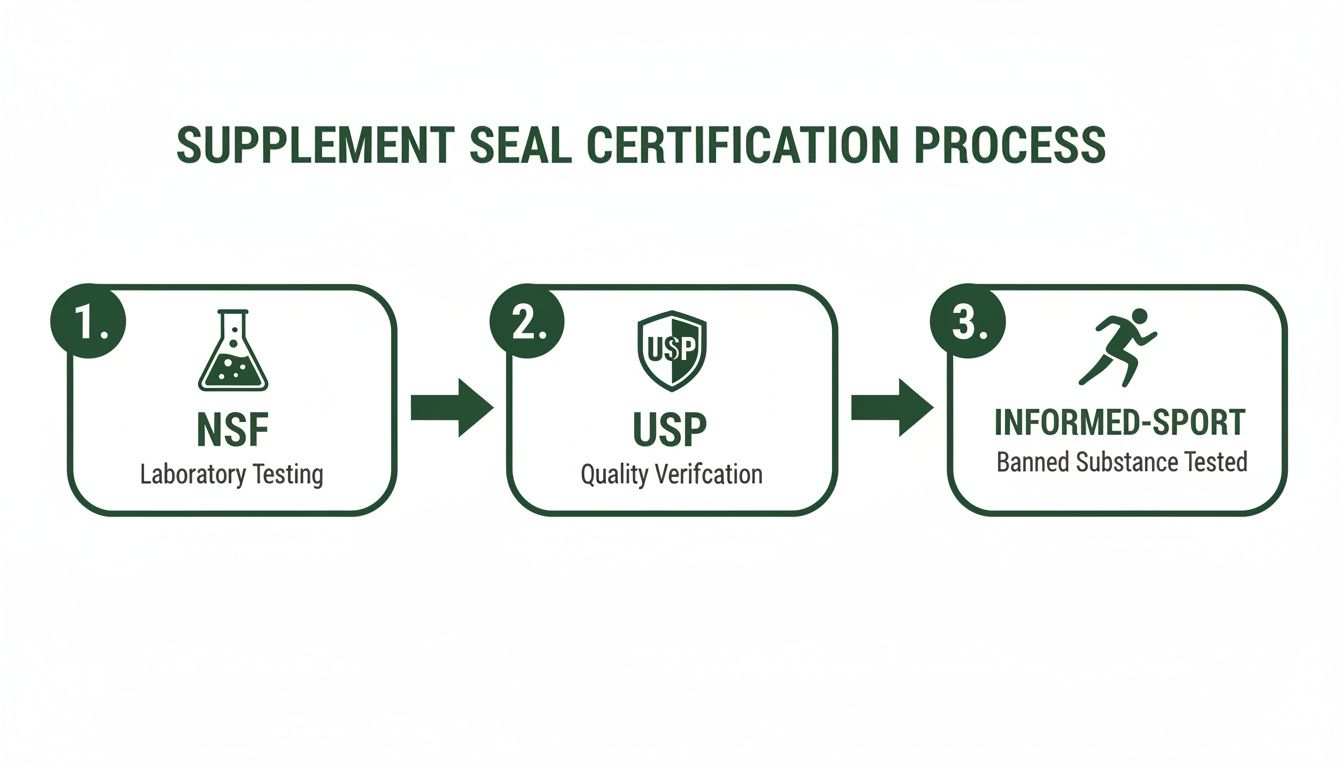
Each of these paths—from deep lab analysis to quality checks and athletic screening—adds another layer of trust you can count on.
NSF International: The Public Health Protector
The NSF International seal is one of the heavyweights. It's one of the most respected certifications out there, and to get it, a supplement has to go through a serious gauntlet.
The process includes:
- Label Claim Review: This is a simple but crucial check: Is what's on the label actually what's in the bottle?
- Toxicology Review: An expert certifies that the product's formula is safe to take.
- Contaminant Review: They test to make sure there are no unsafe levels of nasty stuff like heavy metals or pesticides.
And it doesn't stop there. NSF also conducts ongoing facility audits and re-tests products to make sure the brand keeps up its standards over time.
USP Verified: A Mark of Purity and Potency
The U.S. Pharmacopeia (USP) Verified mark is another powerful seal of quality you'll want to look for. When you spot this logo, you know the supplement:
- Actually contains the ingredients listed on the label, in the exact strength and amount promised.
- Is free from harmful levels of specific contaminants.
- Will break down and release into your body properly.
- Was made following FDA Good Manufacturing Practices (GMPs).
This kind of verification is a lot like the quality standards you see in high-end food production. To get a better sense of how these different seals work, you can check out the details of what USDA organic certification requirements entail to see another angle on quality assurance.
Informed-Sport: The Athlete's Choice
For any serious athlete, the Informed-Sport certification is the absolute gold standard. There's no room for error when your career is on the line.
This program tests every single batch of a product for over 250 different substances banned in sports before it ever hits the market.
This batch-by-batch testing is a game-changer for competitive athletes under strict anti-doping rules. Seeing that Informed-Sport logo gives them the peace of mind they need to take a supplement without worrying about their career going up in smoke.
Recognizing these seals gives you the power to make smarter, safer choices. It lets you instantly pick out the brands that are willing to go the extra mile to prove they’re the real deal.
How to Read a Certificate of Analysis Like a Pro

Seals and logos on a bottle are a great start, but the real proof of a supplement's quality is in the data. That’s where the Certificate of Analysis (CoA) comes into play. Think of it as the official report card for your supplement, issued directly by the independent lab that did the testing. Learning how to read one is the best way to become your own quality detective.
A CoA is what turns a brand's promises into cold, hard facts. The best third party tested supplement brands don't just talk about quality—they show you the paperwork. They make these reports easy to find because they have absolutely nothing to hide.
This level of transparency is everything in an industry that relies on trust. Independent labs are the backbone of this system, generating USD 1.91 billion in revenue by providing these unbiased reports. And things are speeding up; rapid testing methods are expected to grow by 8.7% annually as consumers demand faster verification. You can dig deeper into these market trends and the importance of independent lab services to see where the industry is heading.
Decoding Key Sections of the Report
Once you've got the right CoA, it might look a little intense at first glance, full of scientific terms and tables. Don’t worry. You only need to check a few key sections to get the whole picture.
Here’s what to look for:
- Identity Test: This confirms the main ingredient is actually what the label says it is. The result should clearly state that it matches the official reference material. No imposters here.
- Potency/Assay: This is the dosage check. It measures the amount of the active ingredient and confirms it meets or exceeds what's promised on the label.
- Microbial Analysis: Your safety check against nasty stuff like bacteria, yeast, and mold. You’re looking for results like "Pass" or "<10 CFU/g," which means any microbial levels are far below the safe limit.
- Heavy Metal Analysis: This part screens for toxic elements you don’t want anywhere near your body—lead, mercury, arsenic, and cadmium. The best possible result is "ND" (Not Detected) or a clear "Pass."
By checking these key areas, you can confidently confirm your supplement is pure, potent, and safe. You're no longer just taking a brand's word for it—you're reading the proof for yourself.
Your Checklist for Choosing Trusted Supplements
Alright, let's put all this theory into practice. When it comes time to actually buy a supplement, how do you sort the good from the bad?
I've boiled it all down to a simple, actionable checklist. Think of these as the critical questions you need to ask before you ever click "add to cart." This is your personal quality control, your way of making sure the third party tested supplement brands you choose are the real deal.
Key Questions to Ask Any Supplement Brand
Before you spend a dime, run any potential product through this quick evaluation. It's a surprisingly effective way to see which companies are transparent and which ones might have something to hide.
-
Do They Use a Reputable Certification Body? Keep an eye out for seals from major certification bodies. These logos aren't just for show; they’re a quick visual cue that a brand is serious about meeting incredibly high standards for quality and safety.
-
Does the CoA Match Your Product’s Lot Number? A generic, one-size-fits-all lab report won't cut it. You need to be able to match the specific lot number on the bottle in your hand to a corresponding CoA. This is the only way to know for sure that the test results apply to your batch. Getting comfortable with this is key, and our guide on how to read supplement labels breaks it down even further.
-
Is the Brand Transparent About Sourcing and Manufacturing? Honest companies are proud of their process and aren't afraid to show it off. They’ll tell you where their ingredients come from and what kind of manufacturing standards they hold themselves to. Vague answers or total silence on this front is another warning sign.
And on the off chance you do run into a sketchy product, it's good to know your options. Understanding how to report counterfeit products helps protect not only you but other consumers from potentially dangerous fakes.
Frequently Asked Questions About Supplement Testing
It's totally normal to have questions when you're navigating the supplement aisle. To help clear up any confusion, we’ve put together some straightforward answers to the questions we hear most often about supplement testing and quality.
What’s the Difference Between GMP and Third-Party Testing?
Think of it this way: GMP (Good Manufacturing Practices) is about the kitchen, and third-party testing is about the final dish.
GMPs are the rules the FDA sets for how a supplement has to be made—the cleanliness, procedures, and quality control during the manufacturing process. It's crucial, but it's focused on the process.
Third-party testing takes it a step further. It's where an independent lab pulls a finished product off the line and tests that specific batch to see if what's on the label is actually in the bottle. It's a final check on the finished product, confirming purity and potency.
Why Don't All Brands Use Third-Party Testing?
Honestly, it comes down to time and money. Rigorous third-party testing isn't cheap, and it adds another step to the production timeline.
Some brands decide it's a corner they can cut, relying only on their own internal checks. But for the most trusted third party tested supplement brands, it's a non-negotiable part of doing business. They see it as a critical investment to prove their products are safe, pure, and effective.
A brand's willingness to invest in independent verification says a lot about how much they stand behind their own products. It’s the difference between just claiming you have a quality product and being willing to prove it.
Are All Third-Party Labs the Same?
Not at all. The quality and standards can vary widely from one lab to another.
This is why it's so important to look for testing done by established, accredited labs and, ideally, certifications from respected organizations. These groups have incredibly strict protocols, which ensures the testing is both thorough and unbiased. That accountability is what gives the process its real value.
At Peak Performance, we’re committed to providing products that are not only effective but also transparently safe. Our strict, batch-by-batch third-party testing is a core part of that promise to you. Explore our full range of clean, verified supplements and see what a difference proven quality can make.
Learn more at https://buypeakperformance.com.
Also in Blog


The "Gut Glue": Top 10 Ways CoreBiome Seals Leaky Gut Syndrome


A Practical Guide to the 36 Hour Water Fast in 2026
Unlock metabolic renewal with our practical guide to the 36-hour water fast. Learn how to prepare, what to expect, and how to refuel for optimal results.

