


Iodine from Sea Kelp vs. Synthetic Potassium Iodide
Across commercially available whole and sheet-form seaweeds, the U.S. National Institutes of Health records iodine concentrations from 16 to 2,984 micrograms per gram (NIH Office of Dietary Supplements). Two products of near-identical weight can sit at opposite ends of that spread, and neither label has to tell you which end you bought.
That gap is the whole argument. Iodine from sea kelp isn't one ingredient with one potency. It's a variable food, so the useful comparison isn't "natural versus synthetic" in the abstract. It's a fixed, labelled compound against a whole food whose iodine has to be measured batch by batch.
Natural Sea Kelp vs. Synthetic Potassium Iodide
The answer fits in one line. Potassium iodide is a defined compound, so its iodine content is fixed by chemistry and confirmed on the label. Whole sea kelp is a biological food, so its iodine content depends on species, harvest and processing. Everything else follows from that difference.
The NIH lists potassium iodide and sodium iodide as the common forms used in iodine supplements, while kelp supplements provide iodine in a seaweed-based form (NIH iodine consumer factsheet). Treating the two as interchangeable is a mistake the front label rarely corrects for you: kelp weight tells you nothing about dose, because milligrams of seaweed say nothing about micrograms of iodine.
| Feature | Potassium iodide | Whole-food sea kelp |
|---|---|---|
| Iodine form | A defined compound, potassium iodide | Iodide stored in kelp tissue, plus natural iodine-containing compounds |
| Dose predictability | High when the label matches a lot assay | Low, because species, harvest and processing shift the number |
| Natural co-factors | None | Polysaccharides, alginates, polyphenols and trace minerals in amounts that vary by species and processing |
| What to verify | The label against the lot assay | Iodine per serving, species name, batch assay and contaminant testing |
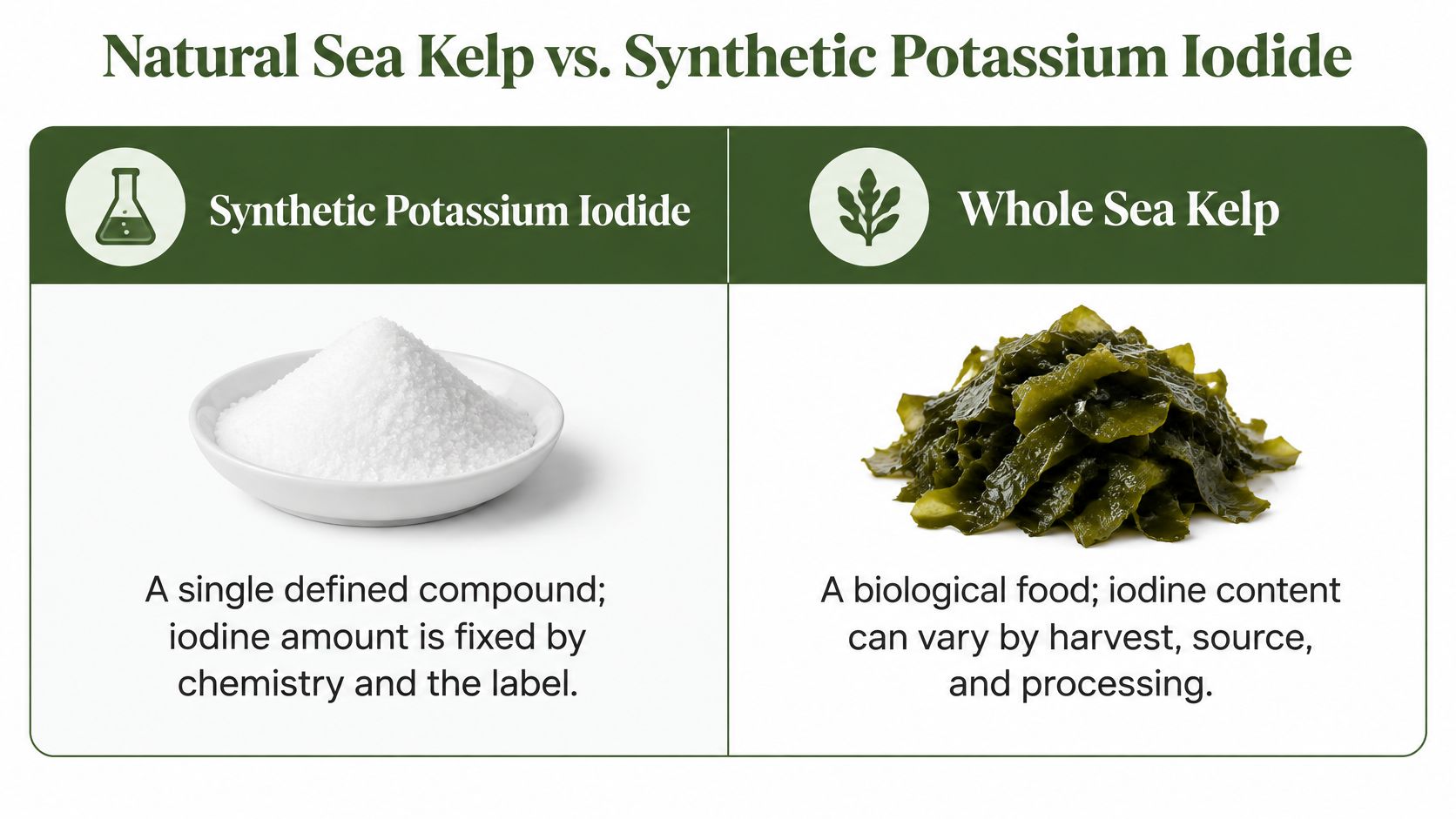
What each row means in practice
Iodine form. Potassium iodide is a single chemical entity with a calculable iodine fraction. Kelp holds iodine inside living tissue, largely as iodide, and releases iodine-containing compounds when it comes under oxidative stress. Chemistry researchers have traced that release through vanadium haloperoxidases and hydrogen peroxide at the cell wall (Springer reference chapter on iodine in kelp).
Dose predictability and verification. With potassium iodide, arithmetic settles the question: if the label matches a lot assay, the dose is what the label says. Kelp offers no such shortcut, so its column asks for more paperwork. Iodine per serving, the species name, a batch assay and contaminant testing are the substitutes for the certainty a defined compound gives you by default.
Natural co-factors. A review of marine algae describes polysaccharides, proteins, pigments and polyphenols as the major bioactive classes in seaweed, with brown seaweeds generally carrying more iodine than red and green types (review of marine algae bioactives). Potassium iodide carries none of that matrix. The research cited here does not report any kelp co-factor that changes iodine's effect on the thyroid, so the matrix is best treated as a bonus rather than a reason to relax verification.
The verdict by situation. If a fixed, predictable dose matters most, say because you're tracking total intake around a diagnosed thyroid condition, potassium iodide wins on arithmetic, provided the label matches a lot assay. If you value a whole-food matrix and are willing to check iodine per serving and per batch, kelp is a legitimate route.
Both end in the same element. Total iodine from every source is the number that counts.
What Iodine Does in Your Body and How Much You Need
Your thyroid works like a factory, and iodine is the raw material arriving at the loading dock. The gland pulls iodine from the blood and builds thyroxine (T4) and triiodothyronine (T3), the hormones that set metabolic rate, heart rate, body temperature and, in infants, brain development. Cut the deliveries and output falls, however healthy the factory is.
The NIH puts adult iodine needs at 150 micrograms a day, rising to 220 micrograms during pregnancy and 290 micrograms while breastfeeding, with an adult tolerable upper intake level of 1,100 micrograms a day (NIH iodine consumer factsheet). That ceiling applies to everything you swallow, not to one product in isolation.
The margin is narrower than it looks
Seven times the requirement is a tight window as minerals go, and it's tighter still for anyone stacking a kelp capsule on iodized salt and a multivitamin. Most vitamin ceilings sit so far above typical intakes that nobody thinks about them. Iodine's does not.
The question is never whether kelp contains iodine. It plainly does. The question is how much you're already getting before the first capsule.
Most diets in countries with iodized salt already clear 150 micrograms through salt, dairy, eggs and seafood, which is why iodine deficiency became rare in developed countries. Plant-based eaters have a harder time of it, since plant foods carry iodine only in amounts that reflect the soil they grew in. For that group a supplement with a stated dose is more reliable than a seaweed dish.
Estimate your baseline from food first. A kelp product is rarely the thing standing between you and adequacy.
Why Sea Kelp Iodine Varies From Batch to Batch
Kelp does not hold a fixed percentage of iodine the way a fortified food does, and the measured spread is wide. In one Centre for Food Safety assessment of Hong Kong products, plain seaweed ran from 49 to 220,000 micrograms of iodine per 100 grams, dried kelp averaged 180,000 micrograms per 100 grams with a median of 170,000 (about 1,700 micrograms in a single gram), and a 30-product analysis measured kombu at 241 to 4,921 milligrams per kilogram, compared with 93.9 to 185.1 for wakame and 29.3 to 45.8 for nori.
Species choice alone moved the reading more than a hundredfold inside that single analysis.
Fresh kelp sits toward the top of the range. A 2024 study in the journal Foods measured raw fresh Saccharina japonica at 5,964.44 plus or minus 155.68 milligrams of iodine per kilogram (Foods study on kelp iodine, 2024). That works out to roughly 5,960 micrograms in a single gram: about five times the adult tolerable upper limit of 1,100 micrograms, and around forty times the 150-microgram daily requirement.
| Seaweed or product | What the measurement means for a dose |
|---|---|
| Plain seaweed products, Hong Kong assessment | Lowest and highest products sit more than three orders of magnitude apart |
| Dried kelp, Hong Kong assessment | One gram at the median already exceeds the adult daily upper limit |
| Kombu, wakame and nori | Species alone shifts iodine content more than a hundredfold |
| Raw Saccharina japonica, fresh | Fresh-weight benchmark; storage and blanching pull it down from there |
Processing moves the number as much as species does
Handling changes the figure before kelp ever reaches a capsule. A 2024 Journal of Applied Phycology study found blanching produced an 87% iodine reduction in kelp that had been stored, against 80% in kelp that was not stored (Journal of Applied Phycology, 2024). Two processors working from the same harvest can ship powders that differ substantially, and neither has done anything wrong. Whole-food kelp also brings whatever co-factors the plant concentrated in the water it grew in; that is a real benefit, and it still does not replace a measured iodine figure.
Why this matters at the scoop: a nominally identical kelp powder dose can deliver iodine amounts that differ by orders of magnitude, so a certificate of analysis should report iodine as a batch-specific active constituent. Kelp weight alone cannot stand in for it.
How to Check a Kelp Label for Real Iodine Content
You can run this check in about two minutes, and it's the only part of the decision that matters. If you want the wider skill, our guide to how to read supplement labels covers panel layout and serving math in detail.
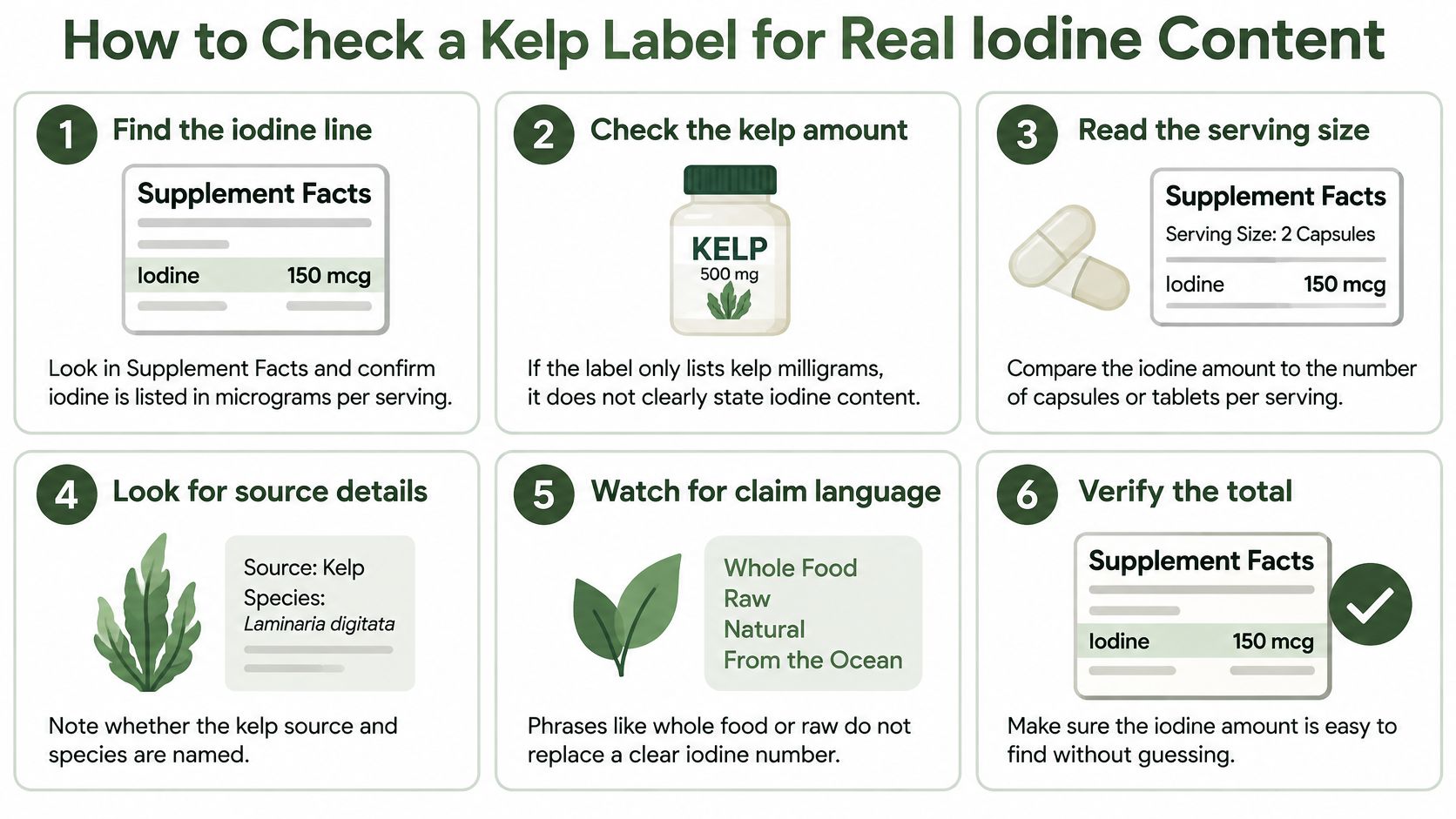
- Find the iodine line in Supplement Facts. It should be stated in micrograms per serving. If the panel lists only kelp powder in milligrams, treat the iodine amount as unknown, because kelp mass and iodine content are different measurements.
- Check whether the species is named. Ascophyllum nodosum, kombu and other brown kelps can run high, while nori is far lower. A named species tells you which end of the range you're probably buying. "Seaweed blend" tells you nothing.
- Look for a batch-specific assay or certificate of analysis from an accredited lab. A test on the lot in your hand beats a general claim about the plant, because the plant varies.
- Confirm contaminant testing is stated. Seaweed absorbs what's in the water around it, so heavy metals testing belongs in the same document as the iodine figure.
- List every other iodine source you take. Iodized salt, multivitamins, prenatal products and any second supplement all count toward the same total.
- Add the numbers together before you decide the serving size. Say a capsule label states 1,000 micrograms and your multivitamin lists 150 micrograms. You're at 1,150 micrograms before a single grain of iodized salt, which is past the adult upper limit.
Organic certification and a large kelp weight never substitute for a stated iodine number. Organic describes how the seaweed was grown, not how much iodine it holds.
Who Should Avoid Concentrated Kelp Iodine and Why
The serious risk from concentrated kelp is iodine-induced thyroid dysfunction. Excess iodine can temporarily inhibit thyroid-hormone synthesis through the acute Wolff–Chaikoff effect, and in susceptible people the same exposure can run in the opposite direction, triggering the iodine-induced hyperthyroidism known as the Jod–Basedow phenomenon. One mineral can push the gland toward shutdown or toward overproduction, and which way it goes depends on the state of the thyroid it lands on.
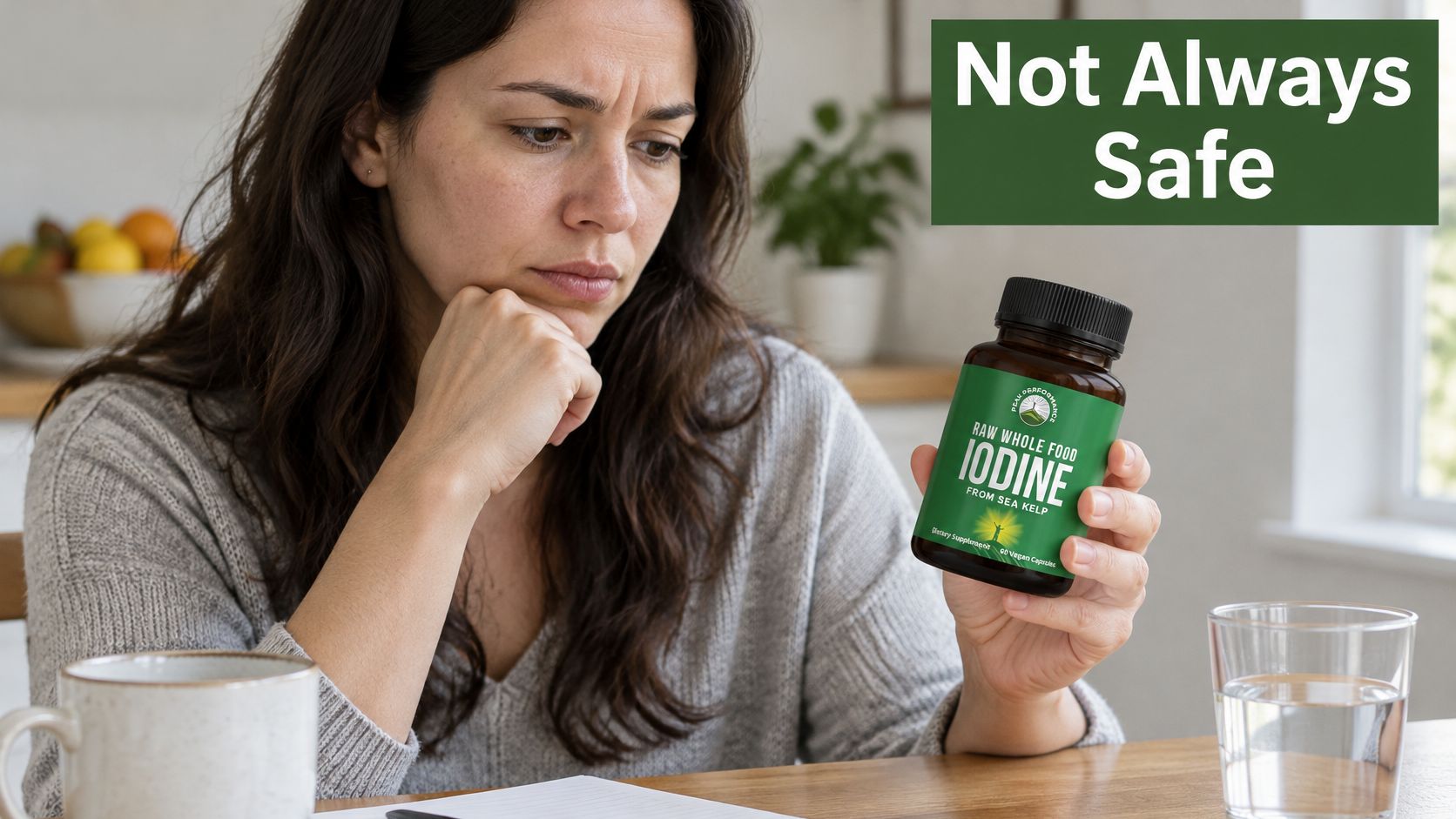
The groups at highest risk share one feature: a thyroid gland that can no longer regulate itself. That means people with Graves' disease, autonomous thyroid tissue, Hashimoto's disease or other pre-existing thyroid damage, plus anyone pregnant, breastfeeding or feeding a child.
| Source | Iodine amount | Relation to the 1,100 microgram limit |
|---|---|---|
| Adult tolerable upper intake | 1,100 micrograms per day | Benchmark for total intake from all sources |
| Whole-food macroalgae portion | From a modest serving up to tens of thousands of micrograms | Single portions can exceed the limit many times over |
| Supplement daily dose | From a few micrograms up to several thousand per day | Upper doses exceed the limit on their own |
| Kombu or kelp broth, one portion | 2,000 to 10,000 micrograms | Above the limit in one serving |
The ranges behind that table come from British Dietetic Association guidance on iodine: a portion of whole-food macroalgae can run from 128 to 62,400 micrograms, and a supplement's daily dose from 5 to 5,600 micrograms. An endocrinology review of iodine and thyroid dysfunction reports kelp capsules containing 1,000 to 10,000 micrograms, which puts a single capsule above the adult ceiling. Spreads that wide are why whole seaweed works poorly as an everyday iodine source.
An occasional seaweed side dish and a concentrated capsule taken daily are different exposures. Cooking lowers iodine content, yet boiling never turns a kelp dish into a labelled dose.
Anyone with a thyroid condition, anyone pregnant or breastfeeding, and anyone already taking iodine from another product should ask a clinician before adding kelp. An unverified concentrated dose landing on an already unstable gland can push hormone output in either direction.
If thyroid symptoms are what sent you looking at iodine in the first place, the podcast episode on thyroid issues with Elle Russ lays out where supplementation fits and where it stops.
Choose Iodine You Can Verify Before You Buy
The choice comes down to two questions. Does the label state iodine per serving in micrograms, and can a batch assay confirm that number? If you want iodine from a whole-food source, buy the product that answers both, names the species, and shows its testing. If a fixed, labelled dose is what you need, potassium iodide is the more predictable tool.
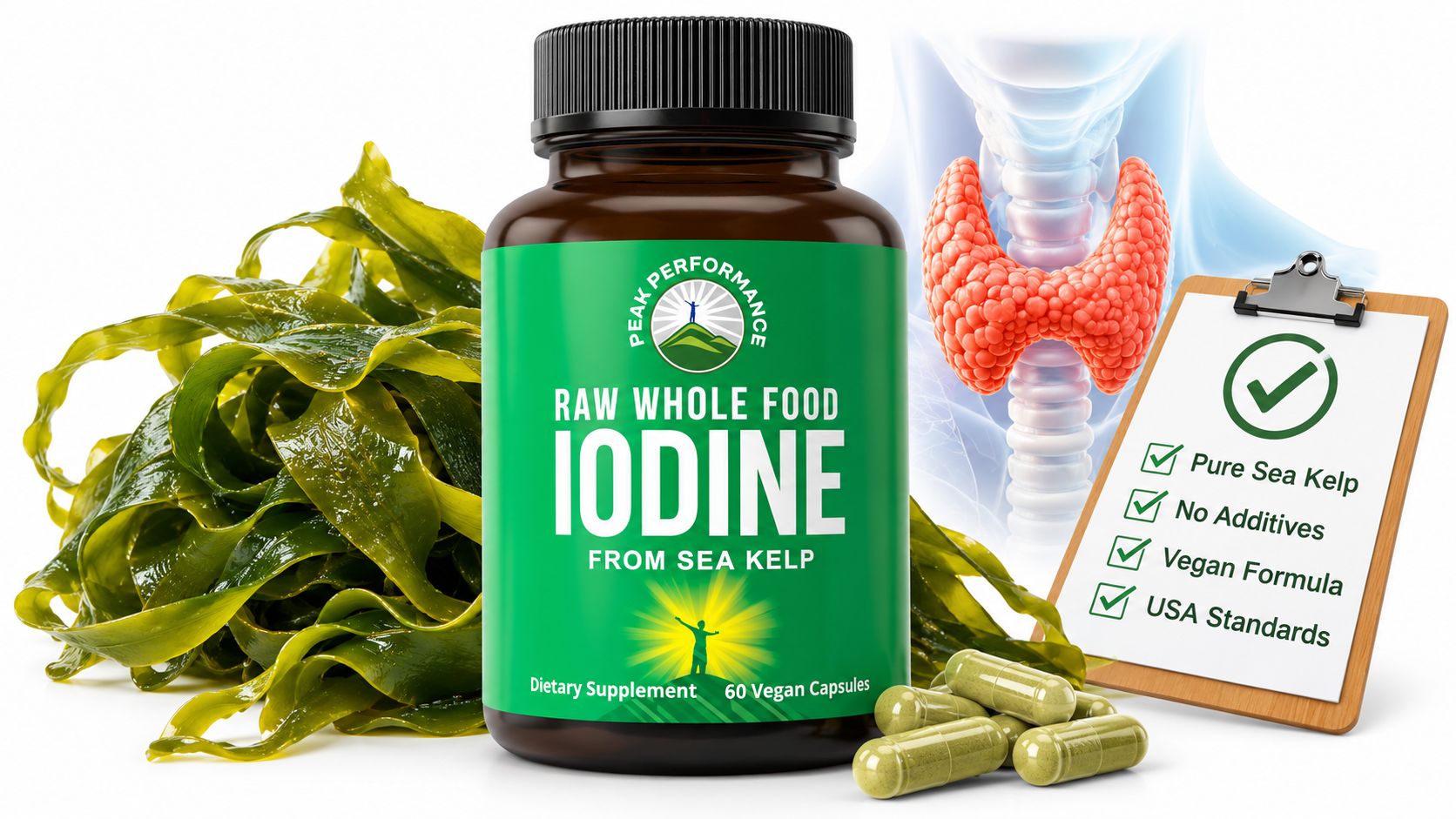
One caution before you compare labels. A capsule's kelp weight tells you almost nothing about its iodine dose: "500 mg of kelp" is a quantity of plant material, not a measured intake. The comparison is between a fixed synthetic compound with a labelled dose and a whole food whose iodine has to be verified batch by batch. Kelp's natural co-factors are a reasonable bonus, but they do not replace that verification.
For the whole-food route, Peak Performance's Raw Whole Food Iodine Supplement from Organic Kelp (Ascophyllum Nodosum) supplies iodine from organic kelp in vegan capsules at $19.95. The USDA Organic Iodine Capsules listing is the same supplement in a 60-capsule format.
Run the six-step check on the Supplement Facts before you buy, and read how third-party testing works so you know what a batch assay covers. Then add your total daily iodine from every source against the adult upper limit.
These statements have not been evaluated by the Food and Drug Administration. This product is not intended to diagnose, treat, cure or prevent any disease. Review total iodine intake with a clinician first, especially if you're pregnant, breastfeeding or managing thyroid disease.
Peak Performance makes its iodine supplement from organic kelp (Ascophyllum Nodosum) rather than a synthetic compound, and each batch goes through third-party lab testing, so you can check the iodine figure on the label against the batch assay. The capsules cost $19.95 and support metabolism, energy, and immune health. Visit Peak Performance to read the Supplement Facts, check the iodine per serving and see whether the number fits your total daily intake.
Also in Podcasts


