


Zinc and Copper Balance: Why Zinc Alone Can Deplete Copper
The advice arrives every autumn and it sounds sensible: take zinc at the first scratch of a sore throat, and take a big dose. It's repeated on labels, in group chats, and by the person behind the counter at the pharmacy. What that advice leaves out is the reason this article exists. Zinc and copper compete for the same absorption route in your small intestine, and a dose that helps for three days can work against you across ten weeks.
Copper isn't an optional extra. Your body uses it to move iron into red blood cells, to insulate nerves, and to build part of an antioxidant enzyme. Zinc doesn't destroy copper. It changes how much copper crosses the intestinal wall and reaches circulation. That distinction makes the problem predictable and, for many individuals, preventable.
The risk isn't about taking zinc at all. It's about total dose and duration. A short course at a modest amount behaves nothing like a bottle of 50 mg capsules finished over two months on top of a multivitamin that also contains zinc. Same mineral, different arithmetic.
Zinc Doses That Start to Deplete Copper
In the gut, zinc and copper compete for absorption, and zinc taken above the adult upper limit for several weeks can leave copper too low.
The detail behind that sentence is where the useful decisions live, because the gap between a helpful dose and a copper-depleting dose is narrower than most labels suggest. The U.S. National Institutes of Health zinc fact sheet puts numbers on it: doses of 50 mg or more per day, taken for weeks, can inhibit copper absorption, while the adult tolerable upper intake level sits at 40 mg per day from all sources. Recommended intake is 11 mg a day for men and 8 mg a day for women, so a 50 mg capsule runs four to six times higher than the body needs.
| Zinc intake pattern | Typical amount | Effect on copper | Action to take |
|---|---|---|---|
| Food-only intake | Usually well under 40 mg a day | Copper absorption generally unaffected | No change needed |
| Supplement within the limit | 40 mg or less a day from all sources | Low risk for most healthy adults | Total every product before adding more |
| Sustained high dose | 50 mg or more a day for several weeks | Copper absorption may be inhibited | Stop or review with a clinician |
| Long high dose | About 60 mg a day for 10 weeks | Lower red blood cell copper-zinc SOD documented | Request clinician-directed copper testing |
| High-zinc denture adhesive | Variable, can exceed the limit | Neurological and anemia cases reported | Switch product and seek medical evaluation if symptoms appear |
Find your own row rather than the worst one. People who take zinc sit in the first two rows and never need to think about copper. Trouble clusters in rows three and four, where dose and duration climb together.
One detail does a lot of quiet work. Per that same NIH guidance, the upper limit covers food, beverages, supplements and medications combined. A multivitamin with zinc plus a separate zinc capsule can cross the ceiling while neither label looks extreme on its own, and fortified cereal or a zinc lozenge adds more on top.
Before you change anything, add up. Write down every product you swallow in a day, note the zinc each one supplies, and total it. The number that governs your risk is the sum, not any single bottle.
How Zinc Blocks Copper Absorption in the Gut
Your small intestine doesn't screen minerals the way a label screens ingredients. It moves them through cells, and those cells respond to whatever arrives in the largest amount.
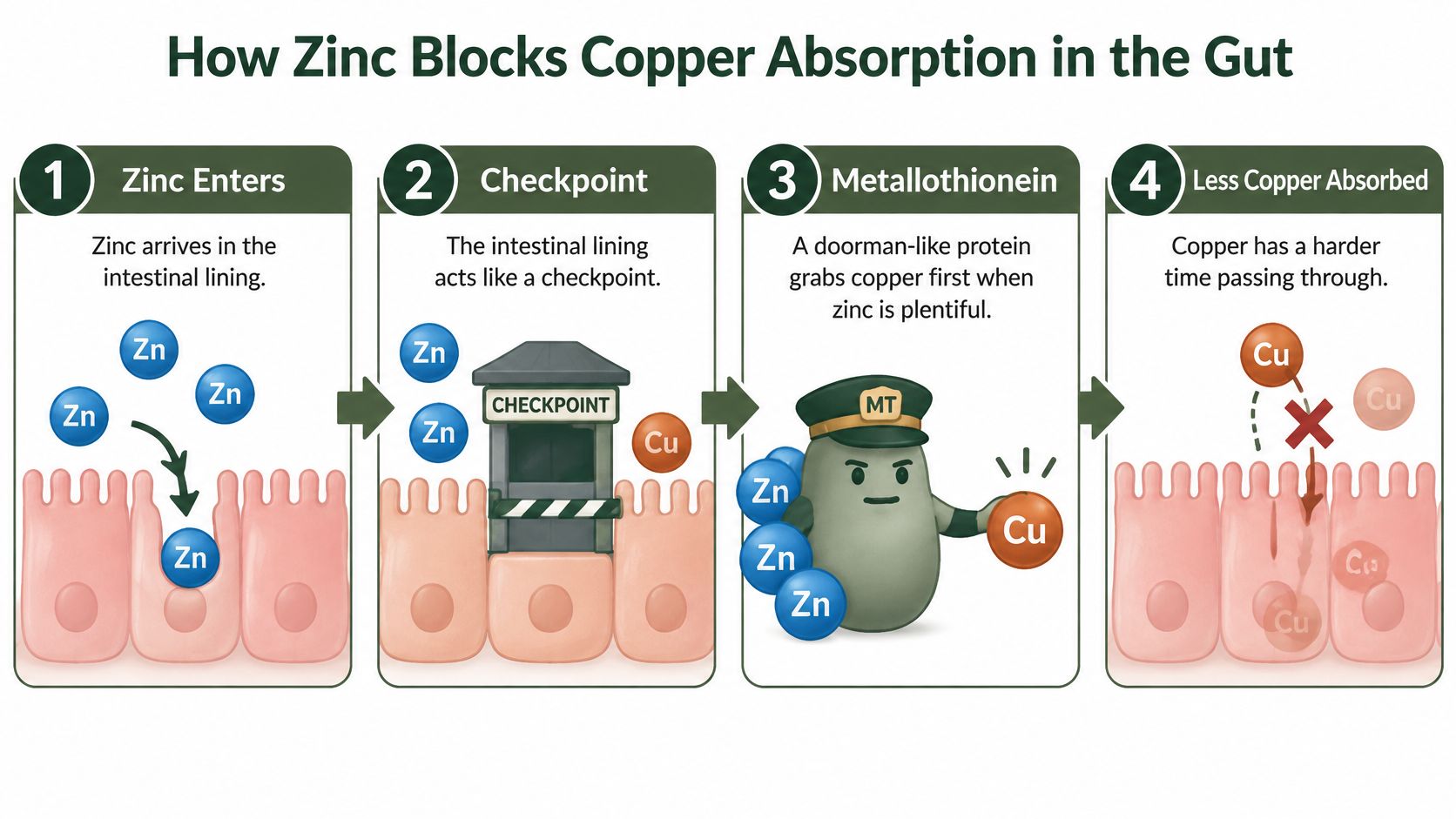
Think of the enterocyte, the cell lining your small intestine, as a checkpoint with one doorman. When zinc shows up in force, that doorman grabs copper first.
A review of the zinc-copper interaction in the gut lays out the sequence in exactly this order.
- Zinc arrives at a high concentration. A capsule delivers a burst far larger than any meal would.
- Enterocytes produce metallothionein. High zinc exposure stimulates production of this binding protein inside the intestinal cells.
- Metallothionein prefers copper. It binds copper more strongly than it binds zinc, and that preference is the entire mechanism.
- Copper gets stuck. Newly available copper stays inside the enterocyte instead of crossing into systemic circulation.
- The cell sheds and the copper leaves. Enterocytes slough off naturally, carrying metallothionein-copper complexes out in feces.
- Circulating copper falls. Over weeks, even though copper intake never changed.
The pace explains the timeline. Each round of cell turnover carries away a small amount of copper, so depletion builds across weeks rather than days. Someone taking a high dose for a long weekend will not notice anything. Someone taking it every morning since spring may.
The trigger is the zinc-driven signal, not zinc as a substance. A three-day course at a modest amount produces a very different signal from a 50 mg capsule taken daily for three months with a multivitamin and an occasional lozenge stacked on top.
Absorption depends on more than mineral competition, too. Meal composition, stomach acid and timing all shift how much of any mineral crosses the intestinal wall, which is why our guide to how to increase nutrient absorption pairs naturally with this one. Basic daily habits that boost nutrient uptake, such as chewing thoroughly and keeping meals varied, change the arithmetic as well.
What decides the outcome: not whether zinc is present, but the total dose and how many weeks it continues.
Why Copper Is Paired With Zinc in Combined Products
If excess zinc pulls copper out of circulation, then supplying copper alongside zinc gives the intestine more copper to absorb at the same time. That's the whole logic behind a combined capsule, and it answers the search question directly: copper is included to offset some of the loss the zinc creates.
That offset is real and limited. A combined product carrying 50 mg of zinc still lands above the adult upper limit, and the copper inside it doesn't change that arithmetic. Copper softens the loss a high dose causes. It doesn't cancel the dose.
Reference values also don't specify a target zinc-to-copper ratio, so don't chase one you saw in a forum thread. What you can check is arithmetic.
Label check: find the elemental zinc and the elemental copper per serving, add each to your totals from other products, and compare both with the adult upper limits for each mineral.
Copper has a second life in skin research that has nothing to do with intestinal absorption. If you've come across copper peptides, this GHK-Cu vial reference describes that compound and where it's used. Topical copper and dietary copper solve different problems, and neither substitutes for the other.
Combined formulas are usually taken as one capsule with both minerals together. Any question about splitting doses or changing timing belongs with a clinician, not with a label.
Recommended Amounts and Upper Limits for Both Minerals
| Mineral | Recommended intake for adults | Tolerable upper intake | Main roles |
|---|---|---|---|
| Zinc | 11 mg for men, 8 mg for women | 40 mg a day from all sources | Immune function, wound healing, protein and DNA synthesis |
| Copper | 900 micrograms a day | 10 mg a day | Iron use, red blood cells, nerves, copper-zinc superoxide dismutase |
Read this table as a pair of boundaries. The zinc row is the same yardstick used in the earlier dose examples, so the fresh work here is copper: 900 micrograms is 0.9 mg, while the adult ceiling is 10 mg. That gap looks wide, yet copper still falls when zinc keeps the intestinal metallothionein signal switched on and enterocytes carry trapped copper out as they shed.
Copper helps the body use iron for red blood cells, supports nerve insulation and connective tissue strength, and sits inside copper-zinc superoxide dismutase, an antioxidant enzyme cells use to manage oxidative stress. Its weakness is positioning, not importance. Zinc and copper compete for the same handling in the gut, so a short course and months of high intake are different problems even when the label looks similar.
Food usually covers both minerals without much planning. Copper is easiest to keep steady through shellfish, nuts and legumes, while red meat and fortified cereals lean more toward zinc; soil conditions and cooking water can shift the exact mineral content, so diet totals are estimates rather than lab values. A varied plate also delivers copper beside protein and other food compounds instead of beside a large isolated zinc dose.
If you want the fuller picture beyond this interaction, this overview of zinc benefits for skin and healing covers the roles people already know about. For supplement math, our guide to how to read supplement labels shows where compound weight and elemental weight diverge, which matters because a capsule listing 50 mg of zinc gluconate does not deliver 50 mg of zinc.
Food first, supplements second: a varied diet keeps both minerals in range for many healthy adults, and capsules fit the cases where diet falls short or a clinician recommends them.
The practical target is steady arithmetic: count every source, respect both ceilings, and keep copper intake consistent enough that dose and duration do the deciding.
Who Faces the Greatest Risk of Copper Loss
The people who run into trouble are rarely the ones finishing a labeled one-week course. Ordinary diets seldom reach the depletion threshold on their own, and the NIH copper fact sheet for health professionals notes that intakes near 50 mg of zinc a day are unlikely to come from food alone, tying them instead to supplements or zinc-containing denture adhesives.

The dose thresholds from the table above define the exposure window these groups fall into. What separates one group from another is how long the exposure runs, or how little copper was in reserve to begin with.
- Therapeutic zinc users. Prescribed high doses for months keep the metallothionein signal switched on far longer than a cold-season course ever would, so copper keeps getting trapped in gut cells and shed with them.
- People with malabsorption. Celiac disease, Crohn's disease and chronic diarrhea reduce the surface available to absorb copper, so reserves start lower before zinc even matters.
- Anyone with gastrointestinal surgery. A shortened absorptive surface narrows the margin in the same way, and the effect is permanent rather than episodic.
- Restrictive eaters. When copper-rich foods such as shellfish, nuts and legumes are absent, there is less incoming copper to offset what zinc removes.
- Daily denture adhesive users. High-zinc creams deliver steady exposure that never looks like a supplement, and the dose repeats every single day. That pattern is exactly why the NIH links neurological cases to these products.
- People with anemia or low neutrophils. These findings on routine blood work can be part of a copper picture nobody has named yet, especially when iron treatment has already failed to explain them.
Copper supplementation isn't the automatic answer for any of these groups. Adding copper without a measured shortfall can push the balance the other way, and it won't fix a dose that's too high in the first place.
The practical step is the same across the list: count every source of zinc, then bring your full product list to a clinician, including lozenges, multivitamins and denture creams.
Signs of Imbalance and When to Seek Medical Advice
Numbness is the symptom that should stop you. NIH guidance on copper documents neurological consequences in severe cases, including loss of coordination, numbness and weakness, and notes that high-dose zinc-containing denture adhesives have caused neurological disease and anemia.
Those outcomes follow months of low copper, not a single dose. Recognizing the earlier and vaguer signs is what buys you time to act before them.
| Symptom | Possible link | Next action |
|---|---|---|
| Numbness, tingling or loss of coordination | Neurological effects linked to low copper | See a clinician promptly |
| Leg weakness or unsteady walking | Neurological effects linked to low copper | Seek urgent medical evaluation |
| Fatigue with pale skin or low hemoglobin | Anemia, which can involve low copper | Blood tests for copper, iron and B12 |
| Low white blood cell count on routine testing | Neutropenia, which can involve low copper | Clinician review and repeat blood count |
| Mild digestive upset that persists | Non-specific, many causes | Pause extra zinc and discuss at the next visit |
Most of these signs have several possible causes, and none of them diagnoses copper status on its own. What they do is tell you when to stop improvising with a supplement bottle.
Expect a clinician to order copper and zinc blood levels, iron and B12, and a complete blood count. Keep a written list of every zinc-containing product you use, including lozenges, multivitamins and denture creams, because the total is what gets reviewed. Long-standing fatigue, hair shedding or slow healing have their own checklist in our guide to signs of nutrient deficiency.
The line to hold: if a symptom is sudden, getting worse, or affects your walking and balance, seek care without waiting for a scheduled appointment. Mild digestive upset on its own is a reason to pause extra zinc and raise it at your next visit.
How to Take Zinc and Copper Safely Together
What follows is the routine that keeps the arithmetic in range, whether you're taking zinc for a week or a season.
- Read elemental zinc, not compound weight. Zinc gluconate and similar forms supply only a fraction of their listed weight as actual zinc, so the number you need sits next to the word "elemental" on the supplement facts panel.
- Add up every product. Multivitamins, lozenges, fortified cereals and denture creams all count toward the same total.
- Check the copper number. If a formula includes copper, add it to your copper total from food and other products.
- Stay at or below the adult zinc upper limit from all sources unless a clinician directs otherwise.
- Set a review date. Two to four weeks is long enough to know whether the course helped and short enough to avoid drifting into months.
- Don't stack for immune support. Two products taken "just in case" add up faster than one product taken deliberately.
- Ask about copper testing if zinc use runs past a few weeks, especially if you fall into one of the higher-risk groups.
Then it comes down to three decisions. Total your current zinc. Decide whether extra zinc is needed at all, given that food already supplies the recommended amount for most adults. If it is, choose a formula with clear elemental zinc and copper numbers rather than a proprietary blend that hides both.
A combined formula looks like this on a label.
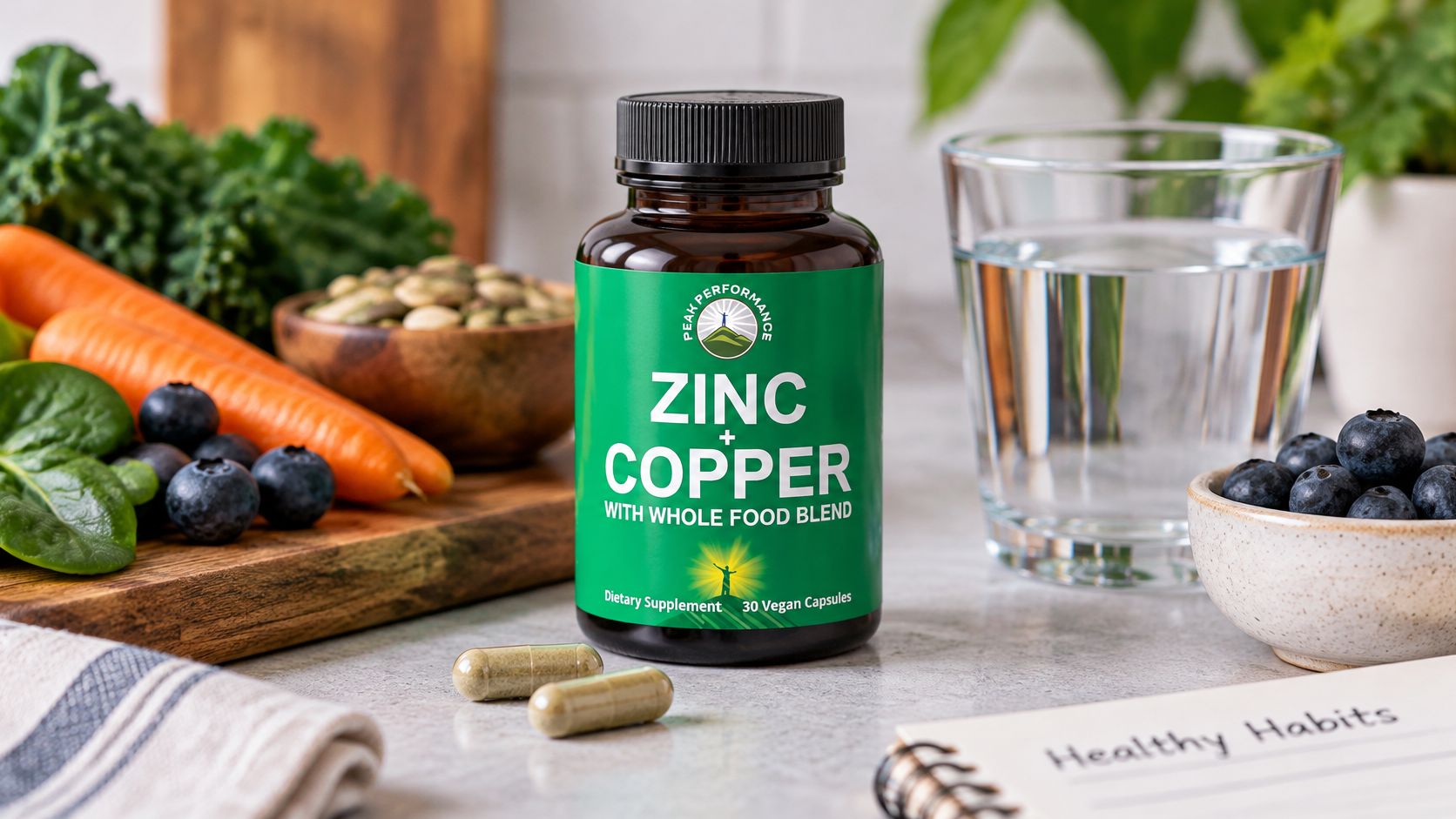
If a combined capsule fits the plan you and your clinician settled on, Zinc with Copper Capsules from Peak Performance pair the two minerals in one product, add a whole food blend of 25 vegetables and fruits, and are formulated for men and women. They cost $16.95, and the formula is vegan, free of gluten, additives, preservatives, artificial colors, soy and dairy, and manufactured under GMP regulations and USA standards.
A copper component doesn't remove the dose ceilings or the need for monitoring, and no capsule prevents depletion or changes your energy levels. It's a formulation choice that sits inside the limits described above, nothing more.
If you're in one of the higher-risk groups, book a check-in and bring everything you take, including the products you only use occasionally.
Peak Performance makes its zinc with copper as a single combined capsule, third-party tested and free of gluten, additives, preservatives, artificial colors, soy and dairy, so both minerals arrive in one serving instead of two competing bottles. If you're rebuilding a routine around a sensible total dose, you can see that formula alongside the rest of the range at Peak Performance. Take the label check with you, total what's already on your shelf, and set a date to look at the numbers again.


