


Reds Superfood Powder vs Greens: Do You Need Both?
The advice you hear most about superfood powders is to buy greens and leave the reds on the shelf. Greens are the vegetable one, the reasoning goes, and reds are fruit sugar in a scoop with a berry on the label. That gets the compound list half right and the conclusion wrong, because the two products aren't competing versions of the same thing.
Greens powders are built around leafy plants and what comes with them: chlorophyll and minerals. Reds powders are built around berries and beetroot, which carry anthocyanins, betalains and dietary nitrate. Judged as substitutes, each one loses. Judged as different tools, the comparison gets useful.
Neither is a multivitamin, and neither replaces vegetables. The question worth answering is which compound set you're trying to buy, and whether the label in front of you delivers a dose that research has tested. That's a label question more than a color question, and it's where most comparisons stop short.
Reds and Greens Powder Side by Side
Core nutrients in reds versus greens powders
| Nutrient group | Reds powder | Greens powder | What to check on the label |
|---|---|---|---|
| Polyphenols and anthocyanins | Berries such as raspberry and elderberry, plus beetroot | Present in some greens blends, amount varies by formula | Named fruit sources and measured amounts |
| Dietary nitrate | Beetroot, the main nitrate source in reds | Leafy greens such as spinach and kale | Milligrams of nitrate per serving |
| Betalains | Beetroot | Not a defining feature | Whether beetroot is listed with a stated amount |
| Chlorophyll | Minor, not a defining feature | Core feature from leafy plants, spirulina and chlorella | Chlorophyll amount, if declared |
| Alkalizing minerals (potassium, magnesium) | Present, amount varies by formula | Core positioning of most greens blends | Mineral values on the Supplement Facts panel |
Two rows decide most purchases: nitrate and polyphenols. On nitrate, reds concentrate beetroot, a high-nitrate vegetable, while greens reach nitrate through spinach and kale. A recent review describes beetroot and other nitrate-rich vegetables as supplying dietary nitrate, betalains, polyphenols and minerals, with proposed effects running through the nitrate-nitrite-nitric oxide pathway, vasodilation and oxygen delivery (the 2025 review). That review also ties the size of the response to dose, timing, training status, oral bacteria, exercise type and processing, which is exactly why the label beats the category.
The polyphenol row splits more cleanly. Reds stack berries, usually raspberry and elderberry alongside beetroot. Greens blends sometimes include fruit powders, but fruit is rarely the point of the formula.
Read the table as a starting framework, not a rule. Leafy greens supply nitrate, and beets supply minerals and polyphenols, so the categories overlap at the edges.
Every cell in the last column assumes the manufacturer declares something. Many don't. The table describes typical formulas, not guaranteed amounts, and the Supplement Facts panel on the specific tub decides.
Buy the powder whose nutrient group matches your goal first. Then read the second label and ask what it adds that the first one lacks. If the answer is nothing, you've saved a subscription.
What Polyphenols and Anthocyanins Bring to Reds
The active group in a reds superfood powder is polyphenols, and mainly one subclass: anthocyanins, the pigments responsible for many red, blue and purple plant colors. A peer-reviewed review published in 2010 reported that fruits such as grapes, apples, pears, cherries and berries contain approximately 200 to 300 milligrams of polyphenols per 100 grams of fresh weight, and described anthocyanins as the compounds investigated for antioxidant, anti-inflammatory and lipid-oxidation-related effects (the 2010 review).
The Fruit You Choose Moves the Number by a Factor of Two Thousand
Anthocyanin content isn't a fixed property of "red fruit." A USDA-linked analysis of more than 100 common foods identified 24 that contained anthocyanins, with measured concentrations from 0.7 to 1,480 milligrams per 100 grams of fresh weight. Chokeberry recorded the highest figure at 1,480 milligrams, while the bottom of the range sat close to zero (the USDA-linked analysis). The same analysis reported that eating more than 100 milligrams a day is achievable through regular servings of blackberries, raspberries, blueberries and Concord grapes.
That range is the argument for reading an ingredient list rather than a color. Raspberry and elderberry sit high on the scale. A blend padded with apple and pear powder sits low, and the scoop still looks red.
Absorption Limits What a Serving Can Do
Here's where marketing and physiology part company. A review of berry pharmacology reports that polyphenols generally have low bioavailability and that anthocyanins appear in human plasma at low concentrations roughly 0.5 to 1 hour after ingestion (the berry pharmacology review). Effects, where they exist, likely run through transient parent compounds, gut-derived metabolites and signaling pathways, not through a high, sustained blood level.
That distinction matters for how you read claims. The 2010 review draws a line between biological activity seen in laboratory models and proven health outcomes in people, and states that a red powder should not be treated as equivalent to whole-fruit consumption or as a disease-prevention product.
The label test: an ingredient list that names raspberry, elderberry and beetroot with amounts can be checked against the research. A front label that says "antioxidant blend" cannot.
A reds superfood powder earns its price when the fruit sources are named and the amounts are measurable. Everything else is pigment.
Nitrate Doses and Exercise Performance in Reds
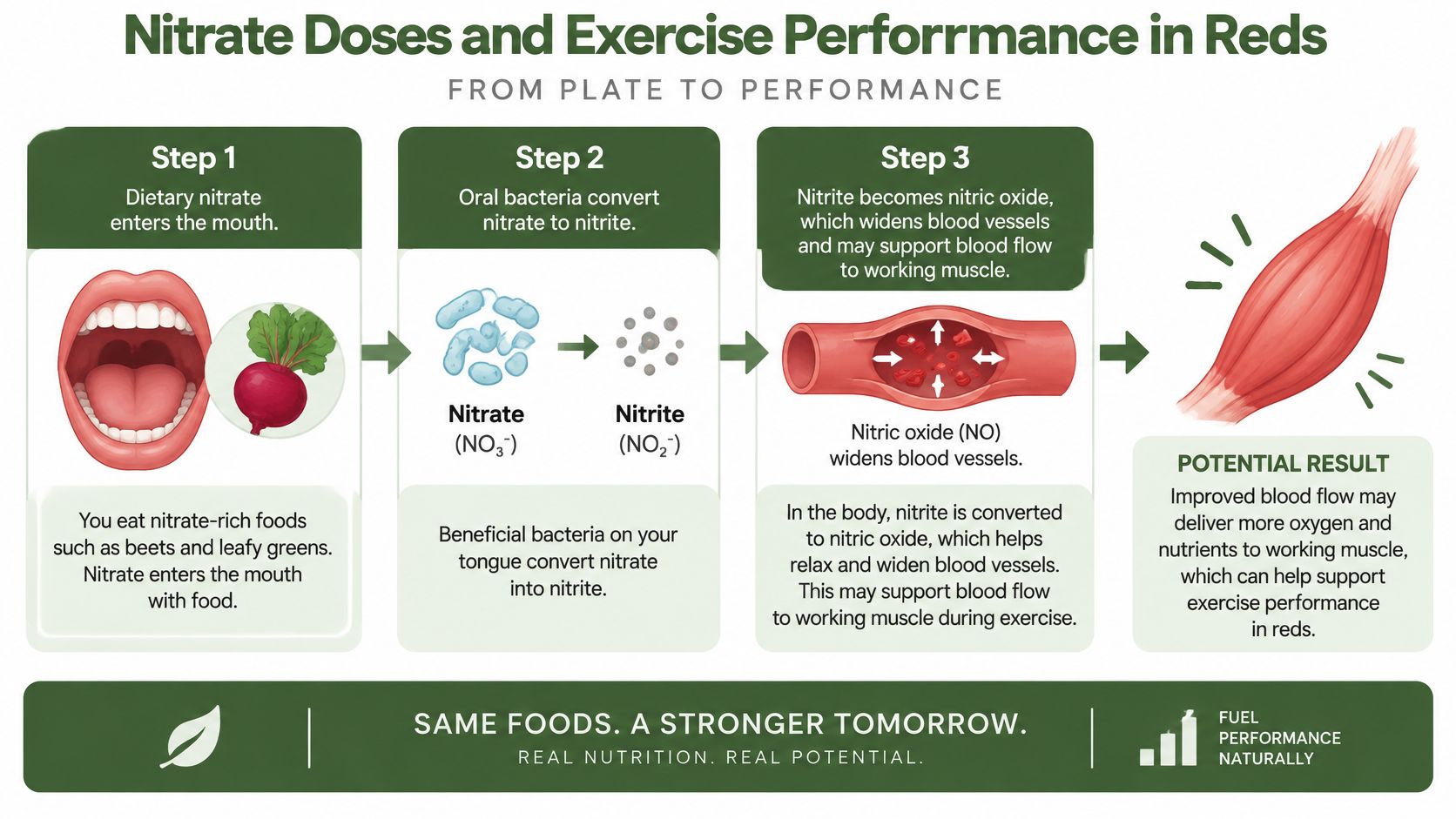
Nitrate works through a route no stimulant uses. You swallow nitrate, oral bacteria reduce part of it to nitrite, and nitrite becomes nitric oxide, a molecule that widens blood vessels and can support blood flow and oxygen delivery to working muscle.
The dose response is one of the better documented in sports nutrition. A 2025 umbrella review covering 20 systematic reviews, 180 primary studies and 2,672 participants found that dietary nitrate improved time to exhaustion, total distance, muscular endurance, peak power and time to peak power, though not every outcome measured (the 2025 umbrella review in Sports Medicine). The clearest benefit appeared at at least 6 mmol of nitrate per day, about 372 milligrams, taken for longer than three days.
A systematic review of nitrate timing fills in the practical side: acute doses of 5 to 14.9 mmol, about 310 to 925 milligrams, were most effective at least 150 minutes before exercise, repeated use was optimal around 5 to 9.9 mmol per day, and benefits were most evident in exercise bouts lasting 2 to 10 minutes (the nitrate timing review).
Nitrate doses in exercise research and what they mean for a label
| Use case | Nitrate dose | Timing | What the research shows |
|---|---|---|---|
| Acute dose before exercise | 5–14.9 mmol (about 310–925 mg) | At least 150 minutes before | Most effective; benefits clearest in 2–10 minute bouts |
| Repeated daily use | 5–9.9 mmol per day | Once daily | Optimal range for repeated use |
| Clearest reported benefit | At least 6 mmol (about 372 mg) | Daily for more than 3 days | Gains in time to exhaustion, total distance, endurance and peak power |
Where the Evidence Thins Out
The umbrella review also shows uneven results across groups: a 2025 analysis of healthy females found small, non-significant effects on muscle strength and sprint performance, with power improving modestly.
The U.S. National Institutes of Health takes a similarly measured line. Beetroot has improved endurance or performance in some, but not all, studies involving runners, swimmers, rowers and cyclists, with the approach most often used being about 2 cups of beet juice, 2.5 to 3 hours before exercise. The evidence is stronger for recreationally active adults than for highly trained athletes, and the agency states it isn't yet known whether beetroot powder produces the same effects as beet juice (NIH Office of Dietary Supplements).
Nitrate is one lever among several. Carbohydrate, electrolyte and caffeine strategy all interact with it around a session, and this comparison of carbs, electrolytes and caffeine lays out how the pieces fit together. For the whole-food version of the same strategy, the breakdown of beet juice benefits covers what the juice itself delivers.
Practical rule: a reds superfood powder that lists beetroot only by weight tells you nothing about nitrate. One that states milligrams of nitrate per serving lets you compare a scoop to the ranges above. That single number is the difference between a performance product and a red drink.
Where Greens Powder Earns Its Place
Greens powders sell a different compound set, and the honest version of the pitch is narrower than the marketing. Chlorophyll is the pigment that makes leafy plants green, and most blends are built on spinach, kale, moringa, spirulina and chlorella. What the label owes you is quantity: milligrams of each plant per serving, because a blend can list five greens and still be mostly one of them.
Minerals Are the Checkable Claim
A mineral claim can be verified in a way a chlorophyll claim usually can't. USDA FoodData Central reports values for calcium, magnesium, manganese, phosphorus, potassium, selenium, sodium and zinc, ingredient by ingredient, so a label promising potassium or magnesium from spinach can be compared against the documented value (USDA FoodData Central Foundation Foods documentation). That comparison cuts both ways: it confirms a real contribution, and it exposes a scoop too small to deliver one.
"Alkalizing" on a greens tub is marketing phrasing for leafy vegetables plus minerals. The body holds blood pH within a narrow range on its own, so the useful question is which minerals the panel actually declares and at what dose.
If you want the full ingredient-by-ingredient picture of what a greens blend contributes, the guide to organic greens powder benefits walks through the plant list. Before you use any greens product as a daily base, confirm four things:
- The ingredient list with amounts. A blend naming 20 plants without quantities hides which ones dominate the scoop.
- A declared chlorophyll figure, if the label leans on chlorophyll. Without a number, chlorophyll is a color, not a dose.
- Mineral values from the Supplement Facts panel. Compare per serving, since per-100-gram figures flatter a product nobody eats in 100-gram portions.
- The serving size that produces those numbers. A 5-gram scoop and a 12-gram scoop aren't the same product with a different label.
Checking a Red Powder's Label and Test Results
"Organic," "natural" and "third-party tested" appear side by side on most tubs. Each of those terms is checked separately, so a pass on one proves nothing about the others. Supplement testing frameworks treat ingredient identity, label potency, heavy metals, microbial contamination, pesticides, residual solvents, undeclared drugs or banned substances, and stability as distinct tests (the nutraceutical testing checklist from BSCG).
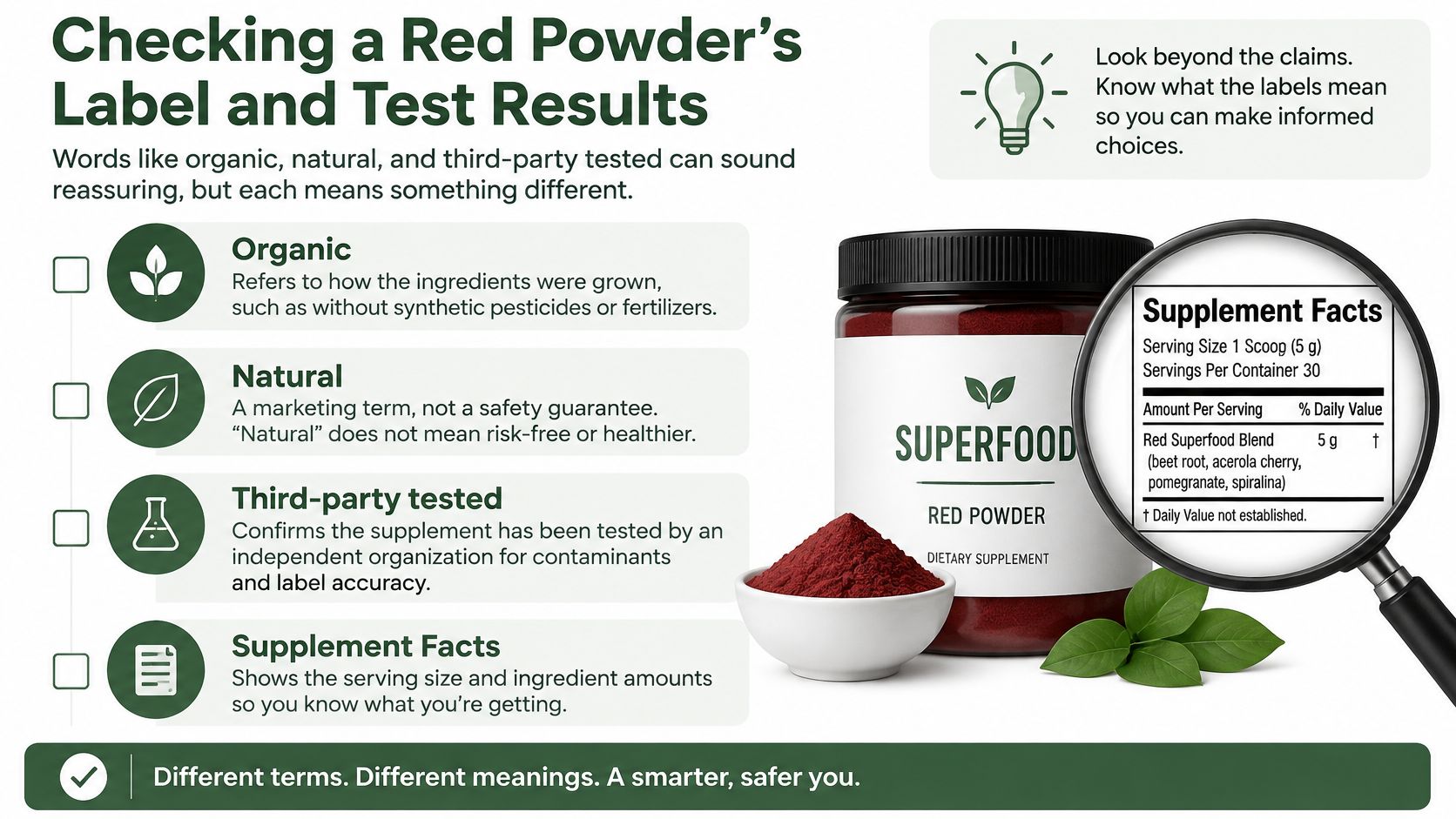
Nitrate per serving is the first thing to verify on a reds powder, and that check gets its own analysis in the performance section earlier in this guide. The four checks below cover everything else.
Four checks for any red powder's certificate or Supplement Facts panel
| Check | What to look for | Red flag |
|---|---|---|
| Polyphenol sources | Named fruits with measured polyphenol or anthocyanin amounts | Generic antioxidant blend |
| Contaminant tests | Heavy metal and microbial results on the same lot | Tests not tied to the batch sold |
| Certificate of analysis | Batch match and date of analysis | Certificate covers a raw ingredient only |
| Result format | Quantitative values with detection limits | Simple pass or fail statement |
One question the table can't answer for you: who ran the tests. A certificate issued by the seller's own quality department carries less weight than one from a lab with no financial tie to the product.
Testing and efficacy are different questions with different evidence. A clean certificate proves the product is what the panel says it is. It cannot prove the blend improves energy, immunity, detoxification or athletic performance.
The mechanics of reading the panel itself are covered in this guide to how to read supplement labels. Before you buy, open the Supplement Facts panel and any certificate the seller publishes. If no certificate is published, that silence is your answer.
How to Use Reds and Greens Powder Together
Combining the two is chemically plausible, because the categories don't hold mutually exclusive nutrients: greens bring leafy-plant compounds, chlorophyll and minerals, while reds bring berry polyphenols, anthocyanins, beetroot betalains and nitrate-related compounds (NIH consumer guidance on exercise and athletic performance). What that guidance doesn't do is establish a rule that every reds powder and greens powder should be mixed.
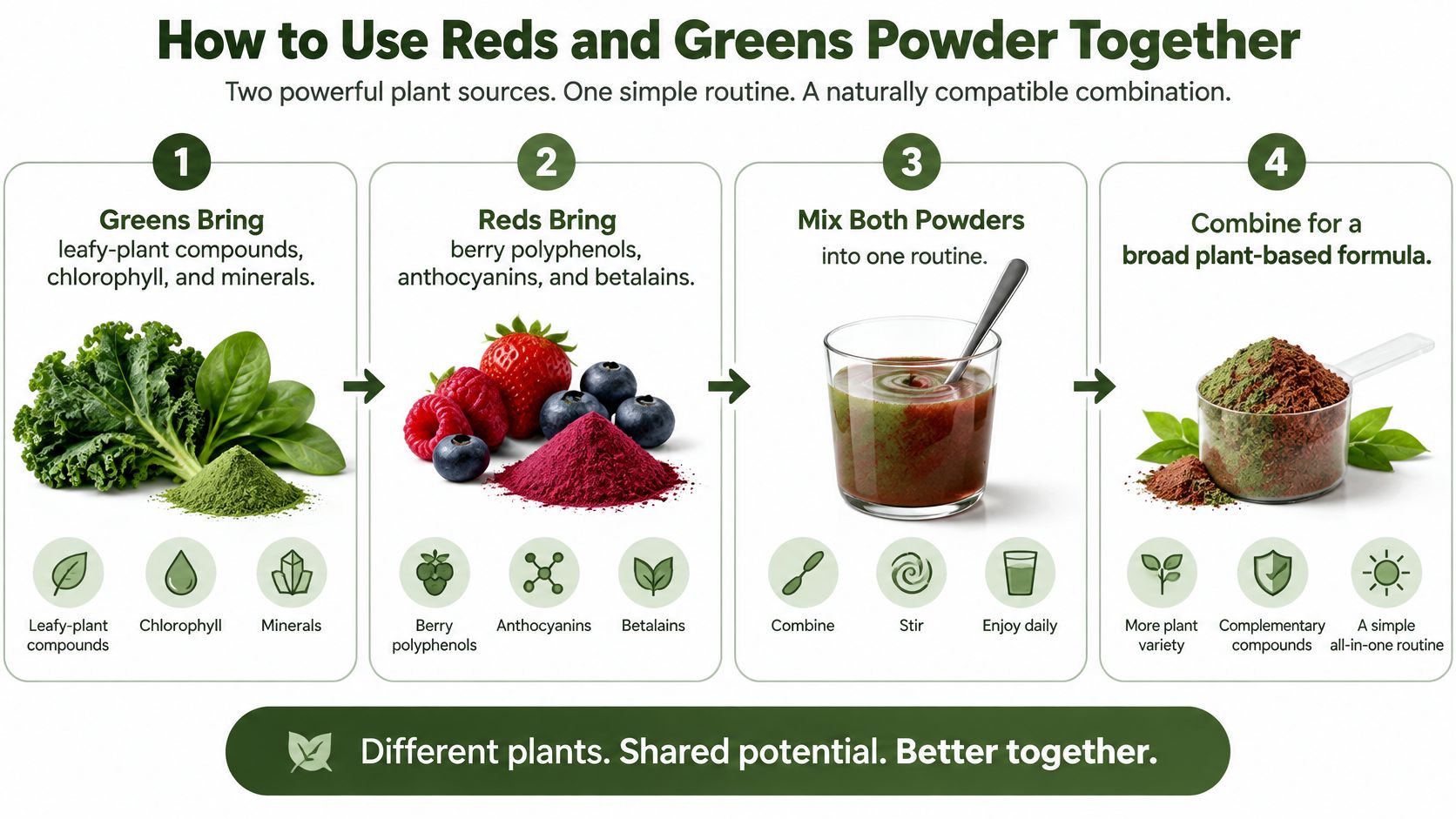
So the decision comes down to the two panels in your kitchen. Run these checks in order:
- Lay both Supplement Facts panels side by side before you mix anything. Duplicate ingredients are the most common waste in a stacked routine, and they're invisible if you only read one label.
- Add up the overlaps. Spinach, spirulina and beetroot appear in both categories. Two half-doses of the same plant can add to one full dose, or to a full dose twice.
- Check the stimulant, vitamin and mineral lines across both products. A greens blend with added B vitamins plus a reds blend with added vitamin C is a different product from either one alone, and the totals are what you swallow.
- Read the warnings against your own medication list. Prescription drugs, thyroid conditions, pregnancy and blood-pressure treatment all change the decision. When the label gives you a reason to ask a clinician, ask.
- Don't stack two nitrate servings into one training window. If both tubs list beetroot, you're guessing at the combined dose, and guessing is exactly what a milligram figure was supposed to eliminate.
- Run the combined routine for a week before judging it. Two scoops a day is a habit question as much as a nutrition one. If you keep skipping the second scoop, buy one product and stop paying for the other.
On paper, a sensible combined day looks like this: greens with breakfast, where the minerals and chlorophyll are the point, and the red scoop ahead of your session rather than after it. Nothing about that schedule requires buying both on day one. It requires two labels you've read.
Choosing Reds, Greens or Both for Your Goal
Reds are the better first buy for exercise or fruit-polyphenol goals, provided the label states nitrate in milligrams or names its berry sources. Greens are the better first buy when you want daily chlorophyll and minerals and the panel shows mineral values. Both earn a place only after you've checked for duplicate ingredients and added the totals.
The compounds overlap less than the marketing suggests. Reds carry anthocyanins from berries and nitrate from beetroot, while greens carry chlorophyll and the minerals that leafy plants concentrate, so the decision is really about which compound class your diet is missing.
Which powder fits your goal
| Your goal | Start with | Add the other when |
|---|---|---|
| Exercise performance in short or endurance efforts | Reds, if the label lists nitrate in milligrams | You also want daily chlorophyll and minerals from leafy plants |
| Daily polyphenol intake from fruit | Reds, if berry sources and amounts are named | Your diet is light on leafy vegetables |
| Daily greens and mineral support | Greens, with mineral values verified | You want berry and beetroot polyphenols as well |
| Both goals on one routine | Both, with split timing | Duplicate ingredients and totals have been checked |
The word "need" overstates what any guideline supports. Powders are optional by definition, and a plate with fruit and leafy vegetables delivers the same compound classes with fiber attached. Treat the pair as a choice that depends on your goal and on what your diet already delivers.
For the exercise or polyphenol path, Peak Performance's Organic Reds Superfood Powder is a direct option: 25+ all-natural ingredients and polyphenols including raspberry, elderberry and beetroot, at $43.95 (Organic Reds Superfood Powder). The ingredient panel on that product page is the version to weigh against your greens candidate.
Then make one comparison. Put the nitrate figure from your reds candidate next to the studied range, and the mineral values from your greens candidate next to your daily target. Whichever label declares more, wins.
Peak Performance blends organic greens and reds superfood powders with 25 or more organic or all-natural ingredients, including the raspberry, elderberry and beetroot behind the red color, and puts every batch through third-party lab testing. If you're building the combined routine described here, start with one tub and one label you can read from top to bottom. Visit Peak Performance to compare the reds and greens formulas side by side and see which one matches your goal this month.


