


Saffron vs. Ashwagandha: Which Herbal Fits Your Routine?
Search for a natural way to take the edge off a hard week and the same advice keeps returning: ashwagandha for stress, saffron for mood, and if you can't choose, take both. The last part is the popular advice, and it's the part with the least behind it.
Saffron and ashwagandha have both been through randomized trials, but not the same trials, and not for the same reasons. One was tested mainly as a mood intervention in adults with mild to moderate depression. The other was tested mainly against stress, anxiety and cortisol. Their doses sit on different scales, their extracts are standardized to different compounds, and the study lengths differ enough to change what you should expect in week one versus week eight.
There's a second difference that rarely makes it into comparison pieces. Saffron is a scarce, hand-harvested crop, which makes the supply chain behind the capsule as much a part of the decision as the trial data. A label that says "premium" tells you nothing you can check.
The useful comparison runs on the rows that can be compared, then passes through two filters. Can you commit to the timeline the evidence used? And can you verify the label in your hand?
Saffron and Ashwagandha Side by Side
The herbs differ in more than dose: their plant parts, extract standards and research questions are distinct. The table summarizes those differences and the trial counts reported in the American Botanical Council's clinical summary of saffron and ashwagandha.
| Attribute | Saffron | Ashwagandha |
|---|---|---|
| Plant part used | Dried red stigmas of Crocus sativus | Root and leaves of Withania somnifera |
| Studied daily dose | 15 to 30 mg of standardized extract | 30 to 600 mg, depending on extract |
| Main research focus | Depression, anxiety, sleep | Stress, anxiety, sleep, cortisol |
| Randomized trials reviewed | 19 | 14 |
| Overall certainty | Moderate at best | Graded outcome by outcome, no single rating |
| Outcomes with no trials | Burnout and post-traumatic stress disorder | Not itemized in the trials reviewed here |
Saffron comes from the dried red stigmas of Crocus sativus, a sterile triploid crocus that cannot reproduce from viable seed. Growers continue to propagate it by lifting and replanting corms, a practice described in a review of saffron's domestication history. Ashwagandha comes from the root and leaves of Withania somnifera, a nightshade shrub.
The studies also use different measures of extract strength. Saffron products may be standardized to crocin and safranal content; ashwagandha products may be standardized to withanolides. So a 30 mg saffron capsule and a 300 mg ashwagandha capsule cannot be compared by milligrams alone.
For context on the proposed nervous-system pathways behind ashwagandha research, see GABA and ashwagandha mechanisms compared.
What the table tells you
- Ashwagandha has the more direct stress focus. Its trials examined stress, anxiety and cortisol.
- Saffron has a stronger mood-research focus. Its trials examined depression scores, anxiety and sleep.
- The evidence gaps differ. Burnout and PTSD were not assessed in the saffron trials summarized here; the ashwagandha summary does not itemize outcomes with no trials.
Time to Effect and Stress Evidence
Six weeks is the shortest honest answer to "when will I feel anything," and that number comes from trial schedules rather than label copy. Both herbs were tested on timelines counted in weeks, so the schedule sets realistic expectations better than anything printed on the front of a bottle.
For saffron, the most common protocol in randomized trials was 30 mg per day for about six weeks in adults with mild to moderate depression, with clinically meaningful falls on the Hamilton Depression Rating Scale. Within that same literature, a meta-analysis reported in a review of the saffron trials covering five trials and 278 participants found saffron reduced depressive symptoms against placebo, with a standardized mean difference of -1.22 (95% confidence interval, -1.94 to -0.49; p<0.001).
Ashwagandha runs on a similar clock. A systematic review and meta-analysis in BJPsych Open pooled 491 adults with self-reported high stress or anxiety, or a diagnosed anxiety disorder, randomized to ashwagandha or placebo for six to eight weeks. At eight weeks it found mean reductions of -3.52 on the Hamilton Anxiety Rating Scale, -4.88 on the Perceived Stress Scale and -2.3626 on cortisol versus placebo (p<0.0001).
What each measure actually tracks
Those three numbers describe three different experiences. The Hamilton Anxiety Rating Scale is completed by a trained clinician after an interview, so it captures observed signs alongside reported ones. The Perceived Stress Scale is a self-report questionnaire about how overloaded and out of control life has felt over the past month. Cortisol is a hormone measure of the body's stress axis, and it swings with time of day, sleep quality and when the sample was drawn.
A fall on a questionnaire and a fall in a blood marker are different kinds of news. Neither predicts how a given Tuesday will feel.
Practical rule: judge at week eight, not week one. Trial data do not separate changes in the first seven days from expectation effects, one better night's sleep or ordinary day-to-day drift.
A tracking routine that produces something useful
- Score yourself on day one, before the first dose, on the thing you want to change. Rate mood or stress from 1 to 10, in the same slot each time.
- Repeat at week four. Treat it as a checkpoint. Note sleep hours and anything unusual that week.
- Repeat at week eight. Three data points show a direction, where a single reading shows only a mood.
- Hold dose, brand and time of day steady for the whole window, because the trials behind both herbs dosed daily on a fixed schedule. Change three variables at once and you learn nothing about any of them.
If nothing has moved by week eight, the useful next step is a conversation with a clinician, written record in hand. Raising the dose on a hunch changes a variable you can't interpret. If you're building a broader daily routine rather than choosing one capsule, a guide to adaptogens for stress relief covers how these botanicals sit alongside sleep, light and training load. For a clinician-facing read on the anxiety data specifically, Refresh Psychiatry & Therapy on ashwagandha separates what was measured from what gets claimed.
What to expect over the first eight weeks
| Timeframe | Saffron | Ashwagandha |
|---|---|---|
| First week | Too early to judge from trial data | Too early to judge from trial data |
| Weeks 2 to 4 | No separate readout, keep the record going | No separate readout, keep the record going |
| About 6 weeks | Standard endpoint in depression trials at 30 mg per day | Common endpoint for stress and anxiety trials |
| 8 weeks | Used in mood trials reviewed | Stress, anxiety and cortisol measured in meta-analysis |
Both literatures built their results on daily, consistent use over weeks. A single capsule on a heavy morning isn't a trial design, and it won't tell you anything the record would.
Focus Claims and Nootropic Limits
Many saffron and ashwagandha comparisons promise sharper focus within the hour. Look at what the trials measured and that promise falls apart.
A nootropic is any substance marketed to improve thinking, memory or attention. The word describes a marketing category, not a regulated one, so it can be attached to almost anything. What matters is whether the outcome a product claims was the outcome researchers measured.
A three-question test for any focus claim
- What does the claim measure? Focus, memory, mood and stress are four different endpoints. Saffron's trials centred on depression, anxiety and sleep, with some cognitive and mental-health outcomes examined. Ashwagandha's centred on stress, anxiety and cortisol. Neither line of work established a reliable gain in attention.
- How long did the studies run? If a claim is about same-day sharpness, it should come from a same-day study. Trials that ran for weeks and reported at the end can't support an acute effect, no matter how the label reads.
- What else is in the capsule? Check the panel for caffeine and other stimulants, and note anything the trials didn't test. A formulation that borrows its alertness from caffeine is making a caffeine claim, not a botanical one.
Say you want to clear a deadline-heavy afternoon. Practical levers are sleep debt from the night before, whether you ate, and whether you've taken a break, none of which a six-week mood trial touches.
A supplement that takes weeks to shift a mood score cannot rescue a 3 p.m. slump, and no capsule substitutes for sleep, food or a walk outside.
Persistent focus trouble is a different problem from a flat afternoon. A sudden drop in concentration, or focus problems that arrive alongside low mood, deserve a clinician visit rather than months of supplement trial and error. When attention difficulties are long-standing rather than situational, ADHD counselling at Interactive Counselling outlines how a proper assessment is structured, which is more informative than guessing at dosages.
How to Check Saffron Quality Before You Buy
Authenticity is the weak point in any saffron purchase, and it's a supply-chain problem that a label cannot fix on its own. A 2025 systematic review covering 23 studies estimates that 20 to 30 percent of commercial saffron is adulterated globally, ranging from roughly 3.5 percent in regulated European Union markets to as high as 60 percent in India, per that review in Critical Reviews in Food Science and Nutrition.
Adulterants named in the review include safflower, marigold, turmeric, other plant material and synthetic dyes such as Sudan compounds and auramine-O. Deep red threads and a strong honeyed smell prove less than shoppers assume, because powdered filler and dye can satisfy both tests at once.
The figure below condenses the checks you can run at the shelf, before any lab gets involved.
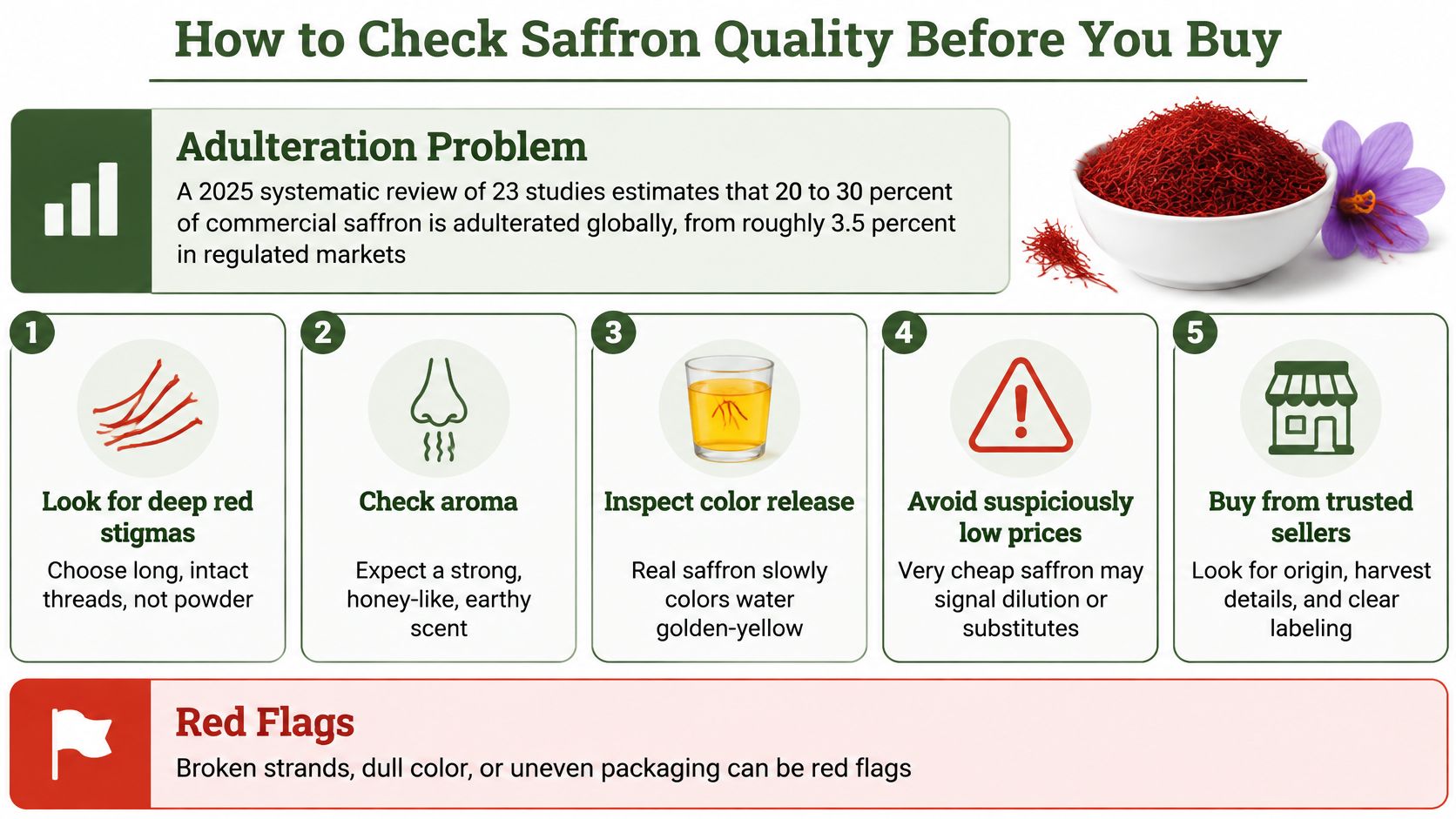
A shelf check can only screen. Measuring anything requires the standardized grading method, spectrophotometry under ISO 3632, which reads the absorbance of a dried aqueous extract, as a review of saffron's analytical markers describes. When a lot is expensive or suspect, chromatography, DNA methods and isotope profiling go further, per a review of saffron authentication methods. The table below maps each test to what it reveals and where its evidence stops; these are also the method names worth looking for on a batch report.
Lab tests that check saffron quality
| Test | What It Reveals | Limit |
|---|---|---|
| UV-visible absorbance at 440 nm | Crocins, the red-orange colour strength | Says nothing about authenticity on its own |
| UV-visible absorbance at 257 nm | Picrocrocin, the bitterness marker | Does not confirm the herb is saffron |
| UV-visible absorbance at 330 nm | Safranal, the aroma-linked volatile | Needs moisture and foreign-matter checks alongside |
| HPLC with photodiode-array or mass spectrometry | Separates saffron compounds from added dyes | Costlier, reserved for high-value or suspect lots |
| DNA-based methods | Detects botanical substitution such as safflower or marigold | Requires a specialist laboratory |
| Stable-isotope and multi-element profiling | Checks the claimed geographic origin | Needs a reference database for the claimed growing region |
A five-step label and paperwork check
- Ask for a batch-level lab report that names its tests. A certificate without method names is decoration. If you're unsure what counts as a real one, how third-party testing works covers what a legitimate panel includes.
- Confirm the label states the extract standardization and the amount per capsule. "Saffron extract" with no milligram figure can't be compared with anything, including the trial doses.
- Check that the report covers moisture and foreign matter. Colour strength alone won't catch a lot stretched with plant filler or stored damp.
- Ask where the material was grown. Origin claims are checkable, and isotope profiling exists precisely because labels aren't always accurate.
- Treat a very low price with suspicion. Saffron is picked three stigmas at a time, and one kilogram takes roughly 100,000 to 150,000 flowers, per a Springer chapter on saffron production economics.
Raw material costs real money before it reaches a capsule. World Bank data records India exporting 10,193 kilograms of saffron worth about US$3.61 million in 2024 (WITS trade data), which sets a rough floor on what honest material costs per kilogram.
A certificate starts the check. The test also has to match the claim being made: a 440 nm reading measures colour strength, an isotope panel measures origin, and neither substitutes for the other.
Who Should Talk to a Clinician First
Situations that call for professional advice first
| Situation | Saffron | Ashwagandha |
|---|---|---|
| Taking prescription medicines | Talk to a clinician first | Talk to a clinician first |
| Pregnant or breastfeeding | Talk to a clinician first | Talk to a clinician first |
| Bleeding risk or blood-thinning medicine | Talk to a clinician first | No specific caution stated |
| Blood-pressure or glucose-lowering medicine | Talk to a clinician first | No specific caution stated |
| Planned surgery | Talk to a clinician first | Tell the surgical team either way |
| Liver or thyroid concerns | No specific caution stated | Talk to a clinician first |
| Diagnosed mood or anxiety condition | Talk to a clinician first | Talk to a clinician first |
The saffron dose picture is narrower than the marketing implies. A systematic review of adverse events found that commonly studied doses of 15 to 100 mg per day generally produced mild, transient side effects, while evidence at 400 mg per day stays thin because the study samples are small, per that review in Health Science Reports. A threshold that held at 30 mg in a six-week trial doesn't automatically cover a concentrated extract at five times the strength.
Culinary use and capsule use are different exposures. A pinch of threads bloomed in broth is not the standardized extract the trials ran on, and results from one form don't transfer to the other.
For ashwagandha, the NIH Office of Dietary Supplements notes that many stress trials were short, and clinical summaries advise attention to possible liver-related concerns during prolonged use, per the NIH ashwagandha fact sheet. Thyroid concerns also warrant advice before starting.
Bring to the appointment: the actual bottle, or a photo of the supplement facts panel, plus your other medications and their doses. "I take a herbal capsule" gives a clinician nothing to check.
Yellowing of the skin or eyes, dark urine or unexplained fatigue while taking any supplement warrants prompt medical assessment rather than a wait-and-see approach. Neither herb replaces prescribed treatment for a diagnosed mood or anxiety condition, and that treatment should stay in place while any supplement is discussed.
Choose the Herb That Matches Your Routine
Which herb fits which goal
| If Your Goal Is | Better Starting Point | Why |
|---|---|---|
| Stress and cortisol in a daily routine | Ashwagandha | Most direct trial evidence on stress and cortisol endpoints at eight weeks |
| Mood support with a studied dose | Saffron | Depression trials used 30 mg per day for about six weeks |
| Quick focus or a stimulant effect | Neither | Evidence points to slow-building effects, not acute stimulation |
| Cooking and flavour | Culinary saffron | Supplement studies used concentrated extracts, not food amounts |
Read that table as trade-offs rather than a ranking, because four things decide the answer: the outcome you want, how many weeks you'll keep a daily habit, the form you can take consistently, and your current health picture.
A daily work-stress routine with poor sleep, no prescription medicines and a morning slot you can protect points to ashwagandha first, since its trials measured stress, anxiety and cortisol directly at eight weeks. Pair it with the same baseline score and week-eight check from the tracking routine, and if any medication enters the picture, the clinician call comes before the first capsule rather than after.
Low mood is a different case. If you already see a clinician, saffron is the botanical to raise at that appointment, because the depression trials used a defined dose over six weeks and produced measurable drops on a clinician-rated scale. The conversation belongs with the person who knows your history.
If you cook, buy threads rather than capsules. Blooming a few strands in warm water for 10 to 15 minutes before adding them to rice or broth gives you the colour and aroma that made the spice worth 3,000 years of trade, at a fraction of the cost of an extract. Form decides consistency too: a capsule you forget four days out of seven delivers less of the studied dose than a habit you keep.
What none of these scenarios support is a fast fix. If you want an edge before a meeting in twenty minutes, neither herb is the tool, and treating one as if it were is how people end up cycling through bottles and concluding that botanicals don't work.
Check the Label Before You Buy Saffron Capsules
A checkable saffron label looks like this in practice, along with how to run the same tests on it that you'd run on anything else.
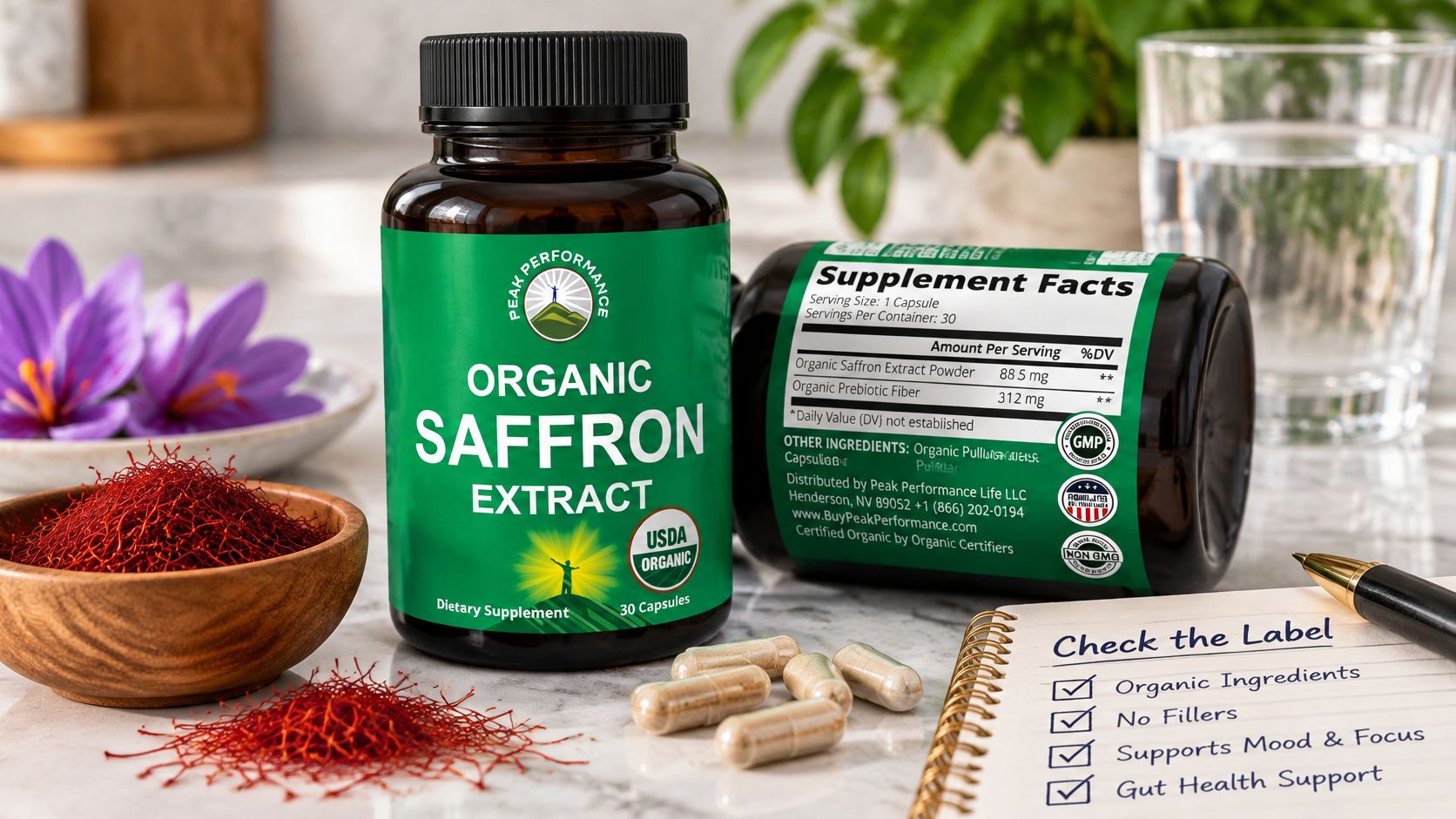
Peak Performance's Organic Saffron Extract Capsules sell for 23.95 USD and carry USDA-certified organic status with third-party lab testing behind each batch. Those two details are the floor, not the ceiling: a label worth buying gives you enough to verify on your own.
Now apply the checks. Find the milligram figure per capsule and compare it with the dose range the mood trials used; a number far outside it needs a reason. Look for the lab report and confirm it names the tests run rather than asserting purity in general terms. If any row from the safety table applies to you, take the bottle to a clinician before the first dose, then decide. Reading a supplement label line by line covers the full method if you want it.
The capsule is a supplement. It is no substitute for prescribed care, and it will not replace sleep, food or a break in the afternoon.
If you're weighing saffron against ashwagandha, the practical starting point is a product whose label you can check: USDA-certified organic saffron capsules with third-party testing, priced at 23.95 USD. Match the extract amount against what the mood trials measured, bring the label to a clinician if any safety row applies, then decide on your own terms. Visit Peak Performance to read the full supplement facts and testing details before you buy.


