


7 Surprising Health Benefits of Soursop Bitters
If a plant has been used for generations, does that mean a concentrated dropper bottle made from it has been proven to work? That gap matters with soursop bitters. Traditional use, laboratory activity, and human evidence answer different questions, and mixing them creates confidence the evidence doesn't support. The seven areas below are best read as general wellness research interests, not promised outcomes.
What Soursop Bitters Are and Where They Come From
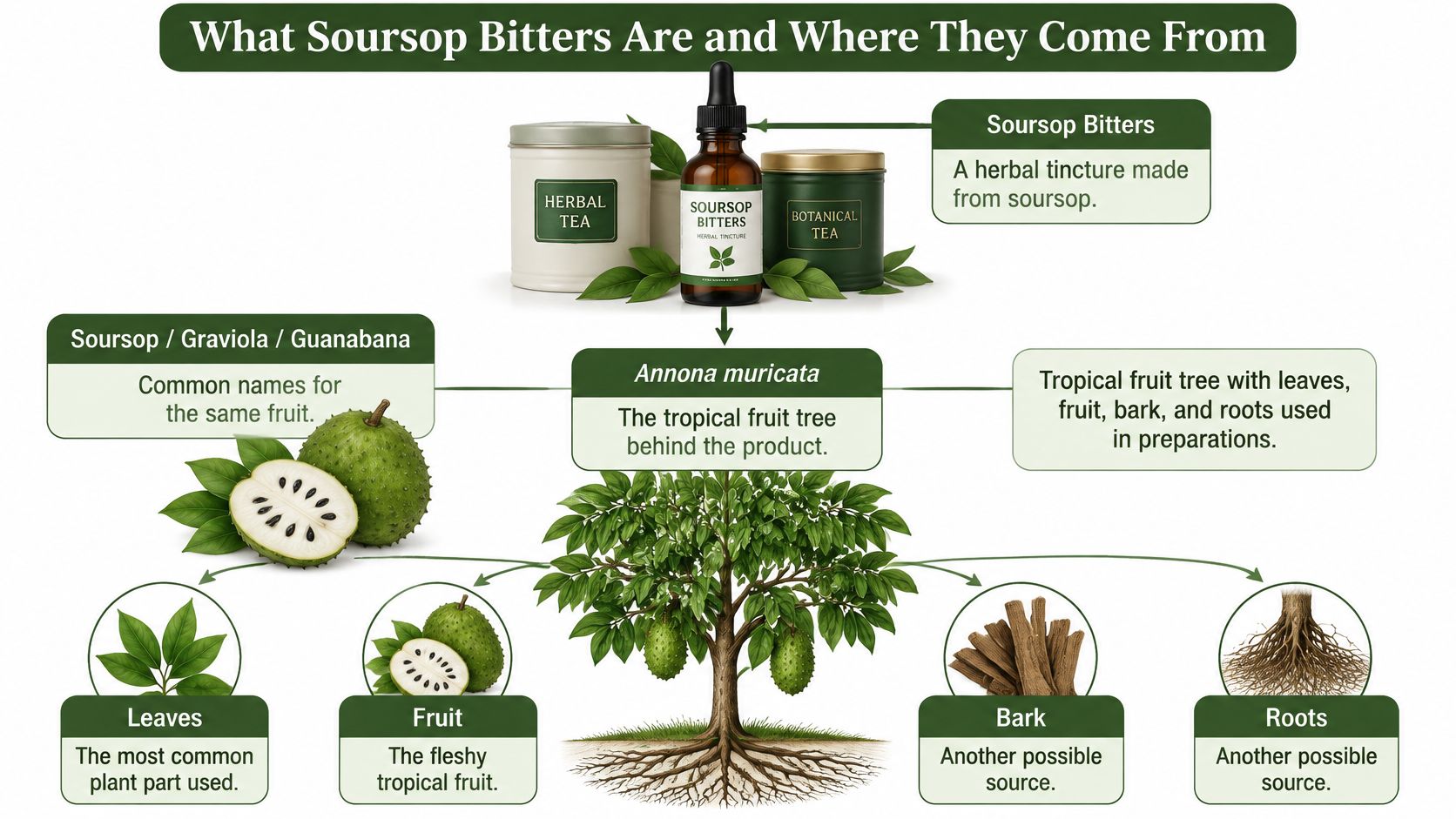
The word soursop on a bottle can describe several different preparations. Soursop, also called graviola or guanabana, is the tropical plant Annona muricata, with a long history of traditional use across Africa, the Caribbean, and parts of South America.
A single product may draw on leaves, bark, roots, seeds, or fruit, and traditional methods include decoctions, infusions, juicing, and direct ingestion. Each method pulls a different mixture of plant compounds at a different strength. A dilute cup of leaf tea and a concentrated liquid extract are not interchangeable exposures, even when both carry the same plant name.
Historical use is not clinical proof
A 2023 review documented historical use for fever, respiratory and skin illnesses, diabetes, hypertension, bacterial infections, pain, and parasitic disease, while the supporting evidence remains primarily ethnobotanical, laboratory, or animal research rather than human clinical trials, according to a review indexed in PubMed Central. Documented use records what people did with the plant; by itself it cannot show what a measured extract does in the body.
Traditional preparations rarely record dose. A bitters product that names its plant parts and states the amount per dropper serving gives you something a folk recipe cannot: a defined exposure you can compare across bottles. Readers weighing soursop against other botanical traditions can find wider context in the HempWell USA guide to botanical wellness, as long as each plant is still judged by its own label and evidence.
What a clear product description should name
- Plant part: Leaves, fruit, bark, roots, seeds, or a stated combination.
- Extraction method: How the compounds were drawn from the plant material.
- Strength per serving: The amount delivered by one measured dropper serving, including any stated acetogenin content.
A label that quantifies compounds per serving says more than the word soursop on the front. The serving size on the label, not a traditional cup of tea, sets your actual exposure.
Seven General Wellness Benefits and Their Evidence Level
Seven wellness areas show up repeatedly in soursop research, and they sit at very different levels of support. Where a percentage appears below, it describes the share of published research topics, never the chance that a product delivers the effect. Traditional marks documented historical use, Laboratory marks test tube work, and Laboratory and animal marks cell or animal studies with no human trial data behind them.
| Benefit | Evidence Level |
|---|---|
| Antioxidant and cell-protection interest | Laboratory |
| Everyday wellness and traditional use | Traditional and ethnobotanical |
| Digestive comfort (antiulcer and antidiarrheal) | Laboratory and animal |
| Metabolic awareness (antidiabetic) | Laboratory and animal |
| Skin and wound care | Laboratory and animal |
| Microbial defense (antibacterial and antiviral) | Laboratory |
| Blood pressure awareness (antihypertensive) | Laboratory and animal |
1. Antioxidant and cell-protection interest
Laboratory work on soursop compounds explains the interest in general antioxidant support for normal cell function. That is structure and function language; it stops well short of showing that bitters prevent disease. For a wider discussion of plant nutrients and cellular health, see this conversation on phytonutrients, herbs, and cellular health.
2. Everyday wellness routines
Ethnobotanical records document broad traditional use of the plant. Documentation of that kind describes what communities did; it cannot measure whether a modern bitters formula changes how a person feels.
3. Digestive comfort
Antiulcer work accounts for 17% of counted research topics and antidiarrheal work for another 8%, the largest combined share once anticancer research is set aside. Both rest on laboratory or animal evidence, so digestive comfort stays a research topic rather than a demonstrated result. A bitters blend may also contain other herbs, which makes it harder to attribute any sensation to soursop alone.
4. Metabolic awareness
Antidiabetic research holds a 14% share, large enough to explain why the marketing language exists. Human proof that soursop bitters improve blood sugar is absent from that literature, so the research interest gives no basis for adjusting food, monitoring, or prescribed diabetes care. People comparing wellness subjects can explore wellness data by topic; topic volume still is not clinical proof.
5. Skin and wound care
At 4%, wound healing forms the smallest counted category and connects partly with traditional topical use. Oral bitters, topical preparations, and laboratory extracts work differently, so this area gives no reason to expect visible skin changes.
6. Microbial defense
Antibacterial and antiviral findings each hold an 8% share and come from laboratory research. Activity against organisms under controlled conditions does not show that a supplement treats an infection in a person, so microbial balance remains a cautious general wellness phrase rather than a treatment claim.
7. Blood pressure awareness
Antihypertensive work holds a 6% share, enough to explain why cardiovascular balance enters the discussion. The evidence comes from laboratory and animal studies. Soursop bitters do not replace prescribed blood pressure medication or monitoring, and anyone taking such medication needs clinician input before use.
Anticancer activity is the largest research category, yet it stays off this benefit list because laboratory cytotoxicity is not proof that a product helps a person with cancer.
Treat each item as a research interest, then check whether the product's exact wording has matching evidence behind it. A measured acetogenin figure on a label tells you more about what you are buying than the word soursop on the front.
Why Lab Results Do Not Yet Prove Health Benefits
Every soursop claim sits somewhere on an evidence ladder. Traditional use forms the lowest rung, followed by test tube studies, animal studies, and human trials. Each step up tests something the level below cannot: dose, absorption, safety, and outcomes that matter to people.
What the human studies actually show
A 2020 review summarized human studies of oral soursop leaf extract that included 3 randomized controlled trials, 1 double-blind randomized controlled trial, and 1 case report, with durations from 1 to 9 months and doses spanning 180 to 540 mg per day, according to the Drugs.com soursop monograph. The review described tolerability at doses up to 540 mg daily for as long as 30 days.
Tolerability is useful data. It still leaves the main question open, because tolerating a compound and benefiting from it are different endpoints. Taken together, these small human studies do not establish a proven benefit for any specific medical condition, and most soursop research has used laboratory or animal models.
That gap also limits what the trials say about commercial bitters. Products vary in plant parts, extraction methods, concentrations, and added herbs, so a studied leaf extract cannot be read onto an untested bottle. Two products can both say soursop while delivering different acetogenin exposure, which is why the extract details on a label carry more weight than the plant name itself.
A household recipe and a tested dose are different things. The same caution applies when reading about other botanicals, including understanding Nigella sativa oil, because traditional familiarity cannot substitute for product specific testing. Our explainer on what third-party testing means covers why independent verification matters before a label claim is trusted.
Three checks: Is the claim based on people? Is the commercial product the same preparation that was studied? Is the dose stated clearly enough to compare?
If any answer is no, the claim is weaker than it sounds. A claim that survives all three is still evidence about one preparation, not a promise for every bitters product sold under the same name.
Safety Limits Behind Annonacin and Acetogenins
The central safety variable is exposure to annonacin and related annonaceous acetogenins. These compounds can inhibit mitochondrial complex I, reducing cellular ATP production, and a concentrated bitters product can create a different exposure from a dilute traditional preparation, according to a safety review indexed in PubMed Central.
That mechanism gives the label question a sharper form. A formula is not made safer by the word soursop alone; the practical issue is how much acetogenin reaches a serving, how often it is taken, and for how long.
Why plant part and solvent change the risk
Soursop bitters are not a chemically standardized category. Fruit, leaf, bark, and concentrated extract can carry different compound profiles, and the extraction solvent plus duration of use can shift exposure further. A product that only says soursop leaves the most important dose question unanswered.
Animal studies using high doses of Annona muricata extracts have been associated with raised liver enzymes and liver tissue changes, which is one reason extraction details matter. Those animal findings cannot be converted into a personal human limit, and no universally accepted safe human dose has been established. They still justify treating indefinite daily use as a decision that needs evidence, not habit.
A safer label narrows uncertainty: plant part, solvent, extract ratio, acetogenin content, and serving exposure should be identifiable before a product earns a place in a routine.
The neurological concern
Experimental work links mitochondrial complex I inhibition with neuronal injury, and sustained exposure in animal models has produced dopaminergic neuron loss or other brain changes. Epidemiological observations from the French Caribbean have associated heavy, long term consumption of soursop products, including leaf tea, with an atypical, levodopa resistant parkinsonian syndrome, according to an Australian pharmacognosy evidence review. These observations do not show that occasional bitters use causes that condition. They do separate occasional dilute use from heavy open ended exposure.
What responsible limits look like
- Define the stop point: Choose a review date or maximum duration before the first serving.
- Require quantified chemistry: Prefer labels that state annonacin or total acetogenins rather than relying on a botanical name.
- Respect concentration: Do not extrapolate from tea to tincture, capsule, or solvent extract.
- Judge the specification: Look for plant part, extraction solvent, drug extract ratio, acetogenin content, serving size exposure, and contaminant results.
The most defensible products make exposure measurable. When those details are absent, the missing data is itself the safety finding.
Who Should Avoid Soursop Bitters or Ask a Clinician First
Start by finding your situation. The safest decision often depends less on the advertised benefit than on your medicines, health history, and planned duration.
| Situation | Why It Matters | Next Step |
|---|---|---|
| Liver disease | Animal studies link high dose extracts with raised liver enzymes | Avoid use unless a clinician approves |
| Neurological disorder or Parkinsonian symptoms | Observational links with heavy long term use | Avoid use and consult a neurologist |
| Pregnancy or breastfeeding | Human safety data are limited | Avoid use unless a clinician approves |
| Blood pressure or glucose lowering medication | Interactions are not well studied | Ask a clinician before any use |
| Prolonged daily use | No safe long term intake has been established | Limit to short periods with clinician review |
| Unknown acetogenin content | Strength and compound levels cannot be judged | Choose a product that quantifies its ingredients or skip it |
Turn caution into action
If you have liver disease, don't try to solve the question by taking a smaller amount on your own. A clinician can consider your liver history alongside the plant part, extract strength, and intended duration. The same principle applies if you already have tremor, stiffness, slowed movement, balance changes, or another neurological condition.
Pregnancy and breastfeeding call for restraint because human safety data remain limited. That isn't proof of harm, but it's also not reassurance of safety. When evidence is missing during a sensitive period, waiting is the conservative choice unless your clinician advises otherwise.
Medication use changes the decision too. If you take blood pressure or glucose lowering therapy, ask before use rather than monitoring for trouble after the fact. Interactions aren't well studied, and traditional use doesn't replace a prescribed treatment.
Stop use and seek care for yellowing skin or eyes, dark urine, unexplained tremor or stiffness, slowed movement, or persistent nausea.
Bring the full label to the appointment. The exact formula matters more than telling a clinician only that you're taking soursop bitters.
How to Read a Soursop Bitters Label
Run through these checks in the store or online. Each one answers a question that marketing language can easily hide.
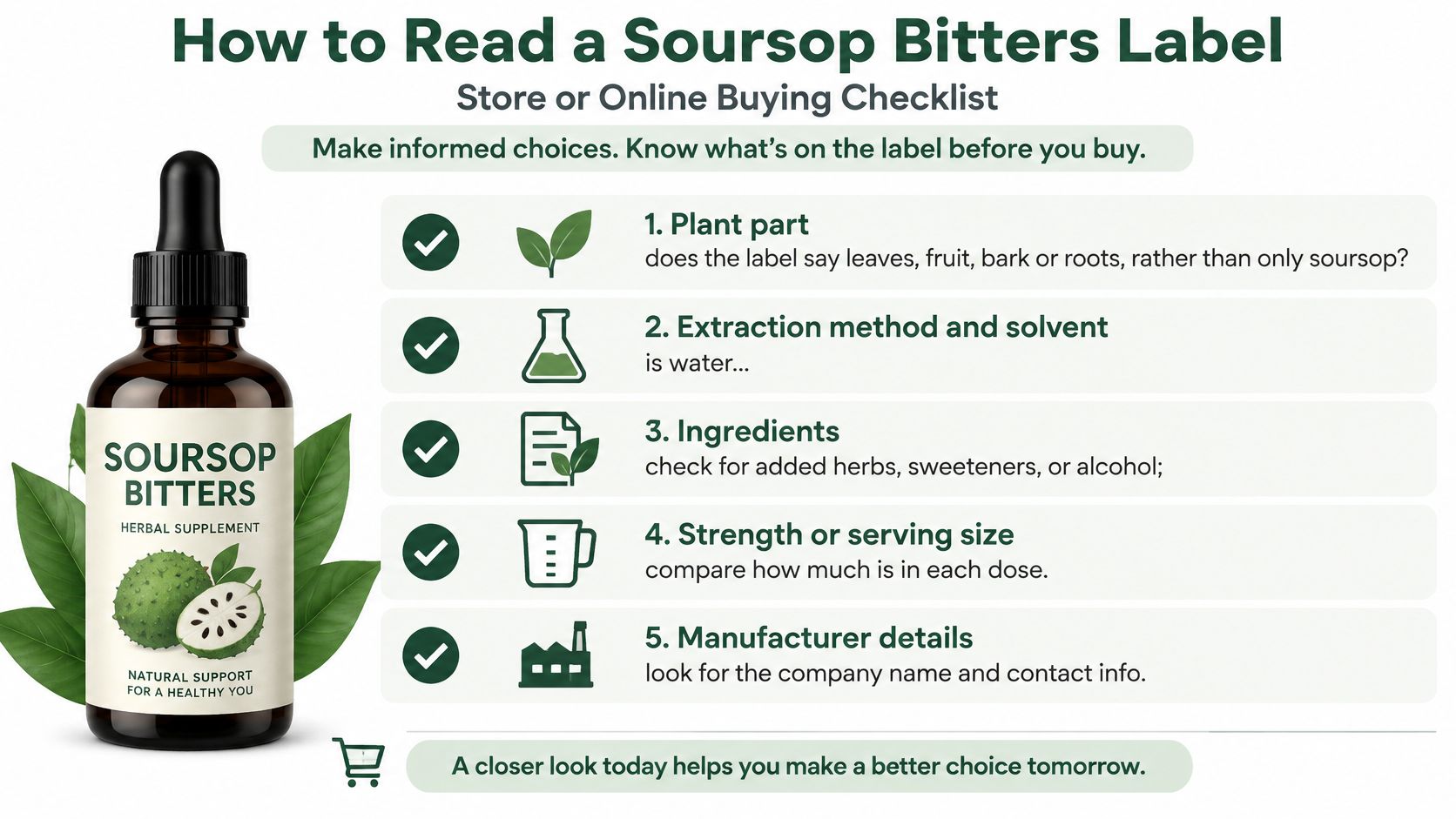
- Plant part: Look for leaves, fruit, bark, or roots rather than only the word soursop, because safety evidence differs by plant part.
- Extraction method and solvent: Check whether water or an organic solvent is named, since extraction changes concentration and compound profile.
- Drug extract ratio and serving strength: Confirm how much extract each serving delivers so the dose can be judged.
- Acetogenin or annonacin testing: Look for validated assay results rather than vague claims about purity or potency.
- Third party testing: Check microbial and heavy metal testing, botanical authentication, and stability data through the stated shelf life. Our guide on how to read supplement labels explains where these details usually appear.
- Claim wording: Language such as supports general antioxidant defenses is structure or function wording, while claiming to treat, cure, or prevent disease crosses into drug territory.
- Required disclaimer: Look for "This statement has not been evaluated by the Food and Drug Administration. This product is not intended to diagnose, treat, cure, or prevent any disease."
Structure and function claims aren't pre-approved by the FDA. A manufacturer must possess substantiation showing the wording is truthful and not misleading and must notify the FDA within 30 days after marketing the supplement, according to FDA guidance on structure and function claims. Evidence should exist before the claim is made.
If a label promises to treat a condition or omits the required disclaimer, skip the product.
Decide Whether Soursop Bitters Fit Your Routine
Soursop bitters are a traditional herbal product backed mostly by laboratory evidence, suitable to consider only occasionally, by adults outside every caution group, and only when the label passes the checks above. That's a narrower verdict than most benefit lists give, but it matches the evidence.
Set one clear limit before starting: use a short trial period, stop at any warning symptom, and get clinician review before longer use. Keep a simple log of dose, timing, and symptoms. That record gives a clinician something concrete to assess rather than a vague memory of how the trial went.
Run any bottle you consider through the checklist above before buying. Plant part, extraction method, serving strength, acetogenin testing, and claim wording separate a documented extract from a marketing label, and a product that fails the safety checks fails regardless of price or packaging.
This article isn't medical advice. Traditional use doesn't replace prescribed treatment, and uncertainty should slow a purchase down rather than be filled in by marketing.
Visit Peak Performance to explore USDA certified organic supplements and superfood blends backed by transparent sourcing and rigorous third party lab testing. Compare the soursop bitters label carefully, choose only products that fit your health situation, and make your next wellness purchase with the evidence in view.
Also in Podcasts


