


Spermidine: Top 10 Myths About Cellular Aging Busted
The most popular advice about spermidine sounds simple. Take it, switch on autophagy, and slow aging. That advice jumps over the hardest question. Does a change inside a cell become a longer, healthier life for a person? For spermidine, that link hasn't been proven yet.
Ten Cellular Aging Myths at a Glance
Headlines often present spermidine as an anti-aging breakthrough. Human research tells a more cautious story. The table below separates what's false, what's overstated, and what's still unproven, so you can see the verdict before the explanation.
Strong means the biology or history is well established. Mixed means findings point in different directions or rest on association. Limited means evidence is mostly preclinical, observational, or from small, short studies.
| # | Myth | Verdict | Evidence strength |
|---|---|---|---|
| 1 | Aging is 100% genetic | False. Aging reflects interacting biological processes | Strong |
| 2 | Spermidine is a newly discovered ingredient | False. Spermine phosphate was observed in 1678 and the pathway was mapped in the 1950s | Strong |
| 3 | Spermidine has proven anti-aging effects in humans | Not proven | Limited, mostly preclinical and observational |
| 4 | Epigenetics means DNA is permanently changed | False. Epigenetic marks are dynamic | Strong |
| 5 | Boosting autophagy reverses aging | Overstated | Mixed, plausible mechanism with few human data |
| 6 | High dietary spermidine proves longer life | Overstated. Association, not causation | Mixed |
| 7 | Spermidine reliably improves memory | Not supported by the largest trial | Mixed |
| 8 | Better autophagy biomarkers mean better health | Unproven | Limited, small pilot without placebo |
| 9 | Supplements can reset your biological age | Not supported | Limited |
| 10 | Natural ingredients are automatically safe | False. Dose and medical context matter | Strong for the principle, limited for spermidine |
The rest of this article takes these myths in groups. Verdicts reflect human trial and cohort data where it exists, and they're clearly labeled as such where it doesn't.
Why Genes and Epigenetics Do Not Lock In Aging
Think of your genes as a house blueprint. The blueprint matters, but it doesn't tell you how the house will be maintained, repaired, or damaged over decades. Two houses from the same plan can look very different after forty years.

Myth 1 Aging Is 100 Percent Genetic
That's false. Research describes aging as interacting processes, including genomic instability, telomere attrition, epigenetic alterations, loss of proteostasis, deregulated nutrient sensing, mitochondrial dysfunction, cellular senescence, stem-cell exhaustion, and altered intercellular communication, in the hallmarks of aging framework. Inherited DNA is only one component. Nutrition, disease, stress, metabolism, and environmental exposure also shape how aging unfolds, which is why two people with similar genetic predispositions can age very differently.
Myth 4 Epigenetics Means DNA Is Permanently Changed
Epigenetics means the opposite of a permanent rewrite. It's about which genes are switched on or off while the DNA sequence stays unchanged. Mechanisms include DNA methylation, histone modification, chromatin remodeling, and regulation by non-coding RNAs.
During senescence, these changes can alter gene expression, including factors in the senescence-associated secretory phenotype, or SASP, which lets aging cells influence nearby tissue through inflammatory signals, as described in the review of epigenetic regulation in senescence. That makes gene activity dynamic, not fixed.
Myth 9 Supplements Can Reset Your Biological Age
Dynamic doesn't mean easily reset. There's no reliable evidence that a supplement rewrites epigenetic age or reverses senescence in people.
Epigenetic marks can change. That isn't the same as a product being able to reset them on demand.
Spermidine belongs in this discussion because it's studied for cellular maintenance and quality control. It isn't proof that aging can be genetically overridden.
Why Spermidine Is Older Science Than the Hype
Myth 2 says spermidine is a newly discovered anti-aging ingredient. Its history is more than three centuries old.
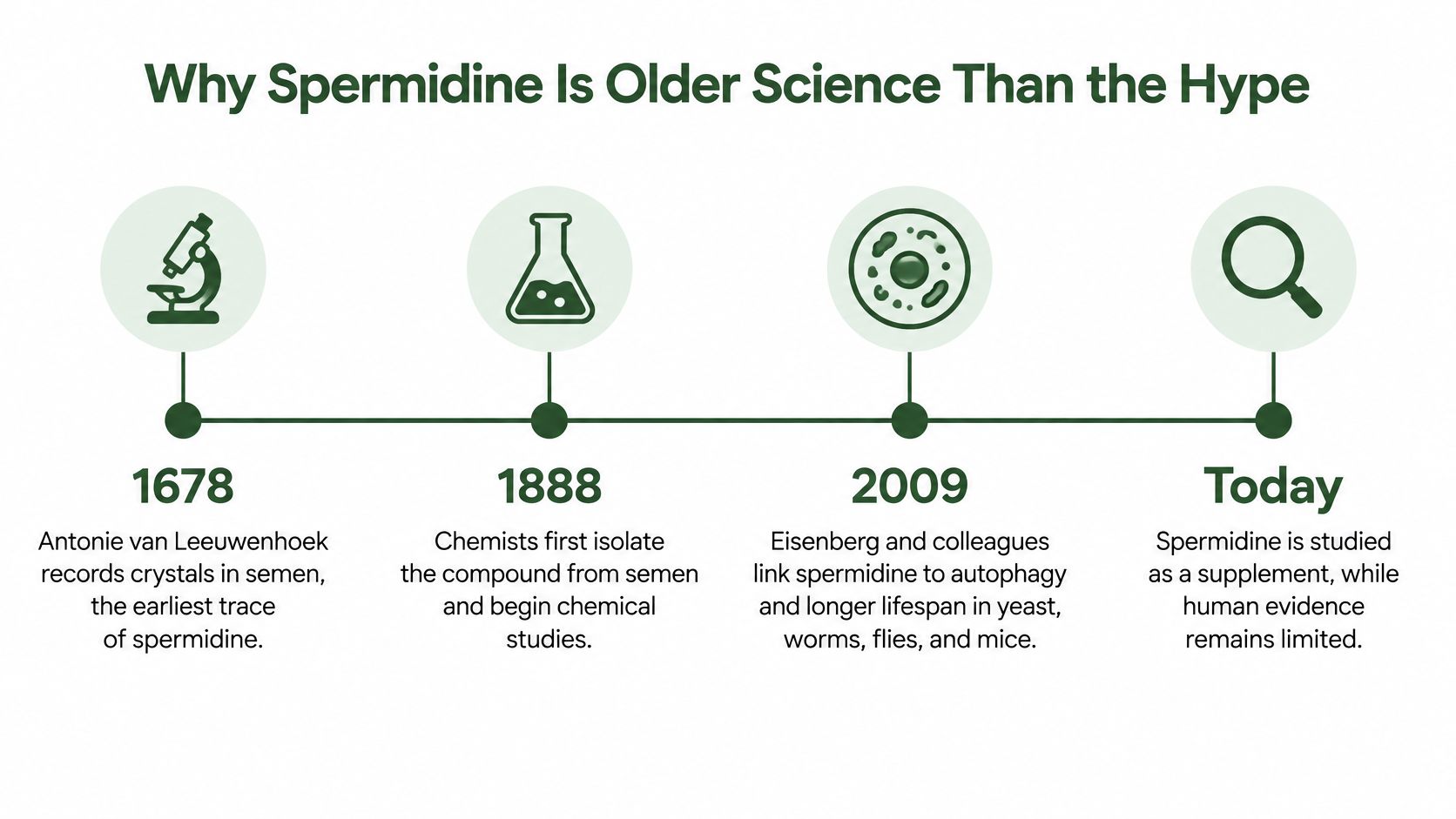
In 1678, Antonie van Leeuwenhoek reported crystalline material in human seminal fluid. That material was later identified as spermine phosphate, the earliest recorded observation of the polyamine family that includes spermidine, according to the history of polyamine research. In the 1920s, Otto Rosenheim and Wrede established the correct chemical structure of spermine.
During the 1950s, Herb and Celia Tabor, working with Sanford Rosenthal, described how bacteria produce spermidine from putrescine. Their 1958 work in Escherichia coli helped researchers study polyamine synthesis in mammals, plants, and disease-causing organisms.
So what is spermidine, in plain language? It's a naturally occurring, positively charged polyamine. Think of that charge as stickiness. It interacts with RNA and other cell structures and supports normal cellular growth.
One modern detail matters here. Hypusination is a chemical tag needed for eIF5A, an essential protein, to work. Spermidine is required for that modification.
Practical takeaway: your body already makes spermidine. That long biochemical role is why researchers study it seriously.
That history gives spermidine scientific weight. It doesn't, by itself, prove that taking more of it produces a health benefit.
What Autophagy Research Can and Cannot Prove
Autophagy is a cell's recycling crew. It clears out damaged parts so the cell can reuse materials and keep functioning. When that cleanup slows, damaged components can build up.
Spermidine may influence this system by inhibiting EP300, an enzyme that promotes acetylation and functional suppression of autophagy-related proteins, so reduced EP300 activity could favor autophagy initiation, as outlined in the mechanistic review of spermidine and EP300. Direct confirmation that oral spermidine increases neuronal autophagy in humans remains limited.
Myth 3 Spermidine Has Proven Anti-Aging Effects in Humans
It hasn't. Spermidine has been reported to induce autophagy and promote longevity in yeast, worms, flies, and mice, with hypusination of eIF5A involved in autophagy initiation, in the review of spermidine and longevity pathways. Those findings don't establish that an oral supplement extends human lifespan.
For broader context on cell maintenance, see the discussion on improving cell and mitochondrial health. It helps to place spermidine inside a bigger picture, not treat it as a standalone answer.
Myth 5 Boosting Autophagy Reverses Aging
A plausible pathway isn't reversed aging. Myth 6 needs the same caution. In the 20-year Bruneck cohort of 829 participants, higher dietary spermidine intake was associated with about 63% lower all-cause mortality, from about 40.5 to 15.1 deaths per 1,000 person-years, and roughly 40% lower risk of fatal or clinically overt heart failure, in the Bruneck cohort and animal evidence summary. Diet quality and lifestyle could still confound that association.
In mice, late-life daily spermidine produced mean lifespan increases of 6% in females and 13% in males in that same summary. Those differences didn't reach statistical significance.
| Evidence level | Example from the research | What it can show | What it cannot show |
|---|---|---|---|
| Yeast, worm and fly studies | Spermidine reported to induce autophagy and promote longevity | Pathway plausibility | Human lifespan effects |
| Mouse studies | Late-life daily spermidine raised mean lifespan without statistical significance | Trends and cardiac autophagy effects | Proof of benefit in people |
| Human observational cohorts | Higher dietary intake linked with lower mortality | Association with diet patterns | Causation |
| Small human mechanistic trials | Pilot studies in about 12 adults over 56 days | Biomarker shifts | Clinical benefit or lifespan change |
| Randomized controlled trials | Largest trial found no memory benefit at about 0.9 mg per day | Real effects compared with placebo | Long-term survival, which hasn't been tested |
Use this rule when you read claims. The higher the study sits on this ladder, the more a claim can carry.
Memory and Biomarker Claims Put to the Test
Myth 7 Spermidine Reliably Improves Memory
An early result looked encouraging. In a 3-month randomized, double-blind pilot of 30 cognitively intact adults aged 60 to 80 with subjective cognitive decline, a spermidine-rich plant extract was associated with improved mnemonic discrimination versus placebo, with Cohen's d of approximately 0.79, in the SmartAge trial report and earlier pilot summary.
The larger test didn't confirm it. The 12-month SmartAge trial enrolled 100 older adults and tested approximately 0.9 mg per day from wheat-germ extract. It found no significant improvement, with a between-group difference of −0.03, 95% CI −0.11 to 0.05, and P = .47 in that same report. Adverse events were balanced between groups.
A small pilot can generate a hypothesis. A larger, longer randomized trial carries more weight when the two disagree.
Myth 8 Better Autophagy Biomarkers Mean Better Health
A 56-day, single-blind pilot in 12 adults reported that 3.3 mg per day increased Beclin-1 by 7.3%, ULK-1 by 13.4%, and BDNF by 12.1%, while reducing triglycerides by 26.9%, in the overview of spermidine health claims and evidence gaps. It lacked a placebo group, and the lower dose produced inconsistent findings.
Think of a biomarker like a speedometer. A changed reading tells you something moved. It doesn't prove you arrived on time, avoided a crash, or reached the right destination.
That's why tracking matters, as discussed for blood biomarkers worth tracking regularly. Biomarker change, memory performance, and survival are three different endpoints. Spermidine is best described as a research interest with nutritional support value, not a guaranteed memory enhancer.
Safety Checks Before Taking Spermidine
Myth 10 says natural ingredients are automatically safe. Natural origin doesn't guarantee safety. Dose, formulation, medical history, and medications all matter.
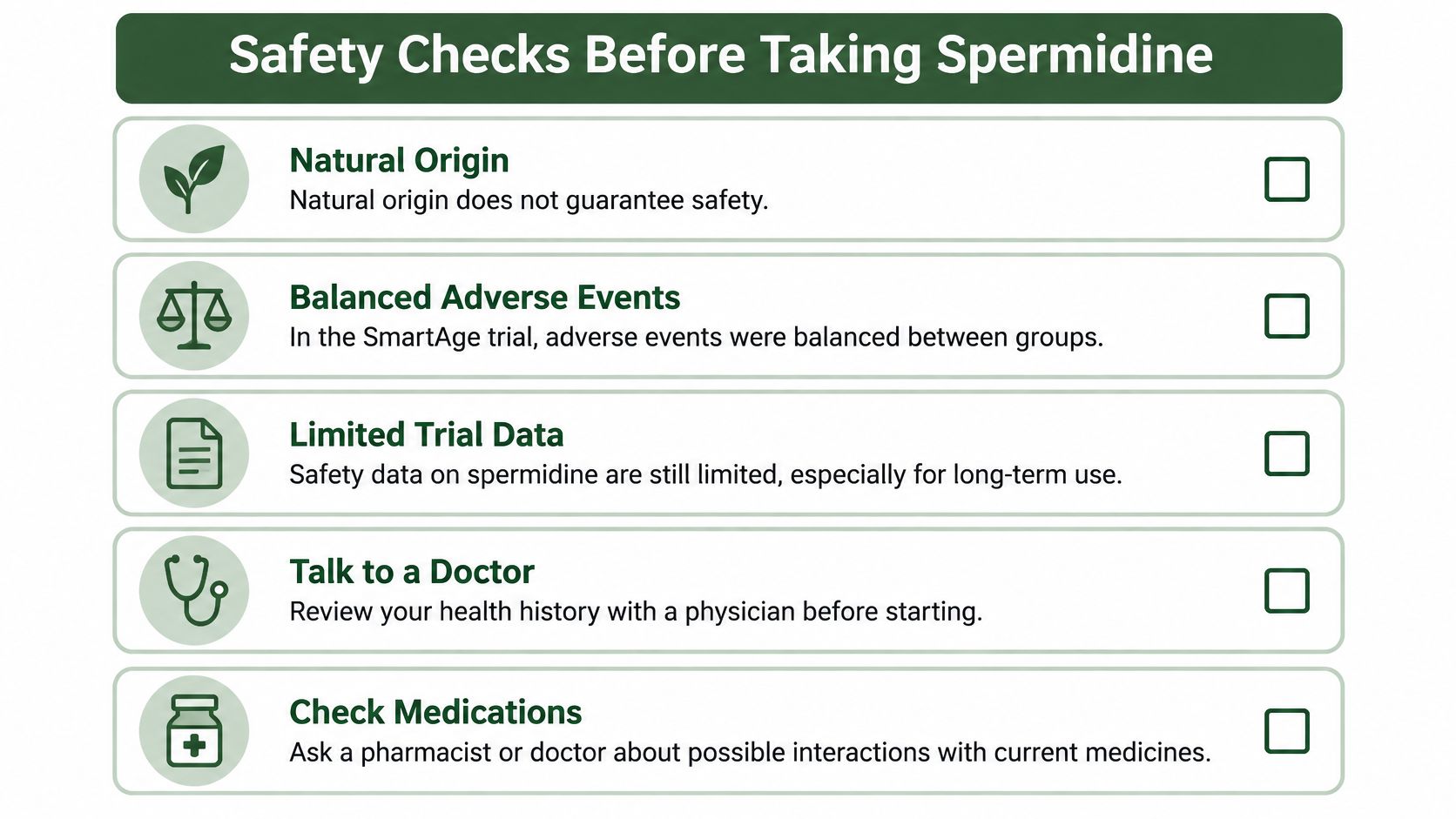
In the SmartAge trial, adverse events were balanced between groups. That's reassuring but limited, because the trial was relatively small and can't answer every long-term safety question.
| Situation | Action |
|---|---|
| Pregnancy or breastfeeding | Avoid unless a clinician approves. No established safety data |
| Cancer history or active cancer treatment | Discuss with an oncologist before use |
| Current medications | Pharmacist reviews the full list. No established interaction profile |
| Wheat or gluten sensitivity | Avoid if the product uses wheat-germ extract |
| Children and adolescents | No pediatric data reviewed. Don't use without medical advice |
| Kidney or liver conditions | Ask a clinician about dose |
Use the checklist as a screening step, not a formality. Polyamines are involved in cell growth, which is why cancer history deserves a direct conversation with an oncologist. Medication review matters because the absence of a well-established interaction profile isn't proof that no interaction exists.
- Don't stack products blindly: combining multiple polyamine-rich products makes total intake harder to judge.
- Check the source: wheat-germ extracts and purified ingredients aren't interchangeable for someone with wheat sensitivity.
- Watch for new symptoms: stop and seek medical advice if something changes after you start.
Quality testing is part of that decision too. Our explanation of what third-party testing means shows what to look for on a label. A cautious start protects you more than a confident guess.
Choose Your Next Step Based on the Evidence
You don't need to decide whether spermidine is miraculous or useless. You need to decide what level of evidence is enough for your own next step.
Three points are solid. Spermidine is a real, naturally occurring molecule with a plausible autophagy-related mechanism. Human data show dietary associations and early biomarker signals. No trial has shown a reliable memory or lifespan benefit.
- If you prefer food first: eat spermidine-containing whole foods such as wheat germ, soybeans, natto, and aged cheese in moderate amounts, and notice how you feel over time.
- If you prefer a supplement: compare milligrams per serving with study doses you've read about here, and choose a product with third-party testing.
- If you have a medical condition: talk to a clinician first, especially if you're pregnant or taking medication.
If you've cleared the safety checklist and want a simple option, our Spermidine Capsules are 21.95 USD. Treat them as nutritional support, not a longevity treatment.
Sleep, activity, and overall diet still have better-established effects on health than any single compound. Spermidine can fit into that picture. It shouldn't replace it.
If you're exploring spermidine for cellular maintenance support, visit Peak Performance to review our Spermidine Capsules, check the label details, and compare them with your safety checklist before you buy. Make the choice that matches the evidence, not the headline.
Also in Podcasts


