


Top 10 FAQs About Taking Valerian Root for the First Time
You open your new bottle of valerian root, catch an unexpectedly earthy smell, and pause. Is it supposed to smell like that? Then come the practical questions: how much should you take, will it help tonight, and should you worry about strange dreams?
Those are sensible questions, especially when a supplement's reputation sounds more certain than its research. Valerian root has mixed evidence for sleep, and understanding that uncertainty can help you make a calmer, better-informed decision.
What Is Valerian Root and How Does It Work
What exactly is valerian root?
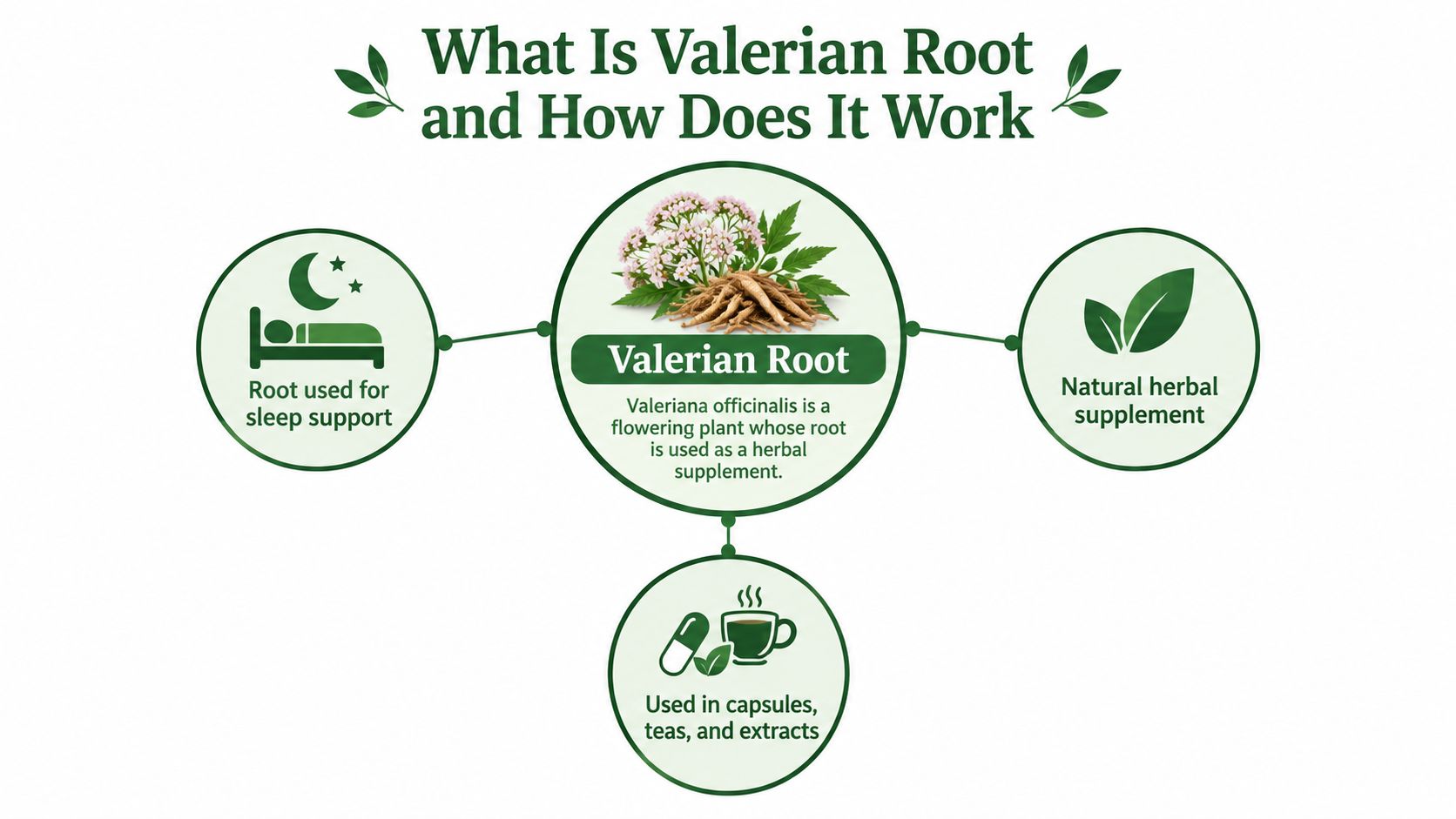
Valeriana officinalis is a flowering plant whose root and rhizome, its underground stem, are used in herbal preparations. It has a long history as a calming botanical, but traditional use and demonstrated clinical benefit aren't the same thing.
You'll encounter valerian root in teas, capsules, and liquid extracts. These are different preparations, not just different packaging for an identical ingredient. A cup of tea, a capsule of dried root, and a serving of liquid drops shouldn't be assumed to deliver equivalent amounts or effects.
The basic plant-to-supplement relationship looks like this:
How is it supposed to work?
The proposed explanation involves interactions with the brain's calming chemistry. Think of that as a working explanation, not proof that taking valerian will reliably quiet your thoughts or put you to sleep. Identifying a possible biological pathway doesn't establish a dependable benefit in everyday users.
It's more helpful to approach valerian as a botanical people try for occasional sleeplessness than as a predictable, prescription-strength sedative. Calling an herb gentle also shouldn't be taken to mean it can't affect alertness.
Keep these distinctions in mind:
- Traditional purpose: Why people have historically used the herb.
- Proposed mechanism: How its constituents might affect the body.
- Clinical benefit: Whether people sleep better in controlled trials.
Those categories answer different questions. A convincing explanation of how something might work can't substitute for evidence that it does.
If you're interested in the tea side of an evening routine, the SleepHabits guide to relaxing bedtime teas offers a useful starting point for exploring that format. Treat a comforting bedtime ritual and a treatment for a sleep disorder as separate decisions.
Does Valerian Root Actually Help You Sleep
Does it work, or is it mostly expectation?
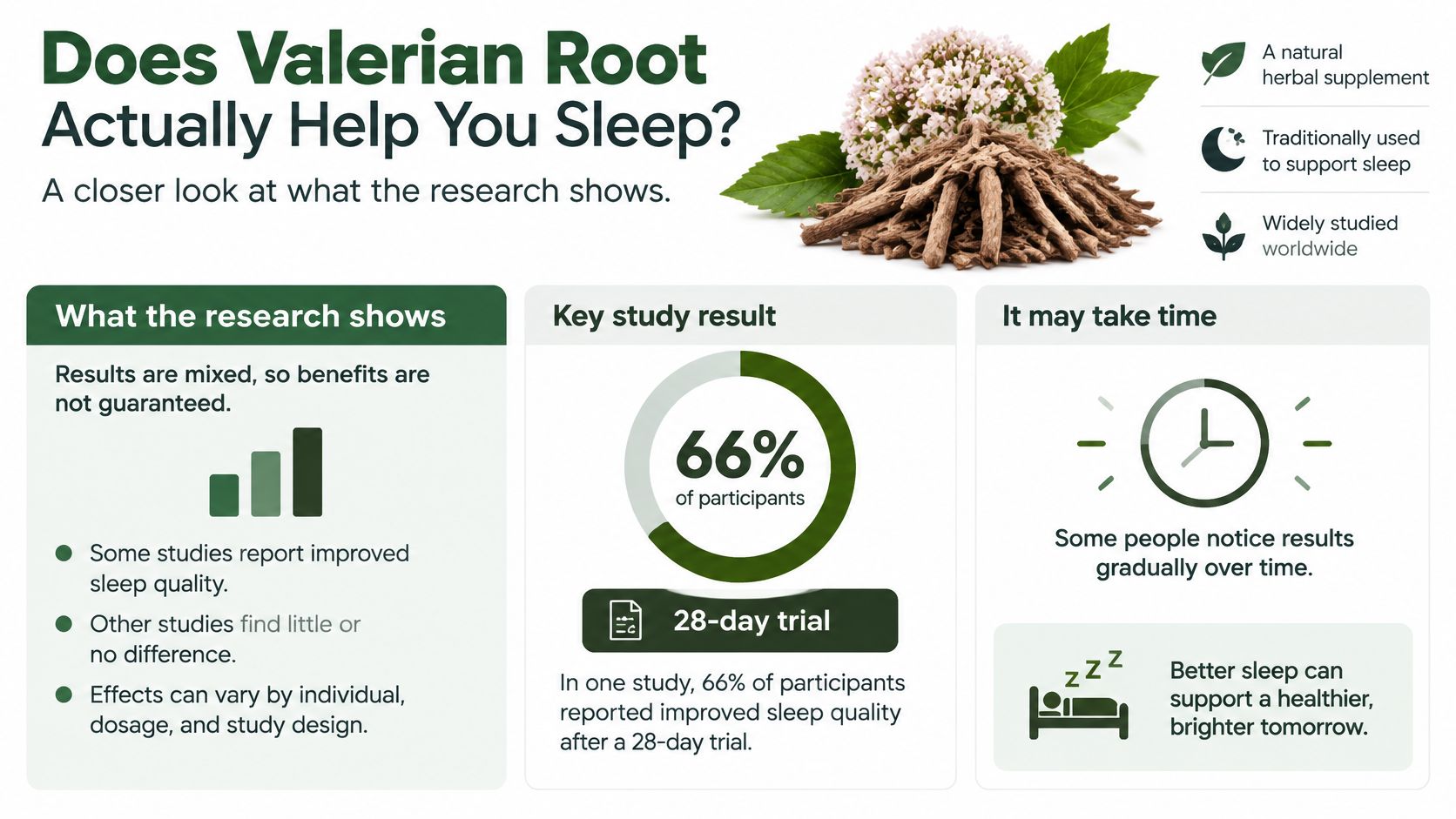
The honest answer is that results are inconsistent. Some trials look encouraging, while others show little meaningful difference between valerian and placebo.
An earlier trial using 600 mg nightly for 28 days found that 66% of valerian-treated participants reported good sleep compared with 26% receiving placebo, but a separate 270-person, 28-day trial reported improvement in 89% of valerian users and 86% of placebo users; a review of 37 studies concluded that the most methodologically rigorous trials generally didn't demonstrate significant insomnia benefit, as summarized in the NIH Office of Dietary Supplements' valerian evidence review.
That contrast matters. In the second trial, improvement was common regardless of which treatment participants received. It shows why feeling better after starting a supplement doesn't, by itself, establish that the supplement caused the change.
The research overview below highlights an encouraging result, but it needs the placebo comparison above to be interpreted fairly.
How long should I wait to judge it?
If a clinician considers a trial appropriate, assess the experience over several weeks rather than expecting a verdict after the first night. That isn't a promise that continued use will eventually work. It's a way to avoid mistaking an unusually good or bad night for a dependable pattern.
Use an evidence-graded distinction:
- Perceived sleep quality: Whether you feel you slept better or wake feeling more satisfied with your sleep.
- Objective sleep measures: Recorded changes in sleep, rather than your impression alone.
- Treatment of chronic insomnia: Addressing an ongoing disorder, which requires more than a favorable supplement experience.
For example, feeling more rested is worth recording. It doesn't automatically mean you fell asleep faster, spent more time asleep, or treated the reason you've been struggling.
Better perceived sleep can matter to you without proving that valerian treats an underlying sleep disorder.
Occasional difficulty settling down is a more plausible setting for a cautious discussion about valerian than persistent insomnia. For ongoing problems, consider discussing structured care and resources such as Total Mental Wellness's information about insomnia therapy for adults.
You can also use this conversation about getting better sleep and performing at your best to develop questions about your broader routine. Keep the goal specific: better sleep and daytime functioning, not just noticing that you took something.
How Much Valerian Root Should You Take
How much should a beginner take?
Start with the serving instructions for the exact product you bought, not a dose borrowed from another bottle or an online discussion. General research ranges provide context, but they aren't a conversion chart for liquid drops.
The National Center for Complementary and Integrative Health reports apparent adult safety with 300–600 mg daily for up to six weeks, while long-term safety remains unknown; the traditional European regimen described in the supplied monograph information uses 30–60 minutes before bed, with a 500 mg extract ceiling specific to the cited valerian-and-hop combination, rather than a universal valerian limit (NCCIH's valerian safety overview).
The distinction between preparations matters. Milligrams of dried root aren't automatically equivalent to milligrams of extract, and neither tells you how many liquid drops to use without the product's concentration.
Don't calculate a dropper serving from a capsule study. Even if the arithmetic looks straightforward, it may compare unlike materials.
When should I take it, and what if it doesn't work?
Use the product's directions to decide timing, with the traditional bedtime window above as context rather than a replacement for the label. If the directions are unclear, ask a pharmacist or clinician to review the actual bottle with you.
Don't double the serving because the first night disappoints. A larger amount doesn't resolve uncertainty about whether that preparation helps you, and it may complicate your assessment of unwanted effects.
Valerian Root Dosing at a Glance
| Question | What Research and Tradition Suggest | What Beginners Should Do |
|---|---|---|
| How much? | Studied amounts depend on the preparation. | Follow your exact product's labeled serving. |
| When? | Traditional use places dosing before bedtime. | Check the label and plan around your intended bedtime. |
| How long? | Repeated use provides more context than an isolated night. | Agree on a reassessment point rather than continuing indefinitely. |
| What if I notice nothing? | A disappointing night doesn't establish that more will help. | Keep the serving unchanged and review whether continuing makes sense. |
| Can I use it indefinitely? | Long-term safety is unresolved. | Discuss ongoing use with a clinician. |
Practical rule: A research dose describes what investigators tested. Your product's label describes the serving for the preparation in your hand.
A useful record can stay simple: note when you took it, whether settling down felt easier, and how you felt the next morning. You don't need a complicated scoring system, but you do need enough consistency to avoid relying only on your most memorable night.
If you're unsure whether the labeled amount fits your health circumstances, resolve that before starting. An adult research range isn't individualized medical advice.
What to Expect When You First Take Valerian Root
Why does it smell so earthy, and is it spoiled?
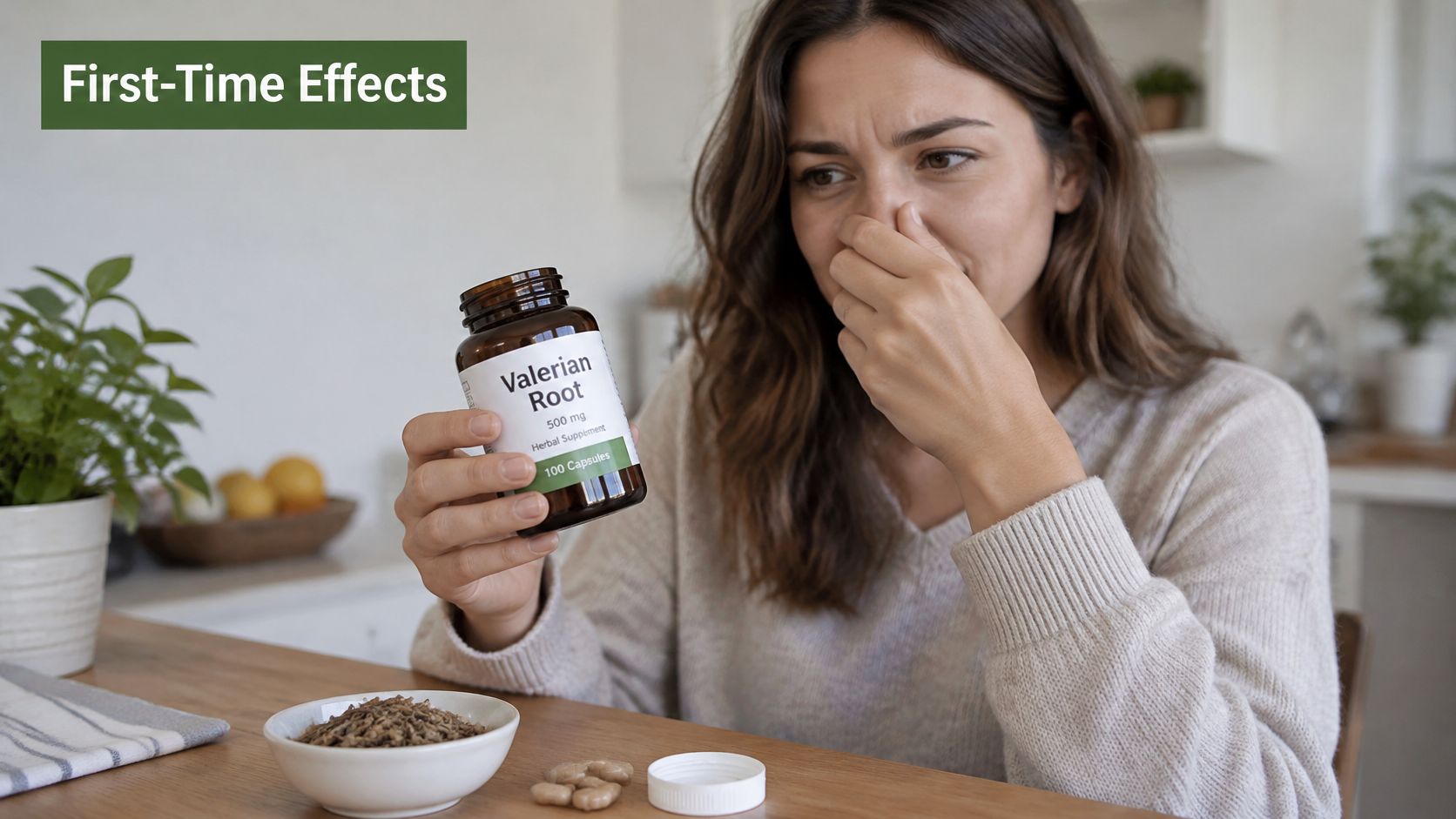
The first surprise may happen before you take a serving. You open the bottle, notice a pungent, earthy odor, and wonder whether something went wrong.
That characteristic smell comes from volatile compounds in valerian root. It can be especially noticeable in liquid or unflavored preparations. The odor itself isn't evidence that the product has spoiled.
The reaction shown below may feel familiar, even if your supplement comes in a different form.
But don't swing to the opposite assumption and treat a powerful smell as proof of quality. Smell alone can't establish potency, freshness, or freedom from contamination. Check the expiration information and follow the storage directions instead of trying to judge the bottle by your nose.
Liquid preparations, including Peak Performance's Organic Valerian Root Liquid Drops, fit this sensory picture. An unfamiliar aroma isn't a reason to increase the serving or assume the product is weak.
Will valerian root cause vivid dreams?
Vivid dreams are possible, but they aren't a proven, predictable outcome. Anecdotal reports don't tell us how likely they are, whether valerian caused them, or which users might experience them.
If you notice unusually memorable dreams after starting, record the timing without treating the connection as settled. Don't interpret intense dreams as proof that you're getting deeper or more restorative sleep.
Your morning experience deserves attention too:
- Notice alertness: Grogginess might feel like lingering sleepiness or difficulty getting mentally started.
- Record changes: Note unusual dreams alongside how rested and functional you feel.
- Avoid forcing a result: Neither stronger sensations nor a stronger smell means a larger serving is needed.
You're looking for a worthwhile change in sleep, not the strongest possible sensation after taking an herb.
If you develop excessive daytime sedation or troubling symptoms, don't keep taking valerian just to finish a trial. A supplement experiment should never require pushing through an experience that feels unsafe.
Side Effects Interactions and Who Should Avoid Valerian Root
Is valerian safe, and can I combine it with other sleep aids?
Natural doesn't mean risk-free. The useful safety question isn't whether valerian comes from a plant. It's whether this preparation is appropriate alongside your medicines, health concerns, and daily responsibilities.
As noted in the earlier NIH evidence summary, adverse events were reported rarely in the reviewed research. That doesn't establish that every preparation, combination, or pattern of use is safe.
Avoid combining valerian with alcohol or sedating medicines without clinician guidance. Don't assume that taking each at its usual amount makes the combination appropriate. Give the clinician or pharmacist the full ingredient list, not just the words “herbal sleep aid.”
A practical safety screen includes:
- Alcohol or sedating medicines: Ask before combining them with valerian.
- Excessive daytime sedation: Stop taking it and seek advice rather than trying to tolerate it.
- Unusual symptoms: Discontinue use and arrange an appropriate assessment.
- Existing health concerns: Ask whether self-directed use makes sense for your circumstances.
When should you skip self-experimentation?
Persistent insomnia, suspected sleep apnea, and severe daytime sleepiness call for clinical assessment, not a different supplement. You don't need to establish the diagnosis yourself before asking for help.
A person who occasionally has trouble settling down faces a different decision from someone whose sleep problems keep interfering with daily life. In the latter situation, tracking symptoms can support an appointment, but it shouldn't become a reason to postpone one.
NCCIH's assessment is that sleep research remains inconsistent, and it notes that the American Academy of Sleep Medicine recommended against valerian for chronic insomnia in adults. That recommendation concerns using valerian as treatment for the disorder, not a judgment about whether an individual can ever report feeling better.
Keep the same caution when exploring other botanicals. Our overview of lemon balm supplements can help you prepare questions, but reading about another herb isn't a reason to combine it with valerian.
The safest decision may be not to start. If you're already unusually sleepy, taking sedating medication, or worried about an underlying sleep problem, getting individualized guidance is a more useful next step than testing your tolerance.
Choosing a Quality Valerian Root Supplement and Your Next Step
Which product should I choose, and what's my plan?
Choose by preparation and labeling, not by the biggest milligram number. Botanical identity, plant material, extraction method, and quality information help you understand what you're buying.
A 2020 systematic review covering 60 studies and 6,894 participants found inconsistent outcomes overall, with repeated whole-root/rhizome treatment more consistently improving subjective sleep quality than short extract trials; the systematic review of valerian preparations and outcomes supports treating product identity and standardization as meaningful variables rather than assuming all valerian is interchangeable.
That finding doesn't prove that any whole-root product will outperform every extract. It explains why borrowing another product's trial results is unreliable.
Read the label before making the plan
Look for information that answers concrete questions:
- Botanical identity and material: Does it identify Valeriana officinalis and the root or rhizome used?
- Preparation details: Are the extraction ratio, solvent, and serving concentration clear?
- Quality documentation: Is marker-compound testing or contaminant testing described?
Our guide to reading supplement labels can help you interpret those details. Review the Organic Valerian Root Liquid Drops product page with the same questions in mind.
If a trial is appropriate, begin with the labeled serving and timing rather than improvising. Keep a brief sleep record over the agreed trial period, stop for concerning effects, and bring your observations to a clinician if problems persist. Decide in advance what would count as a useful improvement, such as feeling more rested without unwanted daytime sleepiness.
Peak Performance offers Organic Valerian Root Liquid Drops for adults considering a liquid valerian supplement. Visit Peak Performance to review the product information, compare it with the label-first checklist, and prepare any safety questions before adding it to your bedtime routine.
Also in Podcasts


