


Your Guide to Choosing a D Vitamin Supplement
A high-quality Vitamin D supplement is far more than just another pill on the shelf. Think of it as a cornerstone for your health, especially when you can't get enough of the real thing—sunlight. Supplements deliver a consistent, reliable dose of this crucial nutrient to keep your bones strong, your immune system firing on all cylinders, and your mood stable.
Why a D Vitamin Supplement Matters More Than Ever

Imagine vitamin D as the master switch for a whole host of your body's most important systems. Its claim to fame is bone health, and for good reason. It’s the key that unlocks your body's ability to actually use the calcium you get from food.
Without enough vitamin D, you only absorb a measly 10% to 15% of the calcium you consume. The rest is wasted, leaving your skeleton in a tough spot.
But its job doesn't stop there. This is a true multitasking nutrient, essential for keeping your immune defenses sharp and your muscles firing correctly. It’s also a key player in nerve signaling and even helps regulate your mood.
The Modern Sun Dilemma
Our bodies have an incredible, built-in system for making vitamin D—all we need is sunlight. For most of human history, that worked perfectly.
But our lives today look completely different.
We spend our days indoors, shuffling between the office, the car, and home. This dramatically cuts down our chances to make vitamin D the old-fashioned way. Even when we do get outside, things like cloud cover, city smog, where we live on the planet, and even sunscreen (which is super important!) get in the way.
Modern life, with all its time spent indoors, has created a huge gap between the vitamin D our bodies were designed to get and what we can actually make from the sun. That’s where a good supplement becomes a smart, necessary strategy.
The bottom line? Relying only on the sun just isn't a winning game plan for most of us anymore. The disconnect between our biology and our lifestyle makes a top-tier Vitamin D supplement an absolute essential.
More Than Bones: Your Immune and Brain Ally
The conversation around vitamin D is getting bigger as we uncover just how much it really does. A healthy immune system depends on it to mount a powerful defense when germs show up.
Plus, new research is pointing to a link between vitamin D and how well we age at a cellular level. Healthy D levels have been tied to slower shortening of our telomeres—the protective little caps on our DNA that are linked to the aging process.
And it’s not just about physical health. Vitamin D also plays a role in cognitive function, a topic explored in these functional medicine insights into cognitive decline. Making sure you have enough is a simple, proactive way to support your long-term wellness.
For all these reasons, adding a trusted Vitamin D supplement to your daily routine isn't just a good idea; it's a critical move to protect your health in the modern world.
Could You Be at Risk for Vitamin D Deficiency?
Feeling run-down all the time? Dealing with nagging aches and pains you can’t quite explain? Or maybe you’re the one who catches every single cold that makes the rounds at the office. These aren't just the normal signs of a busy life—they could be your body’s way of telling you it’s low on vitamin D.
Learning to recognize these subtle whispers is the first step. Deficiency is incredibly common, mostly because the symptoms are so easy to brush off. It's easy to blame fatigue on a stressful week or frequent colds on a "weak" immune system, never suspecting a simple nutrient deficiency is the real culprit.
Key Risk Factors You Should Know
Some of us are just more likely to be running low on vitamin D. A few key factors can dramatically increase your chances of being deficient, making it that much more important to be proactive. See if any of these sound familiar.
-
Limited Sun Exposure: This is the big one. If you live in a northern climate, work indoors most of the day, or are diligent about wearing sunscreen (which you absolutely should be!), your body’s natural vitamin D production is seriously limited. Our modern, indoor lives just don't give us the direct, consistent sun exposure we evolved to need.
-
Darker Skin Tone: Melanin, the pigment that gives skin its beautiful color, also acts as a natural sunblock. While it’s fantastic for protecting against UV damage, it also slows down vitamin D synthesis. This means people with darker skin often need significantly more time in the sun to produce the same amount of vitamin D as someone with lighter skin.
-
Age: As the years go by, our skin becomes less efficient at making vitamin D from sunlight. On top of that, older adults often spend more time indoors and may have dietary needs that make it harder to get enough from food alone. For a deeper dive on this, especially during the darker months, check out our guide on how to get the vitamin D you need as we head into winter.
Common Signs Your Body May Be Asking for Help
While a blood test is the only way to know for sure, your body often drops clues when its vitamin D tank is running on empty. Think of these as early warning signs that it’s time to chat with your healthcare provider.
A deficiency doesn’t always shout; often, it whispers through persistent, low-grade symptoms. Recognizing these patterns is crucial because they directly impact your daily quality of life, from your energy levels to your ability to stay healthy.
To help you connect the dots, here’s a look at some of the most common signs and the science behind why they happen.
Common Signs of Vitamin D Deficiency
This table breaks down the symptoms you might be feeling and why a lack of vitamin D could be the underlying cause.
| Symptom | What It Might Feel Like | Why It Happens |
|---|---|---|
| Frequent Illness | You seem to catch every cold or flu bug that comes your way. | Vitamin D is a powerhouse for your immune system. Without enough, your immune cells can't effectively fight off invaders. |
| Fatigue & Tiredness | You feel drained and exhausted, even after a full night's sleep. | Low vitamin D levels are strongly linked to the kind of deep fatigue that impacts your entire day. |
| Bone & Back Pain | You experience a dull, aching pain in your lower back or bones. | Vitamin D is the key that unlocks calcium absorption. A deficiency can lead to weaker bones, causing aches and pains. |
| Muscle Pain | Your muscles feel weak, sore, or achy for no clear reason. | Vitamin D receptors are found all over your muscle tissue, playing a key role in muscle function and pain signaling. |
Paying attention to these signals is the first and most important step. If any of this sounds familiar, it might be time to look a little closer at your vitamin D levels.
Choosing Between Vitamin D2 and D3
When you start looking for a vitamin D supplement, you’ll quickly see two names pop up: vitamin D2 and vitamin D3. They might share the “vitamin D” name, but in your body, they behave quite differently. Getting this distinction right is the key to picking a supplement that actually delivers.
Think of it like this: your body has vitamin D receptors that are like specific locks. Vitamin D2 is a decent key—it fits, and it can turn the lock. But vitamin D3 is the master key. It's perfectly cut to work seamlessly every single time.
Where Do They Come From?
The biggest difference between these two forms is where they start. This is a big deal when you’re making a choice that fits your diet and health goals.
- Vitamin D2 (Ergocalciferol): This one comes from plants. It’s what you get when certain plants, like mushrooms, are exposed to ultraviolet light.
- Vitamin D3 (Cholecalciferol): This is the exact form your own skin makes from sunlight. For supplements, it’s usually sourced from lanolin (from sheep’s wool) or, more recently, from a unique plant source called lichen.
Because they come from different places, you’ll often find D2 in fortified foods like cereal and plant milks. But for pure supplementation, D3 is almost always the recommended choice for a reason.
Why D3 Is Your Body’s Preferred Choice
The D2 versus D3 debate isn't just about origins—it’s about what your body can do with them. While both forms need to be converted into their active state, your body is simply way better at handling D3.
Study after study shows that vitamin D3 is significantly more effective at raising and maintaining vitamin D levels in your blood. It’s more potent and sticks around longer in your system compared to the same amount of D2.
Choosing vitamin D3 isn't just a small upgrade—it's about picking the form your body is biologically wired to use. That means you get a more reliable and sustained impact from every dose, making sure your body gets the support it needs.
When you take a vitamin D supplement, the whole point is to see a real, measurable increase in your levels. D3 gives you the best shot at making that happen.
Plant-Based Options and Modern Choices
The infographic below shows some of the biggest risk factors that get in the way of your body making enough vitamin D on its own.
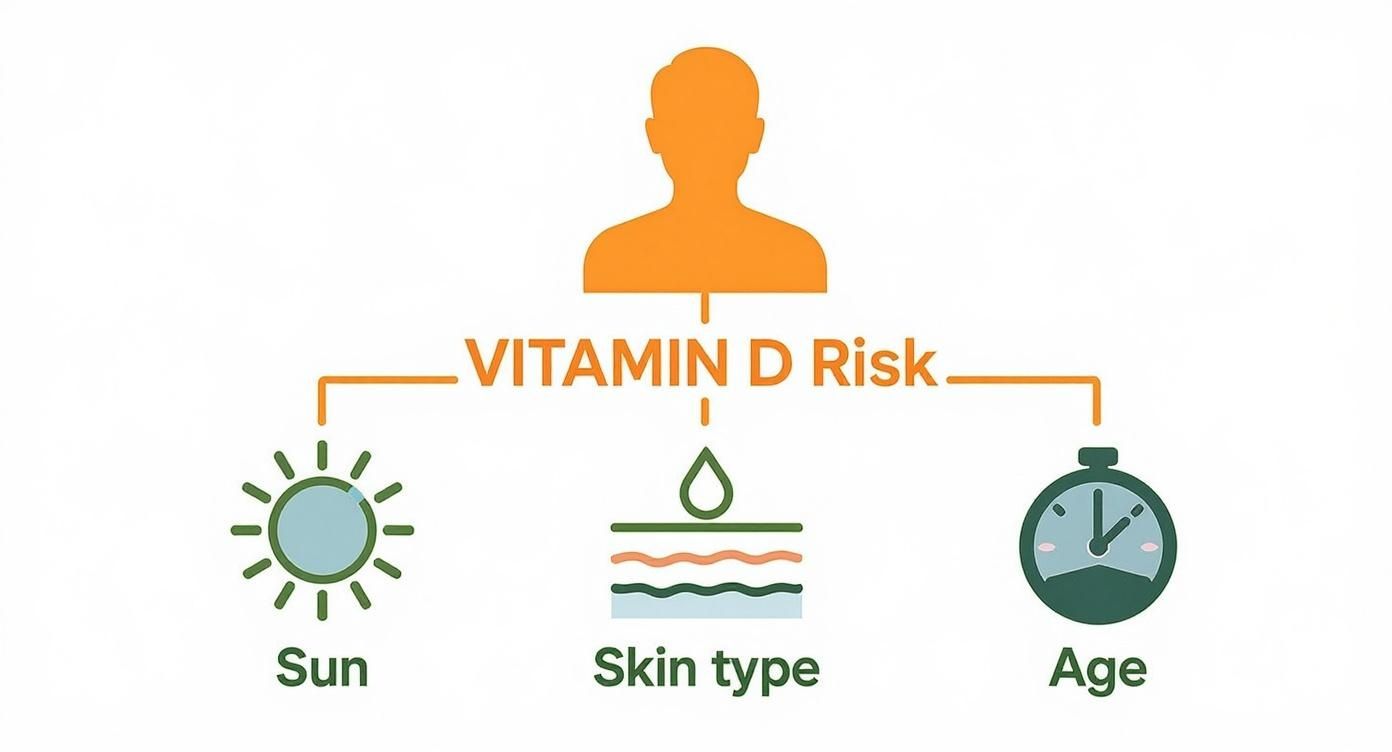
It’s a clear visual of why things like sun exposure, skin tone, and age make reliable supplementation so important. In the past, if you were vegan or plant-based, you were pretty much stuck with the less effective D2. Thankfully, that’s no longer the case.
Plant-based vitamin D—usually from mushrooms or fortified foods—is a critical option for anyone avoiding animal-derived supplements like D3 from lanolin. This shift reflects a bigger trend, with more people going vegetarian or vegan and a growing interest in sustainability. You can explore the latest analysis on plant-based vitamin D trends to see just how much this market is growing.
For those looking for a potent and high-quality D3 supplement, our Peak Performance USDA Organic Vitamin D3 + K2 gives you the most bioavailable form to ensure optimal results. We deliver it in organic olive oil to boost absorption, making it an excellent choice for supporting your bone health and immune function.
The Power of Pairing Vitamin D3 with K2

Taking a vitamin D3 supplement is a fantastic first step, but to really get the most out of it, D3 needs a partner. Think of vitamin D3 as a skilled delivery driver, expertly picking up calcium from your diet and moving it into your bloodstream. It's a critical job, but that’s only half the mission.
Once calcium is in your blood, it desperately needs directions. Without clear guidance, it can get lost and end up in all the wrong places—like your arteries and soft tissues. This is where vitamin K2 comes in, acting as the essential traffic controller for all that calcium.
The Dynamic Duo for Bone and Heart Health
Vitamin K2's main job in this partnership is to activate two crucial proteins: osteocalcin and matrix Gla-protein (MGP). It sounds complex, but their roles are actually quite simple and incredibly important for your health.
- Osteocalcin works like a magnet for your bones. Once K2 flips its switch, osteocalcin grabs calcium from the bloodstream and binds it directly to your bone matrix. This is what helps build strong, dense bones.
- Matrix Gla-protein (MGP) acts as a guardian for your arteries. When activated by K2, MGP actively prevents calcium from building up on the walls of your blood vessels, keeping them flexible and clear.
This teamwork is exactly why a vitamin D supplement with both D3, and K2 is considered the gold standard. D3 makes sure you absorb the calcium, and K2 makes sure that calcium gets to the right address.
The D3 and K2 partnership is a perfect example of nutritional synergy. One without the other isn't just less effective; it could be less safe. Together, they offer comprehensive support for both skeletal strength and cardiovascular wellness.
This coordinated effort is absolutely vital for long-term health. By steering calcium where it's needed (your bones) and keeping it away from where it can cause harm (your arteries), this combo supports two of your body's most important systems simultaneously.
Why Choose a Combined D3 and K2 Supplement
From a biological standpoint, separating these two nutrients just doesn’t make sense. If you boost your vitamin D3 intake without also getting enough vitamin K2, you risk creating a calcium surplus in your bloodstream with no "traffic controller" to manage it.
Over time, this could lead to arterial calcification—a hardening of the arteries that's a major concern for heart health. A combined supplement completely sidesteps this risk by providing both nutrients in a balanced ratio. You can dive deeper into the specific ways vitamin D and K benefits work together in our detailed guide.
Choosing a formula that includes both ensures you get the full spectrum of benefits without the potential downsides. It’s simply the smartest and most efficient way to support your body.
Making the Right Choice for Your Health
When you’re looking for a vitamin D supplement, picking a combined D3 and K2 formula is a proactive step toward smarter supplementation. It ensures you’re not just boosting calcium absorption but also managing it effectively for total-body wellness.
Our Peak Performance D3+K2 is designed with this essential synergy at its core. We combine the most effective form of vitamin D (D3) with a potent dose of vitamin K2 to make sure the calcium you absorb is put to good use—strengthening your bones and protecting your heart. It’s a complete solution for anyone who's serious about their health.
How to Select a High-Quality Vitamin D Supplement
Walking down the supplement aisle can be a head-spinner. You’re hit with a wall of bottles, all shouting similar promises. But finding an effective and safe vitamin D supplement has nothing to do with flashy labels—it's about knowing exactly what to look for under the hood.
A few key quality checks can help you slice through the marketing noise and pick a product that genuinely benefits your health.
Think of it like you're at a farmer's market. You automatically reach for produce that looks vibrant and firm, and maybe you look for an organic sign. Why? Because you know those are markers of quality. The same logic applies right here. You want a supplement made with clean, potent ingredients your body can actually absorb and use.
Reading the Label Like a Pro
First things first, you've got to become a savvy label reader. The real story isn't on the front of the bottle; it's in the fine print on the back. This is where you find out everything about the product's quality, purity, and how well your body will be able to use it.
A top-tier supplement will be completely transparent about what's inside. Keep an eye out for clean carrier oils, like organic olive oil, which seriously boosts the absorption of fat-soluble vitamins like D3. Steer clear of products packed with pointless fillers, artificial colors, or questionable preservatives.
A supplement is only as good as its ingredients. Choosing a product with third-party verification and clean components ensures you're getting exactly what the label promises—nothing more, nothing less. This is your guarantee of both safety and efficacy.
The Importance of Third-Party Testing and Sourcing
One of the most critical signs of a trustworthy vitamin D supplement is third-party testing. This means an independent, unbiased lab has put the product through its paces, verifying it for purity and potency. It’s your proof that the supplement is free from nasty contaminants and contains the precise amount of vitamin D it claims to.
Where the ingredients come from is just as important. Look for brands that are committed to quality, backed by seals like:
- Non-GMO Project Verified: This guarantees the ingredients haven't been genetically modified.
- USDA Organic: For things like carrier oils, an organic certification means they were grown without synthetic pesticides or fertilizers. To dig deeper into why this is a big deal, you can explore the benefits of an organic vitamin D supplement.
These aren't just buzzwords. They represent a brand's deep commitment to creating a pure, clean product from the ground up.
Choosing the Right Form for You
Vitamin D supplements show up in a few different forms, and the best one for you really boils down to your own preference and daily routine.
- Softgels: Easily the most popular choice. They’re simple to swallow, tasteless, and usually contain a carrier oil (like olive oil) that helps with absorption.
- Liquids: Liquid drops are fantastic for flexible dosing. This is great for families or anyone who needs to hit a very specific daily amount. You can take them straight or just add them to a drink or food.
- Gummies: They might be tasty, but gummies often come with a side of added sugar and other fillers. If you go this route, you have to be extra diligent about checking the label.
At the end of the day, consistency is what matters most. Our Peak Performance D3+K2 capsules are a perfect example of putting all these quality standards into practice, giving you a potent, effective dose in a format that’s easy to absorb. When you make purity, third-party testing, and clean ingredients your non-negotiables, you can feel confident you're choosing a supplement that truly works.
Finding Your Optimal Dose Safely
When it comes to a d vitamin supplement, piling on more isn't always better. In fact, it can be a risky game. The real goal isn't to hit the highest number you can find on a label; it's about giving your body the precise amount it needs to function at its peak. This means getting clear on the difference between a daily "maintenance" dose and a powerful "therapeutic" dose used to pull your levels out of a deficit.
You’ll see supplement strengths all over the map, from 1,000 IU for daily upkeep to hefty 10,000 IU doses for more serious support. Think of a maintenance dose like regularly topping off the oil in your car—a small, consistent action to keep the engine humming. A therapeutic dose, on the other hand, is the full-on oil change you need when the dipstick comes up dry.
Maintenance vs. Therapeutic Dosing
A daily maintenance dose, usually somewhere between 1,000 IU and 2,000 IU, is perfect for most adults trying to keep their vitamin D levels in a healthy range. If you get decent sun exposure and don't have any specific risk factors, this is likely your sweet spot.
A therapeutic dose is a different beast entirely. This is a higher amount, prescribed by a healthcare pro, designed to rapidly correct a deficiency and get you back to baseline. It’s a short-term, personalized strategy, and the goal is always to drop back down to a maintenance dose once your levels are stable.
This clinical approach to vitamin D is gaining massive traction. The global market for vitamin D therapy is expected to more than double, rocketing from USD 2.64 billion in 2025 to over USD 5.62 billion by 2032, all because we're finally grasping its critical role in our health. You can read more about the growing vitamin D therapy market here.
The Gold Standard: A Personalized Blood Test
General guidelines are a decent starting place, but they're just that—general. They can’t hold a candle to personalized medical advice. The only way to truly know where you stand and dial in the perfect dose for your unique body is with a simple blood test.
Your optimal dose is a specific target, not a universal number. A blood test removes the guesswork, ensuring you supplement effectively and safely without overdoing it. This data-driven approach is the key to achieving your health goals.
Working with a healthcare professional lets you build a smart vitamin D supplement strategy. They can look at your test results, factor in your lifestyle—like your diet, where you live, and how much sun you get—and recommend a dose that’s just for you. This expert guidance ensures you get all the upside of vitamin D without running into the risks of taking too much, like nausea or muscle weakness. It’s hands-down the safest and most effective way to optimize your health.
Frequently Asked Questions About Vitamin D
Even after getting the facts straight, you might still have a few questions about adding a vitamin D supplement to your routine. I get it. Let’s clear up the most common ones so you can start with total confidence.
When Is the Best Time of Day to Take My Supplement?
Here’s the simple rule: take it with a meal that contains some fat. Since Vitamin D is fat-soluble, that’s how your body absorbs it best.
The exact time of day doesn’t matter nearly as much as just being consistent. Whether you pair it with your avocado toast at breakfast or a salad with olive oil dressing at lunch, tying it to a meal makes it an easy habit to stick with.
Can I Get Enough Vitamin D From Food Alone?
Honestly, it's next to impossible for most people. Only a handful of foods naturally contain meaningful amounts of Vitamin D—think fatty fish like salmon, egg yolks, and beef liver.
Even with fortified foods like milk and cereal, you’d have to eat a ton to hit optimal levels. When you add limited sun exposure to the mix, especially in the winter months, you can see why there’s often a major gap. A high-quality supplement is the most practical and reliable way to fill that gap.
For the vast majority of us, diet and sunshine alone just aren't enough to keep vitamin D levels where they need to be year-round. A supplement is simply a dependable bridge to make sure your body gets what it needs, every single day.
How Long Does It Take to See a Difference?
Fixing a deficiency is a marathon, not a sprint. How long it takes to feel a change really depends on where you’re starting from and your dosage.
Generally, you can expect to see your levels move into a healthy range after a few weeks to a few months of daily, consistent use. The key word there is consistent. Your doctor can order follow-up tests to track your progress and make sure you're on the right track, adjusting your dose if needed. It’s the best way to take the guesswork out of it.
Ready to feel the difference a high-quality, synergistic formula can make? Explore Peak Performance's USDA Organic D3+K2 supplement today and take a confident step toward optimal health.
Also in Blog


How to Increase Stamina Naturally and Boost Energy


How to Increase Energy Naturally

