


Finding the Right Vitamin D K2 Ratio
When it comes to vitamin synergy, the ratio is everything. For Vitamin D and K2, the evidence points to a sweet spot: roughly 100 micrograms (mcg) of K2 for every 10,000 International Units (IU) of Vitamin D3. This isn't just a random number; it's the balance that ensures calcium gets where it needs to go—into your bones, not your arteries.
The Power Couple of Vitamins: Why the D3 and K2 Ratio Matters
Think of Vitamin D3 as the bouncer at an exclusive club, deciding who gets in. Its main job is to open the doors in your gut to let calcium enter your bloodstream. It's incredibly good at this, making sure you absorb this crucial mineral from your food.
But once calcium is in the club, it needs a host to show it where to go. Without guidance, it might just hang out by the bar, causing trouble in places it doesn’t belong.
That's where Vitamin K2 comes in. K2 is the master host, grabbing that calcium and escorting it directly to the VIP section—your bones and teeth. It makes sure every last bit of calcium is put to good use, building a strong, dense skeletal structure. This teamwork is exactly why getting the vitamin d k2 ratio right is a non-negotiable for your health.
Why This Teamwork Is So Important
Taking a high dose of Vitamin D3 without its partner, K2, can actually backfire. D3 boosts your calcium levels, but it has no say in where that calcium ends up. Without K2 to manage the traffic, you can get a buildup of calcium in soft tissues and arteries.
This process, called calcification, is something you want to avoid, as it can stiffen arteries and impact long-term cardiovascular health.
When working together, this power couple delivers on several fronts:
- Bone Density: K2 activates specific proteins that act like glue, binding calcium directly to your bone matrix to keep your skeleton strong.
- Cardiovascular Support: By steering calcium away from your arteries, K2 helps keep them flexible and clear, supporting healthy circulation.
- Total Calcium Balance: The pair ensures calcium is a helpful builder for your skeleton, not a harmful intruder in your soft tissues.
Getting a handle on this partnership is the first step. To go deeper on what each vitamin brings to the table, check out our guide on the benefits of Vitamin D and K.
Let's break down how these two vitamins work together versus on their own.
Vitamin D3 vs K2 Synergistic Action at a Glance
| Nutrient | Primary Function Alone | Synergistic Function with Partner |
|---|---|---|
| Vitamin D3 | Increases the absorption of calcium from the gut into the bloodstream. | Works with K2 to ensure the absorbed calcium is properly utilized. |
| Vitamin K2 | Activates proteins (MGP & osteocalcin) that manage calcium placement. | Directs the D3-absorbed calcium into bones and teeth, keeping it out of arteries and soft tissues. |
As you can see, they’re far more powerful together than they are apart. One without the other leaves the job half-done.
The Science Behind the Synergy
This isn't just a wellness theory; it's backed by solid science. Clinical studies involving over 8,000 participants have driven home just how critical a balanced D-to-K2 ratio is for both your bones and your heart. The research consistently reinforces that the 100 mcg of K2 per 10,000 IU of D3 ratio is a reliable benchmark for getting the job done right.
By working in concert, Vitamin D3 and K2 transform calcium from a free-roaming agent into a targeted tool for building a stronger body. This collaboration is especially vital during the darker winter months.
As we'll explore next, the drop in sun exposure during winter tanks your body's natural Vitamin D production. This makes a well-balanced supplement like Advanced Vitamin D + K an essential part of your wellness strategy, setting you up for resilience when you need it most.
Decoding the Optimal Vitamin D to K2 Ratio
Okay, so you’re on board with the fact that Vitamin D3 and K2 are a team. That’s the first big step. The next question that always comes up is, "How much of each do I actually need?"
While there's no single magic number that works for everyone, a mountain of research points to a solid, widely accepted guideline for the ideal vitamin d k2 ratio.
Here’s the simple, evidence-based rule of thumb: for every 1,000 International Units (IU) of Vitamin D3 you take, you should aim for about 10 micrograms (mcg) of Vitamin K2. This ratio helps ensure there’s enough K2 on hand to properly manage the extra calcium that D3 helps you absorb.
Think of it this way: if you're taking a common dose like 5,000 IU of D3, you'd pair it with 50 mcg of K2. Bump that up to a higher 10,000 IU of D3, and you'd want 100 mcg of K2 to keep things in balance.
Finding Your Personal Ratio
That 1000:10 rule is a fantastic starting point, but it's not set in stone. Your personal needs might look a little different depending on a few key things. It’s all about considering your own health landscape.
Here are a few factors that can shift your ideal ratio:
- Your Current Vitamin D Levels: If a blood test shows you're seriously deficient, your doctor might suggest a higher "loading dose" of D3 to get your levels back up. Naturally, this would mean you'd need a corresponding increase in K2.
- What You Eat: If your diet is already packed with K2-rich foods—think natto, grass-fed dairy, or certain cheeses—you might need less from a supplement. On the flip side, if those foods rarely make it to your plate, supplementation becomes that much more important.
- Your Specific Health Goals: Someone laser-focused on building bone density or supporting their cardiovascular health might work with their doctor to tweak this ratio for maximum impact.
This simple flowchart breaks down the basic logic of why you'd want to supplement with both.
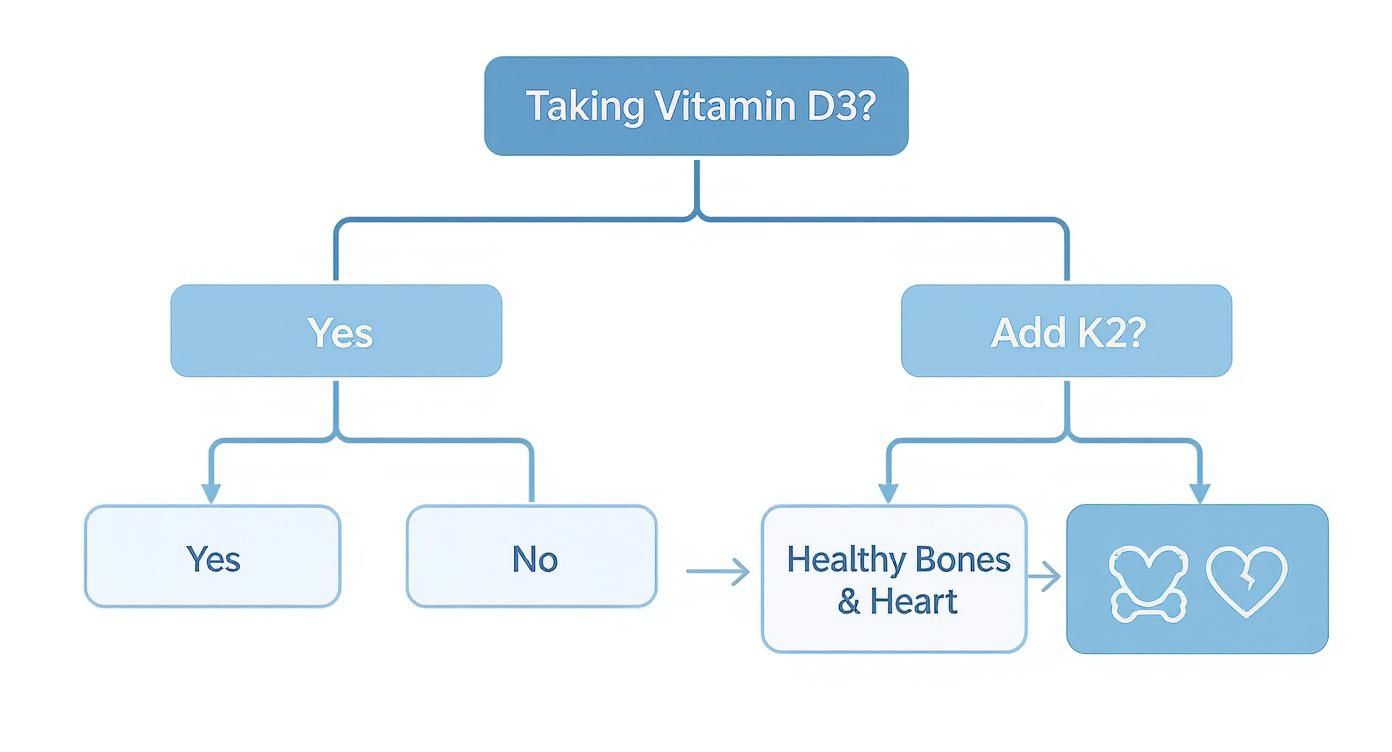
The visual drives home a critical point: if you're taking a Vitamin D3 supplement, adding K2 is the smart move to make sure all that calcium goes where you want it—your bones and not your arteries.
The goal is to move beyond generic advice. Understanding the principles behind the vitamin d k2 ratio empowers you to have an informed conversation with your healthcare provider about what's right for you.
This principle of getting your vitamin levels right is crucial at every stage of life. While this article focuses on the D3 and K2 partnership in adults, the foundational importance of specific vitamins is universal. For instance, guidelines on Ensuring Adequate Vitamin D for Your Breastfed Baby highlight just how vital this nutrient is from day one.
The Problem with Guesswork
Trying to manage these ratios by buying separate bottles of D3 and K2 can get messy fast. It's easy to create an imbalance. One of the simplest, most effective ways to nail this partnership is to choose a supplement that already did the math for you.
A high-quality, pre-formulated product like our Advanced Vitamin D + K is designed to give you that balanced, effective dose in a single capsule. It takes out all the guesswork and ensures you consistently get the synergistic benefits these two powerhouse vitamins offer. This is especially important during the winter months when your body's own Vitamin D production tanks.
Why Winter Wellness Demands Both D3 and K2
As the days get shorter and the sun hangs lower in the sky, your body’s internal Vitamin D factory slowly grinds to a halt. The specific UVB rays your skin needs to synthesize this critical vitamin just don't reach us, causing a natural, and often significant, drop in our levels. This isn't just about the winter blues; it creates a real gap in your body's wellness defenses.
This seasonal dip is exactly why winter is the most important time to get strategic about your vitamin D and K2 ratio. When sunlight isn't a reliable source, supplementation becomes the only game in town for maintaining the levels your body needs to thrive. Without enough D3, your immune system can't perform at its best, and your entire calcium management system gets thrown off balance.

Immune Support During Colder Months
Let's face it, winter means more time cooped up indoors, in closer contact with everyone else—the perfect recipe for seasonal bugs to make the rounds. Vitamin D3 is a master regulator of your immune response, basically acting as the "on" switch for the T-cells that hunt down and destroy invading pathogens.
When your D3 levels are low, it's like sending your immune system into a fight with one hand tied behind its back. A well-balanced D3 and K2 supplement helps ensure your internal defenses are primed and ready to go, giving you crucial support right when you need it most.
Protecting Bones and Heart When Activity Decreases
Winter often brings a more sedentary lifestyle. Less time outdoors means less weight-bearing exercise, which is absolutely essential for keeping our bones strong and dense. This is where the D3 and K2 partnership becomes even more critical.
The D3 and K2 combo works to counteract the potential for bone density loss during these less active months by making sure the calcium you get from your diet is shuttled directly into your skeleton. Think of it as a proactive insurance policy for your long-term bone strength.
At the same time, K2 is busy keeping calcium out of your arteries and soft tissues where it doesn't belong. This is huge for keeping your cardiovascular system flexible and healthy—a benefit that’s important year-round but especially when our activity patterns shift with the seasons.
This isn't just a niche health trend; the awareness of this synergy is going mainstream. The vitamin K2 supplements market was valued at USD 1.36 billion in 2023 and is on track for major growth, driven by a better understanding of its powerful role in bone and heart health.
To get a better handle on keeping your D levels up as the temperature drops, check out our guide on how to get the Vitamin D you need heading into winter.
A Simple Strategy for Seasonal Resilience
Trying to navigate the darker, colder months with subpar vitamin levels is an uphill battle you don't need to fight. A high-quality supplement takes the guesswork out of the equation, providing a steady, reliable source of these crucial nutrients day in and day out.
Choosing a pre-formulated supplement like our Advanced Vitamin D + K is a simple and incredibly effective way to keep your levels where they need to be when the sun won't cooperate. It’s a proactive step to support your immune system, bone density, and cardiovascular health, empowering you to feel your best all winter long.
Choosing Your K2: Comparing MK-4 and MK-7
When you start digging into Vitamin K2, you’ll quickly realize not all forms are created equal. On a supplement label, you'll almost always see two main players: Menaquinone-4 (MK-4) and Menaquinone-7 (MK-7). They're both technically Vitamin K2, but they act very differently inside your body.
Getting this distinction right is key to picking a supplement that actually works.
Think of it like choosing fuel for a long road trip. MK-4 is like a quick jolt of high-octane racing fuel. It gets absorbed fast and goes right to work, but it burns out just as quickly, leaving the tank empty.
MK-7, on the other hand, is like a super-efficient, slow-burning diesel. It takes longer to build up in your system, but it provides a steady, sustained supply of K2 that your body can rely on for the long haul.
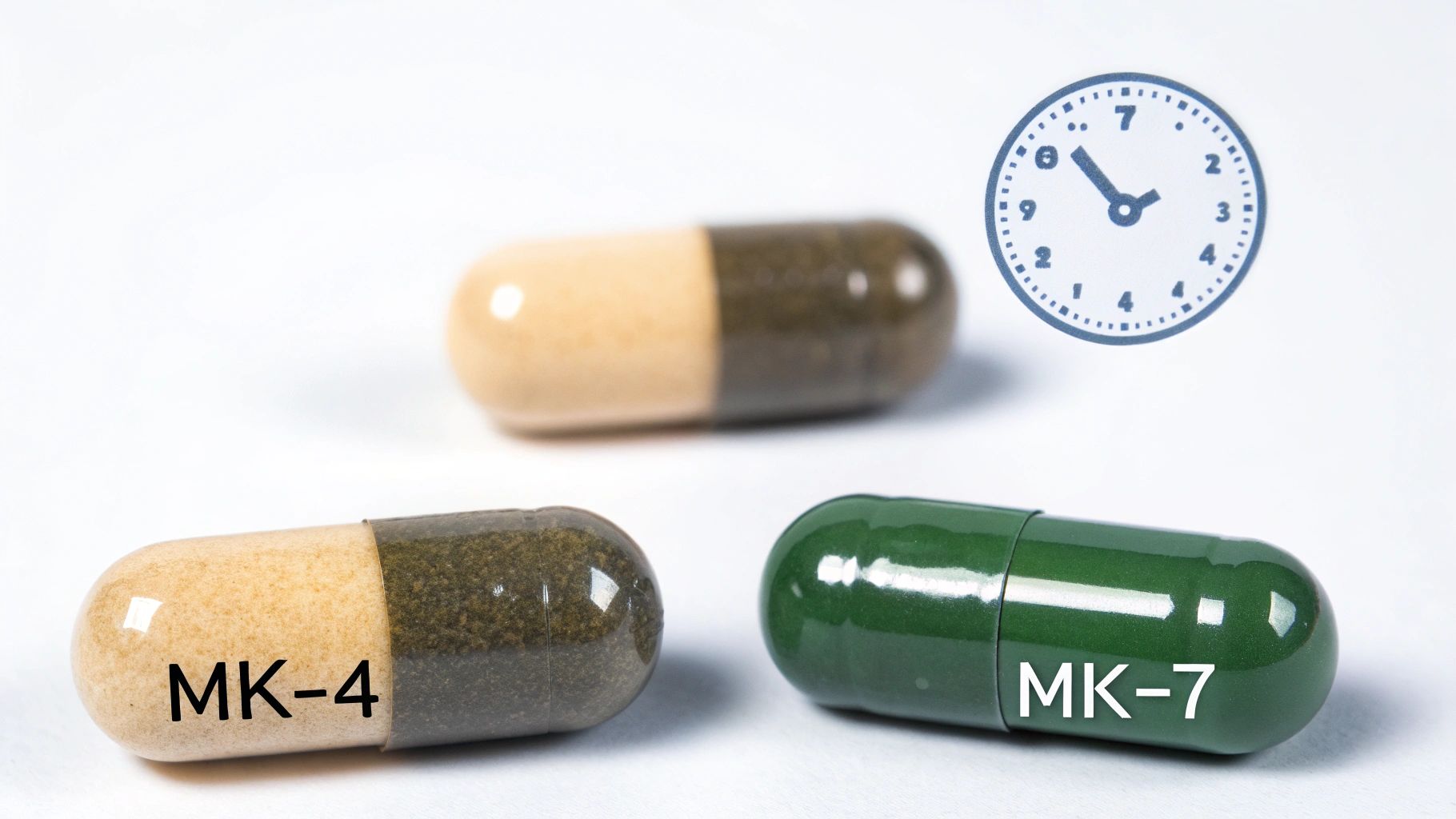
To really grasp the difference, we need to talk about their "half-life" and where they come from.
Comparison of Vitamin K2 Forms: MK-4 vs. MK-7
The table below breaks down the must-know differences between these two crucial forms of Vitamin K2.
| Feature | Vitamin K2 (MK-4) | Vitamin K2 (MK-7) |
|---|---|---|
| Half-Life | Very short (1-2 hours) | Very long (up to 72 hours) |
| Dosing Frequency | Needs multiple doses per day | Effective with one dose per day |
| Primary Sources | Animal products (butter, eggs, liver) | Fermented foods (like natto) |
| Bioavailability | Lower; rapidly cleared from blood | Higher; sustained blood levels |
| Tissue Reach | Concentrates in specific tissues | Circulates widely (bone, arteries) |
| Best For | Not ideal for once-daily supplements | Long-term bone & cardiovascular support |
For anyone looking for a reliable, once-a-day supplement strategy, the evidence clearly points to one winner.
Why MK-7 is the Smarter Choice for D3 Synergy
The core difference comes down to half-life—the time it takes for half the substance to be flushed from your system. MK-4 has a half-life of just a few hours, meaning you’d need to pop pills all day to keep your levels stable.
MK-7 is the real workhorse here. It hangs around in your body for up to 72 hours. This long-lasting presence is what makes it so powerful. It allows for a simple, once-daily dose that builds and maintains steady, effective K2 levels in your blood.
When you're supplementing for long-term bone and heart health, you need consistency. The long half-life of MK-7 provides that constant, reliable presence needed to keep calcium-directing proteins activated around the clock.
Where these vitamins come from also tells part of the story. MK-4 is found in animal foods like grass-fed butter and egg yolks. MK-7 is a product of bacterial fermentation, famously found in the Japanese dish natto (fermented soybeans).
But when it comes to how well our bodies absorb and use it—its bioavailability—MK-7 consistently comes out on top. Its structure allows it to be better absorbed and sent to all the right places, reaching bone and vascular tissues far more effectively than its short-lived cousin.
That's why MK-7 is the hands-down preferred form for pairing with Vitamin D3. When D3 is constantly working to boost calcium absorption, you need a version of K2 that is just as consistently on duty to make sure that calcium goes where it's needed.
This is exactly why we formulated our Advanced Vitamin D + K with MK-7. It creates a perfect partnership, ensuring a steady and reliable vitamin d k2 ratio that works 24/7 to keep your body in balance. Choosing the right form isn't just a small detail; it’s a strategic decision for your long-term health.
Your Guide to Safe and Effective Supplementation
So, you're ready to start a new supplement routine. That's great, but like any journey, a little prep work goes a long way. When you're dealing with something as powerful as the D3 and K2 partnership, a smart, safe approach ensures you get all the upside without any unnecessary risks.
Think of it this way: you wouldn't start a cross-country road trip without first checking the gas tank. The first—and most important—step is to figure out your starting point with a simple blood test for 25-hydroxyvitamin D.
This gives you an objective, no-nonsense baseline of your current vitamin D status. It takes all the guesswork out of the equation and gives you and your doctor the hard data needed to dial in a dose that’s right for your body.
Navigating Supplement Safety
Once you know your numbers, it's time to think about safety. While Vitamin D3 and K2 are a fantastic team, they don’t work in a vacuum. You need to be aware of how they might interact with your unique health situation.
The biggest one to watch for involves blood-thinning medications. Vitamin K’s whole claim to fame is its role in blood clotting, which means it has the potential to interfere with anticoagulants.
Crucial Safety Note: If you're on any blood-thinning medication, like warfarin, it is absolutely essential to talk to your doctor before adding a Vitamin K2 supplement to your routine. They can help you find a safe dosage that won't mess with your current treatment plan.
Your doctor is your best partner here. They can look at your full health picture and help you make choices that are both safe and effective for you.
Why Quality and Transparency Matter
In the wild west of the supplement world, not all products are created equal. To make sure you’re getting what you pay for, you have to look for products that undergo third-party supplement testing. This is a crucial step that verifies what’s on the label is actually what’s in the bottle—no more, no less. It’s a key part of being a savvy consumer, and you can get the full scoop in our guide on how to read supplement labels.
As more people wake up to the benefits, the market is exploding. The global vitamin K2 market is expected to hit USD 602 million by 2030. This isn't just hype; it's driven by solid clinical research showing that the D3 and K2 combo can seriously improve bone strength and cut cardiovascular risks, especially as we age.
Make It Easy on Yourself with a Combined Formula
Let's be real—trying to juggle separate bottles of D3 and K2 to hit the perfect ratio is a hassle. It’s easy to mess up the dosage and a pain to manage. A far simpler and more reliable approach is to grab a pre-formulated supplement that does the work for you.
This is exactly why we created products like our Advanced Vitamin D + K. It takes the complexity and guesswork out of the equation, delivering an effective, synergistic ratio designed for optimal results.
By starting with a blood test, looping in your doctor, and choosing a high-quality combined formula, you can confidently and safely tap into the incredible power of this vitamin power couple.
Your Top Questions About the Vitamin D and K2 Ratio, Answered
Let's wrap up by tackling some of the most common questions we hear about the vitamin D and K2 relationship. This should clear up any lingering confusion and help you move forward with total confidence.
Can I Really Get Enough Vitamin D and K2 From My Diet?
Honestly, for most of us, it’s a real challenge. Even with a super clean, whole-foods diet, hitting optimal levels of these two vitamins from food alone is incredibly difficult.
Vitamin D is called the "sunshine vitamin" for a reason—our bodies make it when our skin is exposed to direct sunlight. While you can get some from fatty fish and egg yolks, it's rarely enough to maintain ideal levels, especially if you live in a northern climate or during the winter months.
Vitamin K2 is even trickier. It's packed into very specific foods like natto (a fermented soybean dish) and certain organ meats and cheeses from grass-fed animals. Since these aren't staples in the typical Western diet, supplementation becomes the most practical and reliable way to ensure you're getting what you need, day in and day out.
How Long Does It Take to Feel the Benefits of Supplementing?
When it comes to supplementing with D and K2, patience and consistency are everything. While some people might feel a boost in mood or energy within a few weeks, the real magic is in the long-term protection.
If you have a serious deficiency, it could take several weeks or even a few months of consistent, daily use to see significant changes in your blood work. The main goals here—fortifying your bones and protecting your cardiovascular system—are silent victories that compound over time. Think of it less like a quick fix and more like a daily investment in your future health.
The true power of Vitamin D3 and K2 lies in their long-term, protective benefits. Consistent daily supplementation is the key to building and maintaining a resilient foundation for bone and heart health.
This steady, daily approach is what ensures your body always has what it needs to put calcium in its proper place.
Is It a Big Deal to Take Vitamin D Without K2?
It can be. Taking high doses of Vitamin D without its essential partner, Vitamin K2, can actually work against you. When you supplement with D3, you dramatically increase how much calcium your body absorbs. Without enough K2 to act as a "calcium traffic cop," all that extra calcium can get deposited where you don't want it.
Over time, this can lead to the calcification of arteries and other soft tissues—the very thing you’re trying to prevent. This is exactly why a balanced, synergistic approach is so critical for both safety and results.
A thoughtfully formulated supplement like our Advanced Vitamin D + K provides these two nutrients together in the right ratio. This combination makes for a much safer and more effective strategy for supporting your long-term health.
Who Should Be Extra Careful About Their D and K2 Ratio?
While the right ratio is important for everyone, some groups need to be particularly mindful. Anyone taking higher doses of Vitamin D—generally 5,000 IU or more per day—absolutely needs to ensure their K2 intake is sufficient to manage all that extra calcium.
This is especially true for these groups:
- Postmenopausal Women: This group faces a higher risk of bone density loss, making K2’s role in directing calcium to the bones absolutely vital.
- Older Adults: As we age, keeping our bones strong and our arteries flexible becomes a top health priority.
- Anyone with Pre-existing Heart Health Concerns: For this group, ensuring calcium stays out of the arteries is non-negotiable.
- Those with Limited Sun Exposure: People in northern climates or who spend most of their time indoors often need more D3, which makes the K2 partnership essential for safety.
Of course, the best first step is always to talk with your healthcare provider. They can help you figure out your personal needs and build a supplement plan that’s perfectly tailored to your health goals.
At Peak Performance, we’re all about making wellness simple and effective. Our Advanced Vitamin D + K is expertly formulated with the right ratio of D3 and MK-7 to take the guesswork out of it, giving you powerful, synergistic support for your bones, heart, and overall vitality.
Also in Blog


How to Increase Stamina Naturally and Boost Energy


How to Increase Energy Naturally

