


What to Look for in Protein Powder Explained
So, you're trying to figure out what to look for in a protein powder. Let's cut through the noise. It really boils down to four things: the protein source (where it comes from), the purity of the ingredients, the actual protein content per scoop, and how well your body can digest it.
Get these four right, and you'll find a high-quality powder that actually moves the needle on your health and fitness goals.
Your Protein Powder Decision Checklist
Walking down the supplement aisle can feel like a pop quiz you didn't study for. But it doesn't have to be that complicated. Choosing the right powder isn't about grabbing the tub with the flashiest label; it's about knowing what your body needs and matching it with the right product. Think of this as your roadmap.
The protein market is absolutely exploding. We're talking about a global market projected to jump from $24.8 billion in 2025 to a staggering $45.7 billion by 2035. With more and more options hitting the shelves, it’s more important than ever to know what you're looking for. You can learn more about the growth of the protein supplement market to see just how big this industry is getting.
To make things simple, we've broken it down into four essential pillars. This is the hierarchy we use to evaluate any protein powder, from the big-picture source down to how it feels in your gut.
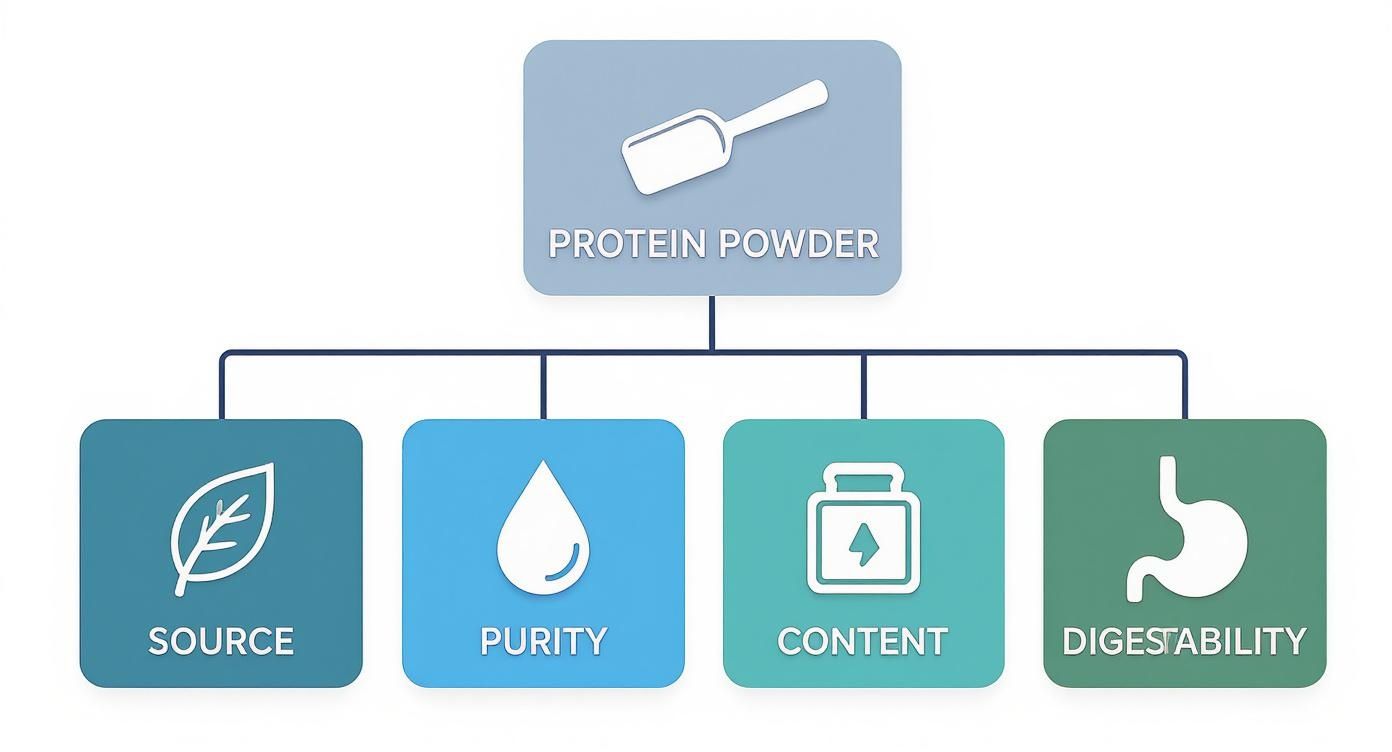
As you can see, you start with the source. From there, you narrow it down based on purity, how much protein is actually in it, and finally, how well you can absorb it. Each step builds on the last, guiding you to a clean, effective product that’s right for you.
The Four Pillars of a Great Protein Powder
Once you understand these four components, you can see right past the clever marketing and focus on what truly matters. We'll dive deep into each one, but here’s a quick snapshot to get you started.
- Protein Source: This is your first big decision. Are you going for an animal-based protein like our Grass-Fed Beef Protein Isolate, or do you prefer a plant-based option like our Chocolate Plant-Based Protein? Each comes with its own unique set of benefits.
- Ingredient Purity: The best powders have a short and simple ingredient list. We’ll teach you how to spot—and avoid—all the unnecessary fillers, gums, and artificial junk.
- Protein Content: It’s all about the protein-per-serving ratio. You want to make sure you're getting a powerful dose of protein without a bunch of extra calories from carbs or fats.
- Digestibility: A great protein powder shouldn't leave you feeling bloated or uncomfortable. Things like the protein type (isolate vs. concentrate) and the absence of common allergens make a huge difference here.
We've put together a quick cheat sheet to help you keep these key factors in mind.
Key Factors When Choosing a Protein Powder
| Factor | What to Look For | Why It Matters |
|---|---|---|
| Protein Source | Animal (whey, casein, beef) or Plant (pea, soy, hemp) | Aligns with your dietary needs, allergies, and ethical preferences. |
| Ingredient Purity | Short ingredient list, no fillers, artificial sweeteners, or gums | Ensures you're getting a clean product without unnecessary additives. |
| Protein Content | High protein-to-calorie ratio (ideally 20-30g per serving) | Maximizes muscle-building benefits without excess carbs or fats. |
| Digestibility | Isolate > Concentrate, allergen-free, added digestive enzymes | A protein you can't digest is a protein you can't use. Good digestibility prevents bloating and discomfort. |
Using this framework, you'll be able to confidently evaluate any protein powder on the market and choose one that truly supports your goals.
Decoding Animal vs. Plant-Based Protein Sources
When you're staring at a wall of protein powders, the first major decision you'll face is the source. Do you go with an animal-based protein or a plant-based one? There's no single right answer here—it all comes down to your personal dietary needs, how your body digests things, and what you’re trying to achieve.
For a long time, animal-based proteins were considered the gold standard, and for good reason. Most of them are complete proteins, which means they contain all nine essential amino acids (EAAs) your body can't make on its own. Think of EAAs like a complete toolkit for muscle repair and growth; if you're missing a few tools, the construction job just isn't as efficient.
But here's the catch: many of the most popular animal proteins, like whey and casein, are derived from dairy. For anyone with lactose intolerance or a dairy sensitivity, that can lead to some serious digestive trouble. This is exactly where high-quality, dairy-free alternatives come in, offering all the power without the problems.
Powerful Dairy-Free Animal Proteins
One of the best dairy-free options out there is beef protein isolate. It packs a powerful, complete amino acid profile and is incredibly bioavailable—meaning your body can absorb and put it to use right away. If you're looking for maximum muscle support without the dairy, a clean beef protein is a game-changer.
For example, our Grass-Fed Beef Protein Isolate gives you all the muscle-building horsepower of beef in a super concentrated, easy-to-digest powder. It’s perfect for post-workout recovery or just bumping up your daily protein intake cleanly. To dig deeper, check out our guide on the benefits of beef protein powder.
The Rise of High-Quality Plant Proteins
On the other side of the aisle, plant-based proteins have exploded in popularity. They used to get a bad rap for having a gritty texture or not containing all the essential amino acids, but modern formulas have completely flipped that script.
Plant-based proteins are no longer a compromise. Today’s advanced blends combine multiple plant sources to create a complete EAA profile that stands toe-to-toe with animal-based options, making them a fantastic choice for vegans, vegetarians, or anyone looking to cut back on animal products.
You'll often see high-quality plant powders blending proteins from sources like pea, brown rice, and hemp. This smart combination ensures you’re getting that full spectrum of amino acids your muscles crave. If you’re leaning toward plant-based, getting more insight into effective plant-based protein for muscle building can help you make a confident choice.
A well-made formula like our Chocolate Plant-Based Protein is proof that you don't have to sacrifice taste or results. It’s smooth, delicious, and delivers the fuel your body needs to perform.
Ultimately, choosing between animal and plant protein is about what works for you and your lifestyle. Both paths can lead to incredible results, as long as you prioritize a high-quality product.
How to Read a Protein Powder Label
Think of a protein powder's nutrition label as its resume. It tells you everything you need to know about what’s inside—from the quality of the protein to any junk ingredients lurking in the fine print. Learning to read it properly is probably the single most important skill you can develop in your search for the right powder.
Your job is to become a bit of a detective, cutting through the marketing hype to focus on what actually matters for your health. A great protein powder should be clean fuel, not a chemical cocktail. The simplest way to do that? Prioritize a minimal ingredient list, just like you would with real food.
This means you’ve got to ignore the flashy promises on the front of the tub, flip it over, and get down to business with the facts panel. A few key details will tell you right away if you’re looking at a premium product or just cleverly marketed filler.
Prioritize a Short and Clean Ingredient List
When it comes to protein powder, the golden rule is simple: less is almost always more. The ideal ingredient list is short and sweet, with the protein source sitting right at the top.
Take a look at a genuinely clean product, and you’ll see what I mean. For example, our unflavored Grass-Fed Beef Protein Isolate has a refreshingly simple list. That kind of transparency is a dead giveaway you're dealing with a brand that values purity over padding their profits.
If the ingredient list reads like a chemistry textbook, put it back on the shelf. That's a huge red flag. Your body doesn’t need a long list of artificial compounds to recover and build muscle.
Watch Out for These Red Flags
A lot of companies bulk up their powders with cheap fillers and artificial junk to make them taste better or improve the texture—all while keeping their costs down. Knowing what to avoid is just as critical as knowing what to look for.
Here are the biggest offenders to keep an eye out for on any label:
- Artificial Sweeteners: Things like sucralose, aspartame, and acesulfame potassium are used to create an intensely sweet taste without sugar. The problem is, they can mess with your gut health and throw your body's natural hunger signals out of whack.
- Fillers and Thickeners: Watch out for maltodextrin, gums (like xanthan or guar), and other agents that are only there to improve "mouthfeel." They offer zero nutritional value and can cause bloating and digestive issues for a lot of people.
- Artificial Colors and Flavors: If you see terms like "Red 40" or "natural and artificial flavors," it's a clear sign the product is heavily processed. Clean, high-quality ingredients don't need synthetic colors or mystery flavorings to be palatable.
By choosing a powder with a minimal ingredient list, you ensure that every gram in your scoop serves a purpose—fueling your body with high-quality protein and nothing else.
If you want to go deeper on this, we've put together a full guide on how to read supplement labels. Mastering this skill will empower you to make smarter choices with all your supplements, not just your protein.
Understanding Protein Purity and Types
Once you've picked a protein source, the next thing to look at is how that protein is processed. Not all powders are the same, and the words you see on the label—like "concentrate," "isolate," and "hydrolysate"—tell you a ton about the product’s purity and how your body will actually use it.
Think of it like making orange juice. You can have juice with lots of pulp, a little pulp, or no pulp at all. Protein processing is a lot like that; it’s just a filtering process designed to separate the pure protein from fats, carbs (like lactose), and other stuff.
The level of filtration makes a huge difference in the final product. Getting a handle on these differences helps you pick a powder that’s a perfect match for your goals, whether you’re trying to build muscle, dealing with a sensitive stomach, or just need a clean protein boost in your day.
Concentrate: The Foundational Form
Protein concentrate is the most common and least processed form you'll find. To make it, the whole food source goes through a basic filtration process that strips out some of the non-protein components.
This usually leaves you with a powder that is 70-80% protein by weight. The rest is made up of fats and carbs. While it’s a bit lower in protein, this form hangs on to more of the naturally occurring nutrients from the original source. It’s a solid, budget-friendly choice for general, everyday use.
Isolate: The Purified Powerhouse
If concentrate is juice with some pulp, then protein isolate is the totally pulp-free version. It goes through another, more intense filtering process to get rid of almost all the leftover fats and lactose.
The end result is a much cleaner product, typically packing 90% or more protein. This makes isolates a go-to choice for a few key reasons:
- Higher Purity: You get more protein and fewer carbs and fats in every scoop, which is perfect for anyone tracking their macros closely.
- Better for Digestion: Stripping out the lactose makes it a game-changer for people with dairy sensitivities who can’t handle standard whey concentrates.
- Faster Absorption: With fewer other compounds getting in the way, your body can absorb the protein more quickly.
For these reasons, you'll see a lot of athletes and people with digestive issues reaching for an isolate. Our Grass-Fed Beef Protein Isolate is a great example of this, delivering pure protein without any of the dairy.
Hydrolysate: The Pre-Digested Option
Hydrolyzed protein, or hydrolysate, takes purity one step further. This form is basically "pre-digested" through a process that chops up the long protein chains into smaller pieces called peptides.
Because the protein is already partially broken down, your body can absorb it almost instantly. This makes hydrolysates the fastest-acting protein available, often favored by elite athletes for immediate post-workout recovery.
But, this advanced processing usually means a higher price tag and a more bitter taste. For most of us, the benefits of an isolate strike the perfect balance of purity, performance, and value, making it the better choice for consistent, daily use. You can check out all these options in our collection of high-grade protein powders.
Why Amino Acid Profiles Are So Important
It's easy to just glance at the protein grams per serving and call it a day, but that number doesn't tell the full story. If you really want to know what makes a protein powder effective, you have to dig a little deeper into its amino acid profile.
Think of protein as a complex structure built from smaller building blocks called amino acids. Your body relies on these tiny compounds for just about everything—from repairing muscle fibers after a workout to producing essential hormones.
Imagine you're building a house. You need all the right materials: wood, nails, concrete, and so on. Amino acids are those raw materials. While your body can manufacture some of them, there are nine it simply can't make on its own. We call these the Essential Amino Acids (EAAs).
A protein source is only considered "complete" if it delivers all nine of these essential building blocks. If you're missing even one, it’s like trying to finish that house without any nails—the whole construction project grinds to a halt.
The Role of BCAAs in Muscle Building
Zooming in even closer, there are three specific EAAs that are absolute rockstars for muscle growth: leucine, isoleucine, and valine. You've probably heard of them as the Branched-Chain Amino Acids (BCAAs).
Leucine, in particular, is the MVP. It acts as the "on" switch, signaling your body to initiate muscle protein synthesis—the actual process of repairing and building new muscle tissue.
For a deeper dive into this key biological process, consider understanding Muscle Protein Synthesis (MPS). It’s the very reason why a high-quality protein powder with a complete amino acid profile is so effective.
This is exactly why that big number on the front of the tub isn't the only thing that matters. A truly high-quality powder will have a complete amino acid profile, loaded with all nine EAAs and a hefty dose of BCAAs to flip that muscle-building switch.
Complete Profiles in Animal and Plant Powders
Animal-based proteins are naturally complete sources. They come pre-loaded with all the EAAs in ratios that our bodies can use incredibly efficiently.
But modern plant-based proteins have caught up. By strategically combining different plant sources—like pea and rice—formulas can achieve a complete and powerful amino acid profile that stands shoulder-to-shoulder with animal-based options.
If you want to explore this topic more, check out our guide on the 9 essential amino acids and why they matter so much.
Finding Brands You Can Actually Trust
In a market flooded with options, figuring out which protein powder to buy goes way beyond just scanning the ingredient list. Trust and transparency are everything.
Here’s the deal: protein powders are classified as supplements, which means they aren’t regulated by the Food and Drug Administration (FDA) with the same strictness as food. This lack of oversight creates a "wild west" scenario where quality can be all over the map.
In fact, some shocking studies have found that many bestselling protein powders contain nasty stuff like heavy metals and BPA. This is where third-party certifications become your best friend. Think of these seals as an independent audit, a stamp of approval that verifies what's on the label is actually in the tub—and that it’s clean.
When a brand voluntarily pays for this rigorous testing, it’s a massive signal. It shows they’re committed to quality and safety, and they’re willing to put their money where their mouth is.
Decoding the Seals of Approval
When you see certain logos on a protein powder, it means the product has passed a series of tough, expensive tests. That's why these certifications are such a powerful indicator of a brand you can count on.
Here are the big ones to look for:
- NSF Certified for Sport: This is the gold standard. It confirms the product is free from over 270 substances banned by major athletic organizations, that the label is accurate, and that there are no unsafe levels of contaminants.
- Informed-Choice / Informed-Sport: Much like NSF, this program tests every batch for banned substances. It’s a go-to for competitive athletes who can't afford any risks with their supplements.
- USDA Organic: This seal guarantees the ingredients were grown and processed without synthetic pesticides, GMOs, or irradiation. It speaks directly to the purity and quality of the raw ingredients.
When you choose brands that carry these certifications, you’re not just buying a supplement; you’re investing in peace of mind. You can fuel your body with confidence, knowing you aren't getting any hidden junk or falsely advertised formulas.
Finding a transparent brand that’s obsessed with quality is the final, most important piece of the puzzle. Our entire collection of high-grade protein powders is built on this very principle, ensuring you get a pure, effective product every single time.
Got Questions About Protein Powder? We’ve Got Answers.
Even after you know what to look for, a few questions always seem to pop up when you’re trying to fit protein powder into your life. Let's clear the air and give you some straightforward answers.
How Much Protein Do I Actually Need?
This really boils down to your goals and how active you are. For most people putting in work at the gym or on the trail, a good target is 1.2 to 2.0 grams of protein for every kilogram you weigh.
So, for a 150-pound person (that’s about 68 kg), you'd be shooting for somewhere between 82-136 grams of protein per day.
A clean, high-quality protein powder isn't magic—it's just a super-efficient way to help you hit that daily number, whether it’s in a post-workout shake or a quick smoothie on a packed day.
It's not about nailing the timing perfectly. The real key is consistently hitting your daily protein target. A supplement just makes that goal much, much easier to reach.
When Is the Best Time to Take It?
Everyone talks about the post-workout "anabolic window," and while it's a great time to refuel, the science shows that your total daily protein intake matters a whole lot more than when you take it.
You can have a shake first thing in the morning to start your day strong, right after you train to kickstart recovery, or between meals to keep hunger at bay. The "best" time is whatever time works for you and keeps you on track.
Will Protein Powder Make Me Bulky?
This is probably one of the biggest myths out there, especially for women. Let’s be clear: protein powder, on its own, will not make you bulky.
Putting on serious muscle mass takes two things: a serious, consistent calorie surplus (eating more than you burn) and a tough, progressive weight training plan.
For the average person, a clean protein powder simply helps you build lean muscle, recover faster, and feel more full. It’s a tool to get stronger and leaner, not to accidentally turn into a bodybuilder.
Ready to find a clean, effective protein that actually aligns with your goals? Peak Performance offers a full range of high-grade protein powders designed for purity and results, from grass-fed Beef Isolate Protein Powders to our smooth and delicious Chocolate Plant Based Protein Powder.
Also in Blog


How to Increase Stamina Naturally and Boost Energy


How to Increase Energy Naturally

