


Whole food vitamins for kids: A simple guide
Let's be honest, getting kids to eat a perfectly balanced diet every single day is a tall order. Between picky eating phases and our own hectic schedules, it's easy to worry if they're getting all the nutrients they need to thrive.
This is exactly why so many parents are turning away from the brightly colored, sugar-loaded kids' vitamins of the past. We're getting smarter about reading labels and questioning the long lists of artificial ingredients, fillers, and dyes.
The focus has shifted toward clean, natural nutrition that fills those inevitable dietary gaps without adding junk. This is where whole food vitamins for kids come in, and they are a game-changer.

A Bridge to Better Health
So, what are they? Simply put, whole food vitamins are supplements made directly from real, concentrated foods—think dehydrated fruits, vegetables, and other natural sources.
Unlike synthetic vitamins cooked up in a lab, these nutrients come packaged just as nature intended. They include all the helpful co-factors and enzymes found in actual food, which helps your child's body recognize and absorb them far more easily.
Think of it like this: a whole food vitamin isn't just a supplement; it's a bridge. It connects the ideal, nutrient-packed diet we all strive for with the reality of our busy lives. It’s like getting the goodness of a fresh apple or a stalk of broccoli in a convenient form.
This desire for clean-label products isn't just a passing trend. It’s a full-blown movement. The market for children's health supplements, including whole food options, was valued at roughly USD 2.52 billion and is expected to climb to USD 4.13 billion by 2035. This massive growth is driven by parents who are tired of artificial additives and want real, effective nutrition for their kids.
It highlights a simple truth: giving our kids a natural start is one of the best ways to build a foundation for a lifetime of good health.
A focus on natural nutrition provides children with the essential building blocks they need during their most critical years of growth. It's about more than just avoiding "bad" ingredients; it's about actively choosing "good" ones that work in harmony with their bodies.
Making the Right Choice for Your Family
Diving into the world of kids' supplements can feel overwhelming, but just knowing the difference between whole-food and synthetic is a huge first step. When you prioritize ingredients derived from nature, you can feel confident you're supporting your child’s immune system, brain development, and energy levels in the best way possible.
If you're dealing with a particularly selective eater, we've got more tips in our guide on nutrition for kids. This principle is the very foundation of our own Kids Vitamins, designed to give your child clean, effective nourishment.
What Exactly Are Whole Food Vitamins?
Let's break down what whole food vitamins for kids actually are. The easiest way to think about it is like building a house.
A synthetic vitamin is like getting a pile of bricks dumped on your lawn. Bricks are obviously important, but you can't build a house with just bricks. You still need the mortar, the wood for the frame, the pipes, the wires... you get the idea.
A whole food vitamin, on the other hand, is like getting the entire construction crew showing up with a truck full of all the right materials, ready to work together. These vitamins aren't cooked up in a lab from isolated chemicals. They come directly from real, concentrated foods like organic fruits and vegetables.
This means the main vitamin—say, Vitamin C or D—doesn't show up to the party alone. It brings a whole team of helpers with it, all naturally packaged together.
The Power of Nutrient Synergy
So, who are these "helpers"? They’re what we call cofactors. This team includes enzymes, antioxidants, trace minerals, and other phytonutrients that exist naturally in the food source.
They all work together in synergy, which is a fancy way of saying their combined effect is way more powerful than any one of them working alone.
Think of an orchestra. A single violin (the main vitamin) sounds nice, but it’s the combination of the strings, the percussion, and the woodwinds (the cofactors) that creates a truly powerful symphony. This synergy is what helps your child's body recognize, absorb, and use the nutrients. A kid’s body knows exactly what to do with an orange or a carrot; it's designed to process food in its complete, natural form.
The big idea behind whole food nutrition is that nutrients work best when they’re consumed the way nature made them—as part of a complex, synergistic whole, not as a bunch of isolated chemical parts.
This natural complexity is the game-changer. For example, the Vitamin C in a whole food supplement isn’t just plain old ascorbic acid. It's the entire Vitamin C complex as you’d find it in a real food like an acerola cherry, complete with bioflavonoids that help the body actually absorb and put it to use. This makes a well-formulated Liquid Kids Multivitamin a completely different (and, we think, better) approach to supporting your child’s health.
Sourced from Nature, Not a Lab
The real difference becomes clear when you look at where they come from. The journey of a whole food vitamin starts on a farm, not in a factory.
- Step 1: Sourcing: It begins with carefully selected, high-quality, nutrient-rich fruits and veggies.
- Step 2: Concentration: These whole foods are then gently processed—often using low-heat methods—to preserve all those delicate nutrients.
- Step 3: Formulation: Finally, the nutrient-dense powders are blended to create a balanced multivitamin that delivers a wide spectrum of nutrients.
This process ensures the final product has the same nutritional integrity as the original food. Synthetic vitamins, in contrast, are chemically built to copy the molecular structure of a natural vitamin, but they're missing the entire supporting cast of compounds found in real food. While they might prevent a major deficiency, they just don't offer the same complete nutritional support. If you want to dive a bit deeper, check out our guide on the best whole food vitamin supplements.
Ultimately, choosing whole food vitamins for your kids is about giving their growing bodies nutrition they can easily recognize and use. It’s about filling in the gaps with clean, effective nutrients that come straight from nature.
Natural vs Synthetic Vitamins What’s the Real Difference?
Walking down the supplement aisle can feel like a pop quiz you didn't study for. All those bright colors and cartoon characters are vying for your attention, but the real test is understanding what’s inside the bottle. When it comes to whole food vitamins for kids, the biggest difference from their synthetic cousins comes down to where they come from and how they're built.
Think of Vitamin C. In an orange, it isn't flying solo. It's part of a powerful team, working with bioflavonoids, enzymes, and other phytonutrients that help your child's body put it to good use. A whole food vitamin is like bottling that entire nutritional team.
Synthetic vitamins, on the other hand, are created in a lab. They're like a clone of just one player from the team—ascorbic acid, in the case of Vitamin C. While it’s chemically the same as the natural molecule, it shows up alone, missing the entourage of helpers that food provides. This can make a big difference in how well a little one's body recognizes and uses it.
Absorption and Bioavailability: What the Body Knows
This brings us to a key concept: bioavailability. It’s just a fancy word for how much of a nutrient your body can actually absorb and use. Since whole food vitamins come packaged with their natural co-workers, a child's body recognizes them just like it recognizes a bite of broccoli or a slice of apple.
That familiarity often leads to better, more efficient absorption. A synthetic vitamin, being an isolated compound, isn't always as easy for the body to process. It might get absorbed, but without its supporting cast, the body might not use it as well, meaning more of it could just pass through as waste.
This is why we focus on the entire food-based package—the nutrient teams, the natural sources, and the superior absorption that follows.
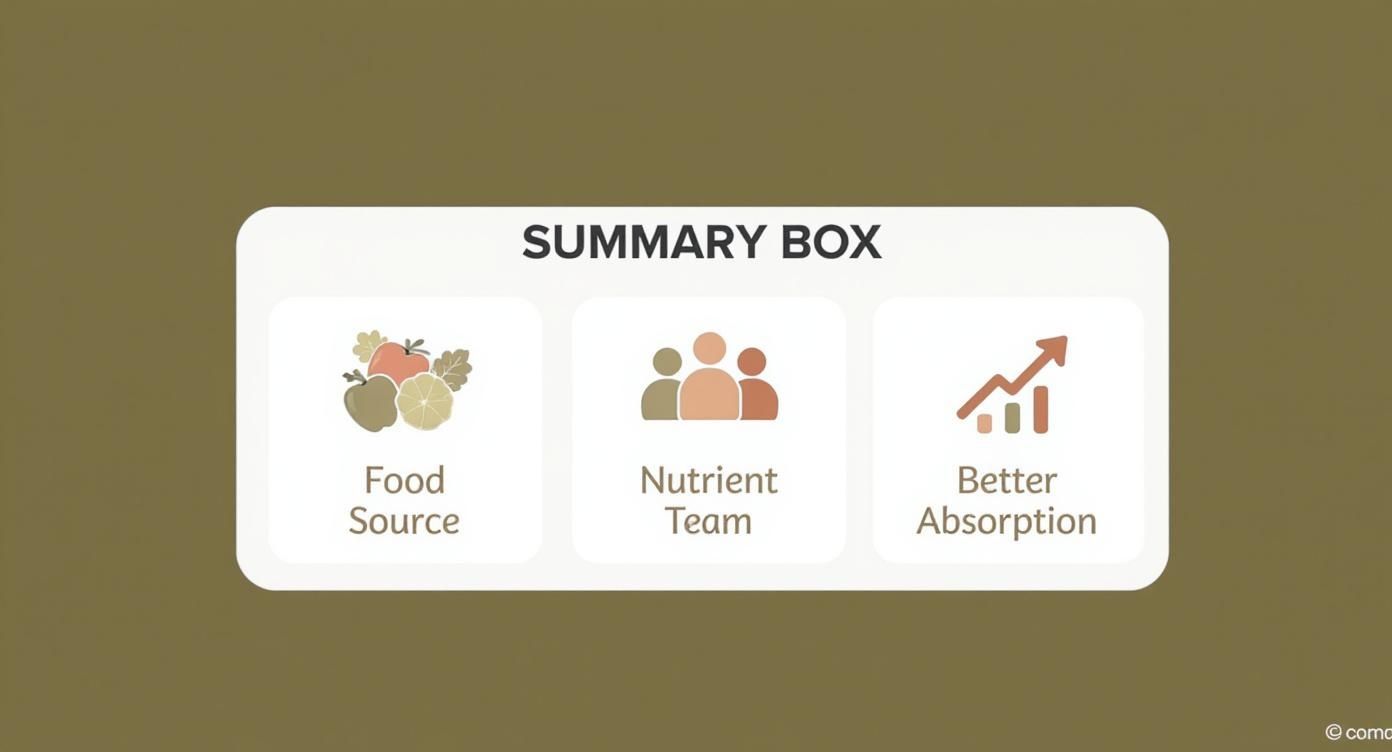
As you can see, it's all about synergy. Nutrients from real food work together, which is what helps the body make the most of them.
Whole Food Vitamins vs Synthetic Vitamins: A Quick Comparison
To make it even clearer, let's break down the differences side-by-side. Knowing what to look for on a label is the first step toward making a confident choice for your child’s health.
| Feature | Whole Food Vitamins | Synthetic Vitamins |
|---|---|---|
| Source | Derived from concentrated fruits, vegetables, and other natural foods. | Created artificially in an industrial process or laboratory setting. |
| Nutrient Structure | Contains a complex of vitamins, cofactors, enzymes, and phytonutrients. | Provides an isolated or single form of the vitamin molecule. |
| Body Recognition | Easily recognized by the body as food, leading to better utilization. | May be less recognizable to the body due to its isolated nature. |
| Bioavailability | Generally higher bioavailability due to the presence of natural cofactors. | Can have lower bioavailability, with a portion potentially being unused. |
| Ingredient List | Often features recognizable food names like acerola cherry, spinach, or carrots. | Typically lists chemical names like ascorbic acid or pyridoxine hydrochloride. |
Ultimately, it comes down to this: whole food vitamins are concentrated food, while synthetic vitamins are lab-made chemicals designed to act like nutrients.
Parents are catching on. The kids' nutrition market is expected to grow from USD 58.8 billion to nearly USD 89.4 billion by 2032. A huge part of that growth is driven by parents seeking out natural, plant-based products without synthetic junk. If you're curious, you can explore more on kids' nutrition market trends to see the shift for yourself.
When you choose a supplement from our collection of Kids Vitamins, you’re getting a product built on these natural principles. It’s about giving your child nutrition that’s as close to nature as possible, with ingredients their growing bodies are designed to use.
Your Checklist for Choosing the Best Kids Vitamins
Walking down the supplement aisle can feel overwhelming, but picking the right whole food vitamins for kids doesn't have to be a guessing game. Armed with a simple checklist, you can cut through the noise and confidently choose a high-quality product that actually supports your child's health.
The first place to look is the ingredient list. Does it read like a science experiment full of long, chemical-sounding names? That’s a red flag. What you want to see are recognizable foods like "acerola cherry," "spinach," and "broccoli." That tells you the nutrients come from the real deal.

This kind of transparency is the foundation of a brand you can trust. You should never have to guess what you’re giving your child.
Look for Key Quality Certifications
Think of certifications as a stamp of approval from an unbiased referee. They give you an extra layer of confidence that the product meets strict standards for quality and purity. When you’re shopping for kids' vitamins, two of the most important seals to look for are USDA Organic and Non-GMO Project Verified.
-
USDA Organic: This seal is your guarantee that the ingredients were grown and processed without synthetic pesticides, fertilizers, or GMOs. It’s a powerful sign of a clean, farm-sourced product.
-
Non-GMO Project Verified: This label confirms the product has gone through rigorous testing to make sure it's free from genetically modified organisms. It's a must-have for parents focused on a natural diet.
These certifications aren't just fancy logos on a bottle; they represent a real commitment to quality, from the farm all the way to your family. They’re a quick way to spot brands that walk the walk.
Prioritize Third-Party Purity Testing
Beyond certifications, the single most critical factor for your peace of mind is third-party testing. This means an independent lab—with zero connection to the brand—has tested the product to verify its purity, potency, and safety.
This unbiased testing confirms that the supplement is free from nasty contaminants like heavy metals, pesticides, and microbes. It also proves that what's on the label is actually what's in the bottle. Any brand that invests in third-party testing is showing you they’re serious about transparency and your child's safety.
A supplement is only as good as its ingredients, and third-party testing is the ultimate proof of quality. It moves a product from "we think it's clean" to "we can prove it's clean," offering an essential layer of trust for parents.
For any high-quality children's supplement, this should be non-negotiable. Our entire collection of Peak Performance Kids Vitamins is rigorously third-party tested to meet these strict standards, giving you complete confidence.
Avoid Unnecessary and Harmful Additives
Finally, always flip the bottle over and read the "other ingredients" list. This is where many popular kids' vitamins hide junk that offers zero nutritional value and can even work against your child's health.
Here’s what to look out for and avoid:
- Artificial Colors and Flavors: Dyes like Red 40 or Yellow 5 have no business being in a health supplement. Natural flavors should come from actual food.
- Added Sugars and Sweeteners: So many gummy vitamins are packed with sugar, corn syrup, or artificial sweeteners like aspartame. Look for products sweetened naturally with fruit, or even better, unsweetened ones.
- Common Allergens: If your child has sensitivities, double-check for gluten, dairy, soy, and nuts. A top-tier formula will be free from these common troublemakers.
Learning to spot these additives is a game-changer. For a deeper dive, check out our guide on how to read supplement labels. By following this simple checklist, you can easily filter out the subpar options and choose a whole food vitamin that truly nourishes your child from the inside out.
Essential Nutrients For Growing Children
Kids seem to have these incredible growth spurts overnight, and their nutritional needs are changing just as fast. To keep up, they need a solid supply of key vitamins and minerals—the literal building blocks for everything from strong bones to a sharp mind.
As a parent trying to stick to natural nutrition, you know how important wholesome meals are. Diving into some healthy, kid-friendly recipes is a great way to get those nutrients on the plate. But let's be honest, even with the best intentions, picky eating happens. That’s where a high-quality whole food vitamin for kids can step in as the perfect backup.
The Bone Builder: Vitamin D
Often called the "sunshine vitamin," Vitamin D is non-negotiable for building strong bones and teeth. It’s the key that unlocks calcium absorption, and without enough of it, the calcium in your child’s diet can’t do its job properly. This is a huge deal during those peak bone-building years.
Sure, sunshine is a natural source, but things like the season, where you live, and even sunscreen can limit how much they get. Fortified foods help, but it’s tough to know if it’s enough. A good multivitamin ensures they’re getting a consistent daily dose to support their growing frame.
The Brain Fuel: Iron
Iron is an absolute powerhouse for brain development, especially when they're little. It’s a core component of hemoglobin, the stuff that carries oxygen from the lungs to every part of the body—including the brain. A well-oxygenated brain is crucial for focus, learning, and cognitive function.
An iron deficiency can show up as fatigue or trouble concentrating, which can really impact how a child performs in school and at play. Whole food sources like spinach and lentils are fantastic, but a gentle, non-constipating form of iron can help fill the gaps, especially for kids who aren’t big on red meat or leafy greens.
Adequate nutrition is more than just fuel; it's the raw material for development. Essential nutrients like Vitamin D, Iron, and B-Vitamins are the non-negotiable foundations for a child's physical, cognitive, and emotional well-being.
The Energy Crew: B-Vitamins
If your kid is a whirlwind of energy, you can thank B-Vitamins. This group of eight different vitamins—like B6, B12, and folate—works as a team to help the body convert food into fuel. They power everything from running around the playground to focusing on homework.
B-Vitamins are also vital for a healthy nervous system and making red blood cells. Because they’re water-soluble, the body doesn't store them for long, so a steady daily intake is key. A complete multivitamin makes sure your child gets the full spectrum of B-Vitamins they need to power through their busy days.
The shift toward natural, nutrient-dense supplements is clear. In fact, multivitamins and probiotics now account for 82% of sales in the children's supplement market. Sales of supplements with natural ingredients like elderberry have jumped over 57%, showing that parents are actively looking for plant-based, whole-food options to support their kids' health.
A well-rounded, whole food-based multivitamin, like our Liquid Kids Multivitamin, is designed to deliver these critical nutrients in a form the body recognizes and can easily use. It’s all about giving your child the foundational support they need to thrive.
Your Questions Answered: What to Know About Whole Food Vitamins
Deciding what’s best for your child’s nutrition can feel like a huge responsibility. You want to be sure you're making the right call, and that often comes with a lot of questions. We get it.
Let’s clear up some of the most common concerns parents have about whole food vitamins for kids. Think of this as the final step to feeling confident and empowered in supporting your child’s health.
Are Whole Food Vitamins Really Better Than Gummy Vitamins?
This is easily one of the most common questions we hear, and for good reason. Gummy vitamins are everywhere, marketed as a fun, treat-like way for kids to get their nutrients. But that’s precisely where the problem lies.
Most are packed with added sugars, high-fructose corn syrup, artificial colors, and synthetic nutrients. They’re often more candy than a health supplement, which can feed into sugar cravings and fill your child up with ingredients that offer zero nutritional benefit.
Whole food vitamins are a different beast entirely. They’re built on purity, delivering nutrients straight from real, recognizable foods without all the junk. For instance, our Liquid Kids Multivitamins is designed to provide clean, bioavailable nutrition without any added sugars or artificial fillers. It’s a clean ingredient list that gives your child more of what they need and none of what they don't.
How Can I Get My Picky Eater To Take a Vitamin?
The daily struggle with a picky eater is real. If you’re living it, you know how frustrating it can be. The good news? You don’t have to resort to sugary chewables to get them on board.
This is where liquid whole food vitamins shine. Their versatility is a game-changer for parents of selective eaters. You can easily mix the daily dose into foods and drinks they already love, and they’ll never even know it’s there.
- Smoothies: A small amount disappears completely into a morning smoothie.
- Juice or Water: It mixes right into their favorite juice or a small glass of water without altering the taste.
- Yogurt or Applesauce: Try stirring it into a bowl of yogurt, applesauce, or oatmeal.
This simple approach sidesteps the power struggle of getting them to take “medicine” and makes sure they get their essential nutrients, day in and day out. Vitamin time becomes a seamless, stress-free part of their routine.
When Is the Right Age To Start Giving My Child a Multivitamin?
Knowing when to introduce a multivitamin is a big question, and the best person to start with is always your pediatrician. They can give you personalized advice based on your child's diet, development, and overall health.
Generally, a multivitamin can be a smart move once a child is consistently eating solid foods, which is often around age two. This is especially true during the toddler and preschool years—a time famous for picky eating. A multivitamin can act as a nutritional safety net, filling in the gaps.
A well-formulated whole food vitamin is gentle enough for a young child's system. It offers foundational support during these years of explosive growth, helping ensure they have all the building blocks they need, even when their diet isn't perfect.
Ultimately, it’s less about a specific birthday and more about providing consistent nutritional backup so they can build a strong foundation for life.
How Do I Know if a Kids Vitamin Is Truly High-Quality and Safe?
With a sea of products on the shelf, how do you spot one that’s actually safe and high-quality? It all comes down to transparency and proof.
First, check for meaningful certifications. Seals like USDA Organic and Non-GMO Project Verified aren’t just fancy logos; they’re backed by strict standards and tell you the ingredients were sourced with integrity.
But the single most important factor is third-party testing. This is non-negotiable. It means an independent lab has verified that the product is pure, potent, and free from contaminants like heavy metals or pesticides. It also confirms that what’s on the label is actually what’s in the bottle. A brand that invests in third-party testing is showing you they’re serious about your child's safety.
This is the exact philosophy behind the entire Peak Performance Kids Vitamins line. When you see that commitment to clean ingredients and rigorous testing, you can finally feel confident about what you’re giving your family.
At Peak Performance, we believe that giving your children the best shouldn't be complicated. Our kids' vitamins are crafted with the highest quality organic, whole food ingredients to give you peace of mind and give your child the support they need to thrive.
Explore our collection of Kids Vitamins today and give your child the gift of clean, effective nutrition.
Also in Blog


How to Increase Stamina Naturally and Boost Energy


How to Increase Energy Naturally

